
On 21 November 2026, after an eight-year, ten-billion-kilometre journey, the European–Japanese BepiColombo mission was captured into orbit around Mercury — only the second spacecraft ever to orbit the innermost planet, and the first to send two orbiters at once.
The news, when it finally came, was stated in the plain language of a flight dynamics room. The European Space Agency announced on 21 November 2026 that BepiColombo had inserted into Mercury’s orbit, according to Nature on 21 November 2026. Behind that single sentence lay eight years of travel, a journey of about ten billion kilometres, according to Scientific American and Europe Says, a mission that cost $2 billion, or 1.7 billion euros, according to the Associated Press on 21 November 2026, and a final burn that had to be judged not in the moment it happened but hours later, from telemetry sent across 94 million miles of space.
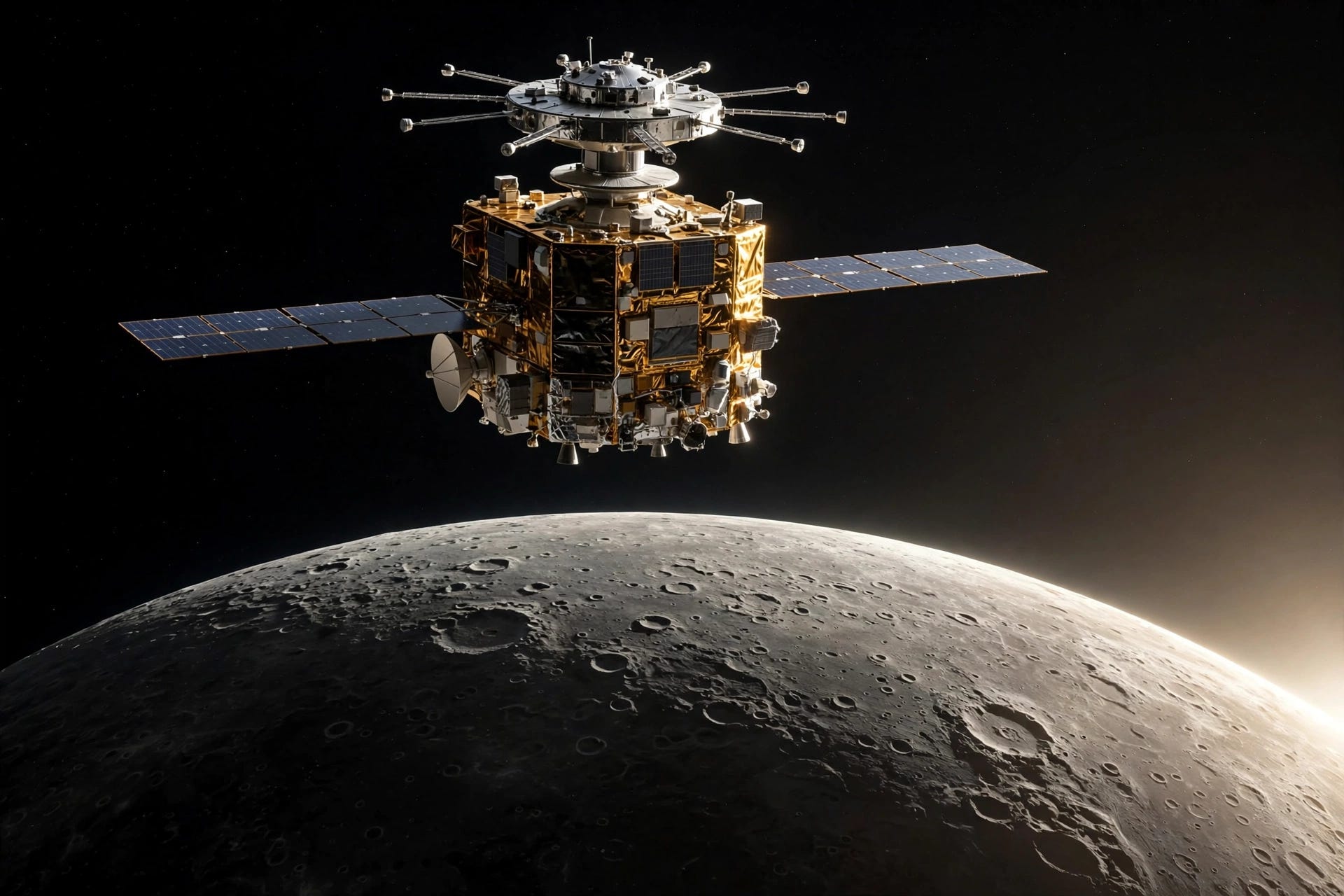
On the evening of 21 November 2026, European time, there was no spacecraft to watch and no flame to photograph. There was a signal, delayed by more than eight minutes on its journey to Earth, according to the Associated Press on 21 November 2026 and ESA, and there were flight controllers at the European Space Operations Centre, ESOC, in Darmstadt, Germany, poring over telemetry to decide whether a machine launched in 2018 had, at last, been caught by the gravity of the smallest planet in the solar system. The distinction matters. BepiColombo did not arrive at Mercury in the way an aircraft arrives at an airport, crossing a line and coming to rest. It fell, under careful control, into a condition from which Mercury would not immediately let it go.
The capture burn began at 18:24 UTC on 21 November 2026, which was 19:24 Central European Time and 12:24 Central Standard Time, according to an ESA Operations post on 20 November 2026. Four 20-newton axial thrusters on ESA’s Mercury Planetary Orbiter, known as MPO, fired for 37 minutes, according to the same ESA Operations post. Thirty-seven minutes is a long time in the life of a spacecraft burn, and it is also, in the context of this mission, a strikingly modest instrument for so consequential a task. The burn did not need to stop BepiColombo. It did not need to place it in its final science orbit. It needed to slow the spacecraft just enough, and in exactly the right direction, for Mercury’s gravity to hold it. ESA Operations and Scientific American, on 20 November 2026, described the result with a phrase that deserves to be understood rather than merely repeated: this was a weak capture.
A burn that had to be enough, and no more than enough
A weak capture is not a failed capture, a partial capture, or a capture achieved by luck. According to ESA Operations and Scientific American on 20 November 2026, the spacecraft slowed just enough for Mercury’s gravity to hold it. That wording, just enough, contains the entire discipline of the manoeuvre. Arriving at a planet from interplanetary space, a spacecraft carries the energy of its long fall and its long cruise. If it passes too fast, the planet’s gravity bends its path and lets it go again, and a flyby becomes another departure. If it is to stay, it must give up enough speed at the right moment so that the curved path closes around the planet instead of opening back out into space. On 21 November 2026, BepiColombo crossed that threshold.
The word weak describes the hold, not the achievement. A weak capture leaves a spacecraft in a large, loose, highly stretched orbit, one that can be reshaped over the weeks and months that follow. It is a beginning that must be protected and then refined. It is also, for a mission arriving at Mercury, the prudent form of success. The initial orbit into which BepiColombo was captured was elliptical and polar, approximately 590 by 11,640 kilometres, according to ESA and reporting by Fana and QNA on 22 November 2026. Those two numbers describe a path that brings the spacecraft comparatively close to Mercury at one end and carries it far away at the other. They do not describe the tight, working orbit from which the main science campaign will be conducted. They describe the first closed loop, the proof that the spacecraft now belongs, gravitationally, to Mercury.
That is what capture does mean. It means that after eight years in transit, after the launch on 20 October 2018 on an Ariane 5 from Europe’s Spaceport at Kourou, French Guiana, according to ESA and USA Today, BepiColombo is no longer simply passing its target. It is orbiting it. It means the mission has survived the transition from a cruise through the inner solar system to a new and demanding phase in which every subsequent manoeuvre will be performed in Mercury’s own gravitational environment. It means the two orbiters carried in a single stack, ESA’s Mercury Planetary Orbiter and JAXA’s Mercury Magnetospheric Orbiter, known as Mio, have been delivered together to the planet they were built to study.
What capture does not mean is equally important, because the coming months could easily be mistaken for delay if the nature of the achievement is misunderstood. Capture does not mean the two orbiters have separated. They remain joined as one stack for now, according to Nature on 21 November 2026. Capture does not mean the spacecraft is in its final orbit. MPO will descend gradually until March 2027 to a final orbit of 400 to 1,500 kilometres, according to Nature. Capture does not mean science operations have begun. Science operations begin on 6 April 2027, according to Sky & Telescope and ESA. And capture does not mean the danger or the work is over. Arrival, in the language used around this mission, is a sequence, not an event, with about sixteen manoeuvres and burns running from capture to March 2027, according to Space.com via Telescope Advisor. ESA operations manager Elsa Montagnon called arrival, in the account reported there, “six months of continuous activities”.
Those qualifications do not diminish the news of 21 November 2026. They define it. BepiColombo has done the thing that had to happen before anything else could happen, and it has done it at a planet that human beings have visited only twice before in the entire history of spaceflight.
The anxious hours in Darmstadt
Confirmation took several anxious hours, according to the Associated Press on 21 November 2026. Flight controllers at ESOC in Darmstadt pored over telemetry while the spacecraft was 94 million miles, or 152 million kilometres, away, and signals took over eight minutes to arrive, according to the Associated Press and ESA. To understand why a 37-minute burn could not be confirmed in 37 minutes, it is necessary to understand what distance does to knowledge.
No one at ESOC was watching BepiColombo in real time, because real time, at that distance, does not exist for a human operator. By the time a signal describing an event reached Darmstadt, the event itself was already more than eight minutes in the past. By the time a question could be sent and an answer received, the spacecraft had lived through a further stretch of its own autonomous history. The burn had to be executed by a machine that could not be steered moment by moment from Germany. The role of the ground was different: to listen, to reconstruct, and to judge from the returning telemetry whether the spacecraft’s trajectory had in fact changed from an approach into an orbit.
That reconstruction is not a single reading. Telemetry has to be assessed, the spacecraft’s health has to be understood, and flight dynamics specialists have to determine whether the path the spacecraft is now following is the closed path of capture. A signal saying that a spacecraft is alive and in contact is welcome, but it is not, by itself, the same as a confirmed orbit. A thruster firing is not the same as a thruster firing producing precisely the change in velocity that was required. The anxious hours described by the Associated Press on 21 November 2026 were therefore not empty waiting. They were the interval in which a distant, delayed stream of data had to be turned into a conclusion solid enough to announce to the world.
ESA’s official mission account captured both the relief and the continuing work in a post on X on 21 November 2026. The post said, verbatim: “We’ve heard back from Bepi – the spacecraft is now in contact with the ground and the teams at ESOC are busy assessing the telemetry. Flight Dynamics already has confirmed it achieved orbital capture around Mercury!” ESA also posted that it would share the next update early the following week, according to Europe Says on 22 November 2026.
Read closely, that announcement tells the story in the right order. First, contact. The spacecraft had been heard from. Second, assessment. The teams at ESOC were busy with the telemetry, because contact alone was not the whole answer. Third, confirmation. Flight Dynamics, the specialists responsible for determining where the spacecraft is and where it is going, had confirmed orbital capture. The exclamation mark at the end was earned, but the sentences before it are a reminder that celebration in a mission control centre follows verification, not the other way round.
There is a temptation, in retelling an arrival like this, to compress those hours into a dramatic pause and then move on. That would miss something essential about how deep-space missions are actually run. The spacecraft was 94 million miles away, according to the Associated Press on 21 November 2026. The people responsible for it could not shorten that distance. They could only be patient, rigorous, and honest about the difference between hoping a manoeuvre had worked and knowing that it had. On 21 November 2026, after several anxious hours, they knew.
Why an elliptical polar orbit is the right first address
The initial orbit, approximately 590 by 11,640 kilometres, elliptical and polar, according to ESA and Fana and QNA on 22 November 2026, is a compact description that rewards unpacking. Elliptical means the orbit is not a circle. The spacecraft does not maintain a constant distance from Mercury. It swings in close and then retreats far away, over and over, following the stretched loop into which the weak capture delivered it. The lower figure, about 590 kilometres, marks the close end of that first orbit. The higher figure, about 11,640 kilometres, marks how far the loop extends at its distant end. Between those two extremes, BepiColombo now travels around a planet it had previously only approached and flown past.
Polar describes the orientation of the loop. A polar orbit carries a spacecraft over the planet’s polar regions rather than confining it to a path around the equator. For a mission whose purpose is to study an entire planet, that geometry matters, because the view changes as Mercury turns beneath the orbit and because regions that would be neglected by a narrower path can come within reach. In BepiColombo’s case, the value of broad coverage is not abstract. MESSENGER, the previous orbiter, covered Mercury’s northern hemisphere well and the south poorly, according to the reporting in Sky & Telescope, and BepiColombo’s orbit gives much better southern coverage, including signs of ice in southern shadowed craters. The first polar loop is therefore not the science orbit, but it already expresses the mission’s intent: to see Mercury whole, rather than to revisit only the parts already seen best.
An elliptical orbit also imposes a rhythm. Near the planet, the spacecraft moves through the environment it has come to measure at close range. Far from the planet, it gains distance and perspective. For Mio, which after separation will trace ellipses of 500 to 11,000 kilometres altitude with a period of about nine hours, sampling the magnetic field and the solar wind interaction, according to Nature and Scientific American, that rhythm is central to the work. For MPO, the rhythm will tighten. Its final orbit of 400 to 1,500 kilometres, to be reached gradually by March 2027 according to Nature, has a period of about two hours, and it will pass as close as about 480 kilometres above the surface, according to Sky & Telescope, or 300 miles, according to USA Today. The contrast between the first captured loop and those later working orbits shows why capture and commissioning must not be confused. The loop of 21 November 2026 is the foothold. The loops of 2027 will be the observatories.
A foothold, however, is not a small thing when the ground itself has been so hard to reach. Shoshana Weider, Mercury science lead at NASA Headquarters, told Scientific American: “For a long time, people didn’t think it was possible to get to Mercury orbit.” That sentence should be kept in mind when the initial orbit is described as weak, loose, or preliminary. The preliminary orbit is around Mercury. For most of the space age, no spacecraft achieved even that. Only one had done so before BepiColombo.
Only the third visit, only the second orbiter
BepiColombo is only the third spacecraft to visit Mercury and the second to orbit it, and it is the first visitor in more than a decade, according to the Associated Press and Eos on 21 November 2026. In an era when orbiters, landers and sample-return missions have become familiar headlines at several planets, that scarcity can sound implausible. Mercury is, after all, the closest planet to the Sun and a near neighbour of Earth by the standards of the solar system. It orbits about 36 million miles from the Sun, roughly three times closer than Earth, according to Scientific American. Proximity, however, has never been the same as accessibility.
The history in the brief is brief because the history itself is brief. Mariner 10, a NASA spacecraft, flew by Mercury three times in 1974 and 1975, and it was the only other spacecraft to visit before MESSENGER, according to Scientific American. MESSENGER, also from NASA, orbited Mercury from 2011 to 2015, and it remains the only prior orbiter, according to Nature and Scientific American. Then, for more than a decade, no one went back. BepiColombo’s arrival on 21 November 2026 therefore closes a gap as well as opening a mission. It returns human-built instruments to a planet that had been left alone since MESSENGER struck Mercury in 2015 at about 3.9 kilometres per second, or 8,700 miles per hour, according to Sky & Telescope, an impact NASA estimated would leave a crater about 16 metres, or 52 feet, wide in Suisei Planitia.
The energy problem explains much of the neglect. It takes more energy to reach Mercury orbit than to reach the outer solar system, according to the account given in Nature, where Emma Bunce of the University of Leicester said: “Energetically, it takes more energy to go to Mercury than to go to the outer Solar System”. A spacecraft leaving Earth already orbits the Sun at about 30 kilometres per second and must shed most of that speed while the Sun’s gravity accelerates it inward, according to Nature and the Voyager Files video account. The paradox is worth dwelling on, because it overturns the intuitive map most readers carry. Going to Mercury is not a short hop downhill. It is a controlled fall toward the Sun that must be braked with extraordinary care, lest the spacecraft arrive too fast to stay.
That braking problem shaped the entire architecture of BepiColombo’s journey. Nine planetary flybys were used as a brake: one of Earth, two of Venus, and six of Mercury, according to ESA and Scientific American. The sixth and final Mercury flyby took place on 8 January 2025, according to Eos, which published BepiColombo’s image of Mercury’s sunlit northern hemisphere from that flyby. Propulsion for the cruise came from the Mercury Transfer Module, the MTM, using solar-electric, or ion, propulsion. Even that carefully constructed plan did not run untouched. In 2024 a glitch and power fault in the thrusters prevented them operating at full power; the trajectory had to be adjusted and arrival slipped by about a year, from December 2025 to November 2026, according to Eos, Scientific American and Sky & Telescope. The capture of 21 November 2026 was therefore not simply the end of an eight-year journey. It was the end of a journey that had already had to be replanned in flight.
The mission is named for the man who worked out how such a journey could be done. Giuseppe “Bepi” Colombo, the Italian mathematician and engineer who died in 1984, worked out the gravity-assist route, according to Scientific American and ESA. There is a fitting severity in that lineage. BepiColombo did not reach Mercury by overpowering the problem. It reached Mercury by using the gravity of Earth, Venus and Mercury themselves, again and again, as instruments. The nine flybys were not detours on the way to the destination. They were the mechanism by which arrival became possible at all.
Sean Solomon, of Columbia University and the former lead of MESSENGER, told Scientific American: “Every time we go to Mercury, we are surprised. I expect that to repeat.” He also told Scientific American: “After BepiColombo, we will have done all of the things that we can think of today from orbit. If we want to learn more about Mercury, we have to go to the surface.” Those two remarks frame the stakes of the present arrival with unusual precision. BepiColombo is expected to surprise, because Mercury has surprised every visitor so far. And BepiColombo may also complete, for this generation, what can be done from orbit, which makes the quality and completeness of its orbital campaign all the more consequential. A third visit is not a routine return. It is, for now, the definitive orbital examination.
Two orbiters at once, for the first time
If BepiColombo were a single orbiter, its arrival would already be historic as only the second orbit insertion at Mercury. It is more than that. After separation, BepiColombo becomes the first mission flying two spacecraft around Mercury at once, according to ESA. MPO and Mio separate on 9 to 10 December 2026, according to ESA. Until then they remain joined as one stack, according to Nature on 21 November 2026. The spacecraft that was captured on 21 November is therefore best understood not as one observatory but as two observatories still travelling in their transport configuration, awaiting the moment when they will be released to do different work in different orbits.
MPO is the surface-facing orbiter. Built by ESA, it carries cameras in the SIMBIO-SYS system, spectrometers including MIXS and MERTIS, the BELA laser altimeter, a radio science experiment, an accelerometer and a magnetometer, according to Sky & Telescope. Mio, JAXA’s Mercury Magnetospheric Orbiter, studies the magnetic environment, according to Sky & Telescope. It spins at about 15 revolutions per minute, swings out to roughly 11,000 kilometres, and must extend 15-metre wire antennas and 5-metre magnetometer booms over about a month during commissioning, according to Sky & Telescope. One spacecraft looks down at the planet. The other attends to the invisible structures around it. Together, they are designed to answer questions neither could settle alone.
The clearest example is the magnetic field. Mercury is the only rocky planet besides Earth that generates a global magnetic field from its core, and its field is about 100 times weaker than Earth’s, according to Scientific American and Sky & Telescope. Two spacecraft can measure the magnetic field simultaneously from inside and outside the magnetosphere, distinguishing Mercury’s own field from solar-wind-driven fluctuations, something impossible for a single spacecraft, according to National Geographic and Scientific American. The importance of that simultaneity is easy to miss if the two orbiters are treated as a duplication of effort. They are not duplicates. They are separated witnesses to the same event. When the solar wind disturbs Mercury’s magnetic environment, a single spacecraft must guess, from one vantage point, which changes belong to the planet and which belong to the disturbance passing through. Two spacecraft, measuring at the same time from different positions, can begin to separate cause from local effect as the event unfolds.
That is why the first of its kind matters beyond the record books. The first mission to send two orbiters at once to Mercury is also the first mission able to watch the planet and its magnetic surroundings as a coupled system, in the same moments, from complementary places. Mio will trace its wide ellipses, sampling the magnetic field and the interaction with the solar wind, according to Nature and Scientific American. MPO will work closer to the planet, descending gradually to its 400 to 1,500 kilometre orbit by March 2027, according to Nature. The science that begins on 6 April 2027, according to Sky & Telescope and ESA, will rest on that division of labour.
None of this should make the separation sound routine. Separation on 9 December is expected to be the true drama, according to Scientific American: latches unclasp, wires connecting the spacecraft are cut, and a spring pushes them apart slower than walking speed. The slowness is the point, and also the risk. Two spacecraft that have travelled together for eight years must become independent without damaging each other, in an environment where help cannot be sent and where every signal still takes minutes to cross the distance to Earth. Ignacio Tanco, head of inner solar system mission operations at ESA, told Scientific American: “It’s the most complex mission I have worked on by far,” and “probably the most complex mission that ESA has operated ever. It’s extremely challenging.” Coming after a successful capture, those words are not a warning that something has gone wrong. They are a measure of how much of the mission’s difficulty lies in operations still to come.
Thermal danger runs through that coming work. Each separation, including the MTM drop in September 2026, leaves holes in protective coverings that must close, and Tanco told Sky & Telescope: “If they don’t close, then we will have a serious problem.” Santa Martinez, ESA’s mission manager, noted that solar radiation at Mercury can be ten times that received at Earth, and contingency procedures have been rehearsed, according to Sky & Telescope. Mercury’s closeness to the Sun, the very fact that makes the planet scientifically precious as an example of a world orbiting near its star, also makes it a hostile place to operate machinery. Capture puts BepiColombo into that hostility permanently. From 21 November 2026 onward, there is no cruise phase to retreat into. The spacecraft now lives where it will work.
What two billion dollars bought, and what it has not yet bought
The mission cost $2 billion, or 1.7 billion euros, according to the Associated Press on 21 November 2026. A figure of that size invites a simple question: what has been purchased? On the evidence of the brief, the honest answer as of this weekend is narrower and more impressive than a list of instruments. What has been purchased, so far, is presence. A European and Japanese mission has been delivered, after eight years and about ten billion kilometres, into orbit around a planet visited only twice before. Two orbiters have been carried together through nine gravity-assist flybys, through a thruster fault in 2024 that forced the trajectory to be adjusted and arrival to slip by about a year, according to Eos, Scientific American and Sky & Telescope, through the separation of the Mercury Transfer Module on 3 September 2026, according to ESA, and through the final approach to a weak capture that held.
Presence at Mercury is not a preliminary administrative step. It is the scarce achievement on which every later result depends. Without capture, the cameras, spectrometers, altimeter and magnetometers are cargo passing through the inner solar system. With capture, they become a planetary mission. The $2 billion figure reported by the Associated Press on 21 November 2026 therefore should not be read as the price of the answers BepiColombo may produce about Mercury’s oversized core, its magnetic field, its polar ice, its hollows, its shrinking surface or its wispy exosphere. Those answers have not been bought yet, and they cannot be announced in advance. The money, the eight years and the ten billion kilometres have bought the opportunity to ask those questions from orbit, with two spacecraft, for a nominal science phase of at least one year and a planned extended mission through 2029, according to Eos on 21 November 2026.
There is also a discipline in admitting what the mission has not yet bought. It has not yet bought the separation of MPO and Mio. It has not yet bought MPO’s final orbit or Mio’s fully commissioned configuration, with the 15-metre wire antennas and 5-metre magnetometer booms extended over about a month during commissioning, according to Sky & Telescope. It has not yet bought the first science campaign, which begins on 6 April 2027, according to Sky & Telescope and ESA. It has not yet bought public images on any announced timetable. ESA has not said how quickly new images will reach the public, and lead project scientist Geraint Jones said the question would go to a science-team meeting in Lisbon in November 2026, according to Sky & Telescope. Readers who expect the capture announcement to be followed immediately by a flood of new Mercury portraits may therefore be disappointed, not because the mission is withholding success, but because the mission’s own sequence puts commissioning and orbital refinement before the formal start of science.
That sequence is not bureaucratic caution. It follows from the physical facts already established. The spacecraft was captured into a large elliptical polar orbit, not its working orbit. The two orbiters are still a stack. About sixteen manoeuvres and burns remain between capture and March 2027, according to Space.com via Telescope Advisor. The road from capture to science is the mission working as designed, and the design is one in which arrival takes six months, in Elsa Montagnon’s phrase reported there, of continuous activities.
The road from capture to science
The next public milestone is close. An ESA, JAXA and Airbus media briefing is scheduled for Friday 27 November 2026 at the Science Museum in London, according to the ESA media invitation. That briefing, six days after capture, will be the first structured occasion on which the agencies and the industrial partner explain what the telemetry has shown, what the spacecraft’s condition is understood to be, and how the coming sequence will proceed. It should not be expected to turn capture into completed science. Its importance lies elsewhere: it is where the first confirmed account of the arrival will be tested in public, with the agencies speaking together about a mission that is European and Japanese in its orbiters and already international in its scientific community.
Then comes December. MPO and Mio separate on 9 to 10 December 2026, according to ESA, and after separation BepiColombo becomes the first mission flying two spacecraft around Mercury at once. The mechanics described by Scientific American are almost disarmingly gentle: latches unclasp, wires connecting the spacecraft are cut, and a spring pushes them apart slower than walking speed. Yet the consequences are irreversible in the practical sense that matters to operations. Once apart, each orbiter must be commissioned as itself. Mio must extend its antennas and booms over about a month, according to Sky & Telescope. MPO must continue its gradual descent. The single captured stack of November becomes, in December, a pair of independent spacecraft whose coordination is the mission’s scientific advantage.
From December to March, the work is refinement. About sixteen manoeuvres and burns run from capture to March 2027, according to Space.com via Telescope Advisor. MPO descends gradually until March 2027 to its final orbit of 400 to 1,500 kilometres, according to Nature, an orbit with a period of about two hours. Mio traces ellipses of 500 to 11,000 kilometres altitude with a period of about nine hours, according to Nature and Scientific American. Those contrasting periods are a useful way to picture the mission’s shape. MPO will circle Mercury roughly twelve times in an Earth day once in its final orbit, staying close to the surface it maps. Mio will take the longer view, moving through the magnetic environment on its wider, slower loop. The two clocks will not match, and that mismatch is deliberate. Mercury will be observed at two scales at once.
Science operations begin on 6 April 2027, according to Sky & Telescope and ESA. The date deserves emphasis because it corrects the natural assumption that an arriving spacecraft begins its real work the moment it is captured. For BepiColombo, the real work of arrival continues for more than four months after capture, and the formal science phase follows it. The nominal science phase will last at least one year, and a planned extended mission runs through 2029, according to Eos on 21 November 2026. At the end, the orbits decay and both spacecraft crash into Mercury, according to Scientific American. Even the mission’s ending is already written into its design: there will be no departure, no return journey, and no retirement in deep space. The orbiters will finish where they worked.
Understanding that timetable changes how the capture should be judged. If science does not begin until April 2027, then the success of November 2026 cannot be measured by discoveries. It must be measured by whether the mission has entered the sequence that makes discoveries possible, with its spacecraft intact, its orbit confirmed, and its next steps still available. On the evidence announced on 21 November 2026, it has. Flight Dynamics confirmed orbital capture, according to ESA’s post on X that day. The spacecraft was in contact with the ground. The teams at ESOC were assessing telemetry. The initial orbit was reported by ESA and by Fana and QNA on 22 November 2026. The briefing is set for 27 November 2026. The separation is set for 9 to 10 December 2026. The mission is no longer travelling toward its programme. It is inside it.
Why Mercury was worth eight years
The stakes of the arrival reach beyond the difficulty of getting there. Mercury is, in Shoshana Weider’s words in Scientific American, a planet that does not fit. Weider said: “Mercury is a strange little oddball. It doesn’t fit with the rest of the solar system. Maybe, in the next few years, we’ll finally find out why.” That is the promise that justifies the eight years, the ten billion kilometres and the $2 billion reported by the Associated Press on 21 November 2026. BepiColombo has not gone to Mercury because Mercury is convenient. It has gone because Mercury is anomalous, and because anomalies, examined closely, tend to revise the rules that were built without them.
Consider only the outlines that the arrival now puts within reach. Mercury’s iron-rich core extends about 85 percent of the way from centre to surface, while Earth’s core extends about 55 percent, according to Scientific American. The leading theory for that oversized core, as Geraint Jones, ESA’s lead project scientist, explained at a Europlanet Science Congress briefing at The Hague in September 2026, reported by Sky & Telescope, is captured in his words: “Mercury … is more massive than you would expect for a body of its size. The leading theory is that it was hit by something very large in the distant past, and the outer mantle was removed.” Mercury generates a global magnetic field from that core despite the field being about 100 times weaker than Earth’s, according to Scientific American and Sky & Telescope. Its surface temperatures swing from about 800 degrees Fahrenheit in daylight to about minus 290 degrees Fahrenheit at night, according to Scientific American, and yet radar and MESSENGER data point to water ice in permanently shadowed craters near both poles, according to Sky & Telescope. Each of those facts is a question wearing the clothes of an answer. BepiColombo’s two orbiters are now in place to interrogate them together.
The exoplanet connection widens the stakes further. Most exoplanets detected so far orbit very close to their suns, and Mercury is our solar system’s example of such a planet, according to National Geographic, where Catherine Johnson of the University of British Columbia and the Planetary Science Institute, a guest investigator, said: “There’s a lot of interest in exoplanets right now, and it’s our example in our solar system of a planet that’s close to the sun.” A mission to Mercury is therefore also, in part, a mission about the most common kind of planetary neighbourhood yet discovered elsewhere. What BepiColombo learns about a small, dense, magnetised, ice-bearing world enduring intense solar radiation will be read by scientists whose real subject may be a planet around another star that no spacecraft will ever visit.
That is the full shape of the news from 21 November 2026. A spacecraft fired four 20-newton thrusters for 37 minutes, beginning at 18:24 UTC, according to ESA Operations on 20 November 2026. It slowed just enough to be held. Hours later, after telemetry had crossed 94 million miles and been pored over in Darmstadt, ESA could say that Flight Dynamics had confirmed orbital capture. The spacecraft settled, provisionally, into a polar ellipse of about 590 by 11,640 kilometres. It became only the third visitor to Mercury, only the second orbiter, and the carrier of the first pair of orbiters ever sent there. The stack has not yet separated. The science has not yet begun. The final orbits have not yet been reached. All of that lies ahead, through the London briefing on 27 November 2026, the separation on 9 to 10 December 2026, the manoeuvres to March 2027, and the start of science on 6 April 2027.
But the hardest threshold has been crossed, and it has been crossed in the only way Mercury allows: slowly, indirectly, and by falling with precision. Eight years after leaving Kourou, BepiColombo is no longer a spacecraft on its way to a planet that refused to be visited. It is in orbit around that planet, and the long work of finding out why Mercury is the way it is can now, at last, be prepared on the ground where the questions live.
The Journey: Why the Closest Planet Was the Hardest to Reach
BepiColombo was captured into orbit around Mercury on 21 November 2026, according to ESA on 21 November 2026, but that capture was possible only because the spacecraft had spent eight years learning, in effect, how not to fall past the planet it had come to study.
That is the central paradox of Mercury exploration, and it is the reason this mission’s journey deserves as much attention as its arrival. Mercury is, by the standards of the Solar System, a near neighbour. According to Scientific American, Mercury orbits about 36 million miles from the Sun, roughly three times closer than Earth. A reader looking only at a map of distances might reasonably assume that it would be among the easiest planets to reach, a short inward hop compared with the long outward voyages to Jupiter, Saturn or Pluto. The mission’s history shows the opposite. According to Scientific American and Europe Says, BepiColombo travelled for eight years and about 10 billion kilometres, or six billion miles, to get there. According to the Associated Press on 21 November 2026, the mission cost $2 billion, or 1.7 billion euros. According to Nature on 21 November 2026, it became only the third spacecraft to visit Mercury and, with its capture, the second ever to orbit it. The distance was never the main problem. The energy was.
Falling Toward the Sun Is Not the Same as Arriving
To understand why Mercury is so difficult, it helps to set aside the familiar image of a spacecraft pointing its nose at a destination and flying straight there. Spacecraft do not travel in straight lines between planets in that simple sense. They are always in orbit around the Sun, even after they leave Earth, and their journeys are changes from one solar orbit to another. A spacecraft departing Earth carries with it the motion Earth itself has around the Sun. As Emma Bunce of the University of Leicester explained in Nature, a spacecraft leaving Earth already orbits the Sun at about 30 kilometres per second and must shed most of that speed while the Sun’s gravity accelerates it inward.
That single sentence, reported in Nature, contains the whole difficulty. Earth is not a stationary platform from which a probe can simply drop toward the Sun. Earth is moving fast around the Sun, and anything launched from Earth inherits that sideways motion. If a spacecraft did nothing to change that motion, it would continue in an orbit much like Earth’s, circling the Sun at roughly Earth’s distance. To move inward toward Mercury, it must reduce the energy of its solar orbit. To stay at Mercury, rather than swing past it and out again, it must reduce that energy far more precisely, until its motion matches the conditions under which Mercury’s own comparatively small gravity can hold it.
At the same time, the Sun complicates the task from the other direction. As a spacecraft moves inward, the Sun’s gravity pulls it faster, in much the same way that an object falling toward Earth gathers speed as it falls. The spacecraft is therefore trying to slow down in one crucial sense — to shed the large orbital energy it started with — while its fall toward the Sun is making it move faster in another sense. It arrives in Mercury’s neighbourhood travelling too fast to be captured unless it has found a way, over years, to dispose of that excess energy. If it has not, Mercury, a small planet with a small gravitational reach, cannot hold it. It will pass by.
That is why the phrase used for the capture itself matters. According to ESA Operations and Scientific American on 20 November 2026, BepiColombo’s arrival was a “weak capture”: the spacecraft slowed just enough for Mercury’s gravity to hold it. The word “just” is doing important work there. Capture at Mercury is not a matter of arriving with a large margin to spare. It is a matter of arriving, after eight years of carefully managed braking, within a narrow window in which a relatively modest burn can tip the balance from escape to orbit. The burn that achieved it, according to ESA Operations on 20 November 2026, began at 18:24 UTC on 21 November 2026 and used four 20-newton axial thrusters on ESA’s Mercury Planetary Orbiter, firing for 37 minutes. Those thrusters did not, by themselves, brake the spacecraft all the way from Earth. They completed a braking process that had been under way since long before the spacecraft first saw Mercury close up.
Bunce put the scale of the problem in a comparison that has become the mission’s defining line. In Nature, she said: “Energetically, it takes more energy to go to Mercury than to go to the outer Solar System.” That statement can sound counterintuitive, even exaggerated, until the orbital mechanics behind it are laid out. Going outward, a spacecraft can add energy to its solar orbit and let a trajectory carry it away from the Sun, and the great outer planets themselves can be used to add further energy along the way. Going inward to Mercury and then stopping there requires the opposite operation, performed on a much larger scale than intuition suggests: removing energy, repeatedly and controllably, without removing so much at the wrong moment that the spacecraft falls into a trajectory it cannot correct. The destination is closer. The energy bill is higher.
Shoshana Weider, Mercury science lead at NASA Headquarters, made the historical consequence plain in Scientific American: “For a long time, people didn’t think it was possible to get to Mercury orbit.” That was not a failure of imagination about rockets alone. It reflected a genuine mismatch between the size of the energy problem and the means available to solve it with a conventional spacecraft carrying chemical propellant. A spacecraft that tried to carry enough propellant to brake itself, by rocket power alone, from Earth-like solar orbit into Mercury orbit would have to carry the propellant to accelerate that propellant, and the structure to hold it, in a spiral of mass that quickly becomes impractical. The problem needed a different idea, one that borrowed energy — or, in this case, disposed of it — using the planets themselves.
The Man Who Worked Out How to Do It
The mission carries the name of the man who supplied that idea. According to Scientific American and ESA, BepiColombo is named for Giuseppe “Bepi” Colombo, the Italian mathematician and engineer who died in 1984 and who worked out how to do it — the gravity-assist route.
Colombo’s contribution deserves to be understood as more than a naming honour. Before a practical gravity-assist route to Mercury was worked out, the planet sat in a strange position in the exploration programme: visible, close, scientifically compelling, and effectively out of reach for an orbiter. Flybys could be imagined. A sustained orbit, of the kind needed to map a surface, measure a magnetic field over time and return to the same regions under different conditions, was the far harder prize. Colombo’s insight was to treat the planets encountered along the way not as obstacles to be avoided or merely as sights to be passed, but as moving gravitational tools that could reshape a spacecraft’s trajectory.
A gravity assist is often described, loosely, as a slingshot, but for BepiColombo the more useful image is a brake. When a spacecraft passes close to a moving planet, it exchanges energy with that planet through gravity. The planet is so massive compared with the spacecraft that its own motion is effectively unchanged, while the spacecraft’s trajectory can be bent and its speed relative to the Sun can be raised or lowered, depending on the geometry of the encounter. Pass on one side of the planet, and the spacecraft can gain energy. Pass on the other, in the configuration BepiColombo needed, and it can give energy up, emerging on a solar orbit that falls closer to the Sun and matches Mercury a little better than the orbit it arrived on.
The exchange depends on direction because the planet itself is moving around the Sun. From the planet’s own point of view, a spacecraft approaches and departs at comparable speeds, its path curved by gravity. From the Sun’s point of view — the point of view that decides whether the spacecraft can be captured at Mercury — the story is different. If the spacecraft’s encounter is arranged so that it leaves the planet moving less strongly in the direction of the planet’s own orbital motion than it arrived, it has surrendered some of its solar orbital energy to the planet. Repeated carefully, encounter after encounter, that surrender becomes a controlled descent. Each flyby is therefore both a navigation event and a braking event. The spacecraft does not fire an engine to achieve most of that slowing. It steers, with great precision, through a gravitational encounter that does the work.
That precision is the hidden cost of the method. A gravity assist is free in propellant and expensive in time, planning and accuracy. The spacecraft must arrive at the right place, at the right moment, at the right distance from a moving planet, on a trajectory that has been calculated years in advance and refined as the journey proceeds. An error does not simply mean a slightly different view of the planet passing below. It can mean the wrong energy change, the wrong next leg, and a missed encounter further down the chain. BepiColombo’s route used nine such encounters, according to ESA and Scientific American, and each one had to set up the next. Colombo’s route turned an impossible propellant problem into a possible, if extraordinarily demanding, navigation problem. It traded fuel for patience. The eight years that followed the launch were the price of that trade, paid in full.
It is worth pausing on the date of Colombo’s death, given in the brief of his life as 1984, according to Scientific American and ESA. He did not live to see a spacecraft fly the full route to Mercury orbit that his work made conceivable. He did not live to see the spacecraft that bears his name launch, or its final flyby, or its capture. The mission’s name therefore records something real about how space exploration advances: the mathematics can precede the machine by decades. An idea worked out by one generation becomes, in the hands of engineers and flight dynamics teams in another, a sequence of burns, flybys and telemetry sessions spread across ten billion kilometres. When ESA announced capture on 21 November 2026, according to ESA on that date, it was announcing the completion of an argument as well as a journey — an argument, first made on paper, that Mercury orbit could be reached if a spacecraft was willing to take the long way in and brake against the planets themselves.
A Launch That Was Only the Beginning
BepiColombo launched on 20 October 2018 on an Ariane 5 from Europe’s Spaceport at Kourou, French Guiana, according to ESA and USA Today. In the public life of a space mission, a launch is usually treated as the dramatic opening: the rocket rises, the spacecraft separates, and the story moves on to its destination. For BepiColombo, that framing would be misleading. The launch placed the spacecraft into the first of a long series of solar orbits. It did not place it on anything resembling a direct road to Mercury orbit. From Kourou, the mission entered the slow, deliberate process that Colombo’s idea required — a cruise measured not in days or months but in years, during which the spacecraft’s most important manoeuvres would often involve no engine firing at all, only a precisely aimed passage past a planet.
That distinction matters for how the whole journey should be read. A direct flight, if such a thing were energetically possible, would make the cruise a waiting period between departure and arrival. BepiColombo’s cruise was the mission’s main braking system in action. Each leg between flybys positioned the spacecraft for the next exchange of energy. Each flyby altered the orbit. The spacecraft that finally approached Mercury in November 2026 was travelling on a trajectory that had been sculpted, encounter by encounter, since 2018. The launch was necessary, spectacular and, in energy terms, only a first instalment.
That imbalance — more than eight years of travel before the principal science programme even begins — is not an inefficiency in the mission design. It is a measure of how expensive, in energy and therefore in time, Mercury orbit is to buy.
Nine Flybys Used as a Brake
According to ESA and Scientific American, nine planetary flybys were used as a brake: one of Earth, two of Venus and six of Mercury. The sequence repays attention, because its composition tells the story of the energy problem in miniature.
The Earth flyby came first in the chain, using the spacecraft’s home planet to begin reshaping the orbit it had inherited at launch. Venus, closer to the Sun and encountered twice, provided two further opportunities to shed energy and bend the trajectory inward. Then came Mercury itself, six times. Those six Mercury flybys are the most revealing part of the route. A spacecraft that could be captured on first arrival would need no such repetitions. BepiColombo passed its destination again and again, each time using Mercury’s gravity to adjust its orbit and reduce the mismatch between its own motion and the planet’s, gradually bringing a final capture within reach of the orbiter’s own thrusters. The planet that could not hold the spacecraft at first encounter became, over six encounters, the instrument of its own capture.
This is a subtle point, and it is central to the mission. A flyby of Mercury is not a failed attempt to orbit Mercury. In this architecture, the flybys were the plan. Each pass extracted a further measure of the energy that had made capture impossible, and each pass also demanded that the spacecraft survive a close encounter, navigate accurately and depart on exactly the trajectory required for the next leg, which might be years long. The braking was distributed across the Solar System and across most of a decade. There was no single moment, until the capture burn itself in November 2026, when the spacecraft’s engines could be said to have stopped it. The planets did most of the stopping, a little at a time.
The sixth and final Mercury flyby took place on 8 January 2025, according to ESA and Scientific American reporting summarised in the mission record, and Eos published BepiColombo’s image of Mercury’s sunlit northern hemisphere from that flyby. That image deserves its place in the journey’s account for two reasons. First, it was evidence, visible and public, that the long braking sequence had reached its final stage: the spacecraft was now making its last rehearsal pass before the encounter that would be an arrival rather than a flyby. Second, it was a reminder that the cruise was not scientifically empty. A spacecraft flying a gravity-assist route past its target is also an observing platform, and the northern-hemisphere view from January 2025 belonged to the growing record of a planet that, according to the Associated Press and Eos on 21 November 2026, no spacecraft had visited in more than a decade before BepiColombo. The flyby image looked forward as well as back. It showed the hemisphere that the earlier orbiter, MESSENGER, had covered well — a point made in reporting by Sky & Telescope and Scientific American — while the mission approaching capture was designed, once in orbit, to give much better coverage of the south.
Counting the flybys also clarifies why a delay late in the cruise could not simply be absorbed by flying faster. A gravity-assist trajectory is a chain of appointments. Earth, Venus and Mercury are moving targets, and the geometry that makes a particular flyby produce a particular energy change exists at particular times. Miss or degrade one element of the chain and the consequences propagate forward into dates, distances and arrival conditions. The mission’s timetable was therefore never a simple function of distance remaining. It was a function of orbital mechanics, of when the planets would be where the plan required them to be. That fact would become painfully concrete in 2024.
The Engine That Pushed by Being Patient
Propulsion for the cruise came from the Mercury Transfer Module, the MTM, using solar-electric, or ion, propulsion, according to ESA. If the gravity assists were the mission’s brake, the MTM was its patient engine — the system that provided controlled thrust over the long legs between encounters, adjusting the trajectory so that each flyby could do its work.
Solar-electric propulsion suits this kind of mission for reasons that follow directly from the energy problem already described. A chemical rocket produces large thrust for a short time by burning propellant quickly. An ion system produces very small thrust for a very long time, accelerating propellant electrically rather than by combustion, and using that propellant far more efficiently. The push at any given moment is slight. Applied over weeks and months, across cruise legs measured in years, slight pushes accumulate into substantial changes in velocity, achieved with a fraction of the propellant mass a chemical system would need for the same total change. For a mission whose entire difficulty lies in changing velocity — shedding solar orbital energy in controlled amounts, again and again — efficiency matters more than drama. The MTM did not need to overpower the trajectory. It needed to tend it, continuously and economically, between the large, free adjustments supplied by the planets.
There is a fitting symmetry in the power source. A mission travelling toward the Sun moves into sunlight that grows stronger as it advances. Solar-electric propulsion draws its energy from that same environment, converting sunlight into electrical power and electrical power into thrust. The closer the spacecraft came to Mercury, the more intense the solar environment became in every sense — as a resource for its propulsion during cruise and, later, as a thermal hazard for the orbiters that the propulsion module would leave behind. According to Santa Martinez, ESA’s mission manager, in Sky & Telescope, solar radiation at Mercury can be 10 times that received at Earth. The Sun that made the journey energetically punishing also powered the gentle engine that helped solve it.
The MTM’s role was always temporary, and that too is part of the design’s logic. A transfer module is, by definition, a vehicle for the journey rather than the destination. It carried the stacked orbiters through the cruise, supplied their propulsion and then, its work complete, was to be discarded before arrival, leaving the science spacecraft to enter orbit in the configuration in which they would work. That planned discard created one of the journey’s most consequential late milestones, and one of its most delicate, because a spacecraft that has travelled as a single stack for eight years does not become separate vehicles without risk. Every separation changes the spacecraft’s thermal and structural condition at a stroke. Reporting in Sky & Telescope recorded Ignacio Tanco, head of inner solar system mission operations at ESA, warning of the separations that each one leaves holes in protective coverings that must close: “If they don’t close, then we will have a serious problem.” The MTM separation, when it came in September 2026, would be the first full test of that warning on the road to arrival.
The Glitch That Cost a Year
In 2024, a glitch and power fault in the thrusters prevented them operating at full power; the trajectory had to be adjusted and arrival slipped by about a year, from December 2025 to November 2026, according to Eos, Scientific American and Sky & Telescope. Few sentences in the mission’s record carry more weight per word than that one. By 2024, BepiColombo had been flying for roughly six years. It had completed the long inward sequence through its Earth and Venus encounters and most of its Mercury flybys. The final Mercury flyby, on 8 January 2025 according to the mission record, still lay ahead when the fault appeared, and the arrival for which a decade of planning had been aimed was scheduled for December 2025. The thruster problem struck at the one system whose whole purpose was the fine, sustained control of the trajectory between gravitational encounters.
The consequences of reduced thrust on such a mission are worth explaining carefully, because they are not the consequences a reader might expect from an engine problem on a more conventional flight. The MTM’s ion propulsion was not being asked to produce a single decisive burn on which arrival immediately depended. Its work was cumulative. Small amounts of thrust, applied over long periods, kept the spacecraft on the precise path that made each subsequent flyby produce its intended effect. When the thrusters could not operate at full power, the mission did not lose a single manoeuvre; it lost margin across the remaining trajectory. The available thrust no longer matched the plan’s assumptions, so the plan itself had to be rebuilt around a weaker engine, and a rebuilt plan, on a gravity-assist route, means new geometry and new dates.
That is why the penalty was measured not in days or weeks but in about a year. According to Eos, Scientific American and Sky & Telescope, arrival moved from December 2025 to November 2026. A year is the natural currency of orbital mechanics. Planets return to useful configurations on orbital timescales, not on human scheduling timescales. If a trajectory must be adjusted so that a spacecraft arrives at Mercury with the right energy, approaching from the right direction at a moment when capture is possible, the corrected opportunity may simply not exist until the planets have moved through a large part of their cycles again. The delay was therefore not evidence that the mission team had chosen to wait. It was evidence that the Solar System had set the next available terms.
There is a second, quieter cost to such a delay, and it falls on the spacecraft itself. Every additional year of cruise is another year in which instruments, mechanisms and electronics must survive in space before their main scientific work begins, another year of operations to staff and fund, another year in which a further fault could compound the first. A mission already described by Ignacio Tanco, head of inner solar system mission operations at ESA, in Scientific American as “the most complex mission I have worked on by far” — and, in his words, “probably the most complex mission that ESA has operated ever” — had to sustain that complexity for a year longer than planned, with a propulsion system known to be impaired. That the adjusted trajectory then delivered the spacecraft to its final flyby, to the MTM separation and ultimately to capture on the revised date in November 2026 is one of the journey’s most substantial achievements, and it is easily missed because it appears in the record only as a changed date. December 2025 became November 2026, and the mission arrived. Behind that single substitution lies a replanning of the final approach to the hardest planetary orbit in the Solar System, executed with an engine that could not give full power.
The delay also changed what the arrival meant for everyone waiting on Earth. Instruments that might have been switched on for their main programme in one year were instead asked to prove themselves in another. Teams that had planned around a December 2025 capture replanned around November 2026. And the scientific questions the mission was built to answer — questions that, in some cases, had been waiting since MESSENGER ended its orbital mission in 2015, according to Nature and Scientific American — waited one year more. Mercury, which had already made the mission take the longest route in, exacted a final toll in time before it allowed the spacecraft to stay.
Letting Go of the Engine: 3 September 2026
On 3 September 2026, the Mercury Transfer Module separated from the orbiter stack, according to ESA, confirmed by ground stations in Spain and Argentina, per Telescope Advisor’s account of ESA reporting. With that separation, the journey’s architecture changed for the last time before arrival. The module that had powered the cruise — that had carried the stacked spacecraft through the era of flybys, ion thrust and the long recovery from the 2024 fault — was released, and the orbiters continued toward Mercury without it.
The significance of the date is easy to underestimate because the separation was not the arrival, and because it happened more than two months before capture. In mission terms, however, 3 September 2026 was the moment BepiColombo stopped being a cruise vehicle and became, in configuration, the Mercury mission itself. The capture burn in November would be performed not by the MTM that had done the travelling, but by thrusters on ESA’s Mercury Planetary Orbiter, according to ESA Operations on 20 November 2026. The handover between those two propulsion roles — from the transfer module’s solar-electric system, built for patient adjustments across billions of kilometres, to the orbiter’s own thrusters, built for the decisive minutes of capture and the work of orbit maintenance thereafter — was made physical on 3 September. After that date there was no returning to the cruise configuration, no further use for the engine that had brought the spacecraft in. The stack that remained had to reach Mercury as it was.
Separations are also moments of exposure. As Tanco explained in Sky & Telescope, each separation, including the MTM drop in September 2026, leaves holes in protective coverings that must close, and if they do not close, in his words, “we will have a serious problem.” The reason lies in the environment the spacecraft was entering. At Mercury, according to ESA mission manager Santa Martinez in Sky & Telescope, solar radiation can be 10 times that received at Earth, and contingency procedures for the thermal danger had been rehearsed. A covering that fails to close is not a cosmetic defect in such an environment; it is an opening through which an already extreme thermal load can reach systems designed to be shielded from it. The confirmation of the separation by ground stations in Spain and Argentina, recorded in Telescope Advisor’s account of ESA reporting, therefore marked more than a successful mechanical event. It marked the spacecraft’s passage through one of the specific failure points its own operations leadership had identified in advance, on the far side of which the approach to Mercury could continue.
There is a human geography in that confirmation worth noticing. The spacecraft was, by the time of its arrival, 94 million miles, or 152 million kilometres, from Earth, with signals taking over eight minutes to arrive, according to the Associated Press on 21 November 2026 and ESA. A mission to the innermost planet is operated, necessarily, from a network spread across the planet it left behind — flight controllers at the European Space Operations Centre in Darmstadt, Germany, poring over telemetry during the capture, according to the Associated Press on 21 November 2026, and ground stations in Spain and Argentina confirming the transfer module’s separation two months earlier. BepiColombo’s journey was a European and Japanese mission — ESA’s Mercury Planetary Orbiter and JAXA’s Mio travelling as one stack — but its safe conduct depended on listeners and transmitters positioned around the Earth, catching signals from a spacecraft falling around the Sun. The eight-year journey was flown from the ground as surely as it was flown in space, one delayed signal at a time.
First Light Before Arrival: 15 September 2026
On 15 September 2026, all of the Mercury Planetary Orbiter’s instruments were switched on together for the first time since separation and found healthy; the BELA laser altimeter fired more than 700,000 pulses into open space over 21.5 hours; the MERTIS thermal infrared spectrometer achieved first light; and the SIMBIO-SYS imaging system was ready, as reported in the Voyager Files video account of ESA updates. The date matters. This was not a post-arrival celebration. It was a full instrument proving exercise conducted on 15 September 2026, twelve days after the transfer module had been discarded and more than two months before the spacecraft would be captured, at a point in the flight when a serious instrument failure could no longer be answered by any change to the cruise plan. The team switched everything on, together, and listened.
Consider what each element of that exercise actually tested. BELA, the laser altimeter, is an instrument built to measure distance by timing laser pulses reflected from a surface. Fired into open space, as it was for more than 700,000 pulses over 21.5 hours according to that account of ESA updates, it had no surface to measure — and that was precisely the point of a health test rather than a science observation. The question being answered was not what Mercury’s topography looked like. It was whether the laser, its electronics and its timing chain still worked, at full operational tempo, after eight years of cruise, a propulsion fault in the transfer stage and the mechanical shock of separation. Seven hundred thousand pulses is not a cursory check. It is a sustained run, long enough to expose intermittent faults that a brief test firing might miss, conducted while there was still time — though only just — to understand any problem before arrival.
MERTIS, the thermal infrared spectrometer, achieved first light in the same exercise, as reported in the Voyager Files account of ESA updates. First light is the moment an instrument designed to build images or spectra from radiation demonstrates that its optical path and detectors are genuinely seeing. For a spectrometer intended to study Mercury’s surface through its thermal infrared emission — on a planet whose surface temperatures, according to Scientific American, swing from about 800 degrees Fahrenheit in daylight to about minus 290 degrees Fahrenheit at night — a successful first light before arrival meant that one of the mission’s principal tools for reading the surface had survived the journey in working order. SIMBIO-SYS, the imaging system, was likewise reported ready in the same account. Taken together, the 15 September 2026 switch-on converted an assumption on which the entire arrival plan rested — that the orbiter arriving at Mercury would be a working observatory, not merely a surviving spacecraft — into a tested fact. The stack that approached Mercury in November carried instruments that had spoken, all together, and been found healthy.
That sequence, separation first and full switch-on second, also reveals the order in which risk was retired on the final approach. First the spacecraft had to become its arrival self, shedding the transfer module on 3 September 2026. Then, in its arrival configuration, it had to prove that the payload that justified the whole journey still functioned, on 15 September 2026. Only then did the remaining risk concentrate where it finally belonged: on navigation, on the capture burn and on Mercury’s gravity. When flight controllers at ESOC waited through the anxious hours of 21 November 2026 for confirmation, according to the Associated Press on that date, they were not also waiting to learn whether the instruments worked. That question had been asked and answered two months earlier, in open space, at 700,000 pulses a test.
A Spectrometer Rehearses on a Supernova
En route, scientists tested MIXS, the Mercury Imaging X-ray Spectrometer, by pointing it at the Crab Nebula, the remnant of a supernova witnessed on Earth in 1054; MIXS is the first X-ray imaging device sent on an interplanetary mission, according to Emma Bunce in Nature. Of all the episodes of the cruise, this one may be the most elegant, because it shows a mission using the universe itself as a calibration target on the way to its destination.
The Crab Nebula is a fitting choice for such a test for reasons that follow from what it is. It is the expanding remnant of a stellar explosion recorded on Earth in 1054, and it shines brightly across the spectrum, including in X-rays, from a distance so great that for practical purposes it is a fixed, unchanging reference point in the sky. An X-ray instrument travelling through interplanetary space cannot be returned to a laboratory for checking. It can, however, be pointed at a source whose X-ray character is well known from Earth-based and orbital astronomy, and its response can be compared with what that source ought to produce. If the instrument sees the Crab as the Crab is known to appear, its optics, detectors and electronics have demonstrated their performance in the actual conditions of flight. If it does not, the team learns so while there is still a cruise in which to understand the discrepancy.
For MIXS, the stakes of that demonstration were heightened by its novelty. As Bunce noted in Nature, MIXS is the first X-ray imaging device sent on an interplanetary mission. First instruments carry a particular burden: there is no predecessor data set from a comparable voyage against which anomalies can be judged, and the measurement the instrument exists to make — in MIXS’s case, X-ray imaging in the service of understanding Mercury’s surface and its interaction with its environment — cannot be rehearsed in full until the spacecraft is at its target. Pointing it at the Crab Nebula during cruise was therefore more than a pleasing diversion on a long flight. It was the closest available approximation, before arrival, of the act of observing: a real celestial source, observed by a real instrument in deep space, producing real data by which the instrument could be judged. The supernova that observers on Earth witnessed in 1054 became, nearly a thousand years later, a test card for an instrument on its way to Mercury.
The episode also stands as a concise answer to anyone who imagines the eight-year cruise as dead time. Across those years, the spacecraft braked against Earth once, Venus twice and Mercury six times, according to ESA and Scientific American. It pushed patiently on ion thrust from its transfer module. It absorbed a propulsion fault in 2024 that cost it a year, according to Eos, Scientific American and Sky & Telescope, and flew a rebuilt trajectory to its final flyby on 8 January 2025. It discarded its transfer module on 3 September 2026, proved its orbiter instruments together on 15 September 2026, and rehearsed its most novel instrument on the remnant of a medieval supernova. The cruise was not the interval before the mission. In large part, the cruise was the mission’s hardest work, and by the time the capture burn began at 18:24 UTC on 21 November 2026, according to ESA Operations on 20 November 2026, almost everything that could be tested, adjusted, separated and proved short of capture itself had already been done.
What remained, after eight years and about 10 billion kilometres according to Scientific American and Europe Says, was the narrowest of margins: a 37-minute burn, a weak capture, and a planet that had refused visitors for most of the space age finally holding one. Shoshana Weider’s judgement in Scientific American — “For a long time, people didn’t think it was possible to get to Mercury orbit” — can now be read with its tense intact. For a long time, it was not possible. Then Colombo worked out the route, engineers built a spacecraft that could fly it, a transfer module pushed it patiently inward, nine planets’ worth of encounters braked it, and a team that had already lost one year to a failing thruster brought it in on the revised date anyway. The journey did not merely deliver BepiColombo to Mercury. It demonstrated, end to end, that the most energetically expensive orbit in planetary exploration could be bought with mathematics, patience and time — and it is on the foundation of that demonstrated route that everything the two orbiters now do at Mercury will rest.
The Planet and Its Mysteries
To understand why two orbiters were worth an eight-year journey, a $2 billion mission cost reported by the Associated Press on 21 November 2026, and the most complex operations the European Space Agency has attempted, it helps to begin not with the spacecraft but with the place they have gone to study. Mercury is, in the phrase used by Shoshana Weider, Mercury science lead at NASA Headquarters, in Scientific American, “a strange little oddball. It doesn’t fit with the rest of the solar system. Maybe, in the next few years, we’ll finally find out why.” That sentence, reported in Scientific American, is the real mission statement for the science phase that, according to Sky & Telescope and ESA, begins on 6 April 2027. The arrival on 21 November 2026 put BepiColombo in orbit. The questions it has carried to Mercury are older, stranger and, in several cases, still unanswered after two previous generations of visitors.
EarthSky has framed those questions as five mysteries, and the framing is useful because it separates what sounds like a single puzzle — why is Mercury the way it is? — into distinct problems that require distinct measurements. The five, as EarthSky lists them, are these. First, where did Mercury come from? Second, is there really water on Mercury? Third, is Mercury dead or alive? Fourth, why is Mercury so dark? And fifth, why does Mercury have a magnetic field? A mission with one orbiter might have had to choose among those questions, answering one well and the others partially. BepiColombo, as Nature reported on 21 November 2026, will become the first mission flying two spacecraft around Mercury at once when ESA’s Mercury Planetary Orbiter, known as MPO, and JAXA’s Mio separate on 9 to 10 December 2026, according to ESA. That pairing matters for the mysteries themselves, not only for engineering. Some of them are questions about the surface, best answered from MPO’s final orbit of 400 to 1,500 kilometres described by Nature, with a period of about two hours. Others are questions about the space around the planet, best answered by Mio tracing ellipses of 500 to 11,000 kilometres with a period of about nine hours, sampling the magnetic field and the solar-wind interaction, as Nature and Scientific American reported. The planet and its environment have to be measured together, because on Mercury they are not separate subjects.
A World of Extremes, Close to the Fire
Mercury’s basic character starts with distance. According to Scientific American, Mercury orbits about 36 million miles from the Sun, roughly three times closer than Earth. That single number organises almost everything else about the planet’s conditions. Proximity to the Sun is why, as ESA mission manager Santa Martinez noted in reporting by Sky & Telescope, solar radiation at Mercury can be 10 times that received at Earth. Proximity is why surface temperatures, according to Scientific American, swing from about 800°F in daylight to about −290°F at night. And proximity is why arriving there at all required shedding, rather than gaining, most of a spacecraft’s speed, a point made by Emma Bunce of the University of Leicester in Nature when she said, “Energetically, it takes more energy to go to Mercury than to go to the outer Solar System.”
The temperature swing deserves attention because it is not a detail of local weather in any ordinary sense. A range from about 800°F by day to about −290°F by night, as Scientific American reported, describes a surface that moves between extremes that would each, on their own, define a hostile world. Taken together in a single daily cycle on a single planet, they describe a place where the idea of an average temperature is almost meaningless for understanding what the surface experiences. What matters is the contrast, and the contrast is what makes several of Mercury’s other features so difficult to explain. A planet baked that fiercely by day is not the obvious place to look for water ice, yet, as Sky & Telescope reported, radar and MESSENGER data point to water ice in permanently shadowed craters near both poles. A planet that cools to about −290°F at night is not holding its heat in a thick blanket of air, yet it does possess an atmosphere of a kind — a wispy one, called an exosphere, according to Scientific American. The extremes do not merely coexist with the mysteries. They are the conditions against which each mystery has to be judged, because any explanation for Mercury has to work at both ends of that range at once.
The exosphere illustrates the point. According to Scientific American, Mercury has a wispy atmosphere called an exosphere, and MPO’s Strofio instrument will capture particles kicked off the surface on ballistic trajectories and reveal how they are launched, a capability described by Weider in Scientific American. The wording matters. These are particles kicked off the surface, travelling on ballistic trajectories — arcs governed by gravity rather than by the collisions and circulation that govern a dense atmosphere — and the scientific question is how they are launched. That is a different kind of atmospheric science from studying weather. It is the study of a boundary in motion, where the surface itself is the source of the atmosphere, particle by particle. To measure it well, a spacecraft needs to catch those particles as they move, identify them, and connect their motion back to the process that freed them from the ground. Strofio’s role, as Weider described it in Scientific American, is exactly that connection: capture the particles, and from their behaviour reveal the launching mechanism.
That measurement also shows why the two-orbiter design is more than redundancy. The exosphere does not exist in isolation. It sits inside Mercury’s magnetic environment and in the path of the solar wind, which Mio was built to sample as it traces its larger ellipses, according to Nature and Scientific American. A particle launched from the surface enters a region shaped by forces arriving from the Sun and by the planet’s own field. Studying the launch without studying that region would leave half the story untold, and studying the region without knowing what the surface is supplying to it would leave the other half untold. BepiColombo’s division of labour — MPO facing the surface with cameras, spectrometers, the BELA laser altimeter, a radio science experiment, an accelerometer and a magnetometer, as Sky & Telescope listed them, and Mio studying the magnetic environment — is a recognition that Mercury’s mysteries cross the boundary between ground and space. The planet’s basic character is extreme in distance, extreme in temperature and extreme in thinness of air, and each of those extremes pushes the science toward simultaneous measurement rather than sequential observation.
Where Did Mercury Come From? The Core That Takes Up the Planet
The first of EarthSky’s five mysteries — where did Mercury come from? — begins inside the planet, where no spacecraft can look directly, and where the evidence arrives as proportion. According to Scientific American, Mercury’s iron-rich core extends about 85% of the way from centre to surface. Earth’s core, by the same measure reported by Scientific American, extends about 55%. The comparison is the mystery in miniature. Two rocky planets, formed in the same solar system, divide their interiors in radically different proportions. On Earth, the core is the inner half and a little more of the radius, and the rocky mantle and crust make up the rest. On Mercury, the core dominates the radius to a degree that leaves only a comparatively thin outer layer between the iron and the surface. A planet built that way is, in a meaningful sense, mostly core.
Geraint Jones, ESA’s lead project scientist, stated the consequence at a Europlanet Science Congress briefing at The Hague in September 2026, as reported by Sky & Telescope: “Mercury … is more massive than you would expect for a body of its size. The leading theory is that it was hit by something very large in the distant past, and the outer mantle was removed.” Every element of that statement carries weight. The mass is the observation: for its size, Mercury weighs too much, which is what a planet mostly made of iron would do. The impact is the proposed cause: something very large struck the young Mercury. And the removal of the outer mantle is the mechanism that connects cause to observation, because stripping away lighter rocky material from the outside of a planet leaves behind a body in which the dense core accounts for a larger share of what remains. The theory does not require Mercury to have formed with an 85% core. It requires Mercury to have lost much of what once covered a more ordinary core.
Thinking through that theory carefully shows both its strength and what BepiColombo still needs to test. Its strength is economy. One violent event in the distant past, as Jones described it at The Hague in September 2026, accounts for the central oddity of Mercury’s interior without requiring the planet’s birth materials to have been wholly unlike those of its neighbours. A collision large enough to remove an outer mantle would have been a planetary-scale catastrophe, and its effects would not have been confined to the interior proportions. It would have reshaped the surface, reset parts of the planet’s early history and left a body whose subsequent cooling, volcanism and tectonic life all unfolded in a mantle far thinner than the one it started with. That is why the core question cannot be separated from the later mysteries in EarthSky’s list. If the mantle was stripped, then the volcanism that produced features still not understood, the shrinking that raised vast escarpments, and the long thermal history of the planet all took place in the stripped remnant, not in the original planet. The origin story, if the leading theory is right, is the first chapter of every other story Mercury has to tell.
What is not known is just as important, and Jones’s own wording preserves the distinction. He called the impact the leading theory, as Sky & Telescope reported the September 2026 briefing — not a settled fact, not a demonstrated event, but the best current explanation for a measured proportion. A proportion alone cannot prove a collision. It can show that Mercury’s interior is arranged as a stripped planet’s interior would be arranged, and it can rule out comfortable assumptions that Mercury simply formed as it now is, but the difference between a theory that fits the evidence and a history that has been established lies in the accumulation of further measurements: the composition of the surface that remains, the structure of the interior inferred from how the planet responds to measurement from orbit, and the record written into the terrain by everything that happened after the proposed impact. MPO’s instrument suite, as listed by Sky & Telescope — cameras including the SIMBIO-SYS imaging system, spectrometers including MIXS and MERTIS, the BELA laser altimeter, the radio science experiment, the accelerometer and the magnetometer — is the toolkit for that accumulation. Each instrument reads a different part of the surviving evidence. Imaging reads the terrain. Spectrometers read composition. Altimetry reads shape and height. Radio science and the accelerometer read the planet’s gravitational and rotational behaviour, from which interior structure is inferred. None of them, alone, answers where Mercury came from. Together, over a nominal science phase of at least one year and a planned extended mission through 2029, according to Eos on 21 November 2026, they give the leading theory its most demanding test yet.
Why Does Mercury Have a Magnetic Field?
The fifth of EarthSky’s mysteries — why does Mercury have a magnetic field? — is in some ways the most counterintuitive of the five, because the field’s existence is the surprise before its strength is even considered. According to Scientific American and Sky & Telescope, Mercury is the only rocky planet besides Earth that generates a global magnetic field from its core. That distinction places Mercury in a category of two among the rocky planets, alongside the largest of them, and it does so despite everything about Mercury’s size and interior that might have suggested its core would long ago have ceased the internal motion that a self-generated field requires. The field is there. The question is why it is still there, and what its present behaviour reveals about the core whose proportions define the planet.
Its weakness is the second half of the puzzle. According to Scientific American and Sky & Telescope, Mercury’s field is about 100 times weaker than Earth’s. A field that exists but at roughly a hundredth of Earth’s strength is a specific kind of evidence. It is not the signature of a core behaving just as Earth’s does at smaller scale, and it is not the silence of a core that has stopped altogether. It sits between those states, and pinning down exactly where — how the field is structured, how it varies, and how it responds when the solar wind presses on it — is how scientists test ideas about what Mercury’s enormous core, extending about 85% of the way from centre to surface according to Scientific American, is actually doing now. The core question and the field question are therefore the same question asked from opposite ends. The impact theory concerns what the core was left as in the distant past. The magnetic field reports what that core is doing in the present.
That present-tense reporting is precisely where a single spacecraft reaches its limit, and where BepiColombo’s design answers a measurement problem that neither Mariner 10 nor MESSENGER could solve in the same way. According to National Geographic and Scientific American, two spacecraft can measure the magnetic field simultaneously from inside and outside the magnetosphere, distinguishing Mercury’s own field from solar-wind-driven fluctuations — something impossible for a single spacecraft. The logic of that advantage deserves spelling out, because it is the clearest example in the whole mission of a mystery that is partly an artefact of how it was measured. A lone orbiter moving through Mercury’s magnetic environment records a changing field, but the change it records mixes two causes together: the planet’s own field, varying as the spacecraft moves through it, and disturbances driven from outside by the solar wind, varying in time. From one moving point, separating a change caused by motion through a structure from a change caused by the structure itself being disturbed is an enduring ambiguity. Two spacecraft break the ambiguity by being in two places at once. When MPO is close to the planet in its roughly two-hour orbit and Mio is far out on its ellipses of 500 to 11,000 kilometres, as Nature reported, a disturbance seen by both at the same time points to an external driver arriving through the system, while a feature seen by one and not the other belongs to the local structure where that spacecraft is flying. Simultaneity is the instrument. The two orbiters together measure what neither can measure alone.
What is known, then, can be stated cleanly. Mercury generates a global field from its core, according to Scientific American and Sky & Telescope. It is the only rocky planet besides Earth known to do so. The field is about 100 times weaker than Earth’s. What is not known is the internal story those facts summarise: the state of the core that sustains the field, the reason a planet of Mercury’s size and history sustains it at all, and the detailed way the field mediates between the planet and the solar wind from hour to hour. The BepiColombo measurement that answers it is the two-point measurement itself, sustained over the science phase that begins on 6 April 2027 according to Sky & Telescope and ESA, and across the planned extended mission through 2029 reported by Eos on 21 November 2026. Time matters here as much as geometry. A field that responds to the solar wind can only be characterised by watching it respond, repeatedly, under different conditions, with observers inside and outside at once. That watching is now, for the first time, possible.
Is There Really Water on Mercury?
The second of EarthSky’s mysteries asks its question in a tone of disbelief that the evidence has been steadily overtaking: is there really water on Mercury? Set against the daylight temperature of about 800°F reported by Scientific American, the question answers itself in the negative for almost the whole planet. The exception is a matter of shadow — permanent shadow. According to Sky & Telescope, radar and MESSENGER data point to water ice in permanently shadowed craters near both poles. The mechanism hidden in that short statement is the key to the whole mystery. Near the poles, the interiors of some craters are shadowed in a way that never lifts, and a surface that never receives direct sunlight is not governed by the daylight extreme that governs the sunlit planet around it. In those cold traps, water ice — a substance that would not survive exposure on the open, sunlit surface — can persist. The mystery is therefore not whether Mercury as a whole is wet; it plainly is not, in any surface sense the word suggests. The mystery is whether the polar shadows hold what the radar and the earlier orbiter say they hold, how it got there, and whether the story is the same at both poles.
The radar evidence has a specific landmark. According to Sky & Telescope, a 2004 Arecibo Observatory radar image of the north polar region showed radar-bright patches coinciding with shadowed crater interiors. That coincidence is the evidentiary core. Radar-bright patches on their own would be an anomaly in search of an explanation. Radar-bright patches located exactly where permanent shadow falls, inside the craters where ice could survive, form an argument: the bright returns come from the places the ice hypothesis predicts, and not from the sunlit terrain where ice could not last. MESSENGER’s orbital data later pointed the same way, according to Sky & Telescope’s summary of radar and MESSENGER data together. Two different techniques, one from Earth in 2004 and one from orbit between 2011 and 2015, converging on the same shadowed interiors, is why the question in EarthSky’s list is now phrased as a challenge to intuition rather than as an open doubt about any evidence existing at all.
Where the ice came from is the deeper question, and Carolyn Ernst of Johns Hopkins Applied Physics Laboratory stated the leading answer in Scientific American: “The leading theory is that material came from either a volatile asteroid or comet impact. That ties back to how Earth got its water.” The first sentence proposes delivery from outside — volatile-rich bodies, an asteroid or a comet, striking Mercury and bringing water-bearing material with them. The second sentence is the one that widens the mystery beyond Mercury. If the innermost planet’s water arrived by impact delivery, the same class of process implicated in Earth’s water is at work at the opposite thermal extreme of the inner solar system, and Mercury’s polar craters become a preserved record of a delivery system that operated across the whole region. Ice in shadow, on that reading, is not a local curiosity. It is evidence about how water moved around the young solar system and where it could be stored when it arrived.
A study published in May 2026 sharpened that delivery story from a general mechanism into a specific, testable event. According to Sky & Telescope, a modelling study published in May 2026 in the Journal of Geophysical Research: Planets, co-led by Parvathy Prem of Johns Hopkins Applied Physics Laboratory, suggests that one large impact — comparable to the one that formed the Hokusai crater — could have spread water vapour around the planet, much of it becoming trapped in polar craters. The significance of the Prem study is that a single impact, of a size Mercury’s own crater record shows to be realistic, could do the global work. Water vapour released by such an impact would not stay where it landed. It would spread around the planet, and the fraction of it that wandered into permanently shadowed polar craters would be trapped there, cold-stored while the rest was lost. Delivery, transport and trapping are three separate steps, and the May 2026 modelling connects them in one chain, each link of which BepiColombo’s measurements can examine: the composition of the surface the vapour spread across, the craters that received it, and the distribution of the deposits between the two poles.
Hollows, Volcanoes and a Planet That May Not Be Finished
EarthSky’s third mystery — is Mercury dead or alive? — is the one that gathers the largest number of separate puzzles under a single heading, because Mercury keeps presenting features that belong to a geologically active world on a planet small enough, and old enough in its traumas, that settled quiet might have been expected. The strangest of those features may be the hollows. According to Scientific American, hollows are strange holes where parts of the surface appear to have collapsed, possibly linked to past volcanism stretching back billions of years. David Rothery of the Open University, who works on two MPO instruments, gave Scientific American the honest summary: “We don’t understand what’s causing the volcanism.”
That admission, from a scientist working on the very instruments now arriving to study the problem, defines the state of knowledge precisely. What is known is the morphology: holes in the surface, places where the ground appears to have collapsed, as Scientific American described them. What is suspected is a link to volcanism, and not recent, incidental volcanism but volcanism stretching back billions of years. What is not understood, in Rothery’s own words, is the cause. The gap between observing a collapsed hole and explaining the volcanic process behind it is the gap BepiColombo’s surface science is built to work in. MPO’s cameras, including the SIMBIO-SYS imaging system listed by Sky & Telescope, will image the hollows in the context of the terrain around them. Its spectrometers, including MIXS and MERTIS, will read the composition of the material the hollows expose and the material surrounding them, because a collapse that exposes or removes a particular kind of material leaves a compositional fingerprint that imaging alone cannot supply. The BELA laser altimeter will measure the shapes and depths involved with a precision that turns “parts of the surface appear to have collapsed” from a description into a set of quantities — how deep, how wide, how the profiles compare from one hollow to another and from one region to another. A mystery stated as “we don’t understand” is answered, in practice, by measurements that replace the single strange feature with a population of measured features whose patterns an explanation has to fit.
The volcanism question also reaches backward into the origin story. If the giant impact described by Jones at The Hague in September 2026 stripped Mercury’s outer mantle, then the volcanism that followed unfolded in the thin mantle that remained, over billions of years, as Scientific American’s account of the hollows suggests. How a stripped planet sustains or produces volcanism across such spans, and what material it brings to the surface when it does, are questions whose answers would constrain the impact theory from an entirely different direction than the core’s 85% proportion. The surface, read carefully, is an archive of the interior’s history. That is the sense in which the hollows are not a side puzzle. They are one of the few places where that archive opens at the surface in a form strange enough to announce that something in the standard account is missing — Rothery’s “we don’t understand” being the archive’s way of saying the relevant page has not yet been read with adequate instruments.
The Shrinking Planet
If the hollows ask whether Mercury’s surface has collapsed in places, the escarpments ask a larger version of the same question about the whole planet at once. According to Scientific American, Mercury appears to be shrinking slightly as it cools, forming vast escarpments and thrust faults “a couple of kilometres high” where chunks of surface have been scraped over one another. The picture that description creates is of a planet whose skin no longer quite fits its interior. As the interior cools, the planet’s volume contracts slightly, and the rigid surface, unable to contract smoothly, accommodates the change by breaking and riding up over itself along thrust faults. The escarpments — cliffs a couple of kilometres high, in the account reported by Scientific American — are the visible seams of that accommodation, each one a place where a vast slab of crust was pushed over its neighbour and stayed there, frozen into the landscape as a record of the shrinkage that produced it.
A shrinking planet is, on its face, a dying planet in geological terms: cooling is what interiors do as their ancient heat escapes, and faulting of this kind is the surface settling into its smaller future. That is what makes Rothery’s second observation, also reported in Scientific American, so consequential. Some thrust faults are still moving, he said, “so Mercury’s tectonics haven’t finished.” The distinction between a landscape of old faults and a landscape with moving ones is the distinction at the heart of EarthSky’s third mystery. Old faults would make Mercury a planet whose activity belongs to its past, readable as history. Moving faults make it a planet whose activity continues into the present, and they convert BepiColombo’s task from pure archaeology into something closer to monitoring. The spacecraft has not arrived at a museum. If Rothery’s account holds, it has arrived at a world still, slowly, in motion.
What is known can again be separated from what is not. Known, according to Scientific American: the planet appears to be shrinking slightly as it cools; vast escarpments and thrust faults a couple of kilometres high mark where surface chunks have been scraped over one another; and some of those faults are still moving, on Rothery’s assessment. Not known: the present rate and distribution of that movement, how it relates to the cooling of a core that occupies 85% of the planet’s radius, and how the faulting connects to the volcanism behind the hollows — whether Mercury’s geological behaviours are separate remnants of its heat or expressions of one continuing internal story. The measurements that bear on those questions are the mission’s most patient ones. Imaging from MPO’s cameras establishes the fault population and its geography. Altimetry from BELA measures the heights and profiles of escarpments precisely enough to compare the scale of faulting between regions and hemispheres. Repeated observation across a science phase of at least one year, with a planned extension through 2029 according to Eos on 21 November 2026, gives the baseline against which movement — the claim that makes Mercury alive rather than dead — can be examined rather than merely asserted. A single visit can photograph a fault. Only a sustained orbital presence can build the case about what the fault is doing.
The Hemisphere the Last Orbiter Barely Saw
Every mystery discussed so far carries an asterisk, and the asterisk is geographical. According to the accounts reported by Sky & Telescope and Scientific American, MESSENGER’s orbit covered the northern hemisphere well and the south poorly. The first orbital map of Mercury, the one on which the modern understanding of the planet rests, is therefore a map of uneven knowledge: a north read closely and a south read thinly, with every global claim — about ice, about terrain, about the distribution of features — resting partly on a hemisphere that was never examined as well as its counterpart. BepiColombo’s orbit gives much better southern coverage, as those same accounts describe, and that single improvement reframes the entire science case. It is not only that new territory will be seen. It is that the existing picture will be tested where it is weakest, which is where tests matter most.
Jones made the point in terms of the ice, as reported in Scientific American in a passage quoting Sean Solomon: “It will tell us whether what we saw in the north is also found in the south,” said of MPO’s camera. The sentence is modest and its implications are not. If what was seen in the north is also found in the south — the ice deposits in shadowed craters, the character of the terrain, the patterns of faulting and volcanism — then the global stories built from northern data gain the second hemisphere they always needed, and theories like the planet-wide vapour-spreading mechanism in the May 2026 Prem study acquire the symmetrical evidence they predict. If the south differs — if its shadowed craters hold less, or its terrain tells a different history — then the northern picture was a regional picture mistaken for a planetary one, and the theories have to be rebuilt around an asymmetry that itself becomes a fact to explain. Either way, the southern coverage is not a bonus added to a complete mission. It is the completion of the evidentiary base, the half of the planet without which words like “global” in Mercury science have always carried a quiet qualification.
Within that completion sits one small, poignant measurement that captures the relationship between the two orbital eras better than any statistic. According to Sky & Telescope, MPO may image MESSENGER’s resting site. MESSENGER struck Mercury in 2015 at about 3.9 kilometres per second, or 8,700 miles per hour, and NASA estimated the crater it made at about 16 metres, or 52 feet, wide in Suisei Planitia, as Sky & Telescope reported. A 16-metre crater is a modest feature — a single fresh mark in an ancient landscape of vast escarpments and shadowed polar craters — and imaging it would be an act of precision as much as of homage. It would confirm, from a new orbiter’s instruments, exactly where the previous orbiter’s long mission ended, and it would do so in the course of the survey that supersedes MESSENGER’s own. There is a lineage in that image, if MPO obtains it: Mariner 10’s flybys in 1974 and 1975, MESSENGER’s orbit from 2011 to 2015, and now two spacecraft where one flew before, photographing the small crater in which its predecessor lies. The mysteries Mercury still holds were defined by those earlier missions. The crater image would be the new mission signing its predecessor’s work before going beyond it.
Why Is Mercury So Dark, and What Mercury Tells Other Worlds
EarthSky’s fourth mystery — why is Mercury so dark? — is the one on which the brief of established facts is the most sparing, and that sparingness is itself informative. The question stands on the list because Mercury’s surface presents a darkness that demands explanation, and an explanation requires knowing the surface’s composition in detail: what the dark material is, where it is concentrated, and how it relates to the terrain’s age and history. Those are compositional questions, and composition is the business of MPO’s spectrometers — MIXS, the Mercury Imaging X-ray Spectrometer, and MERTIS, the thermal infrared spectrometer, among the instruments listed by Sky & Telescope — working with the SIMBIO-SYS cameras that record where the dark material lies. En route to Mercury, as Emma Bunce described in Nature, scientists tested MIXS by pointing it at the Crab Nebula, the remnant of a supernova witnessed on Earth in 1054, and MIXS is the first X-ray imaging device sent on an interplanetary mission. An instrument proven against a supernova remnant now turns to a planetary surface, and among the questions it serves is the one EarthSky poses fourth: read the composition finely enough, across enough of the planet — including the southern hemisphere previous coverage slighted — and the darkness stops being an impression and becomes a material with a name, a distribution and, from those, an origin story that can be argued from evidence. What is known is the question and the instruments assigned to it. What is not known is the answer, and the honest treatment of this mystery is to say so, and to note that BepiColombo’s contribution will be the compositional map from which an answer can finally be built.
That same pattern — a precisely measured local answer with consequences far beyond the local case — governs the last and widest implication of Mercury science, the one that carries this innermost planet’s story out of the solar system altogether. According to National Geographic, most exoplanets detected so far orbit very close to their suns, and Mercury is our solar system’s example of such a planet. Catherine Johnson of the University of British Columbia and the Planetary Science Institute, a guest investigator on the mission, stated the connection in National Geographic: “There’s a lot of interest in exoplanets right now, and it’s our example in our solar system of a planet that’s close to the sun.”
The weight of that statement grows the longer it is considered. The exoplanets astronomers can detect most readily are, disproportionately, worlds in tight orbits around their stars — scorched, close-in planets whose properties must be inferred from minute measurements made across interstellar distances. For every such world, the interpretation of those measurements leans on assumptions about what a planet so close to its star is like: what its interior does, whether it holds a magnetic field, how its surface and exosphere behave under radiation many times stronger than Earth’s, of the kind Santa Martinez quantified for Mercury in Sky & Telescope at 10 times the solar radiation received at Earth. Mercury is the one close-in planet that can be visited, orbited and measured in place, by two spacecraft at once, with instruments that touch every mystery on EarthSky’s list. Each answer BepiColombo returns therefore has two audiences. The first is Mercury science itself, closing questions opened by Mariner 10 and MESSENGER. The second is the far larger community Johnson spoke for in National Geographic, for whom Mercury is the ground truth — the single example, examined at close range, of the most common kind of planet yet found around other stars. A magnetic field measured at two points at once around Mercury informs what a field might do around an exoplanet that will never be visited. Ice trapped in shadow at Mercury’s poles informs where volatiles can survive on worlds baked by their suns. A core that takes up 85% of a planet informs what collisions can make of close-in worlds generally.
That is the final answer to the question with which this part began: why this planet, why two orbiters, why eight years and ten billion kilometres to reach a world 36 million miles from the Sun. Mercury is not a detour from the main story of planetary science. Increasingly, it is a reference point for it — the oddball, in Weider’s word, whose refusal to fit the rest of the solar system is precisely what makes it fit the population of planets now being found beyond it. Solomon expects to be surprised, as he told Scientific American, because every visit so far has produced surprise. The five mysteries — an origin written in an oversized core, water ice in permanent shadow, a surface that collapses and faults that still move, a darkness awaiting its compositional explanation, and a magnetic field a hundred times weaker than Earth’s yet still alive — are the standing invitations to that surprise. On 6 April 2027, according to Sky & Telescope and ESA, the science operations begin that will take them up, one measurement at a time, in both hemispheres at last.
The Two Orbiters
For now, according to Nature on 21 November 2026, the two orbiters that make up BepiColombo remain joined as one stack. That single sentence, reported on the day the European Space Agency announced that the spacecraft had been captured into orbit around Mercury, contains the central fact that distinguishes this mission from everything that came before it. BepiColombo is not one spacecraft learning to work in a new place. It is, according to ESA, two spacecraft that travelled together for eight years, that were captured together on 21 November 2026, and that will, on 9 to 10 December 2026, separate and become the first mission flying two spacecraft around Mercury at once.
That distinction matters because Mercury itself refuses to be understood from a single vantage point. According to Scientific American, Mercury is the only rocky planet besides Earth that generates a global magnetic field from its core, and that field is about 100 times weaker than Earth’s, a figure also reported by Sky & Telescope. According to Scientific American, Mercury also has a wispy atmosphere called an exosphere, made of particles kicked off the surface.
The orbiter that looks down is ESA’s Mercury Planetary Orbiter, known as MPO. The orbiter that looks around is the Japan Aerospace Exploration Agency’s Mercury Magnetospheric Orbiter, known as Mio. Their names describe their jobs with unusual directness. MPO is the planetary orbiter, the surface-facing spacecraft. Mio is the magnetospheric orbiter, the spacecraft built to study the magnetic environment. Everything else in this part of the story, from their instruments to their orbits to the danger of the day they part company, follows from that division of labour, and from the decision, unusual in the history of Mercury exploration, to fly both at the same time, around the same planet, in the same months, so that a measurement made in one place can be read against a measurement made in another place at the same moment.
To understand why that matters, it helps to hold in mind what a single orbiter cannot do. According to National Geographic and Scientific American, two spacecraft can measure the magnetic field simultaneously from inside and outside the magnetosphere, distinguishing Mercury’s own field from solar-wind-driven fluctuations, in a way that is impossible for a single spacecraft. A single spacecraft moving through Mercury’s magnetic environment measures a field that changes as it moves. It cannot, on its own, be certain whether the change it recorded happened because it travelled into a different region, or because the whole environment changed around it while it was travelling, driven by the solar wind.
MPO: The Orbiter That Looks Down
MPO is, according to Sky & Telescope, the surface-facing orbiter. Its instrument list, as given in that reporting, is built around the planet itself: cameras in the SIMBIO-SYS imaging system, spectrometers including MIXS and MERTIS, the BELA laser altimeter, a radio science experiment, an accelerometer and a magnetometer. Each name in that list points to a different way of asking the same planet a question, and the brief for this mission, as it emerges from the reporting of the arrival, is to ask those questions together, over the same terrain, in the same season of the mission, rather than one at a time across different years.
SIMBIO-SYS is described by Sky & Telescope as MPO’s camera system, and its role became clearer in the weeks before arrival. According to an account of ESA updates reported by the Voyager Files video, on 15 September 2026 all of MPO’s instruments were switched on together for the first time since the separation of the Mercury Transfer Module on 3 September 2026, and were found healthy, with the SIMBIO-SYS imaging system ready. That September check, reported as an account of ESA’s own updates, was not a science result. It was a readiness result.
MIXS, the Mercury Imaging X-ray Spectrometer, carries a distinction that was set out by Emma Bunce of the University of Leicester in Nature. According to that reporting, MIXS is the first X-ray imaging device sent on an interplanetary mission. En route to Mercury, according to Nature, scientists tested MIXS by pointing it at the Crab Nebula, the remnant of a supernova witnessed on Earth in 1054.
MERTIS, the thermal infrared spectrometer on MPO, reached its own early milestone in the same September 2026 instrument check. According to the Voyager Files video account of ESA updates, MERTIS achieved first light during that period when all of MPO’s instruments were switched on together for the first time since separation. First light, in the language used in that account, is the moment an instrument first works as an observing instrument rather than as cargo.
BELA, the laser altimeter, produced the most concrete number in the September check. According to the Voyager Files video account of ESA updates, BELA fired more than 700,000 pulses into open space over 21.5 hours. Those pulses, fired into open space rather than at Mercury, were a test of the instrument itself. A laser altimeter works by timing light that it sends out and that returns, and the value of firing hundreds of thousands of pulses before the instrument is pointed at the planet it must measure is that the team learns whether the instrument fires, times and records as it should, at length, over a sustained period of 21.5 hours, rather than in a brief demonstration.
Strofio belongs to a different part of MPO’s work, the study not of the solid planet but of what leaves it. According to Shoshana Weider, Mercury science lead at NASA Headquarters, speaking in Scientific American, Mercury has a wispy atmosphere called an exosphere, and MPO’s Strofio instrument will capture particles kicked off the surface on ballistic trajectories and reveal how they are launched. The image in Weider’s description is precise. Particles are kicked off the surface.
The radio science experiment and the accelerometer, listed by Sky & Telescope among MPO’s instruments alongside its magnetometer, complete a payload that is not only about looking at Mercury but about feeling the spacecraft’s own motion around it with enough precision to learn from that motion. Radio science, in the context of an orbiter’s instrument list as reported by Sky & Telescope, belongs to the careful tracking of the spacecraft itself as a test body in Mercury’s gravity. The accelerometer belongs to the careful measurement of forces acting on the spacecraft other than gravity alone.
That final orbit is not the orbit of arrival. According to ESA and reporting by Fana and QNA on 22 November 2026, the initial orbit after capture was elliptical and polar, at approximately 590 by 11,640 kilometres. According to Nature, MPO will descend gradually until March 2027 to reach its final 400 to 1,500 kilometre orbit. The descent is part of a longer arrival sequence.
Mio: The Orbiter That Spins
If MPO is built to settle into a comparatively low, comparatively regular circuit of the planet, Mio is built to range. According to Sky & Telescope, Mio, the Mercury Magnetospheric Orbiter built by JAXA, studies the magnetic environment, spins at about 15 revolutions per minute, and swings out to roughly 11,000 kilometres. According to Nature and Scientific American, after separation Mio will trace ellipses of 500 to 11,000 kilometres altitude, with a period of about nine hours, sampling the magnetic field and the solar-wind interaction. Set those figures beside MPO’s final orbit of 400 to 1,500 kilometres, with a period of about two hours, according to Nature, and the contrast between the two spacecraft’s working lives is clear: one will circle close and often, the other will range wide and slowly, and Mercury will be measured at both scales at once.
The spin is central to Mio’s strategy. According to Sky & Telescope, Mio spins at about 15 revolutions per minute. A spinning spacecraft sweeps its instruments through the space around it again and again, and for a magnetospheric orbiter that sweeping motion is a way of sampling a three-dimensional environment rather than staring in one fixed direction.
To do that work fully, Mio must first unfold itself in space. According to Sky & Telescope, Mio must extend 15-metre wire antennas and 5-metre magnetometer booms over about a month during commissioning. The timescales and the dimensions both deserve attention. The antennas are 15 metres in length and the magnetometer booms are 5 metres, and extending them, over about a month during commissioning, according to Sky & Telescope, is itself one of the mission’s careful, staged operations, each deployment changing the spinning spacecraft’s configuration and needing verification before the science configuration is complete.
The contrast between the two orbiters also explains why their separation cannot be treated as a mere undocking. MPO must go on to descend, according to Nature, gradually until March 2027 to its final orbit of 400 to 1,500 kilometres, while Mio remains on its wide ellipses — two different spacecraft, with different orbits and different work, that must each come through the parting undamaged and fully functional.
Why Two Spacecraft Change the Question
The case for two spacecraft is often reduced to the phrase that more data are better than less. The reporting behind BepiColombo makes a sharper case than that. According to National Geographic and Scientific American, two spacecraft can measure the magnetic field simultaneously from inside and outside the magnetosphere, distinguishing Mercury’s own field from solar-wind-driven fluctuations, and that is impossible for a single spacecraft. The word impossible is the important one. This is not a claim that two spacecraft improve a measurement at the margins. It is a claim that a particular distinction, between what belongs to Mercury and what belongs to the solar wind driving against Mercury, cannot be made by one spacecraft alone, because one spacecraft cannot be inside and outside the magnetosphere at the same time.
That distinction reaches into almost every large question the mission carries. Mercury’s magnetic field is itself a mystery in the framing used by EarthSky, whose five mysteries of Mercury, as given in the reporting, ask where Mercury came from, whether there is really water on Mercury, whether Mercury is dead or alive, why Mercury is so dark, and why Mercury has a magnetic field. The fifth question is not rhetorical decoration. According to Scientific American, Mercury is the only rocky planet besides Earth that generates a global magnetic field from its core.
There is also a geographical gain that belongs mainly to MPO but that the two-spacecraft architecture protects. According to Sky & Telescope and Scientific American, MESSENGER’s orbit covered the northern hemisphere well and the south poorly, while BepiColombo’s orbit gives much better southern coverage, including signs of ice in southern shadowed craters. Jones, via Sky & Telescope, put the point in the words quoted in Scientific American from Solomon: it will tell us whether what we saw in the north is also found in the south. The ice question is not a minor detail.
The Most Dangerous Remaining Moment
Arrival, for all its anxiety, is not the end of danger. According to ESA, MPO and Mio separate on 9 to 10 December 2026. According to Scientific American, separation on 9 December is expected to be the true drama: latches unclasp, wires connecting the spacecraft are cut, and a spring pushes them apart slower than walking speed. The slowness of that final push deserves to be read carefully. This is not an explosive parting, and it is not meant to be. The gentleness is the safety: two spacecraft that have flown locked together for eight years must drift apart without touching, tumbling or damaging the instruments each of them carries.
Ignacio Tanco, head of inner solar system mission operations at ESA, gave the scale of the undertaking in Scientific American in words that leave little room for understatement. According to that reporting, Tanco said: “It’s the most complex mission I have worked on by far,” and “probably the most complex mission that ESA has operated ever. It’s extremely challenging.” Those are not the words of a manager describing a routine undocking at the end of a successful arrival.
The thermal danger makes the separation more than a mechanical test. According to Sky & Telescope, each separation, including the Mercury Transfer Module drop in September 2026, leaves holes in protective coverings that must close. Tanco, in Sky & Telescope, said: “If they don’t close, then we will have a serious problem.” The sentence is short because the consequence it describes does not need elaboration to a reader who holds the radiation figure beside it. According to Santa Martinez, ESA mission manager, in Sky & Telescope, solar radiation at Mercury can be 10 times that received at Earth.
Against that danger, the mission offers preparation rather than reassurance. According to Sky & Telescope, contingency procedures have been rehearsed, a point reported alongside Martinez’s account of the radiation environment. Rehearsal is the flight team’s answer to irreversibility. Latches, wires and a spring cannot be tested in their true configuration on Mercury before the day itself, because the true configuration exists only once, in place, on 9 to 10 December 2026 according to ESA.
It is also worth placing the December separation in the full arrival sequence, because isolation makes it sound like a single day’s gamble after which the mission can relax. According to Space.com via Telescope Advisor, about 16 manoeuvres or burns run from capture to March 2027. According to ESA operations manager Elsa Montagnon, in that reporting, arrival is six months of continuous activities.
Mercury Before BepiColombo: Two Visitors in Half a Century
BepiColombo is, according to the Associated Press and Eos on 21 November 2026, only the third spacecraft to visit Mercury and the second to orbit it, and the first visitor in more than a decade. That sparseness is itself a fact about Mercury. The innermost planet is, according to Scientific American, about 36 million miles from the Sun, roughly three times closer than Earth. Closeness on a map of the Solar System has never meant ease of access.
The first visitor was Mariner 10. According to Scientific American, Mariner 10, a NASA spacecraft, flew by Mercury three times in 1974 and 1975, and it was the only other spacecraft to visit before MESSENGER. A flyby is a meeting measured in hours rather than years.
The second visitor, and the first orbiter, was MESSENGER. According to Nature and Scientific American, MESSENGER, a NASA mission, orbited Mercury from 2011 to 2015, and it remains the only prior orbiter before BepiColombo. Four years in orbit, on those dates, transformed a flyby planet into an orbited planet. MESSENGER’s data, together with radar, point, according to Sky & Telescope, to water ice in permanently shadowed craters near both poles.
Sean Solomon, of Columbia University, the former MESSENGER lead, set out the expectation that experience has taught him, in Scientific American: “Every time we go to Mercury, we are surprised. I expect that to repeat.” The sentence should be allowed to stand without embellishment. It comes, according to Scientific American, from the former lead of the only previous orbiter, a person whose mission ran from 2011 to 2015 and whose data still define much of what BepiColombo must test. If every previous visit surprised its investigators, then the correct posture for a new mission, and for those who write about it, is not confidence that the known mysteries will be neatly closed.
Solomon’s second judgement in Scientific American looks beyond BepiColombo altogether: “After BepiColombo, we will have done all of the things that we can think of today from orbit. If we want to learn more about Mercury, we have to go to the surface.” That is a remarkable statement to set beside a mission that has only just arrived. It says that the two orbiters now at Mercury represent, in the former MESSENGER lead’s view, the completion of what can presently be imagined from orbit. It does not diminish BepiColombo. It defines its place: the mission that completes what this generation can imagine doing from orbit, and that makes the case, by the quality of its own results, for whatever is proposed next.
The Lander That Does Not Yet Exist
A Mercury lander is, according to Scientific American, the hoped-for next step after BepiColombo, and it is immensely challenging. The reporting gives the reasons in plain terms. Mercury has no atmosphere to slow descent. A spacecraft arriving at the surface cannot rely on the kind of atmospheric braking that, elsewhere, does part of the work of landing.
The hope is not merely rhetorical. According to Scientific American, a lander proposal by Carolyn Ernst and colleagues was drawn up in 2020. Ernst, of Johns Hopkins APL, said in Scientific American: “It is not impossible.” Three words of that kind, from a scientist who, in the same publication’s reporting, explained the leading theory of Mercury’s polar ice as material from a volatile asteroid or comet impact tied back to how Earth got its water, carry a particular weight. Ernst did not say a lander was likely, funded, approved or imminent.
There is a further poignancy in the lander history that Scientific American records. According to that reporting, BepiColombo itself once had a lander earmarked, and it was scrapped for cost and complexity. The mission that arrived in November 2026, at a cost, according to the Associated Press on 21 November 2026, of 2 billion dollars, or 1.7 billion euros, therefore carries within its own history the outline of the more ambitious mission it might have been. The lander was considered, carried in the mission’s early plans, and then removed — a reminder that even a mission of this scale is a negotiation between ambition and what can actually be built, funded and flown.
The Timeline Ahead
The months immediately ahead are already written, in outline, by the mission’s own sequence. According to ESA, the two orbiters separate on 9 to 10 December 2026. According to Space.com via Telescope Advisor, about 16 manoeuvres or burns run from capture to March 2027, and ESA operations manager Elsa Montagnon called arrival six months of continuous activities. According to Nature, MPO descends gradually until March 2027 to its final orbit of 400 to 1,500 kilometres.
That date is 6 April 2027. According to Sky & Telescope and ESA, science operations begin on 6 April 2027. The interval between capture on 21 November 2026 and science on 6 April 2027 is the true length of arrival, and Montagnon’s description of arrival as six months of continuous activities, reported by Space.com via Telescope Advisor, is the most accurate way to understand it.
The nominal science phase, according to Eos on 21 November 2026, lasts at least one year, and a planned extended mission runs through 2029. Those two statements should be kept together. The mission is guaranteed, in its nominal plan as reported by Eos, at least a year of science from April 2027. It is also planned, in its extension, to run through 2029.
Before any of that, the public has two nearer dates to hold. The first is the question of images. According to Sky & Telescope, ESA has not said how quickly new images will reach the public, and lead project scientist Geraint Jones said the question would go to a science-team meeting in Lisbon in November 2026. That meeting, in November 2026 on Sky & Telescope’s account, is where the mission will consider a question that matters greatly to everyone outside it.
The second nearer date is formal and public. According to ESA’s media invitation, an ESA, JAXA and Airbus media briefing is scheduled for Friday 27 November 2026 at the Science Museum in London. That briefing, six days after ESA announced capture on 21 November 2026, is the next fixed news point in the mission’s story. It is the moment at which the agencies and the builder will speak together, in public, about an arrival that was confirmed, according to the Associated Press on 21 November 2026, only after several anxious hours in which flight controllers at ESOC in Darmstadt, Germany, pored over telemetry from a spacecraft 94 million miles, or 152 million kilometres, away, with signals taking over eight minutes to arrive.
Reading the Two Orbiters Together
The full meaning of the two-spacecraft design becomes clearer when the instruments are read not as a list but as a chain. MPO’s SIMBIO-SYS cameras, listed by Sky & Telescope, record the surface in images. MIXS, described by Emma Bunce in Nature as the first X-ray imaging device sent on an interplanetary mission, reads the surface in X-rays. MERTIS, which achieved first light in the September 2026 check reported in the Voyager Files video account of ESA updates, reads it in thermal infrared. BELA, which fired more than 700,000 pulses into open space over 21.5 hours in that same reported check, measures its shape. Strofio, on Weider’s account in Scientific American, catches the particles the surface gives up to the exosphere. The radio science experiment, the accelerometer and the magnetometer, all listed by Sky & Telescope, track the spacecraft’s own motion and magnetic surroundings with the precision that turns a flight path into a measurement. No single instrument in that chain answers a large question alone. Together, they allow the same region of Mercury to be imaged, spectroscopically read, thermally measured, topographically mapped and placed in its gravitational and magnetic context during the same mission, from the same orbiter, in its final orbit of 400 to 1,500 kilometres according to Nature.
Mio completes the chain at the point where MPO’s chain leaves the planet. Where MPO’s period is about two hours according to Nature, Mio’s is about nine hours according to Nature and Scientific American. Where MPO’s final orbit is 400 to 1,500 kilometres according to Nature, Mio’s ellipses are 500 to 11,000 kilometres according to Nature. The difference in period is not a scheduling detail. It means the two spacecraft will rarely be in the same kind of place at the same time, and that is the point. On the account given by National Geographic and Scientific American, simultaneous measurement from inside and outside the magnetosphere is what allows Mercury’s own field to be distinguished from solar-wind-driven fluctuations. A nine-hour ellipse carries Mio through a changing environment slowly enough to sample its variation, while a two-hour circuit carries MPO around the planet beneath that environment several times in the same interval. The comparison between them is therefore not between two snapshots. It is between a close, frequent record of the planet and a long, ranging record of the space the planet sits in, gathered over the same hours.
The deployment figures underline how deliberate that design is. Mio spins at about 15 revolutions per minute according to Sky & Telescope, and it must extend 15-metre wire antennas and 5-metre magnetometer booms over about a month during commissioning, also according to Sky & Telescope. A month is a long time to spend unfolding, and the mission accepts that length because the extended configuration is the observing configuration. Antennas of 15 metres and booms of 5 metres place sensors at a distance from the spacecraft that carries them, in a spinning frame that sweeps them through the magnetospheric environment Mio was built to study. Until that month of extension is complete, Mio is a spacecraft in preparation. After it, Mio is the observatory JAXA designed. The same patience appears in MPO’s gradual descent until March 2027 according to Nature, and in the roughly 16 manoeuvres or burns from capture to March 2027 reported by Space.com via Telescope Advisor. Nothing in the arrival sequence rewards haste. Every stage, from the 37-minute capture burn reported by ESA Operations on 20 November 2026 to the month of antenna extension reported by Sky & Telescope, is given the time its mechanism requires.
That patience was earned the hard way during the cruise. According to Eos, Scientific American and Sky & Telescope, a glitch and power fault in 2024 prevented the thrusters from operating at full power, the trajectory had to be adjusted, and arrival slipped by about a year, from December 2025 to November 2026. A mission that has already absorbed a year’s delay caused by a propulsion fault is a mission whose teams have direct experience of the distance between a plan and its execution. The rehearsed contingencies reported by Sky & Telescope for the separation period belong to that experience. So does the September 2026 sequence, in which, according to ESA, the Mercury Transfer Module separated on 3 September, confirmed, according to Telescope Advisor’s account of ESA reporting, by ground stations in Spain and Argentina, and in which, according to the Voyager Files account of ESA updates, all MPO instruments were switched on together on 15 September 2026 for the first time since separation and found healthy. Each completed step is evidence for the next one, and the December separation will be judged by a team that has the September separation, with its own thermal covers that had to close according to Sky & Telescope, in its immediate institutional memory.
What Success Would Look Like
Success for the separation on 9 to 10 December 2026, according to ESA’s dating, has a precise and modest definition. The latches unclasp, on Scientific American’s account. The wires connecting the spacecraft are cut. A spring pushes the two orbiters apart slower than walking speed. The holes left in protective coverings close, as Tanco’s warning in Sky & Telescope requires: “If they don’t close, then we will have a serious problem.” In an environment where, according to Santa Martinez in Sky & Telescope, solar radiation can be 10 times that received at Earth, those closures are not housekeeping. They are the condition on which both spacecraft continue. Success after that point looks like commissioning completed in sequence: Mio’s antennas and booms extended over about a month according to Sky & Telescope, MPO’s descent completed by March 2027 according to Nature, the roughly 16 manoeuvres or burns of the arrival sequence completed according to Space.com via Telescope Advisor, and the whole six months that Elsa Montagnon called continuous activities, in that reporting, brought to the threshold of science operations on 6 April 2027 according to Sky & Telescope and ESA.
Success for the science phase has a different shape, and Solomon’s words in Scientific American define its outer limit. If, as Solomon said there, every previous visit to Mercury brought surprise, then a successful BepiColombo is not one that merely confirms the present picture of the planet. It is one that tests that picture thoroughly enough for the surprises to be trustworthy. The present picture, on the reporting, includes an iron-rich core extending about 85 per cent of the way from centre to surface according to Scientific American, a leading theory of a giant impact that removed the outer mantle on Jones’s account at The Hague in September 2026 via Sky & Telescope, water ice in permanently shadowed polar craters on radar and MESSENGER data according to Sky & Telescope, a May 2026 modelling study in the Journal of Geophysical Research: Planets co-led by Parvathy Prem suggesting one large impact comparable to the one that formed the Hokusai crater could have spread water vapour around the planet according to Sky & Telescope, hollows linked possibly to past volcanism that Rothery, in Scientific American, said is not understood, thrust faults a couple of kilometres high that are still moving on Rothery’s account, and an exosphere whose particles Strofio will capture on Weider’s account. Each element of that picture now has an instrument, an orbit or a comparison designed to test it, and the southern hemisphere coverage that Jones, via Sky & Telescope, said will show whether what was seen in the north is also found in the south gives many of those tests a geographical completeness that MESSENGER, orbiting from 2011 to 2015 according to Nature and Scientific American, could not provide for the south.
Success also has a public dimension that the mission has not yet settled. According to Sky & Telescope, ESA has not said how quickly new images will reach the public, and Jones said the question would go to a science-team meeting in Lisbon in November 2026. The 27 November 2026 briefing at the Science Museum in London, scheduled according to ESA’s media invitation with JAXA and Airbus, is the next fixed point at which the mission speaks in public, and it falls before the separation, before commissioning is complete, and long before science begins on 6 April 2027. What the public can reasonably expect from that briefing is an account of the arrival as it then stands, in the same dated and attributed terms in which ESA announced capture on 21 November 2026 and in which its official account on X that day confirmed orbital capture. The larger public story, the new Mercury in images, waits on the Lisbon decision reported by Sky & Telescope. Until that decision is known, the honest position is the one the reporting itself takes: the cameras are ready, on the September account reported by the Voyager Files video, the question of release is open, and the next verified answers will arrive at the mission’s own fixed points, beginning in London on 27 November 2026 and continuing through the separation on 9 to 10 December 2026.
Beyond those points, the ending is already written in the mission’s physics. According to Eos on 21 November 2026, the nominal science phase lasts at least one year and a planned extended mission runs through 2029. According to Scientific American, at the end the orbits decay and both spacecraft crash into Mercury. MESSENGER ended the same way in kind, striking Mercury in 2015 at about 3.9 kilometres per second according to Sky & Telescope, leaving a crater NASA estimated at about 16 metres wide in Suisei Planitia, which MPO may image. When BepiColombo’s own end comes, after 2029 on the extended plan reported by Eos, it will close a progression that began with Mariner 10’s three flybys in 1974 and 1975 according to Scientific American. Flyby, single orbiter, two orbiters at once, and then, if Ernst’s 2020 proposal according to Scientific American and Solomon’s judgement in the same reporting are any guide, the long argument for a lander, which Ernst called not impossible. That is the arc into which the December separation fits. It is one irreversible afternoon in a half-century story, and everything the two orbiters are meant to become depends on it going as rehearsed.
The exoplanet connection gives that arc a reach beyond Mercury itself. According to Catherine Johnson of the University of British Columbia and the Planetary Science Institute, a guest investigator quoted in National Geographic: “There’s a lot of interest in exoplanets right now, and it’s our example in our solar system of a planet that’s close to the sun.” Most exoplanets detected so far, on the reporting, orbit very close to their suns, and Mercury, orbiting about 36 million miles from the Sun and roughly three times closer than Earth according to Scientific American, is the one example of such a world that spacecraft can actually visit. Every measurement BepiColombo makes of a planet enduring radiation that can be 10 times that at Earth, on Martinez’s account in Sky & Telescope, and temperatures swinging from about 800 degrees Fahrenheit to about minus 290 degrees Fahrenheit, on Scientific American’s figures, is therefore also a measurement of the kind of planet that dominates the exoplanet catalogues Johnson described. Mercury is studied for its own sake, as the strange planet of the brief, and it is studied, on Johnson’s account in National Geographic, as the local representative of a class of worlds that can otherwise only be observed from an immense distance. That double role is another reason the two-orbiter design matters: the more completely Mercury’s surface, interior and magnetic environment are understood together, the more honestly it can stand as the example Johnson named.
Following the Mission From Here
For readers who want to follow the mission as those dates approach, the starting point is ESA’s own continuing account of the arrival and its aftermath, which can be followed through ESA’s BepiColombo coverage. That coverage is the natural companion to the sequence set out above, from the separation on 9 to 10 December 2026 according to ESA, through the manoeuvres to March 2027 reported by Space.com via Telescope Advisor, to the beginning of science operations on 6 April 2027 according to Sky & Telescope and ESA. A mission of this length rewards the reader who returns to it at its fixed points rather than expecting a single day’s news to contain it.
Students and teachers following the mission into exam season have a particular reason to keep returning to those fixed points, because a story that develops in dated stages, from a capture burn on 21 November 2026 to a separation in December, a descent to March 2027 and science from 6 April 2027, lends itself to the same habits of checking a claim against its date and source that examinations reward. Working through A Level Past Papers Practice alongside a mission whose every milestone must be verified in telemetry that takes over eight minutes to arrive, according to the Associated Press on 21 November 2026, is a reminder that careful reading, patience with evidence and respect for what has not yet been confirmed are not only examination skills. They are the skills by which a flight team in Darmstadt, on the Associated Press account, pored over telemetry for several anxious hours before capture could be confirmed at all.
A mission that flies for eight years also accumulates a record that deserves a home as durable as the mission itself. The flight from a launch on 20 October 2018, according to ESA and USA Today, through nine planetary flybys, according to ESA and Scientific American, one of Earth, two of Venus and six of Mercury, through a thruster glitch in 2024 that, according to Eos, Scientific American and Sky & Telescope, forced a trajectory adjustment and slipped arrival by about a year, and through the separation of the transfer module on 3 September 2026, according to ESA, generates eight years of flight notes, decisions and records that no single day’s report can hold. Keeping that kind of long record in one durable, searchable home, where a decision taken in one year can still be found and read in the context of the years that followed it, is the quiet archival work on which a mission’s later understanding depends, and it is why a tool such as VaultBook belongs in a paragraph about records rather than in any banner: the notes matter because the mission is long, and a long mission is only as intelligible, in the end, as the record it kept of itself.
What remains is the planet that justified the effort. All of those judgements can be true at once, because all of them are responses to the same small, dense, magnetic, shrinking, ice-bearing, exosphere-shedding planet that has surprised every visitor it has received. Weider, Mercury science lead at NASA Headquarters, gave that planet its most affectionate and most accurate description in Scientific American, and it is the right note on which to leave it, with the two orbiters still joined, the separation still ahead, and the science still to come: “Mercury is a strange little oddball. It doesn’t fit with the rest of the solar system. Maybe, in the next few years, we’ll finally find out why.”