
On 12 November the most valuable chipmaker on Earth accepted its founder’s resignation in disgrace. On 23 November, after a weekend of phone calls from the White House, the same board voted unanimously to take him back — and the market added nearly a trillion dollars before lunch.

The morning he walked back in
There are corporate comebacks, and then there is what happened in Santa Clara on the morning of Monday 23 November 2026. Eleven days earlier, Jensen Huang had left Nvidia as its president, its chief executive and a director, his resignation accepted by a board that, according to Reuters, announced the departure on 12 November. On Monday morning, according to Reuters, he returned to headquarters to the sound of staff cheering and chanting his name. The founder who had been ushered out in disgrace walked back into the building as if the building itself had been waiting for him, and the first words Reuters reported from that return were not triumphant. “I’m terribly sorry for putting all of you all through all of this,” he told the staff, according to Reuters.
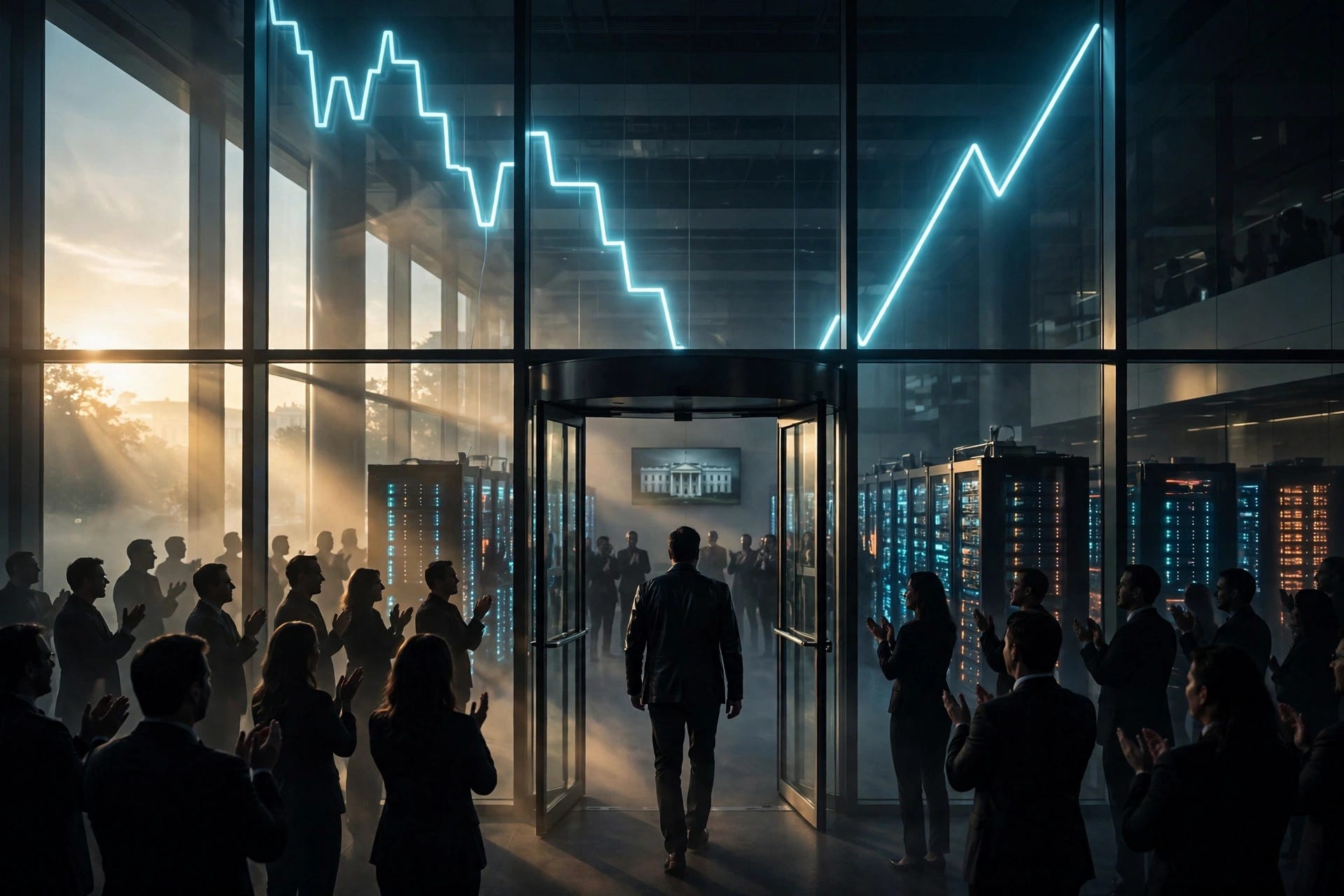
It was an extraordinary sentence to hear from a man who had just been restored to one of the most powerful jobs in world business, and it was also, in its way, the only honest summary of the previous eleven days available to anyone in the room. The staff who chanted his name had lived through a fortnight in which their company had become, simultaneously, a governance scandal, a national-security investigation, a congressional battleground, a stock-market panic and a test of how far a president of the United States would go to put a favoured executive back in his chair. None of those stories had ended on Monday morning. The investigation had not ended. The questions in Washington had not ended. The lawsuits had not ended. What had ended, abruptly and unanimously, was the board’s willingness to run Nvidia without the man who founded it.
The vote itself, as reported by Reuters and the Wall Street Journal on 23 November, was unanimous. The board reinstated Huang as president, chief executive and director, effective immediately. There was no probationary language in the announcement, no interim title, no suggestion that he was returning to tidy up unfinished business while a successor was groomed. He was back in the offices he had held, in substance, since he co-founded the company in 1993. Colette Kress, the chief financial officer who had served as interim chief executive during his absence, would continue as chief financial officer, according to the board’s announcement as reported on 23 November. Harvey C. Jones, who had been named Nvidia’s first board chair when Huang resigned, would stay on as chair. The structure around the restored chief executive had changed. The man at the centre of it had not been replaced at all.
The board’s own words, quoted in the coverage of 23 November, deserve to be read slowly, because they contain the whole argument of the reinstatement in miniature. The board said it was satisfied with Huang’s candour and with his ability to lead after a series of meetings, according to reports of its statement on 23 November. It said it was “confident that Mr. Huang’s reinstatement poses no national security risk”, and it grounded that confidence, in its own phrasing, in “input from senior levels of the United States government”. Jones, the chair, put the commercial case in a single sentence: “Jensen is the right person to lead NVIDIA”.
Each clause of that statement does different work, and the differences matter. Candour is a character judgement, offered by directors who had spent eleven days in possession of facts the public still does not fully have. Ability to lead is a commercial judgement, the kind boards are elected to make. But the national-security clause is something else entirely. A board of a semiconductor company is not, in the ordinary run of things, the body that determines whether its chief executive poses a national-security risk. That determination belongs, if it belongs anywhere, to intelligence agencies, to export-control officials and to the criminal and congressional investigators who, as the Wall Street Journal reported on 23 and 24 November, were still pursuing their own inquiries. By resting its confidence on “input from senior levels of the United States government”, the board was telling shareholders, in plain language, where the decisive assurance had come from. It had not come from the boardroom. It had come from the administration.
That is why Monday 23 November will be remembered as more than a personnel announcement. It was the morning on which the governance of the world’s most important artificial-intelligence company and the political will of the White House were seen, openly and on the record, to move together. The board did not hide the government’s role; it cited it. The president did not hide his role either; he boasted about it on television. And the market, which had spent eleven days pricing the possibility that Nvidia might have to be run by somebody else, delivered its own verdict within hours, in numbers so large that they require a moment’s pause to absorb.
Before those numbers, though, the human scene at headquarters is worth holding in mind, because it explains something the numbers cannot. Companies do not chant for chief executives they merely respect. The cheering reported by Reuters on 23 November was the sound of an organisation that experiences its founder not as a manager but as an identity. Huang had led Nvidia for 33 years, from its founding in 1993 until his resignation in November 2026, a span that covers almost the entire commercial history of the graphics processor and the whole of the artificial-intelligence boom that turned a specialist chipmaker into, in the framing used by both CNN and Reuters, a company at the centre of the American economy. For the engineers and executives inside that building, the eleven days had not been an abstract governance episode. They had been a sudden amputation. Monday morning, in their hearing, the limb had been reattached, and the man doing the apologising was the man they had been afraid of losing.
A trillion dollars, give or take a morning
If the board supplied the decision and the White House supplied the pressure, the market supplied the exclamation mark. Nvidia’s shares closed on Monday 23 November at $165.05, according to the market reporting compiled that day, up $39.52, or 31.48 per cent, from Friday’s close of $125.53. During the session the shares reached a high of $171.50. The company’s market capitalisation rose from roughly $3.03 trillion to roughly $3.98 trillion, a gain of about $952 billion in a single session, which the day’s reporting described as the largest single-day market-capitalisation gain on record. At its intraday peak the company briefly touched $4 trillion in value, according to the same reporting.
Numbers of that size resist comprehension, so it is worth translating them into the language of ordinary corporate life. A gain of $952 billion is larger than the entire market value of almost every company on Earth. It is the kind of sum that governments borrow in a year and that industries earn in a decade. Nvidia did not earn it on Monday. It did not announce a product, sign a contract or report a result. It announced a person. The entire increment — nearly a trillion dollars of shareholder wealth, created between the opening and closing bells — was the market’s valuation of the difference between Nvidia with Jensen Huang and Nvidia without him. Short sellers, who had bet against the stock, lost an estimated $12 billion on the day, according to an estimate reported in the day’s market roundups. Even Huang’s personal fortune moved by a figure that would be a national statistic elsewhere: one market analysis of the day estimated that roughly $35 billion came back to him personally on Monday, an estimate that should be read as an estimate, resting on his holding of about 3.58 per cent of the company, some 870.6 million shares, as set out in Nvidia’s 2026 proxy and discussed in pre-reversal analysis of his voting position.
The contagion, if that is the right word for a rally, spread far beyond one stock. The Nasdaq rose 6.51 per cent on Monday, according to Reuters’ Trading Day summary, and the S&P 500 rose 4.73 per cent. Reuters put the Dow’s gain at about 3 per cent and the Philadelphia chip index’s at about 12 per cent, with Dell up about 20 per cent and Micron up about 18 per cent on the day. Analysts writing up the session described it, according to the day’s market commentary, as the best day for both the S&P 500 and the Nasdaq since April 2025. A single personnel decision at a single company had lifted the entire American market, which tells you less about the decision than about how completely the artificial-intelligence trade, and with it a measurable share of American retirement savings, had come to rest on one firm’s shoulders.
And yet, for all the euphoria, Monday’s close contained a quieter and more sceptical message, visible to anyone who compared it with where the story began. The shares closed at $165.05 on Monday. On 11 November, the day before the resignation was announced, they had closed at $173.73. Even after the largest single-day gain in market history, in other words, Nvidia was worth about 5 per cent less than it had been before anyone outside a small circle knew that its founder was about to fall. The October peak, put at $239.24 by CEOWORLD’s long account of the board mechanics, was far above Monday’s close; Friday 20 November’s low of $124.50 had been a 52-week low. One widely cited count put the value lost since 11 November at about $1.2 trillion. Monday recovered most of that loss, but not all of it, and the difference between “most” and “all” is where the unresolved part of this story lives. The market had decided that Huang’s return was worth nearly a trillion dollars. It had not decided that the scandal was worth nothing.
That distinction matters for understanding what the board actually did. Directors are often accused, in episodes like this, of capitulating to the share price, and the accusation will be examined later in this account. But the share price on Monday was not simply a reward for the reinstatement. It was also a measurement of the cost of the alternative. For eleven days, investors had been asked to value Nvidia as a company whose founder had departed in disgrace, whose interim leadership was untested at the top, whose permanent succession was in the hands of a search firm, and whose regulatory and criminal exposure was expanding by the day. They valued that company, at Friday’s low, at roughly $1.2 trillion less than they had valued the Huang-led original. A board watching that measurement arrive, day after day, in the most public form imaginable, does not need a phone call from the White House to understand what the market is telling it. The phone calls came anyway, and they mattered enormously. But they landed on directors who had already spent more than a week watching the price of their independence being quoted on a screen.
The president takes a bow
No account of Monday is complete without the performance that accompanied it, because President Donald Trump did not merely approve of the reinstatement; he claimed it, publicly and repeatedly, as his own work. Speaking to CNBC on 23 November, according to CNN’s account of the day, he said: “I’ve been speaking to the board directly and indirectly, and I felt very strongly about it.” He said, in the same interview: “I think we have one of our great stars back in play.” And he set out the condition on which his support rested, in terms that framed the entire affair as a question of personal judgement rather than institutional process: “If I thought he did something wrong, I wouldn’t be recommending his board to hire him.”
On Truth Social the same day, according to Reuters’ timeline of the affair, the president called the reinstatement the “correct and proper decision”. Barron’s reported that he called Huang a “national treasure”, and he was also reported describing him as “a legend”. CNN quoted his summary of what the return meant for the market: “It’s a rocket ship going in the right direction, and it’s taking the whole market.” As colour, the Wall Street Journal reported that the president also posted an image of Huang holding up a red bra, in a play on the famous photograph of Trump raising his fist after the attempt on his life at Butler in 2024 — a detail that captures, better than any policy analysis could, the register in which this White House conducts even its interventions in national-security-adjacent corporate governance: part pressure campaign, part variety show, entirely unembarrassed.
Strip away the showmanship, however, and the substance of the president’s Monday statements is remarkable enough on its own. A sitting president stated on television that he had been speaking, directly and indirectly, to the board of a publicly traded company about who should run it. He described his recommendation to that board in the first person. He offered his personal assessment of the chief executive’s conduct — if he had thought Huang did something wrong, he said, he would not have recommended him — at a moment when, as the Wall Street Journal’s inventory of the affair made clear on 23 and 24 November, a board committee, the Securities and Exchange Commission, three House committees, the California attorney general and the Department of Justice were all, in one form or another, still examining aspects of that conduct and its consequences. The president was not commenting on a concluded matter. He was intervening, proudly and on camera, in the middle of several live ones.
It would be a mistake to treat that as mere indiscipline. Trump, as CNN reported on 23 November in its account of the pressure campaign, is a president who watches markets the way other presidents watch casualty reports, and his fixation on the five-day losing streak and the artificial-intelligence sell-off that preceded the weekend was, according to CNN, the engine of the whole reversal. The reinstatement was, in his telling, a market intervention as much as a personnel judgement. When he called Nvidia a rocket ship taking the whole market with it, he was describing his own theory of the case: that the company, the index and the national economic story had fused into a single object, and that the man at the top of it was therefore a matter of state. Readers who find that theory alarming and readers who find it obvious will divide along lines that have little to do with semiconductors. But no reader can honestly describe Monday’s events without it. The president believed the market needed Huang. He said so. He acted on it. And the board, by its own account, listened to senior levels of his government before it voted.
There is a further detail in Trump’s Monday remarks that deserves attention, because it reveals how the weekend’s assurances were constructed. His formulation — if I thought he did something wrong — locates the judgement in his own assessment, formed over days, not in any completed investigation. CNN reported on 23 November that Vice President JD Vance, who led the weekend campaign, had assured the board that the government had found no evidence that Huang had done anything illegal or untoward that threatened national security. Reuters reported that Attorney General Todd Blanche and Director of National Intelligence Jay Clayton also played roles in the determination that Huang posed no security risk. These are serious officials making a serious representation. But a representation that no evidence has been found, delivered over a weekend, while the underlying investigations continue, is a different thing from a clearance, and the board’s statement, with its careful reliance on “input from senior levels”, preserves that difference in its wording whether it intended to or not. The directors did not say Huang had been cleared. They said the government had given them input, and that on the basis of it they were confident. The gap between those two sentences is where the lawyers will live for the next year.
Six days earlier, the same board said never
To feel the full whiplash of Monday, you have to sit for a moment with the previous Wednesday — or rather, with Tuesday 17 November, the day Nvidia reported its quarterly earnings and its new chairman said the words that Monday’s vote would unsay. The earnings themselves were, by any ordinary standard, spectacular. Revenue for the quarter came in at $115.84 billion, according to TechCrunch’s account, against expectations of $109.11 billion, and the company guided investors to fourth-quarter revenue of about $130 billion, plus or minus 3 per cent, on the explicit assumption of no data-centre chip sales to China. It was the kind of report that, in a normal month, would have dominated the business pages for a week.
But 17 November was not a normal day, and the earnings call was not really about earnings. On that call, according to the accounts of it reported at the time, chairman Harvey Jones told investors that the board had unanimously accepted Huang’s resignation and “does not intend to reinstate Jensen as CEO”. CNN characterised Jones as also describing the behaviour at issue as “inconsistent with the company’s code of conduct, standards and cultural norms”. Read those two statements together and you have the board’s position, stated publicly, unanimously and in the most formal setting American capitalism offers: the founder was gone, his conduct had breached the company’s standards, and he was not coming back.
Six days later, the same board voted unanimously to bring him back, with the same chairman announcing that “Jensen is the right person to lead NVIDIA”. Unanimity in both directions is the detail that should stop every reader. Boards that split can explain a reversal as the product of argument. A board that is unanimous on Tuesday that a man must never return, and unanimous on Monday that he must return immediately, is telling the world that something outside the boardroom changed the facts on which its judgement rested — or that the judgement was never really the board’s to begin with. The board’s own statement points to the first explanation: new input, from senior levels of the government, on the national-security question. The reporting of the weekend, by CNN and Reuters, points to the second: a sustained, organised pressure campaign, led by the vice president, encouraged by the president, and aimed at directors who were simultaneously watching a trillion dollars evaporate. The truth, as so often in this affair, is likely that both explanations are the same explanation. The input was the pressure, formalised.
It is worth being precise about what did not change between 17 November and 23 November, because the list is long and the board did not address most of it. The board’s own investigation did not conclude; the company said on Monday, according to the reports of its statement, that the investigation “will proceed to conclusion”, and that Huang “fully supports” it and will cooperate. The California attorney general’s subpoena, served on 19 November according to the timeline assembled by Reuters, did not evaporate. The Securities and Exchange Commission’s examination of Nvidia’s accounting practices, reported by Reuters on 20 November on the basis of two people briefed on the matter, did not close. The transcribed interviews that the House Foreign Affairs Committee said Huang had agreed to give to three House committees on 1 December, with general counsel Tim Teter to follow on 2 December, remained on the calendar. The shareholder class action filed on 9 November remained on the docket. None of the underlying reports about Huang’s relationships — the matters that had forced the resignation in the first place — had been publicly resolved, retracted or adjudicated. What had changed, between the earnings call and the Monday vote, was the market’s trajectory, the president’s patience, and the government’s willingness to say, over a weekend, that it had found no evidence of a security threat. That is the whole of it. Everything else is commentary.
Huang himself had made one public move during those days that reads differently now. On 17 November, in his first public statement since the resignation, reported in Reuters’ timeline, he said he would be “honored” to return, that he regretted creating “problems for the Board”, and that he was cooperating with the investigation. At the time, with Jones’s “does not intend to reinstate” delivered the same day, the statement looked like a door being closed gently in a supplicant’s face. In retrospect it looks like the opening position in a negotiation that was already under way — a founder signalling, to directors, to Washington and to the petition-signing public, that he was available, penitent and ready. Whether the board solicited that signal or merely received it, the record reported so far does not say. But the sequence is on the record: the founder said he would be honoured to come back on the very day the board said it did not intend to have him, and within a week the board’s intention had reversed completely. In the annals of corporate governance, there are not many cleaner illustrations of the difference between what institutions say under one set of pressures and what they do under another.
Rewind: the resignation
Now step back to where the eleven days began, because the speed of the ending only makes sense against the formality of the start. Huang’s resignation was announced on 12 November 2026, according to Reuters; the company’s 8-K filing records the board’s acceptance of it on 11 November. He resigned as president, chief executive and director, effective immediately. There was no leave of absence, no transition period, no consultancy arrangement of the kind that usually cushions a founder’s exit. One day he was, as he had been for 33 years, Nvidia; the next day, on paper, he was a private citizen with a very large shareholding and a very public problem.
The machinery that replaced him moved with the practised smoothness of a board that had plainly rehearsed the possibility. Colette Kress, the chief financial officer, became interim chief executive, according to the announcement reported by Reuters — a choice that signalled continuity to investors, since Kress was among the most familiar faces in the company’s leadership and the executive who ordinarily presented its finances to Wall Street. Harvey C. Jones was named the company’s first board chair, a detail whose significance is easy to miss. Nvidia had never had a separate chair before; Huang had embodied the company’s leadership so completely that the office had not existed independently of him. Creating it, and filling it with a veteran director, was the board’s way of announcing that a new centre of authority existed and that it was not the founder’s office. And the board hired Heidrick & Struggles, the executive search firm, to find a permanent chief executive, according to the reports of the announcement. Search firms are not hired for theatre. Retaining one was the board’s most concrete statement that it expected the post-Huang era to be a real era, requiring a real search, a real shortlist and a real successor.
Each of those three moves — the insider interim, the first-ever chair, the external search — was a brick in a wall between Nvidia and its founder. Each was reported at the time as evidence that the departure was final. And each was quietly dismantled or bypassed eleven days later: the interim chief executive stepped back into the finance job she had never really left, the first chair stayed in post but now presided over the founder’s restoration rather than his succession, and the search, so far as any public record shows, simply stopped mattering. There is no shame in a board changing its mind; boards are supposed to respond to facts. But the completeness of the reversal invites the question that this entire account exists to answer, and it is worth stating plainly now, because everything in the pages that follow is an attempt to answer it honestly. What changed?
The short answer, which the rest of this story will substantiate, is that the facts about Huang did not change, and the facts about everything around Huang changed at once. The investigation that the board had commissioned — led, as the board announced on 10 November, by Joon Kim, a partner at Wachtell Lipton and a former acting United States attorney for the Southern District of New York — produced no public finding in those eleven days. No investigator cleared Huang. No committee exonerated him. What happened instead is that the cost of his absence was measured, in public, in trillions; that the president of the United States decided the cost was unacceptable; and that senior officials of his government supplied the board with the one thing it needed to reverse itself without quite admitting it had been wrong the first time: an assurance, from the state itself, that the national-security fear at the heart of the scandal was, on the evidence the government had, unfounded. Given that assurance, the board could present its reversal not as surrender but as diligence. It had, after all, only ever been waiting, it could say, for the security question to be answered. Now the government had answered it. The market did the rest.
But that short answer, true as far as it goes, conceals as much as it reveals, because the eleven days were not a waiting room. They were a cascade. Almost every day brought a new institutional actor into the story, a new investigation, a new political demand, a new reason for the share price to fall. To understand why the board folded on the Sunday night it did, you have to feel the accumulation — the sense, by the final Friday, that the story was no longer about one man’s conduct but about whether the American state, the American market and the American chip industry could afford the consequences of treating that conduct as disqualifying. The scandal itself, in its full and troubling detail, is the subject of the next part of this account. Here, at the threshold, it is enough to trace the eleven days as the participants lived them: as a sequence of blows, each landing on a company and a government less prepared for it than the last.
Consider the position on the morning of the resignation. The board had known for days that this was coming. Huang had told employees on 8 November, according to the reports assembled by TechCrunch, that he had been unfaithful to his wife, and the board had launched an independent investigation into reports that he had been targeted by a foreign intelligence effort. The New York Times had reported on 29 October, weeks earlier, that United States intelligence officials were concerned that Alice Huang — a Chinese citizen, a former managing director and chief executive of a Singapore firm called Megaspeed, and no relation to Jensen Huang — was acting for Chinese intelligence and was close to Nvidia’s chief executive; Nvidia had responded that the relationship was not “unusual”. On 11 November, the Times reported, citing five Nvidia sources, an affair between Huang and Kimberly Powell, a vice president for healthcare who reported to him. Reuters reported on 12 November a further intimate relationship with a second, unnamed employee. By the time the resignation was announced, in other words, the board was managing not a single allegation but a thicket of them, touching the founder’s marriage, his direct reports, a suspected intelligence operation and, through Megaspeed’s enormous purchases of Nvidia chips, the integrity of American export controls themselves.
That is the context in which the board’s initial severity must be judged, and, to be fair to the directors, it was severity. They accepted the resignation of the most successful chief executive of his generation at the height of his company’s powers. They did it unanimously. They announced a first-ever chair, an interim chief executive and a search for a permanent successor. They had already, on 10 November, retained one of the most formidable investigators in American corporate law. Whatever else is said about this board in the months ahead — and a great deal will be said, in Congress and in court — the record of 11 and 12 November is not the record of a board asleep. It is the record of a board that looked at the facts available to it and concluded that the founder had to go. Which is precisely why the record of 23 November requires explanation. Boards do not reverse judgements of that gravity because a week has passed. They reverse them because something has been applied to them that is stronger than their original reasoning. The rest of this account is about identifying, precisely, what that something was.
The question the eleven days left behind
There is a temptation, in writing about episodes like this one, to reach for the language of farce: the king exiled on Thursday, crowned again a week on Monday, the courtiers applauding in both directions. The temptation should be resisted, not because the episode lacks absurdity — a president posting a doctored image of the chief executive holding a red bra, as the Wall Street Journal reported, supplies absurdity in industrial quantities — but because the stakes underneath the theatre are as serious as any in modern business. Nvidia’s chips are the substrate of the artificial-intelligence boom. The rules governing who may buy them are a central instrument of American strategy toward China. The suspicion at the heart of this scandal, as reported by the New York Times and examined by Reuters, was that the man who ran the substrate had been personally compromised by a woman United States intelligence believed might be working for Beijing, at the same time as her firm was buying billions of dollars of his chips and investigators were trying to work out where those chips had gone. Attorney General Todd Blanche said on 12 November, according to Reuters’ timeline, that the Department of Justice had not concluded whether Alice Huang is a Chinese spy, and that the FBI was investigating “of course”. That sentence — not concluded, investigating of course — was still the official position of the United States government on the morning the board voted to restore her reported intimate friend to the chief executive’s office of the company at the centre of the investigation. Hold those two facts together and you have the whole story in a single frame.
None of this is to prejudge the investigations, and this account will not. Reuters has been explicit that it could not confirm Alice Huang’s affiliation with the Chinese government. China has denied the spy claim. Singapore’s account, Megaspeed’s account and Huang’s own position all have their place in the fuller telling that follows. What can be said now, without prejudging anything, is that the questions were open, are open, and were known by everyone involved to be open on the day the reversal happened. The board did not wait for them to close. It acted on an assurance about one of them — the national-security risk posed by Huang himself — and left the others to their processes. That may prove, in time, to have been wisdom: companies cannot be suspended in amber while governments deliberate, and a trillion dollars of other people’s savings is not a trivial consideration. It may prove to have been something else. What it cannot be described as, honestly, is a resolution. It was a decision to stop waiting for one.
And so Monday’s scene at headquarters, the chanting and the apology, resolves into something more complicated than either celebration or scandal. The staff were cheering the return of the only leader most of them had ever known, at the end of eleven days in which their company’s future had been debated on television by people who do not work there. The apology they heard — “I’m terribly sorry for putting all of you all through all of this” — was, as far as it went, graciously exact: he had put them through it, and he said so. The board had voted, the president had performed, the market had roared, and by the close of business Nvidia was, on paper, nearly a trillion dollars richer than it had been on Friday. But the filings still said what they said. The subpoena still sat where subpoenas sit. The committees in Washington still had their December dates, and the investigators still had their questions, and the woman at the centre of the intelligence concern was still, in the careful formulation of the attorney general, a person whose status the Department of Justice had not concluded anything about.
Which returns us, as everything in this story returns us, to the weekend. Because the reversal was not made on Monday. It was made between Friday night and Sunday night, in a series of phone calls that CNN reconstructed on 23 November and that Reuters corroborated in its own reporting: a president stewing over a market losing streak, a vice president working the phones for 72 hours, a founder promising to work harder than he had ever worked, and a board telling the government on Sunday night that it would reverse itself. The scandal explains how Jensen Huang fell. Only the weekend explains how he got back up. And the weekend cannot be understood until the fall has been told in full — the relationships as they were reported, the Singapore firm and its billions in chips, the investigators circling from three directions at once, and the week in November when the most valuable company in the world discovered that its greatest asset and its greatest liability were the same man.
A Name That Was Not His Family
The surname was the first confusion, and in a story that would turn on confusion — between private conduct and public risk, between a business relationship and something closer, between what could be proved and what officials feared might be true — it was a fitting place to begin. Alice Huang, as The New York Times reported on 29 October, according to the research assembled for this account, is no relation to Jensen Huang. She is a Chinese citizen. She was, by that reporting, a former managing director and chief executive of a Singapore company called Megaspeed. And, United States intelligence officials were concerned, she might have been acting for Chinese intelligence while maintaining a close relationship with the chief executive of the company that makes the world’s most sought-after artificial intelligence chips.
That sentence, even stated carefully, explains why what followed could not remain a boardroom embarrassment. Nvidia, as Reuters and CNN both framed the story in their coverage on 23 November, sits at the centre of the AI boom and at the centre of a contest between Washington and Beijing over who will control the computing power that underpins it. Its chips are not consumer gadgets. They are strategic assets, subject to export controls, argued over in Congress, discussed in classified memoranda, and counted, in some accounts, when they go missing. A personal relationship involving its founder would have been news in any circumstances. A relationship that intelligence officials were reported to be examining, involving a woman linked to a company that had bought billions of dollars’ worth of those chips, was something else entirely.
It is important, at the outset, to be precise about what was reported and what was not established. Reuters, in its timeline updated on 23 November, noted that it could not confirm Alice Huang’s affiliation with the Chinese government. China, according to that same record, denies the spy claim. On 12 November, Attorney General Todd Blanche said the Department of Justice had not concluded whether Alice Huang is a Chinese spy, while adding that the FBI was investigating “of course”, in the words recorded in the research. Those qualifications were not footnotes. They were, and remain, central to the story. No public finding in the material before the board, or before readers, established that Alice Huang worked for Chinese intelligence. No public finding established that Jensen Huang shared corporate or national-security information with her. Those were questions under investigation, not conclusions. But in counterintelligence, as CNN’s reporting on the pressure campaign and the scandal conveyed, questions can carry their own weight, particularly when the person at the centre of them runs a company whose products the United States has tried to keep out of the hands of its principal rival.
The classified dimension surfaced in the spring of 2026. The New York Times reported in November, according to the research timeline, that Secretary of State Marco Rubio had overseen a classified memorandum that spring warning senior officials about Huang’s close relationship with Alice Huang. The existence of such a memorandum, if the reporting is accurate, matters for two reasons. First, it indicates that concern was not invented in the frantic days of November, when newspapers were publishing daily revelations and members of Congress were demanding briefings. It had been circulating, at a classified level, months earlier. Second, it places the concern inside the national-security apparatus of the same administration that would later, in November, help to determine that Huang’s reinstatement posed no national security risk. That apparent tension — a classified warning in the spring, a reassurance in the autumn — is not resolved by anything in the public record summarised in the research. It may reflect new information. It may reflect a distinction between a risk that warranted vigilance and a risk that warranted removal. It may reflect politics. The research does not settle it, and this account does not pretend otherwise.
What was not contested was the scale of the commercial relationship that had drawn attention in the first place. Megaspeed had not been a trivial customer. It had bought, over two years, approximately $4.8 billion of Nvidia chips, according to TechCrunch’s timeline updated on 23 November. That figure alone would have made the company significant. What made it alarming to investigators, according to Reuters’ examination of filings, was how quickly it had grown, how opaque its rapid expansion appeared from the outside, and how its purchases intersected with United States rules designed to prevent advanced chips from reaching China through third countries. To understand Huang’s fall, therefore, it is necessary to understand Megaspeed — not as a backdrop, but as the commercial engine of the scandal.
The Company That Grew Too Fast to Explain
Megaspeed began, in the corporate record summarised by Reuters in its 23 November timeline, under another name. The Singapore firm was 7Road International, renamed Megaspeed International in March 2023. It described itself, in the research’s terms, as a cloud and AI infrastructure firm. Such companies have proliferated since the generative AI boom created an insatiable demand for computing capacity. They buy graphics processing units, install them in data centres, and sell access to that capacity to customers who cannot, or do not wish to, build their own. In a market where the scarcest resource is not software talent alone but the physical hardware on which large models are trained and run, an intermediary that can obtain chips can grow with startling speed.
Megaspeed’s growth, according to filings reviewed by Reuters, was startling even by those standards. Its assets grew from $33 million in 2023 to $3 billion in 2024. That is not ordinary expansion. It is a transformation in a single year, from a relatively small balance sheet to one measured in billions. Growth of that kind is not proof of wrongdoing. A company that secures financing, signs large customers and buys valuable hardware at the moment that hardware becomes the defining commodity of a technological revolution might legitimately expand very fast. But growth of that kind also invites questions that a slower, more transparent company might never face. Where did the capital come from? Who were the ultimate customers? Where were the chips installed? Who used the computing capacity they provided, and for what purposes? Those questions, according to the Commerce Department’s actions recorded in the research, were being asked by the United States government as early as 2024.
The Commerce Department opened an investigation into Megaspeed in 2024, according to the Reuters timeline. Commerce is not a bystander in the chip contest. Through the Bureau of Industry and Security, it administers the export-control system that determines which advanced semiconductors can be sold, to whom, and under what conditions. When Commerce investigates a company that buys American chips through a third country, the concern is typically diversion: that hardware nominally sold for a lawful purpose in a lawful location might in fact be destined for, or used by, a prohibited end user elsewhere. Singapore occupies a particularly sensitive place in that system. It is a trusted commercial hub and a partner of the United States, but its proximity to China and its role as a regional centre for technology and finance have made it, in the eyes of regulators, a jurisdiction that requires careful end-use checking. The research records that in May 2025, Commerce requested Nvidia’s records on direct and indirect Megaspeed sales. That request marked a step beyond investigating Megaspeed alone. It asked the supplier to account for what it knew, what it had sold, and through which channels.
Nvidia’s internal response, according to the timeline, came the following month. In June 2025, Nvidia put Megaspeed on an internal “no sell” or block list. That decision, too, requires careful reading. A block list can be a precaution taken when a customer comes under scrutiny; it is not an admission that past sales were unlawful. But once a supplier has placed a customer on such a list, subsequent questions become sharper. What had Nvidia known before June 2025? What prompted the listing at that moment? Did sales, direct or indirect, continue through other parties after the listing? And — a question that the board’s investigation would later examine, according to The Wall Street Journal’s inventory of the inquiries — what happened to a disclosure concerning Singapore sales after Megaspeed went on the block list? The Journal, as summarised in the research, reported that the board committee was examining, among other matters, the removal of a Singapore sales disclosure after June 2025. Nvidia has not, in the material summarised here, provided a public explanation that resolves that question.
After that check, according to the research, the Department of Justice took the lead on a criminal investigation, with Commerce and the Justice Department later issuing a joint statement on 16 November releasing details of the probe. A shift from an administrative export-control inquiry to a criminal investigation led by the Justice Department changes the legal stakes for everyone involved. It introduces the possibility of criminal liability, of grand jury processes, of charges that carry penalties beyond fines or loss of export privileges. The research does not say that Jensen Huang was a target of that criminal investigation. It does not say that Nvidia itself was. It says the investigation concerned Megaspeed and the chip sales around it. But for a board considering the position of a chief executive who was reported to have a close relationship with a former Megaspeed leader, the existence of a criminal probe into that company could hardly be treated as distant background.
Yet even stripping away the largest and least established figures, the established commercial core was enough to create a crisis. A company that bought approximately $4.8 billion of chips in two years, according to TechCrunch. Assets that rose from $33 million to $3 billion in a year, according to filings reviewed by Reuters. A Commerce investigation from 2024. A records request to Nvidia in May 2025. An internal block listing in June 2025. An on-site check that same month. A Justice Department criminal investigation thereafter. Those facts, attributed and dated, form a chain that no board could dismiss as gossip. When they were placed alongside reports of a close personal relationship between Nvidia’s chief executive and Megaspeed’s former leader, the chain acquired a human link that transformed a compliance case into a scandal about the man at the top.
The Other Relationships, and Why the Board Could Not Treat Them as Private
If the Alice Huang reports raised questions about national security and export controls, the other relationships reported in November raised questions of a different, though overlapping, kind: about power inside Nvidia, about its code of conduct, and about whether a chief executive who had relationships with people who reported to him, directly or through his organisation, could continue to lead a company that expected its employees to abide by rules he was accused of breaking. Those reports must be handled soberly. They involve named and unnamed individuals, intimate claims, and a marriage of approximately forty years, as TechCrunch noted in its timeline. They are not included here for sensation. They are included because the board itself, in the language reported by CNN, characterised the behaviour at issue as inconsistent with the company’s code of conduct, standards and cultural norms, and because governance experts interviewed by Reuters after the reinstatement argued that a direct-report relationship is not a purely private matter for a chief executive.
On 8 November, according to the research timeline, Huang told employees he had been unfaithful to his wife. That admission, made to staff before the resignation, is a striking detail. It suggests that by that weekend, the matter had moved beyond rumour management. A chief executive does not address his own infidelity to employees unless the information is already circulating, or is expected to circulate, in a way that affects the workplace. The research does not record the exact form of that communication, beyond the fact of the admission and a later apology email in which Huang wrote, according to Reuters, “My family bears no responsibility for my choices. I do.” That sentence, quoted in the research, is notable for its attempt to draw a boundary: responsibility was his, not his family’s. It did not, and could not, draw the same boundary around Nvidia. Once the admission had been made to employees, the company was involved, whether the underlying conduct had begun as a private failing or not.
Three days later, on 11 November, The New York Times reported, according to the research and based on five Nvidia sources, an affair with Kimberly Powell, a vice president for healthcare who reported to Huang. Reuters, on 12 November, reported a further intimate relationship with a second, unnamed employee. Those are reports, attributed here as the research attributes them. They have not, in the material summarised for this article, been established by a published board finding. Powell’s position matters to the governance question because of the reporting line. A relationship between a chief executive and a direct report creates, in the assessment of governance scholars quoted by Reuters Breakingviews on 24 November, an inherent conflict: the chief executive influences the subordinate’s pay, promotion, assignments and career, and other employees may reasonably ask whether decisions affecting that person, or affecting them by comparison, were made impartially. Nada Kakbadse of Henley Business School, in the analysis summarised by Reuters, argued after the reinstatement that accepting the resignation had been right and that reinstatement was, in her words, “The reinstatement is the weak decision”, because a direct-report relationship, combined with reports that he had misled the general counsel, presented a code-of-conduct problem rather than a private matter. That last element — reports concerning the general counsel — appears in the research as part of Kakbadse’s assessment, not as a separately established finding, and it should be read in that context.
The contrast with other recent cases was drawn explicitly by Reuters in its coverage of the reinstatement. In the past three years, according to Reuters, the chief executives of Nestlé, BP, Norfolk Southern and Kohl’s were all pushed out for workplace relationships. That pattern reflects a post-#MeToo tightening of board practice in large companies, where relationships with subordinates, even consensual ones, are often treated as violations of policy because of the power imbalance they involve. Boards in those cases concluded, or were reported to have concluded, that the chief executive’s position had become untenable not because a court had found wrongdoing, but because the company’s own rules and the trust required to enforce them had been compromised. Nvidia’s board, on 12 November, appeared initially to be following that same logic. By 23 November it had reversed it, while insisting that its investigation would proceed. That reversal is examined elsewhere in this article. For the purposes of understanding the fall, the point is that the Powell report and the second-employee report gave the board a governance rationale for accepting a resignation that did not depend on proving anything about Chinese intelligence. Even if every national-security concern had evaporated, the board would still have faced the question of whether its chief executive had violated the standards it required of others.
The Information’s report of 10 November attempted to connect the personal and the commercial directly. It reported, according to the research, that the affair had facilitated shipment of at least $7.5 billion of chips to Chinese firms. The research does not identify which affair that report meant in a way that allows this account to state it as fact, nor does it present the $7.5 billion figure as verified. Its significance in the chronology is that it appeared two days before the resignation, at a moment when the board was already investigating, members of Congress were calling for Huang to go, and a shareholder lawsuit had been filed. A report linking intimacy to the movement of strategic hardware, even an unproven one, changed the political environment in which the board deliberated. It made it harder to describe the matter as a personal lapse with no business consequence, because a respected technology publication was asserting, on its sources, that there had been a business consequence of the largest possible kind. Boards do not decide cases on newspaper assertions alone. But they do decide, in a crisis, whether a chief executive can credibly lead while such assertions remain unanswered. On 12 November, Nvidia’s board answered that he could not — or, more precisely, it accepted the resignation he offered in that environment.
The Week the Story Broke Open
The fall did not happen in a single day. It happened in a sequence so compressed that, by the time one institution had acted, another was already demanding something more. Reconstructing that sequence, from the research timeline, is essential, because the speed of it explains both the resignation and the doubts that later attached to it. A board that acts under intense, simultaneous pressure from Congress, markets, prosecutors and newspapers may reach a defensible decision. It may also reach a decision that it will reconsider when the pressure changes direction. The chronology of early November shows pressure building from almost every direction at once.
On 5 November, according to the Reuters timeline, House Republicans sought a closed-door briefing on the matters surrounding Huang. A request for a closed-door briefing is not a public accusation. It is a signal that a congressional committee believes classified or sensitive information may be involved and wants to hear it away from cameras. Coming from members of the President’s own party, it also signalled that concern about Huang was not, at that stage, a purely partisan attack. Three days later, on 8 November, came Huang’s admission to employees that he had been unfaithful to his wife, as recorded in the research. The board, according to the timeline, launched an independent investigation into reports that he had been targeted by a foreign intelligence effort. That formulation — targeted by a foreign intelligence effort — is important. It frames Huang, at least in part, as a potential victim of cultivation, not necessarily as a willing participant. An investigation into whether a chief executive was targeted is different from an investigation into whether he colluded. It asks whether he was vulnerable, whether he recognised the risk, whether he disclosed what he should have disclosed, and whether information or influence flowed as a result. Those questions can be grave without implying treachery. They can also be impossible to answer quickly.
On 9 November, a class action sued Nvidia and Huang, alleging fraud by concealment, according to the research. Shareholder class actions are a familiar accompaniment to corporate crises in the United States, and the filing of a suit is not proof of its allegations. Its significance lay in the legal theory it introduced: that investors had been harmed not merely by what Huang had done, but by what they had not been told. Concealment claims shift attention from the underlying conduct to the disclosures around it — to what the company said, when it said it, and whether omissions misled the market. That theory would later be reflected, in a different form, in the board investigation’s examination, as reported by The Wall Street Journal, of whether disclosures had misled investors, including in relation to the Singapore sales disclosure. For a public company, the disclosure question can outlast the personal scandal that gave rise to it, because it concerns the integrity of the information on which all investors traded.
On 10 November, two things happened that, together, brought the crisis to a point of no return. The board retained Joon Kim, a partner at Wachtell Lipton and a former acting United States Attorney for the Southern District of New York, to lead its probe, according to the research. Retaining a former federal prosecutor of that standing signalled that the board wanted an investigation whose credibility would survive scrutiny from regulators and Congress. It also signalled that the inquiry would not be a cursory human-resources review. Kim’s background is in investigations where documents, interviews and disclosure decisions are examined with prosecutorial rigour. On the same day, Senator Kevin Cramer called for Huang’s resignation. A call from a senator for a chief executive to resign is not binding, but it alters a board’s calculation of reputational risk. It tells directors that the political cost of standing by their leader is rising, and that if they do stand by him, they will be asked to defend that decision in public, possibly under oath. Schumer’s parallel push on chip legislation added to the sense that Huang had become, in Washington, a liability to the very policy relationships Nvidia needed to manage its export business.
On 11 November, according to the company’s 8-K as summarised in the research, the board accepted Huang’s resignation. Reuters dates the public announcement to 12 November, and this article follows that convention: the resignation was announced on 12 November, effective immediately, with Huang stepping down as president, chief executive and director. The distinction between acceptance on 11 November and announcement on 12 November is a small example of why precision matters in this story. The eleven days that followed are counted from the announcement that stunned the market, but the board’s decision had been taken the day before, after the sequence of revelations and demands described above. Colette Kress, the chief financial officer, became interim chief executive. Harvey C. Jones was named Nvidia’s first board chair — a detail that underscores how completely the company had previously been identified with its founder, who had combined leadership roles in a way that left no separate chair in place. The board hired Heidrick & Struggles to search for a permanent chief executive. That appointment mattered later, when the board reversed itself, because it showed that on 12 November the company had presented the departure not as a sabbatical or a suspension pending inquiry, but as a vacancy to be filled.
It is worth pausing on what did not happen in that week. No regulator published a finding that Huang had violated export controls. No prosecutor charged him with an offence. No board investigation reported its conclusions, because it had only just begun. The resignation was therefore not the product of a completed adjudication. It was a judgment made in a crisis, on incomplete information, by a board that had to weigh the credibility of its own code, the demands of Congress, the risk of further revelations, and the possibility that its chief executive had been compromised in ways it could not yet assess. That does not make the judgment wrong. Boards are often required to act before facts are complete; waiting for certainty can itself be a dereliction when a leader’s ability to lead is in question. But it does mean that the resignation carried a vulnerability that a judgment after a completed investigation would not have carried. If the facts did not develop as feared, if the government indicated it had found no evidence of illegal conduct threatening national security, if the market reacted with a ferocity that threatened the wider economy, the board might be asked why it had acted so definitively on so incomplete a record. Eleven days later, it was asked exactly that — not in a hearing room, but in the movement of its own share price and in phone calls from the White House.
What Was Denied, What Was Not Known
A responsible account of a scandal must spend as much time on what is not known as on what is alleged, because in this case the unknowns are not incidental. They go to the central questions a board, a regulator and a reader would want answered: Was Alice Huang acting for Chinese intelligence? Did Jensen Huang know, or should he have known, of any such risk? Did any information pass between them that should not have passed? Did their relationship affect any decision about selling chips to Megaspeed or to any other customer? Did Nvidia’s disclosures to investors accurately reflect what the company knew about Megaspeed and about Singapore sales? On the public record summarised in the research, none of those questions has a settled answer.
Start with the intelligence claim. The New York Times reported on 29 October that United States intelligence officials were concerned Alice Huang was acting for Chinese intelligence. Concern, in intelligence language, can range from a preliminary assessment based on fragmentary reporting to a high-confidence judgment. The research does not specify the level of confidence, the evidence behind it, or whether the concern was shared across agencies. Reuters, in its own reporting, could not confirm her affiliation with the Chinese government. That is a significant limitation, stated plainly by a news organisation that had investigated the timeline in depth. China denies the spy claim, according to the research. A denial by Beijing would be expected whether the claim were true or false, and readers will weigh it accordingly, but it belongs in the record. Attorney General Blanche, on 12 November, said the Justice Department had not concluded whether she is a Chinese spy. That statement, from the nation’s chief law enforcement officer on the day the resignation was announced, is perhaps the clearest official marker of the state of knowledge at the moment Huang fell: the department responsible for counterintelligence prosecutions had not reached a conclusion, while the FBI was investigating.
Singapore’s position added another layer. According to its statement as summarised in the research, Alice Huang left in February and was barred from re-entering after an investigation not concerning espionage. If accurate, that account suggests Singapore investigated something — the research does not say what — and imposed an immigration consequence, while distinguishing that investigation from espionage. It does not clear her of the American concern, which could rest on different information, nor does it confirm it. It places a third government, one that had participated in the June 2025 end-use check, in the position of saying that its own inquiry was about something else. Megaspeed’s account, on 15 November, that she had officially left on 30 August 2025 and had no current role, conflicts at least in appearance with a February departure, unless the two statements describe different events. The research offers no reconciliation. A congressional committee, when it interviews Huang on 1 December and general counsel Tim Teter on 2 December, according to the schedule recorded in the research, will have the opportunity to ask for one. Until then, the honest position is that her departure date, like her alleged affiliation, remains disputed in the public record. Megaspeed, in that same 15 November statement recorded by Reuters, said its business was “legitimate and lawful” and that it had hired outside counsel — its position, not a verified account.
Later reporting deepened the questions without resolving them. On 20 November, according to the timeline, The New York Times reported Alice Huang’s extensive family and associate ties to China’s defence industry. On 22 November, the Times reported she was in contact with a Chinese Ministry of State Security officer from spring 2025 to fall 2026. Those reports, if accurate, are serious. Contact with a Ministry of State Security officer is not, by itself, proof that a person is an intelligence agent — officers can have overt as well as covert contacts, and the nature of the contact matters enormously — but sustained contact over that period, combined with reported defence-industry ties, would explain why investigators were unwilling to treat the relationship as an ordinary business acquaintance. It is equally important to note the timing. Those Times reports appeared on 20 and 22 November, after the resignation. They cannot have been part of the board’s public rationale on 12 November, though officials may have known some of the underlying information earlier through classified channels, including the Rubio memorandum of spring 2026. The research does not establish what the board knew privately. It establishes only what was reported publicly, and when.
Why This Was Never Only a Private Matter
It would be possible, if the facts were different, to argue that a chief executive’s infidelity is his family’s tragedy and his employer’s irrelevance. If the relationships had involved people wholly outside the company, with no connection to its customers, its regulators or its strategic products, many readers might have concluded that the board should have confined itself to a warning about judgment and left the marriage to the people in it. The facts as reported do not allow that separation. One reported relationship involved a vice president who reported to him, according to The New York Times on 11 November. Another, according to Reuters on 12 November, involved a second employee. A third strand, concerning Alice Huang, involved the former leader of a customer that had bought approximately $4.8 billion of chips, according to TechCrunch, at a time when those chips were subject to an export-control regime designed to keep them from strengthening a rival’s military and AI capabilities. Each strand, on its own, raised a legitimate institutional question. Together, they made the claim that this was a private matter unsustainable.
The chips are the reason the scandal escaped the business pages. Nvidia’s products, as Reuters and CNN framed them, are not merely profitable. They are the hardware on which the current generation of AI systems is built, and the United States government has treated their distribution as a matter of national strategy. In December 2025, according to the timeline, President Trump said the United States would allow H200 shipments to China after an agreement with Nvidia. In August 2025, Nvidia and AMD had agreed to share 15 per cent of certain China chip revenue with the United States government, according to the timeline sources. The House Foreign Affairs Committee later said, on 19 November according to the research, that the administration had approved shipments of nearly 900,000 advanced Nvidia and AMD AI chips to Chinese companies between December 2025 and May. Those figures describe a policy in which enormous quantities of advanced hardware were moving, lawfully and with government approval, even as other shipments were being investigated as possible diversions. In such a system, the integrity of the controls depends on companies knowing their customers, checking end use, and disclosing accurately. A chief executive whose personal relationships touched both his own subordinates and a customer under investigation inevitably raised questions about whether those controls had operated as they should, regardless of whether any individual shipment was ultimately shown to be unlawful.
The largest reported figures illustrate both the stakes and the danger of moving too fast. The Information’s report of at least $7.5 billion in chips facilitated to Chinese firms, flagged throughout this account as a report rather than a finding, would, if established, mean that the affair had not merely created a vulnerability but had altered the flow of strategic technology on a vast scale. The New York Post’s report of at least 50,000 missing advanced chips from a 2025 audit, attributed here to the Post as the research requires, would, if established, mean that hardware whose location the control system was supposed to guarantee could not be accounted for. Neither figure is established in the material before us. Both explain why legislators reacted as they did. When Treasury Secretary Scott Bessent said on CBS on 22 November, according to the timeline, that the United States needs answers on China chip sales and on who was in charge of compliance, he was naming the institutional question that survived every denial: who, inside Nvidia, was responsible for ensuring that a customer placed on a block list in June 2025 did not continue to obtain, directly or indirectly, the products the United States was trying to control? Bessent had earlier, on 13 November, publicly complained, according to the research, that Treasury, the Pentagon, the State Department and the United States Trade Representative had favoured blacklisting Megaspeed for months but that “Commerce has the pen”. That complaint, aimed at his own administration’s process, showed that the argument over Megaspeed was not simply between Nvidia and its critics. It was an argument inside the government about how quickly and how firmly to act, conducted in public while the board was deciding its founder’s fate.
Nvidia’s own governance arrangements, created during the crisis, acknowledged that compliance had become a board-level issue. On 17 November, according to the research, the company created a board-level National Security and Export Control Oversight Committee, chaired by Suzanne Nora Johnson, with members Stephen Neal and John Dabiri, to meet at least quarterly. The research also notes that the company had no chief compliance officer, according to its 2026 proxy. For a company whose principal product is subject to national-security export controls, that absence, once highlighted, was difficult to defend. It suggested a firm that had grown, in thirty-three years under its founder, from a graphics-chip maker into a pillar of national strategy faster than its compliance architecture had grown with it. The committee’s creation did not answer whether past decisions were correct. It was an admission that the questions those decisions raised required a permanent structure, not a crisis response.
By 12 November, then, Huang’s fall was overdetermined. Any one of its causes might, in a different company or a different week, have been managed: a personal admission, handled with a reprimand; a customer investigation, handled by lawyers; a congressional briefing request, handled by government affairs. Together, in eleven days of reporting that moved from a newspaper’s intelligence concern on 29 October to a senator’s resignation call on 10 November, they created a situation in which the board concluded it could not wait for the investigations to finish. It accepted a resignation, appointed an interim chief executive, installed its first chair, and began a search for a successor. That sequence should be remembered when the reversal is judged, because the reversal did not occur after the questions in this part of the story were answered. It occurred while the board’s own investigation, led by a former federal prosecutor, was still under way; while the Justice Department’s criminal investigation of Megaspeed continued; while Congress was preparing to interview Huang and his general counsel in December; and while the reports concerning Alice Huang were, if anything, becoming more detailed. What changed in the eleven days was not the scandal. The scandal, on the public record, was substantially where the board had left it on 12 November, with its denials noted, its unknowns explicit, and its most serious claims still awaiting proof. What changed was everything around it — the price of the shares, the temper of the market, and the determination of a President who decided that the cost of Huang’s absence had become greater than the risk of his return.
The company that became the economy’s weather
To understand why a board reversed itself in eleven days, and why a president spent a weekend working the telephones on behalf of one chief executive, it is necessary first to understand what Nvidia had become by the autumn of 2026. This was no longer, in any meaningful sense, simply a company that made graphics chips. According to the framing used by both CNN and Reuters in their coverage of 23 November 2026, Nvidia sat at the centre of the artificial intelligence boom that was powering the American economy, and its fortunes had become a proxy for the fortunes of that boom itself. When its shares rose, the indices rose with them. When its shares fell, as they did violently during the eleven days of Jensen Huang’s absence, the fall was felt far beyond Santa Clara.
The company was co-founded in 1993 by Jensen Huang, Chris Malachowsky and Curtis Priem, and Huang led it from its founding until November 2026, a tenure of 33 years that the research record treats as one of the defining facts of the business. In the terms used across the coverage studied for this article, Nvidia had travelled the distance from GPU maker to AI infrastructure company, the firm whose data-centre chips, including the H200 named repeatedly in the export-control reporting, had become the essential hardware of the AI age. Its customers were not buying decoration for personal computers. They were buying the capacity to train and run the models on which governments, technology companies and financial markets had staked enormous sums, and Nvidia was, by every account in the record, the supplier that mattered most.
One careful paragraph is owed to the technology that made that position so difficult to dislodge. Alongside its chips, Nvidia built CUDA, its software platform, and the significance of that pairing was a recurring theme in the background material: hardware alone can be imitated, eventually, by a determined rival with enough money and enough time, but hardware wrapped in a software ecosystem that developers have spent years learning, writing for and building upon is a different kind of moat. Engineers trained on the platform, code written for the platform and data centres designed around the platform all raised the cost of switching to anyone else. The research file does not ask the reader to take a view on how durable that advantage will prove over a decade. It records the simpler point that, in November 2026, the combination of the chips and the platform was what placed Nvidia at the centre of the boom, and it was why the identity of the person running Nvidia had become a question with consequences well beyond one company’s shareholder register.
A record quarter, delivered by somebody else
The earnings of 17 November 2026 deserve a pause, because they complicate every simple account of what followed. According to the figures reported by TechCrunch, Nvidia’s third-quarter revenue reached $115.84 billion, comfortably ahead of the $109.11 billion that had been expected, and the company guided investors toward fourth-quarter revenue of $130 billion, plus or minus 3 per cent, on an assumption that, notably, included no data-centre chip sales to China. That guidance matters for two reasons. First, it was a statement of confidence issued at the worst moment in the company’s modern history, six days after its founder’s resignation had been announced and in the teeth of investigations on several fronts. Second, the assumption buried inside it, that the forecast did not depend on Chinese data-centre sales, was a quiet reminder of how completely the export-control question had already reshaped the company’s commercial map before Huang ever fell.
The earnings call also produced the sentence that made the reversal of 23 November so startling. As the research record notes from the call, board chair Harvey C. Jones told listeners that the board had unanimously accepted Huang’s resignation and, in the words preserved in the record, “does not intend to reinstate Jensen as CEO”. CNN, in its reporting of 23 November, characterised Jones on that occasion as also describing the behaviour at issue as inconsistent with the company’s code of conduct, standards and cultural norms. Read together, those two elements, a unanimous acceptance and a stated absence of any intention to reverse it, were about as final as board language ever gets in public. Boards choose such words carefully, precisely because they may one day be read back to them. Six days later they were.
It is worth being precise about who was running the company when those results were presented. After the resignation announced on 12 November, according to the record drawn from Reuters and the company’s own filing, chief financial officer Colette Kress became interim chief executive, Harvey C. Jones was named Nvidia’s first board chair, and the board hired the search firm Heidrick & Struggles to find a permanent chief executive. The arrangements were orderly. There was an interim leader who knew the company’s finances intimately, a chair providing board leadership in a role the company had never previously separated out in that way, and a professional search under way for a successor. Nothing in the record suggests operational chaos. Factories did not stop, customers were not reported to have fled, and the quarter, when it arrived, was a record. If the test of a company is whether it can function for eleven days without its founder, Nvidia passed that test in the only currency that can be audited: $115.84 billion of revenue in a single quarter, reported by TechCrunch, and guidance for considerably more.
Eleven days, priced tick by tick
Markets are often described as voting machines, and for eleven days in November 2026 they voted, with unusual clarity, on a single question: what is Nvidia worth without Jensen Huang? The figures assembled in the research record allow that vote to be followed almost day by day. According to CEOWORLD’s long account of the board mechanics published on 24 November 2026, Nvidia’s shares had reached an October peak of $239.24; a separate market snapshot recorded in the research file put the 52-week high at $243.37 on 6 October. By the close on 11 November, the last close before the resignation was announced on 12 November, the shares stood at $173.73, a level the record preserves because it became the benchmark against which the recovery was later measured. The company, in other words, had already surrendered a substantial part of its autumn valuation before the founder’s departure was public, as the scandal gathered around it through October and early November.
What followed the announcement was not a correction but a rout. By Friday 20 November, according to the market figures in the research record, the shares closed at $125.53, and the intraday low that day, $124.50, was a 52-week low. A company that had been the emblem of the AI boom was trading at its lowest level in a year, not because its products had failed, not because a rival had overtaken it, and not because its earnings had disappointed, the earnings, as TechCrunch reported, had beaten expectations three days earlier, but because the man identified with all of it was gone and under investigation. Video analysis of the market move, recorded in the research notes from 23 November, put the cumulative loss since 11 November at roughly $1.2 trillion of market value. The figure is an estimate from that analysis rather than an audited number, and it should be read as such, but its scale is consistent with the share path itself: a fall from a market capitalisation measured in the region of four trillion dollars toward roughly $3.03 trillion by the Friday close, the starting point given in the record for Monday’s rebound.
Then came Monday 23 November, and the vote reversed itself with a violence that matched the fall. According to the closing figures in the research record, Nvidia ended the day at $165.05, up $39.52, a gain of 31.48 per cent in a single session, having touched $171.50 during the day. Market capitalisation rose from about $3.03 trillion to about $3.98 trillion, a gain of roughly $952 billion that the record describes as the largest single-day market-capitalisation gain on record, with the valuation briefly touching $4 trillion. The ripples were market-wide. Reuters, in its Trading Day account of 23 November, recorded the Nasdaq up about 6.5 per cent and the S&P 500 up about 4.7 per cent, with the Dow up 3 per cent and a chip index up 12 per cent; the fuller figures in the record put the Nasdaq’s rise at 6.51 per cent and the S&P 500’s at 4.73 per cent, described in market analysis cited in the notes as the best day for both indices since April 2025. Other chip and hardware names were carried along, with Dell up 20 per cent and Micron up 18 per cent in the Reuters account. Short sellers, according to an estimate attributed in the record to Crypto Briefing’s roundup, lost an estimated $12 billion on the day. Huang personally, according to the video market analysis noted in the research file, saw roughly $35 billion restored to the value of his stake in a single session, again an estimate, but one that gives human scale to the abstraction of a trillion-dollar swing.
Two qualifications keep the story honest, and both are in the record. The first is that Monday’s close, for all its drama, left the shares still below the $173.73 close of 11 November, by roughly 5 per cent on the record’s own comparison, and far below the October peak. The reinstatement recovered an enormous sum; it did not make shareholders whole against where they had stood before the crisis, let alone at the top. The second qualification arrived within hours. A pre-market snapshot for Tuesday 24 November recorded in the research file, attributed to Finnhub and flagged there for cautious use, indicated Nvidia lower in early trading, at about $155.86, down 5.57 per cent. A single pre-market indication is not a verdict, and the record treats it as no more than the first sign of second thoughts. But it is a useful corrective to any account that treats Monday as a settlement. The market had priced the man’s return at nearly a trillion dollars in a day. By the following morning, at least in that early indication, it was already re-pricing the questions that his return had not answered.
The founder who did not control his own company
There is a paradox at the centre of the reversal, and it was identified, presciently, before the reversal happened. In a video analysis published on about 18 November 2026 by The Mazala Report, noted in the research file, the argument was made that Huang could not come back, because unlike the founders who dominate so much of Silicon Valley mythology, he did not control his company’s votes. According to the figures drawn in that analysis from Nvidia’s 2026 proxy statement and preserved in the research record, Huang owned about 3.58 per cent of Nvidia, some 870.6 million shares, carrying one vote per share. There was, on that account, no dual-class structure of the kind that gives some celebrated founders voting power wildly disproportionate to their economic stake. The names used in the research record as the contrast are Mark Zuckerberg and Elon Musk, founders whose control arrangements have made them, in practical terms, irremovable by their boards. Huang had no such armour. He was, in governance terms, an employee, an extraordinarily successful, extraordinarily wealthy and extraordinarily identified-with-the-company employee, but one whose continuation in office depended, formally, on the pleasure of a board he did not control.
That formal position explains both halves of November. It explains how he could be removed so quickly: when the board accepted his resignation in November, as recorded by Reuters, there was no voting bloc to appeal to and no structural obstacle to the decision, and when chair Harvey Jones said on the 17 November earnings call that the board did not intend to reinstate him, that was not a negotiating position that a controlling shareholder could simply override. It also explains why the return, when it came, had to arrive by an unusual route. A founder with control can wait out a storm, rally his votes and dare a board to move against him. A founder without control who wishes to return must persuade, or must find persuaders whose weight the board cannot ignore. In Huang’s case, on the account given by CNN on 23 November and by Reuters in its reporting of the same period, the persuaders included the President of the United States, the Vice President and senior members of the administration, and the argument they carried was not about votes at all. It was about markets and national security, the two currencies in which the board’s own position was most exposed.
It should also be recorded, because the board itself recorded it, what the formal position was on the morning of the return. According to the company’s statement as summarised in the research record, the board voted unanimously on 23 November to reinstate Huang as president, chief executive and director with immediate effect, saying that it was satisfied with his candour and his ability to lead after a series of meetings, and that it was, in the statement’s words, “confident that Mr. Huang’s reinstatement poses no national security risk”, a judgement it said rested on “input from senior levels of the United States government”. Jones, who six days earlier had said the board did not intend to reinstate him, now said, in the words preserved in the record, “Jensen is the right person to lead NVIDIA”. Kress, the interim chief executive, continued as chief financial officer, Jones remained chair, and the filing, according to the record, contained no new pay terms. A video market analysis noted in the research file put at $108 million, on a Bloomberg count, the amount Huang had given up on resigning; that figure is carried here as it is carried in the notes, attributed and to be used cautiously. Unanimity, it is worth observing, cuts both ways as evidence. It can signify a board genuinely persuaded. It can also signify a board that, having decided it cannot resist the combined pressure of the market and the White House, prefers to move together. The record establishes the unanimity. It does not, by itself, establish which of those it was.
Chips as statecraft: the war behind the scandal
No account of the pressure campaign makes sense without the chip war that formed its backdrop, because the administration that pressed for Huang’s return was the same administration that had spent a year treating Nvidia’s products as instruments of national policy. The timeline assembled by Reuters, updated on 23 November 2026, records the essential beats. In December 2025, according to that timeline, President Trump said the United States would allow shipments of H200 chips to China after an agreement with Nvidia. Earlier, in August 2025, Nvidia and AMD had, on the timeline’s account, agreed to share 15 per cent of certain China chip revenue with the United States government, an arrangement without obvious precedent in the history of export controls, under which the right to sell a strategic product abroad was, in effect, priced as a share of the proceeds. Whatever view one takes of those decisions, they established the pattern into which November 2026 fitted: access to China for advanced American chips was not a purely commercial matter settled by companies, nor a purely prohibitory matter settled by regulators, but a continuing negotiation in which the White House was an active participant and Nvidia was its indispensable counterparty.
The human dimension of that negotiation had been visible for months before the fall. According to the reporting of The New York Times in November, noted in the research record, Secretary of State Marco Rubio had in spring 2026 overseen a classified memorandum warning senior officials about Huang’s close relationship with Alice Huang, the former Megaspeed figure at the centre of the intelligence concerns. On 13 May 2026, the record notes, Huang was added at the last minute to a United States delegation visiting China. On 14 September, he took a call from Trump live at the All-In summit, a small theatrical moment that captured the relationship’s public character. On 8 October, according to the timeline, Trump awarded Huang the National Medal of Science. A chief executive who receives his country’s highest scientific honour from a president one month, and whose travel and contacts are the subject of classified warnings within the same government, is living at the exact point where commerce and statecraft meet, and where the failure of a personal relationship can become a matter for intelligence agencies. That was the terrain on which the scandal broke.
November then hardened the policy even as the politics softened toward the man. On 16 November, the same day the Commerce Department and the Department of Justice released details of their Megaspeed probe in a joint statement, according to the research record, the Bureau of Industry and Security issued a rule restricting China’s access to advanced AI chips: licences would now be needed for shipments to Singapore, Thailand, Malaysia, Indonesia and Brazil, overseas data centres serving China-based AI firms were given 90 days to obtain licences, and the Biden-era global AI diffusion rule was formally rescinded. The geography of that rule is itself a map of the alleged problem, a ring of third countries through which, investigators suspected, chips could be routed toward Chinese end users. On 17 November, according to the record, China threatened countermeasures. In Washington, meanwhile, the legislative fight ran in the opposite direction to the White House’s instincts: the research record notes that Representative Hakeem Jeffries had pushed a defence bill containing chip restrictions, and that Senator Chuck Schumer had pushed an AI Overwatch Act, while on the other side of the argument the administration’s own position, as it emerged over the following weekend, was that the greater risk lay in a leaderless Nvidia and a collapsing AI market.
The scale of what the permissive side of the policy had already allowed became part of the record during the crisis week. According to the research notes, the House Foreign Affairs Committee said the administration had approved shipments of nearly 900,000 advanced Nvidia and AMD AI chips to Chinese companies between December 2025 and May, a figure stated by the committee in November and carried here as its statement. Set that number beside the enforcement side of the ledger, the Commerce investigation into Megaspeed opened in 2024, the May 2025 request for Nvidia’s records on direct and indirect Megaspeed sales, the internal “no sell” listing of Megaspeed in June 2025 and the joint Commerce and Justice statement of 16 November, all as recorded by Reuters in its timeline, and the picture is of a policy pulling in two directions at once: hundreds of thousands of chips approved through the front door under a revenue-sharing dispensation, and a criminal investigation into chips said to have slipped through the side door via Singapore. Huang stood, personally, at the junction of both. He was the beneficiary of the front-door policy and the man whose relationships were under scrutiny in the side-door investigation. That dual position is what made his fate a matter of state, and it is what made the weekend that restored him a matter of statecraft rather than merely of corporate governance. The administration was not, however, speaking with one mind: according to the research record, Treasury Secretary Scott Bessent had complained publicly on 13 November that Treasury, the Pentagon, State and the Trade Representative’s office had favoured blacklisting Megaspeed for months but that, in his reported words, “Commerce has the pen”; Senator Richard Blumenthal said “Lutnick must go”, House Democrats on 18 November opened a probe into whether Commerce Secretary Howard Lutnick had helped Cantor Fitzgerald avoid losses (Commerce said Lutnick had divested; Cantor denied the claim), and Bessent said on CBS on 22 November that the United States needed answers on China chip sales and on who had been in charge of compliance.
The weekend the White House went to work
The fullest account of the reversal weekend in the research record is CNN’s, published on 23 November 2026 under a headline that left little doubt about its thesis: this was a Trump pressure campaign. According to CNN’s reporting, the president had been stewing over a historic five-day market losing streak and the broader AI sell-off, and reached the conclusion that Huang had to return. The detail that gives the account its texture is the road not taken. CNN reported that Trump initially floated Apple chief executive Tim Cook as a replacement, and that he was unimpressed by interim chief executive Colette Kress’s interview on CNBC. Consider what those two details reveal about the decision’s centre of gravity. The objection to the interim arrangement was not, on CNN’s account, that Nvidia lacked a competent finance chief or a functioning board process, a search firm had, after all, been hired, according to the record. The objection was presentational and market-facing: the stand-in had not persuaded on television, and the president’s mind turned first not to the search firm’s longlist but to the most celebrated operator in American technology, as though the chief executive’s job at Nvidia were a piece of national casting. It was, in the event, casting that resolved in favour of the original actor.
The campaign itself, according to CNN, was led by Vice President JD Vance over 72 hours across the weekend, coordinating with Huang and assuring the board that the government had found no evidence that Huang had done anything illegal or untoward that threatened national security. Reuters’ reporting, reflected in the research record, adds the names behind that assurance: Attorney General Todd Blanche and the Director of National Intelligence, Jay Clayton, also played roles in the determination that Huang posed no security risk, the determination the board would cite in its statement the following morning. Commerce Secretary Howard Lutnick and Treasury Secretary Scott Bessent were, according to CNN, also involved, notwithstanding the clash between their departments over Megaspeed described above. Trump, CNN reported, consulted Elon Musk, whose own verdict appeared publicly on X on 23 November in the five words recorded in the research file: “The mistake has been corrected”. And the president, according to both CNN and Reuters, did not leave the persuasion to intermediaries. He called the board directly, and on Sunday night he spoke to Huang himself. The sentence that survives from that call survives because Trump recounted it, to CNBC and The Wall Street Journal on the accounts in the record: Huang told him, “I’m gonna work harder than I’ve ever worked”. It is a pledge perfectly shaped for its audience, part apology, part promise of effort, and it is carried here as what the record says it is: Trump’s account of the conversation, not a transcript.
The board, according to CNN, told officials on Sunday night that it would reverse. Some senior Nvidia staff, the same reporting notes, learned of the decision only shortly before Monday’s announcement, a detail that captures the reversal’s true chain of command: negotiated between a company board and a government over a weekend, settled on Sunday night, and presented to the company’s own senior employees, and then to the world, as a unanimous board decision on Monday morning. Huang returned to headquarters to cheers from staff chanting his name, according to Reuters, and told them, in the words preserved in the record: “I’m terribly sorry for putting all of you all through all of this”. An earlier apology email to staff, also reported by Reuters, had put the personal reckoning more starkly: “My family bears no responsibility for my choices. I do.” The two apologies, one to the workforce in the room and one in writing, are the human bookends of the weekend. Between them sits the institutional fact that no apology, however sincere, was the mechanism of his return. The mechanism was a campaign: a president fixated on the market, a vice president working a 72-hour telephone operation, the nation’s chief law-enforcement officer and its intelligence chief supplying the security assurance, and a board that, told by the government that its founder posed no national security risk and watching its market value bleed by the day, concluded that resistance cost more than surrender.
Founders who came back, and what their returns proved
Reuters Breakingviews, in its analysis of 24 November 2026, placed Huang’s return in the small and storied category of founder restorations, and the comparisons it drew are instructive precisely because none of them quite fits. The closest in speed, according to that analysis, was Sam Altman at OpenAI in 2023, restored five days after his board removed him, in a crisis driven by an employee revolt and the threatened departure of the company’s talent to a rival. Huang’s eleven days sit in the same register of velocity, but the instruments differed: at OpenAI the leverage was the workforce and a major investor; at Nvidia, on CNN’s account, the leverage was the market index and the White House. Steve Jobs, in the Breakingviews comparison, was away from Apple for twelve years, returning to a company near bankruptcy that needed rescuing from itself; Huang returned in eleven days to a company that had just posted, according to TechCrunch, $115.84 billion of quarterly revenue. Bob Iger’s return to Disney came after roughly two years, and the founder returns of Mark Pincus at Zynga and Aneel Bhusri at Workday, both cited by Breakingviews, likewise unfolded over periods of about two years, in the ordinary rhythm of succession failing and boards reaching back for the person who had built the place. Huang’s case compresses that rhythm almost to vanishing point. There was no failed successor, no multi-year experiment, no period in which the company tested life without him and found it wanting on operational grounds. There was, instead, an eleven-day market verdict and a political intervention, after which the experiment was abandoned before the search firm hired to run it, Heidrick & Struggles on the record, can have got far beyond its first telephone calls.
The speed matters because it determines what the return can and cannot claim to be. A founder restored after two years, as in the Iger, Pincus and Bhusri cases cited by Reuters Breakingviews, returns to a verdict: the alternative was tried and found inadequate. A founder restored after five days, as Altman was, returns on a verdict too, delivered by employees whose departure would have hollowed out the company. A founder restored after eleven days in which his company set revenue records under an interim chief executive returns on a different verdict altogether. The business, demonstrably, could run without him for eleven days; whether it could have run without him for eleven quarters is a question the board never allowed to be asked, let alone answered. What the eleven days proved was narrower and, for a board, more frightening: that the market would not wait for the answer. The premium investors attached to Huang personally, measured by the swing from the Friday low to the Monday close, was so large that defending the principle of an orderly succession would have meant presiding over its continued destruction. Boards are fiduciaries for value, and the value, for eleven days, was visibly attached to a man. That is the strongest honest defence of the reversal, and it deserves to be stated in its strongest form: the directors did not invent the key-person premium; they watched it being priced, tick by tick, and they acted to stop the loss.
The verdict of the governance scholars
If the market delivered its verdict in numbers, the governance profession delivered its verdict in words, and the two did not agree. Reuters’ coverage of the reinstatement, reflected in the research record, carried the judgement of Margaret O’Mara of the University of Washington, who placed the episode within Silicon Valley’s cult of the, in her phrase, “indispensable man”, and summarised the valley’s operative norm in a sentence quoted in the record: “You can be a brilliant jerk if you can get things done”. The force of O’Mara’s point, as presented in that coverage, is that the norm long predates Huang and will long outlast him: exceptional commercial performance purchases exceptional personal latitude, and boards that benefit from the performance are slow to withdraw the latitude until the moment when, suddenly, they do. Nvidia’s eleven days contain both halves of that cycle in miniature, the latitude withdrawn on 12 November and restored on 23 November, with the performance figures, $115.84 billion of quarterly revenue on TechCrunch’s reporting, unchanged throughout.
The sharper verdict came from Nada Kakbadse of Henley Business School, quoted in the same Reuters coverage. Accepting the resignation, on her account, had been right. In the words preserved in the research record, “The reinstatement is the weak decision”. Her reasoning, as summarised in the record, went to the nature of the underlying conduct rather than to its consequences for the share price: a relationship with a direct report, together with reports that the general counsel had been misled, is a code-of-conduct problem, she argued, not a private matter to be weighed against market sentiment. That distinction, between the private and the institutional, is the hinge on which the whole governance debate turns. Huang’s own apology to staff, reported by Reuters, framed his responsibility personally: “My family bears no responsibility for my choices. I do.” The board’s original position, as characterised by CNN from the 17 November call, framed the matter institutionally, as behaviour inconsistent with the company’s code of conduct, standards and cultural norms. Kakbadse’s criticism, on the record’s account, is that the reinstatement silently moved the matter back from the institutional column to the personal and political one, where a president’s assurance and a rising share price could settle it, without the code-of-conduct question ever having been answered by the investigation appointed to answer it.
Reuters set the Nvidia decision, in the same coverage, against the recent practice of other large companies, and the contrast is stark enough to state plainly. According to the record, the chief executives of Nestlé, BP, Norfolk Southern and Kohl’s were all pushed out over the past three years for workplace relationships. In each of those cases, on the implication of the comparison, the governing principle was that a relationship crossing the lines of the code ended a chief executive’s tenure regardless of performance. Nvidia’s board applied that principle for eleven days and then, under the pressures documented by CNN, unapplied it, distinguishing its case, in its own statement, on the ground of national security input from senior levels of the government and its satisfaction with Huang’s candour. No one suggests the cases are identical: none of those other companies stood at the centre of a great-power technology race, and none of their chief executives was the subject of a presidential restoration campaign. But the contrast performs a useful service. It isolates exactly what was exceptional about Nvidia’s decision, which was not the discovery of new facts about the conduct, the board investigation, as the company itself said on 23 November, would proceed to its conclusion, but the introduction of two new weights on the other side of the scale: the market’s trillion-dollar verdict and the government’s security assurance. Whether those weights belong on a conduct scale at all is the question Kakbadse’s phrase, “the weak decision”, leaves hanging over the restoration.
Punished company, restored man
The reinstatement did not arrive alone, and its companion piece is the detail on which this part of the story properly ends. On the same Monday, 23 November 2026, according to reporting by The Wall Street Journal, Reuters and Semafor reflected in the research record, the Commerce Department added Megaspeed and its affiliates to the Entity List, the United States government’s trade blacklist. The entities named in the record were Megaspeed International itself, its owner Swiftdata, its Malaysian subsidiary Speedmatrix, MSFusion, PT Megaspeed International and Thailand’s Megaspeed Co, together with Apex Enterprise Solutions, identified by Reuters as Alibaba’s Singapore subsidiary. The rule’s language, as recorded, designated entities “acting contrary to the national security or foreign policy interests of the United States”; American firms would need a licence to deal with them, a licence the record notes would likely be denied; and the additions were, according to the record, the first new Entity List additions since October 2025. In Canberra on Tuesday 24 November, according to Reuters, Singapore’s prime minister Lawrence Wong said Singapore would continue investigating whether Megaspeed had breached Singapore law, and that discussions with the United States were ongoing.
Set the two Monday decisions side by side and the architecture of the settlement, if settlement is the word, becomes visible. The company through which, investigators alleged, advanced chips had moved toward China was blacklisted, its affiliates named across four jurisdictions, its access to American suppliers cut off in law. The man whose relationships had drawn the investigation toward Nvidia’s chief executive’s office was restored to that office the same morning, with the board citing the government’s own input for its confidence that he posed no national security risk. The government that supplied that input was the same government that, through Commerce, was simultaneously declaring the counterparty company a national-security threat. None of this is, strictly, a contradiction: it is possible, as a matter of logic, for a firm to be a conduit of concern while an individual is cleared of personal wrongdoing, and the board’s investigation, the Justice Department’s criminal investigation of Megaspeed and the other inquiries catalogued elsewhere in this article all continue, on the record, to their own conclusions. But as a matter of optics and of institutional coherence, the pairing is the eleven days in a single frame. The machine of enforcement moved against the company it could punish without moving markets. The machine of politics moved to restore the man it could not, it turned out, do without.
That is where the machine around Jensen Huang leaves him on the morning of 24 November: restored unanimously, cheered by his staff, worth, on the market’s Monday arithmetic, $952 billion more than he had been on Friday, and still, on the record assembled by Reuters, the Journal and the rest, the subject of investigations that his restoration did not close and a December calendar of congressional interviews that his restoration did not cancel. The board had answered the only question the weekend asked, which was the market’s question. Every other question, about chips and compliance, about conduct and candour, about who in Washington helped whom and why, remained exactly where the eleven days had left it. The reckoning, deferred, is the subject of the final part of this article.
The company was punished on the day the man was restored
There is a symmetry to Monday, 23 November 2026, that no celebration at Nvidia’s headquarters in Santa Clara could obscure. On the same day the board voted unanimously to reinstate Jensen Huang as president, chief executive and director, the Department of Commerce added Megaspeed and a cluster of its affiliates to the Entity List, according to reporting by the Wall Street Journal, Reuters and Semafor. The founder was welcomed back to cheers inside his own building. The company through which, investigators suspect, advanced American chips may have found their way towards China was formally cut off from American technology. Anyone trying to understand what the eleven days settled has to hold those two decisions together, because together they describe the bargain that was struck. The founder would return. The machinery around him would be tightened, investigated and, in one conspicuous case, blacklisted. Whether that division of consequences amounts to accountability, or merely to its appearance, is the question that will follow Nvidia into December and beyond.
The Entity List is not a rebuke. It is one of the most consequential instruments in the American export-control arsenal, a register of foreign companies that United States firms may not supply without a licence, and licences for listed entities are, in practice, likely to be denied. The rule language applied to Megaspeed and its affiliates, as reported by Reuters and the Wall Street Journal, described entities “acting contrary to the national security or foreign policy interests of the United States”. In this context the standard formulation carried particular weight, because Megaspeed was not an obscure name. It was the Singapore-based cloud and artificial intelligence infrastructure firm, formerly 7Road International and renamed Megaspeed International in March 2023 according to the Reuters timeline, that had bought roughly $4.8 billion of Nvidia chips over two years, according to TechCrunch, and whose assets had grown from $33 million in 2023 to $3 billion in 2024 in filings reviewed by Reuters. A company of that trajectory, in that business, at that moment in the chip war, was never going to remain a private commercial matter once American officials began asking where its machines had ended up.
The listing, as reported on 23 November, reached beyond Megaspeed International itself. It covered the company’s owner, Swiftdata, its Malaysian subsidiary Speedmatrix, MSFusion, PT Megaspeed International and Thailand’s Megaspeed Co, according to the Journal and Reuters reporting. It also covered Apex Enterprise Solutions, identified by Reuters as a Singapore subsidiary of Alibaba. That last name matters, because it widens the frame. The action was not simply a postscript to a chief executive’s personal scandal. It was a statement about a network of companies operating across Singapore, Malaysia, Indonesia and Thailand, jurisdictions that American officials have increasingly treated as potential transshipment routes for advanced chips bound, directly or indirectly, for Chinese artificial intelligence firms. The Bureau of Industry and Security rule issued on 16 November, a week before the listing, had already restricted China’s access to advanced AI chips by requiring licences for shipments to Singapore, Thailand, Malaysia, Indonesia and Brazil, and by giving overseas data centres serving China-based AI firms ninety days to obtain licences, according to the Reuters timeline. The Megaspeed listing landed, therefore, on ground that had been prepared for it. It was the named, specific application of a general tightening that was already under way.
The international dimension was still unfolding as Tuesday began. Singapore’s Prime Minister Lawrence Wong, speaking in Canberra on Tuesday, 24 November, said Singapore would continue investigating whether Megaspeed had breached Singapore law, and that discussions with the United States were ongoing, according to Reuters. Singapore had already said that Alice Huang, the former Megaspeed managing director whose reported closeness to Jensen Huang sat at the centre of the intelligence concerns first reported by the New York Times on 29 October, had left Singapore in February and had been barred from re-entering after an investigation that did not concern espionage, according to the Singapore account. Megaspeed itself said on 15 November that she had officially left on 30 August 2025, held no current role, and that its business was “legitimate and lawful”. Those accounts do not align neatly, and the discrepancy over something as basic as when one executive departed is a reminder of how much of the Megaspeed story remains contested or locked inside investigations that have not reported. Wong’s remarks suggested Singapore intends to conduct its own inquiry under its own law rather than simply accept Washington’s characterisation — a delicate position for a state trusted simultaneously by American technology firms and Chinese capital.
The investigations did not resign when he returned
If there was a single sentence in the board’s reinstatement announcement that deserved more attention than it received amid the market euphoria of Monday morning, it was the commitment that the board’s own investigation “will proceed to conclusion”, and that Huang “fully supports” it and will cooperate. According to the Wall Street Journal’s inventory of the inquiries still surrounding Nvidia and its restored chief executive, that investigation, conducted through a board committee advised by Wachtell Lipton partner Joon Kim, a former acting United States Attorney for the Southern District of New York, is examining whether Huang shared corporate or national security information in the course of the Alice Huang relationship, and whether company disclosures misled investors, including in connection with the removal of a Singapore sales disclosure after Megaspeed was placed on Nvidia’s internal “no sell” list in June 2025. Those are not questions about private morality. They go to the integrity of what Nvidia told its shareholders and, potentially, to whether sensitive information moved where it should not have moved. The board that voted unanimously to restore Huang on 23 November is the same board whose committee must now pursue those questions about the man it has just restored, and report its conclusions to a market that has already, in effect, delivered its own verdict by adding roughly $952 billion to the company’s value in a single session.
The Securities and Exchange Commission is also examining Nvidia’s accounting practices, Reuters reported on 20 November, citing two people briefed on the matter — an examination, not an enforcement action, but a serious one at a company whose valuation rests on growth figures of the size it reported on 17 November. In California, meanwhile, the pressure is of a different legal character. On 19 November, California Attorney General Rob Bonta served Nvidia with an investigative subpoena, according to the Reuters timeline. A subpoena is a compulsory instrument: it obliges the company to produce documents or testimony on the attorney general’s timetable, not its own. Add the shareholder class action filed on 9 November, which sued Nvidia and Huang alleging fraud by concealment, according to the timeline, and the legal exposure takes on a layered quality no single statement is likely to dissolve. The class action alleges investors were harmed because matters were concealed from them. The board investigation is asking, among other things, whether disclosures misled investors. The SEC is examining accounting practices. Different institutions, different powers — but a common theme: whether the public record Nvidia created while the Megaspeed relationship was developing can be trusted. That theme will not be settled by a unanimous board vote.
The criminal dimension runs through the Department of Justice’s investigation of Megaspeed itself. Commerce had opened its investigation in 2024, requested Nvidia’s records on direct and indirect Megaspeed sales in May 2025, and joined the on-site end-use check in Singapore in June 2025 at which Alice Huang was interviewed, according to Reuters. The Justice Department subsequently took the lead on the criminal side, marked publicly by the joint Commerce and Justice statement of 16 November. A criminal investigation into Megaspeed is not a criminal investigation into Jensen Huang, and precision matters: nothing in the verified record states that Huang is a target of it. But its findings will bear on every other inquiry. If investigators establish that advanced chips were diverted, the questions of who knew, who was warned and who was responsible for compliance will acquire an evidentiary foundation they currently lack. Treasury Secretary Scott Bessent made a version of that point on CBS on 22 November, saying the United States needed answers on China chip sales and on who was in charge of compliance, according to the reporting of his remarks. Bessent had already complained publicly on 13 November that Treasury, the Pentagon, the State Department and the Trade Representative had favoured blacklisting Megaspeed for months, but that “Commerce has the pen”. The blacklisting has now happened. The compliance question has not been answered.
Two further inquiries aim not at Nvidia’s conduct alone but at the government’s, and they may prove the most politically combustible of all. On 18 November, House Democrats opened a probe into whether Commerce Secretary Howard Lutnick helped Cantor Fitzgerald avoid losses, according to the timeline; Commerce has said Lutnick divested, and Cantor Fitzgerald denies the allegation. Separately, Democratic lawmakers opened a probe on 20 November into whether Nvidia influenced the Commerce Department’s Megaspeed investigation, according to Barron’s. Together, those inquiries ask whether the department responsible for enforcing export controls on the most strategically sensitive technology in the world was itself subject to improper influence at the moment its decisions mattered most. Senator John Curtis questioned Lutnick’s reported stalling on the blacklist, and Senator Richard Blumenthal said, in the blunt formulation recorded in the reporting, that “Lutnick must go”. Those claims remain claims until evidence is produced. But the structural question underneath them is not partisan. Export controls only work if the referee is visibly independent of the players, and a weekend in which cabinet officials helped persuade a board to restore a chief executive, followed on Monday by the blacklisting of the company in his scandal, will be Exhibit A for anyone arguing that the line has become difficult to see.
December is circled on every calendar in Washington
For all Monday’s finality, the calendar now takes over, and the calendar is not Nvidia’s friend. According to the House Foreign Affairs Committee, Huang has agreed to transcribed interviews with three House committees on 1 December, with general counsel Tim Teter to follow on 2 December. Senate Banking testimony is scheduled for early December, with Senator Tim Scott announcing 3 December, according to the Wall Street Journal, while an aide had earlier said no date had been set, as the Reuters timeline recorded on 20 November. Transcribed interviews are a particular ordeal: a verbatim record is created, and anything said can later be compared with documents, other witnesses and the speaker’s own earlier statements. Huang will enter those rooms days after a board declared itself satisfied with his candour, before members who have read everything published in November. Teter’s appearance may be the more revealing, because the governance criticism reported by Reuters, including Henley Business School’s Nada Kakbadse’s assessment, has included the charge that Huang misled the general counsel. The general counsel’s account of what he was told, and when, is precisely the evidence that either substantiates that charge or lays it to rest. The December gauntlet also includes publication of the Entity List rule in the Federal Register on Wednesday, as CNN reported, and behind the scheduled events sits the unscheduled one: the conclusion of the board’s own investigation, promised on 23 November with no date attached. If it clears Huang quickly, sceptics will ask whether the board that restored him could have done otherwise. If it finds against him on any material point, the board faces acting against a chief executive it restored unanimously, in public, with a president invested in the outcome. The board chose its order of operations on Monday — verdict first, investigation afterwards — and December is when the cost of that ordering comes due.
Congress will not be asking only about the past. The legislative fight over chip controls ran in parallel with the scandal throughout November and will outlast it. Representative Hakeem Jeffries had pushed a defence bill carrying chip restrictions during the fall, Senator Chuck Schumer had pressed the AI Overwatch Act, and the House Foreign Affairs Committee had stated that the administration approved shipments of nearly 900,000 advanced Nvidia and AMD AI chips to Chinese companies between December 2025 and May, according to the committee’s account. That figure will be the backdrop against which Huang testifies. Members will want to know whether the licensing system is a control regime or a toll booth — a question sharpened by the arrangement agreed in August 2025, under which Nvidia and AMD share 15 per cent of certain China chip revenue with the United States government, according to the timeline sources. A government that takes a cut of the sales it licenses has acquired a financial interest in their continuation. Huang, who took President Trump’s call live at the All-In summit on 14 September and received the National Medal of Science from Trump on 8 October, according to the timeline, embodies that argument more completely than any other living executive, and in December he will have to answer for it in rooms where summit applause is not available.
The argument, stated in two short posts
The political reaction to the reinstatement sorted itself with unusual speed into positions that are unlikely to move, because they are not really disagreements about evidence. They are disagreements about what kind of offence this was. Senator Elizabeth Warren called the reinstatement “reckless” and said the board owed Congress answers on export-control compliance, according to the reporting of her response. Senator Chuck Schumer went further and in broader terms, declaring that “Democrats will wield their full power to investigate any wrongdoing by the Trump administration, Jensen Huang, other Nvidia executives, and anyone selling out our national security for financial gain”. That sentence is worth dwelling on, because it names the frame Democrats intend to carry into the new year: not a personnel matter at a chip company, but a story about national security sold for financial gain, with the administration itself inside the investigation rather than above it. Against that frame, the counter-argument arrived in its most economical form from Elon Musk, who posted on X on 23 November, as reported by CNN and Reuters Breakingviews, simply: “The mistake has been corrected”. Five words, and a complete theory of the case. In Musk’s formulation, the mistake was never Huang’s conduct. The mistake was his removal. The correction was the board’s reversal. Everything the investigators are examining is, by implication, noise around a decision that should never have been taken.
Between those poles stood the Republicans who broke ranks, and their dissent may matter more in the long run than the predictable Democratic outrage, because it denies the administration a unified party defence. Representative Don Bacon of Nebraska said Nvidia’s leadership should have ignored the administration’s “inexplicable desire to save Huang”, according to the reporting. Senator Pete Ricketts, also of Nebraska, posted on X on 23 November, as reported by CNN: “Jensen Huang had multiple affairs including with subordinates and an alleged Chinese spy. His behavior does not support reinstatement.” Ricketts’s post is significant not only for its content but for its venue and its directness. A Republican senator used the president’s own favoured medium to state, in plain terms, the factual core of the case against the reinstatement, at the moment of the president’s triumph. It signalled that the unease about Huang’s return is not confined to the opposition, and that when the December hearings begin, the questioning may not divide as neatly along party lines as the White House would prefer. Senator Kevin Cramer had, after all, called for Huang’s resignation during the fall, and the concerns about Megaspeed had been voiced inside the administration itself, by Bessent among others, before the weekend campaign overtook them. The politics of this story are therefore better understood as a three-way split than a two-way one: a White House and a market that wanted the founder back, a Democratic opposition that sees a scandal of state, and a national security wing of the Republican Party that spent a decade building the case for chip controls and now watches the chief beneficiary of those controls restored by presidential intervention.
President Trump’s own contribution to Monday’s record was unusually candid about the nature of his involvement. Speaking to CNBC, he said: “I’ve been speaking to the board directly and indirectly, and I felt very strongly about it”. He called Huang “one of our great stars back in play”, said that “If I thought he did something wrong, I wouldn’t be recommending his board to hire him”, and, in CNN’s account, described Nvidia as a rocket ship: “It’s a rocket ship going in the right direction, and it’s taking the whole market”. On Truth Social he called the reinstatement the “correct and proper decision”, according to the Reuters timeline, and Barron’s recorded his description of Huang as a “national treasure”. The Wall Street Journal added the day’s strangest colour, reporting that Trump also posted an image of Huang holding up a red bra in a play on the photograph of Trump himself, fist raised, after the assassination attempt at Butler in 2024. Set the kitsch aside and consider the novelty of what the CNBC remarks concede. A sitting president has acknowledged, on the record, that he pressed the board of a publicly traded company, directly and indirectly, to reverse a governance decision about its own chief executive, in a matter where federal investigations involving that company remain open. Whatever one thinks of Huang, that precedent now exists, and every board in America has noticed it.
January changes the referees
Everything described so far is scheduled to unfold under a political configuration that is itself about to change. Democrats are poised to take control of Congress in January, in the framing used by CNN and reflected in Schumer’s vow to wield the party’s “full power”, and yesterday’s scan of the midterm results recorded that Democrats had also clinched 258 House seats. Control determines who chairs the committees before which Huang and Teter will appear, who issues subpoenas rather than requesting interviews, and which of the open inquiries acquire the powers and budgets to run for a year rather than a news cycle. The Democratic probes opened on 18 and 20 November were launched from the minority, where a probe is largely an instrument of publicity. From the majority, the same inquiries become instruments of compulsion. The administration that spent a weekend restoring Huang will spend the winter explaining, under oath, the decisions surrounding that restoration, including the roles of Vice President JD Vance, who led the seventy-two-hour pressure campaign according to CNN, and of Attorney General Todd Blanche and Director of National Intelligence Jay Clayton in the determination that Huang posed no security risk, according to Reuters. Yet the change should not be read simply as good news for accountability. A majority that has framed the affair in advance as “selling out our national security for financial gain” has committed itself to findings it has not yet evidenced, and a majority inquiry can become a theatre in which the conclusion precedes the documents. The strongest protection for the truth is whether the independent processes now running — the board committee under Joon Kim, the SEC examination, the California subpoena, the Justice Department’s criminal investigation and Singapore’s own inquiry — are allowed to finish before politics finishes first. On the record so far, that ordering is not guaranteed. For shareholders, meanwhile, each scheduled appearance becomes a known date on which damaging material may emerge: Nvidia’s valuation now carries a political risk that moves with events in Washington as surely as it once moved only with chip supply and demand.
The market’s second thoughts began before Tuesday’s opening
The first evidence that Monday’s euphoria contained its own correction arrived before Tuesday’s opening bell. In pre-market trading on Tuesday, 24 November, Nvidia shares were indicated lower, at around $155.86, down some 5.57 per cent, according to a Finnhub snapshot. A pre-market indication is a thin and jumpy measure, to be handled with the caution it deserves — an early-Tuesday signal, not a close — but directionally it told a story Monday’s close already suggested. The rally had carried Nvidia from Friday’s close of $125.53 to Monday’s $165.05, a rise of 31.48 per cent, or $39.52, in a single session, with an intraday high of $171.50, according to the day’s market reporting. Even after that move, the shares remained below their close of $173.73 on 11 November, the last session before the resignation was announced. The market had spent, give or take the arithmetic of a $952 billion single-day gain in market capitalisation that briefly touched $4 trillion, to arrive at a price lower than the one it set before the crisis. Short sellers lost an estimated $12 billion on Monday, according to an estimate attributed in Crypto Briefing’s roundup — a reminder that the rally’s violence fell on real positions held by people who had bet, reasonably enough on the public evidence, that a company in Nvidia’s position does not recover in a day. What Tuesday’s dip most plausibly means is that Monday priced the removal of an uncertainty, not the resolution of one. The succession question closed — sharpened, as it had been, by reports that Arm’s decision, announced at 7 a.m. Eastern on Monday, to extend chief executive Rene Haas’s tenure to 2033 had closed off a name placed on Nvidia’s successor shortlist. The uncertainties that remain are slower and impossible to settle in a session. Tuesday’s softness is a market waking up and remembering them.
The honest analyst split is not really about the numbers, because the numbers are not in dispute. On 17 November, with Huang gone, Nvidia reported third-quarter revenue of $115.84 billion, up 103 per cent year over year and ahead of the $109.11 billion expected, and guided to $130 billion for the fourth quarter, according to TechCrunch. The business posted a record quarter without him: the data centres, the CUDA platform and supply relationships assembled over three decades did not pause for the eleven days. An investor who believes valuation should follow that machine can make a coherent case that Monday’s premium was an overpayment for a person. Yet the counter-case is written in the share path itself: $173.73 on 11 November, a 52-week low of $124.50 intraday on 20 November, and $165.05 on the Monday of the return, with roughly $1.2 trillion lost across the affair by the count used in market analysis of the period, and Huang’s personal stake recovering an estimated $35 billion on the Monday alone by the same analysis. A market does not move like that for a figurehead. Huang owns only about 3.58 per cent of Nvidia, some 870.6 million shares carrying one vote each, according to the Mazala Report’s reading of the 2026 proxy, with no dual-class structure protecting him. Formally he was among the most removable chief executives in the index; substantively, removing him cost a fifth of the company’s value, with the Nasdaq rising 6.51 per cent and the S&P 500 4.73 per cent on the day of his return, according to the day’s market analysis. Control, it turns out, is not only a property of share classes. It is also a property of belief, and belief, once priced, is very hard for a board to vote against twice.
What the eleven days mean beyond one company
Step back far enough and the affair stops being a story about one executive’s conduct and becomes a diagnostic of the artificial intelligence boom itself. The boom has concentrated an astonishing share of the world’s economic future in a handful of firms, and within those firms, to a degree unusual even in the history of technology, in a handful of individuals. Nvidia sits at the centre because it supplies the indispensable input: its chips train and run the models on which governments, militaries, laboratories and the largest consumer platforms now depend, and its founder led it without interruption from its co-founding in 1993 until this month — thirty-three years, on the company’s well-established history. When a single supplier occupies that position, its internal governance ceases to be a private matter. A board decision in Santa Clara moved the Nasdaq by six and a half per cent. A personnel crisis at one firm became, within days, a matter for the president, the vice president, the attorney general, the director of national intelligence, two cabinet secretaries, three House committees, a Senate committee, a state attorney general and the prime minister of Singapore. No one designed that cascade. It is what happens when critical infrastructure is privately owned, personally led and geopolitically contested at once. Democracies have spent a century building doctrines for banks too big to fail. They have not yet built an equivalent for a chip company too central to be allowed a normal corporate crisis, and the eleven days suggest they will need one, because the alternative is the improvisation the world has just watched.
For boards, the lesson is colder. The Nvidia board did several things the textbooks recommend. It acted on a code-of-conduct matter involving relationships with subordinates, appointed the company’s first independent chair, hired a search firm, retained eminent outside counsel in Joon Kim to lead an independent investigation, and created a national security oversight committee when the gap in its machinery became undeniable. Then, under pressure from the market and the White House, it reversed its central decision before its own investigation reported, justifying the reversal partly by reference to assurances from the government whose agencies are investigating the underlying affair. Every director in America will draw a private conclusion from that sequence, and it will not be the one reformers hope for. It will be that the textbook is optional when the founder is valuable enough, that a unanimous vote is a weather vane rather than a conviction, and that the true constituency of a modern board, in a crisis, is whoever can move the share price or the president’s mood over a weekend. Kakbadse’s verdict, that the reinstatement was “the weak decision”, will be quoted in business schools, and O’Mara’s “indispensable man” in newsrooms. But the precedent that will actually govern behaviour is the outcome: the board that folded kept its chief executive, recovered its market value and suffered no immediate consequence beyond criticism. Until some board pays a higher price for folding than for holding, folding will remain the rational move, and codes of conduct will keep an unwritten exemption, legible to everyone, for the person the company cannot replace.
For export controls, the affair poses a question the December hearings cannot avoid. The control regime is the principal instrument by which the United States intends to slow China’s progress in artificial intelligence, and its credibility rests on the rules being applied without regard to the commercial interests of the firms they govern. November tested that condition in public. While the regime was being tightened on paper, with the 16 November rule extending licensing requirements across Singapore, Thailand, Malaysia, Indonesia and Brazil, the House Foreign Affairs Committee was reporting nearly 900,000 advanced chips approved for Chinese companies in the preceding six months, Bessent was complaining that Megaspeed’s blacklisting had been stalled for months inside the government, and Democratic lawmakers were inquiring into whether the regime’s leading beneficiary had influenced the investigation of its own customer. None of that proves the regime is corrupt, and the Megaspeed listing itself shows enforcement can still bite. But a control regime, like a currency, runs on confidence, and the confidence cost of November will be paid in every future negotiation with allies whose cooperation the controls require. When Singapore’s prime minister stands in Canberra and emphasises that his country is conducting its own investigation under its own law, part of what the world hears is an ally reserving its position on whether American enforcement is a rules-based system or an extension of American politics. Rebuilding that distinction will take longer than eleven days.
There is a human residue to all of this that the filings will not capture, and a magazine should not pretend otherwise. Eleven days produced an extraordinary paper trail: an 8-K recording a resignation and another recording a return, board statements in two opposite directions within a week, a classified memorandum reported but unpublished, congressional letters, a subpoena from California, court filings from shareholders, transcripts still to come from three House committees, and a Federal Register rule that lawyers will cite for years. Investors will mine that record to price the risk. Lawyers will mine it to build the cases. Historians, eventually, will mine it to explain how the republic governed its most important company in the first age of artificial intelligence. Records of that density are only useful, though, if the people who need them can actually keep, search and return to them across the years a case like this will run, which is why serious readers increasingly keep such material in a personal knowledge base such as VaultBook rather than trusting a browser’s forgotten tabs. The paper trail is the one product of the eleven days that nobody can reinstate, rescind or reprice. It will simply accumulate, one filing at a time, until it is heavy enough to settle the questions that November left open.
The affair also lands in the lives of readers who will never own an Nvidia share and never sit in a hearing room, because the artificial intelligence boom is quietly reorganising the ambitions of a generation far beyond Silicon Valley. In India and across Asia, the same technological wave that made a Singapore cloud firm’s chip purchases a matter of state has pushed hundreds of thousands of students and young professionals towards brutally competitive gateways — management admissions, public examinations, technical placements — where the difference between success and failure is often nothing more glamorous than disciplined daily preparation sustained over months. That is the unglamorous truth underneath the trillion-dollar headlines: systems reward the people who show up every day, and the habit is served by modest, regular practice tools such as the CAT Daily Practice Questions that candidates use to keep their preparation honest between one day’s effort and the next. Huang’s own legend, stripped of its scandal, was built on exactly that quality — thirty-three years of showing up, of compounding small advantages in architecture and software until they became an empire. It is one of the ironies of the eleven days that the quality which made him indispensable is available, in its everyday form, to people who will never be rescued by a president, and who succeed precisely because no board and no White House will ever intervene on their behalf.
The question the board answered, and the ones it did not
So the eleven days end where they began, with Jensen Huang back in the building in Santa Clara, apologising to the staff who cheered him — “I’m terribly sorry for putting all of you all through all of this”, as Reuters recorded his words on Monday — and with his earlier written apology standing in the record beside it: “My family bears no responsibility for my choices. I do.” Those sentences, to his credit, accept a personal responsibility that much of the machinery around him has spent a fortnight redistributing. The board redistributed it to the senior levels of the United States government, whose input assured it there was no national security risk. The president redistributed it to the board, whose decision he praised while acknowledging he had pressed for it directly and indirectly. The market redistributed it to the future, paying nearly a trillion dollars for a resolution that resolves only the succession. The investigations, indifferent to the choreography, hold the responsibility exactly where they found it, in the questions open on 12 November and open today. Did sensitive information pass where it should not have passed? Were investors told the truth, in full and on time, about Singapore, about Megaspeed and about the risks inside the company’s most important market? Who was in charge of compliance at the company that sells the world’s most controlled technology, and why, until this month, was the answer effectively nobody? What did the government know about the company it has now blacklisted, when did it know it, and did anyone with a financial or political interest in the answer slow the machinery down?
None of those questions was answered by the unanimous vote of 23 November. All of them are scheduled, in one forum or another, to be asked again in December, under transcription, under subpoena and under the changed management of a Congress about to change hands. That is the honest closing assessment of the strangest fortnight in modern corporate history. The board answered the market’s question, which was who leads Nvidia on Monday morning, and it answered that question completely. It left every other question — of security, of governance and of truth — exactly where it found it, with December circled on the calendar and the record still being written. The rocket ship, in the president’s phrase, is going in the right direction and taking the whole market with it. Where it is carrying the questions it left on the ground in Santa Clara is a matter the next month, and not the last one, will decide.