
Overnight on 19–20 November 2026, Russia fired 404 drones and 111 missiles at Ukraine in the largest strike package of November 2026; two missiles and a drone came down in Poland, in what Prime Minister Donald Tusk called an intentional provocation.
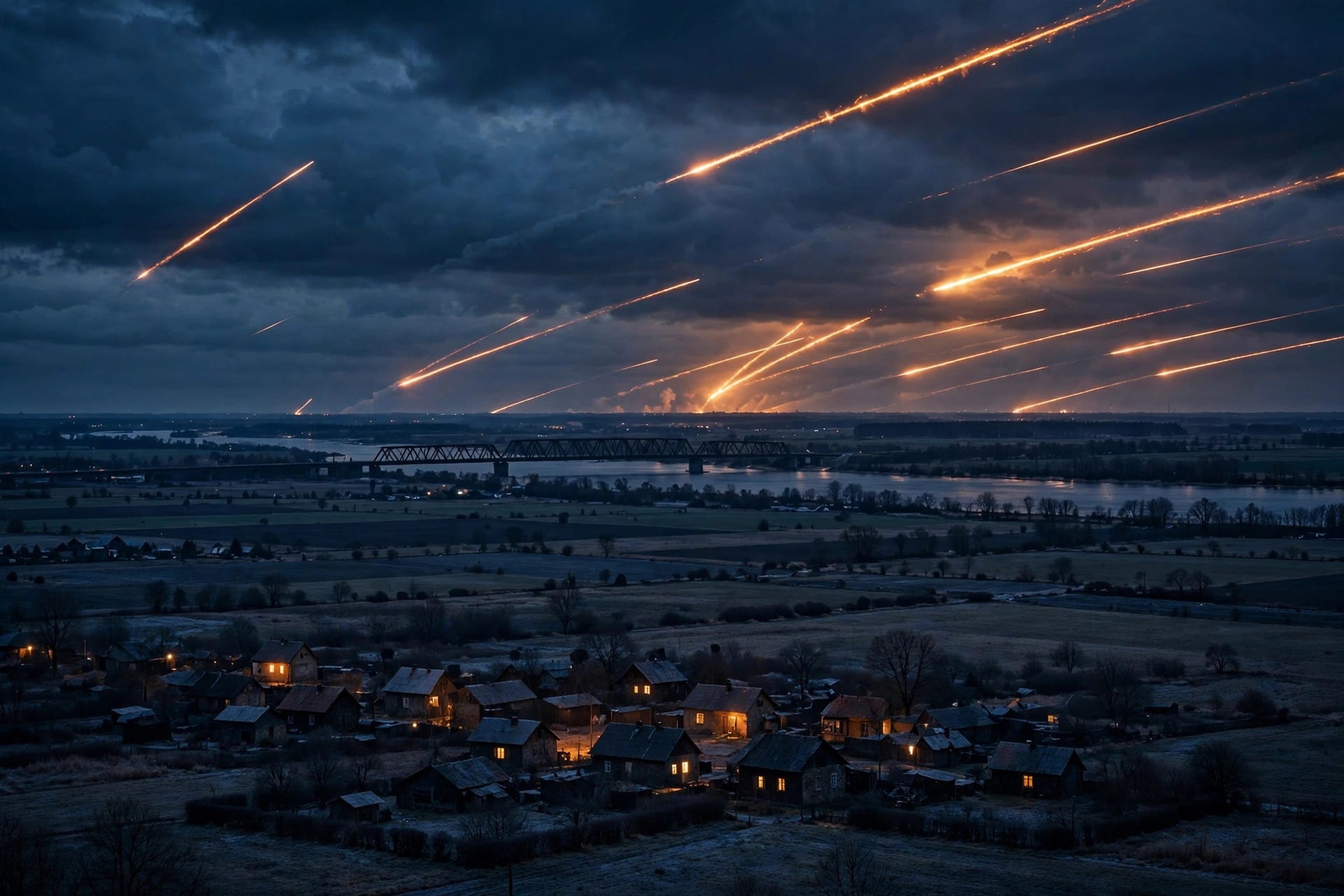
The Night the Sky Filled
The night of 19–20 November 2026 did not begin with a single explosion, and it did not end with one either. According to the Ukrainian Air Force on 20 November, what came towards Ukraine overnight was a combined package of 404 drones and 111 missiles, a total of 515 aerial targets launched against a single country in a single night. The Institute for the Study of War, reporting on 20 November, recorded the same composition that the Ukrainian Air Force described, and that scale is the essential fact from which everything else that night followed. It was, in the terms used to describe the attack, Russia's biggest barrage, and its size was not incidental to its effect. A barrage of this size does not simply test a defence at one place and at one moment. It stretches attention, crews, interceptors and rescue services across hours and across an entire country at once, and it forces every decision that follows to be made under continuing pressure rather than after a clean pause in which the damage can be counted.
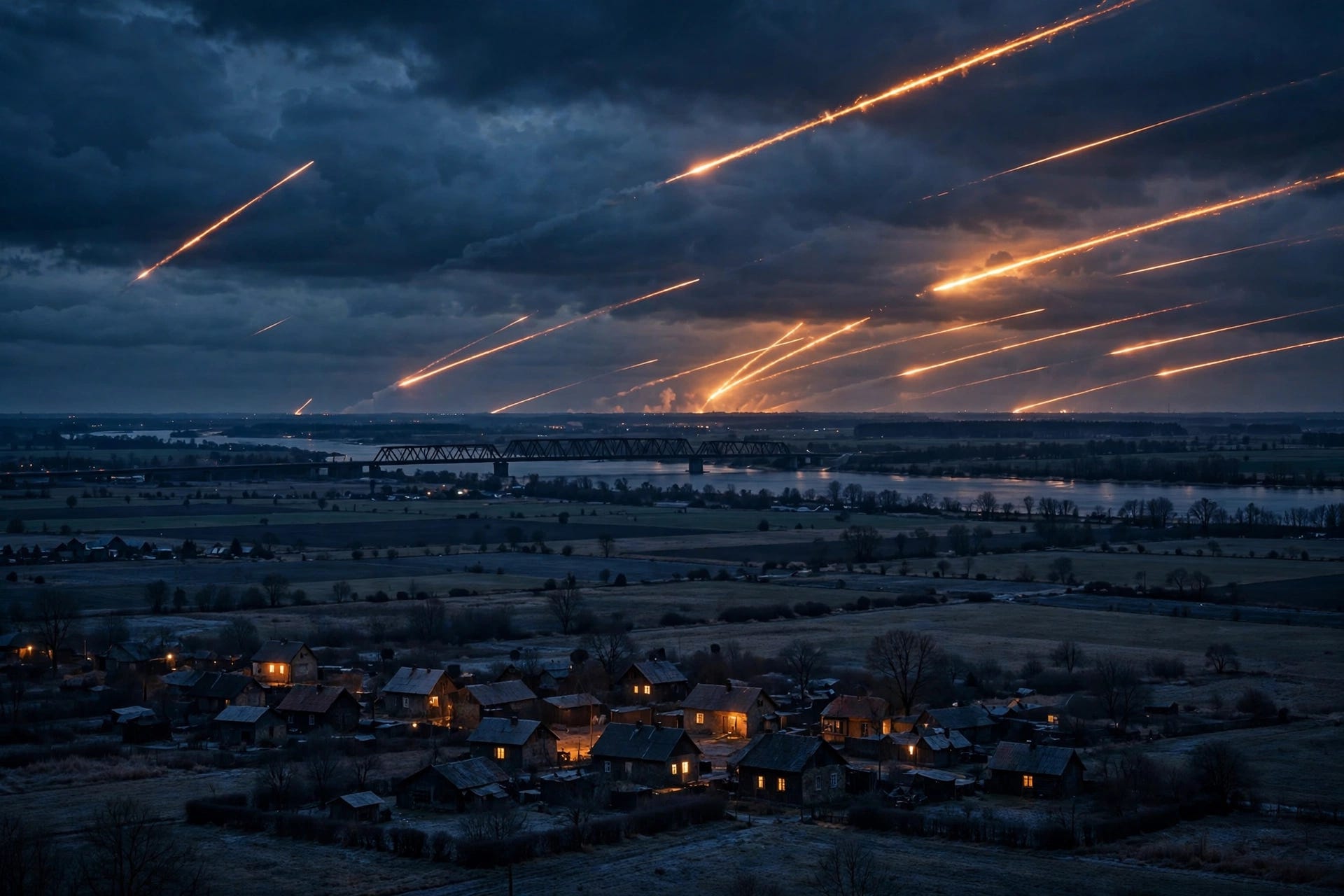
There is also the wider geography to hold in mind from the outset, because the barrage of 19–20 November was not contained, in its consequences, within Ukraine's borders. Two missiles and a drone came down in Poland. Poland is a member of NATO, and the fact that objects from this barrage came down on Polish territory is what lifted the night from a terrible, if by now grimly familiar, mass strike on Ukraine into an incident with a direct alliance dimension. Prime Minister Donald Tusk called it an intentional provocation. That characterisation, by the prime minister of the country on whose soil the missiles and drone came down, frames the second half of this story, which concerns Poland, NATO and the political response. Part of the significance of the night, however, lies in refusing to let that diplomatic escalation eclipse what happened first and most lethally inside Ukraine. Before the barrage became an incident on NATO soil, it was a mass attack on Ukrainian cities, infrastructure and civilians, and the toll recorded on 20 November belongs at the centre of the account.
The sequence, as established by the dated reporting, is therefore this. Overnight on 19–20 November, Russia launched 404 drones and 111 missiles at Ukraine, according to the Ukrainian Air Force on 20 November. The package included, in the breakdown given by the Ukrainian Air Force and reported by ISW on 20 November, 27 ballistic missiles, 84 cruise missiles and 404 Shahed and Gerbera drones. Ukrainian defences intercepted 462 targets in total, according to the Air Force, comprising 380 drones and 79 cruise missiles. None of the 27 ballistic missiles was intercepted, a failure Zelensky attributed to a lack of interceptors. Strikes were recorded at 23 locations. Eight people were killed, six of them in Kyiv and two at a railway station in Lviv, and about 28 people were wounded. In Kyiv, the Podilsko-Voskresensky, Darnytskyi and Southern bridges over the Dnipro were damaged, and fires broke out in three districts. Cluster warheads were used. The Austrian embassy in Kyiv was damaged and there was impact near the Netherlands embassy. Nuclear power plants in Ukraine reduced output after damage to the electricity grid. And beyond the border, two missiles and a drone came down in Poland.
A Package Built in Three Layers
According to the Ukrainian Air Force on 20 November, the 111 missiles in the overnight package comprised 27 ballistic missiles and 84 cruise missiles. Added to those were 404 drones, identified by the Air Force and in ISW's reporting on 20 November as Shahed and Gerbera types. The arithmetic is stark, and it is worth stating plainly because it governs everything that followed. Missiles accounted for 111 of the 515 targets. Drones accounted for 404. In other words, the great majority of what Ukraine's defenders had to detect, track, classify and engage that night arrived not as a missile but as a drone, while the most difficult category to stop, as the interception figures would show, was the smallest category of all: the 27 ballistic missiles.
That three-layer composition is not a technical footnote. It is the design of the problem. Drones, cruise missiles and ballistic missiles present different challenges in speed, trajectory, warning time and the kind of defensive system that can engage them, and a package that combines all three in these numbers forces a defender to solve all of those problems simultaneously rather than in sequence. A defence that is occupied in large numbers by drones is not thereby relieved of the cruise missiles travelling in the same overall attack. A defence that reserves its most capable interceptors for ballistic threats cannot know, at the moment of decision, how many more ballistic missiles may still be to come. The numbers reported on 20 November describe exactly that dilemma in concrete form: 404 drones to absorb attention and effort, 84 cruise missiles as the largest missile component, and 27 ballistic missiles for which, by the end of the night, no interception was recorded at all.
The Ukrainian Air Force figures for interceptions, reported on 20 November, make the contrast explicit. Of the 404 drones launched, 380 were intercepted. Of the 84 cruise missiles launched, 79 were intercepted. Those are, on their face, high interception numbers for those two categories, and they account for the Air Force total of 462 targets intercepted when other interceptions in its accounting are included in the total it gave. Set against them is the figure of zero for ballistic missiles: none of the 27 ballistic missiles was intercepted, according to the Air Force reporting and Zelensky's account of the night. To hold those three results together is to see the barrage accurately. It was not a case of a defence that simply failed across the board. Nor was it a case of a defence that held and rendered the attack ineffective, since strikes were recorded at 23 locations and eight people were killed. It was a case of a layered attack finding the layer where the defence, on this night and for the reason Zelensky gave, had no answer available in sufficient number.
Zelensky attributed the failure to intercept the ballistic missiles to a lack of interceptors. That attribution, reported on 20 November, is a specific and consequential claim, and it should be kept in its exact form. He did not, in the reporting relied on here, present the zero as a mystery, or as a failure of detection, or as a matter of crews being unwilling to engage. He attributed it to a lack of interceptors, that is, to the physical availability of the means to attempt the interception. The distinction matters for what follows politically and militarily. A shortage is a question of supply, stock, production and allocation over time. It can be counted, argued about and, at least in principle, remedied by deliveries and decisions taken elsewhere. It also means that the outcome on a given night may reflect decisions and constraints accumulated over months, brought to a point in the minutes when a ballistic missile is in flight and there is either an interceptor available to meet it or there is not.
Waves Timed Against the Rescuers
Zelensky said the strikes came in waves at intervals of 20 to 30 minutes, and that this pattern complicated rescue work. That short reported statement carries a great deal of the night's moral and practical character, and it deserves to be examined without embellishment. Rescue work, in any city under attack, follows a logic of its own. After an impact, the priorities are to reach the site, to establish whether people are trapped or injured, to control fire, to make a damaged structure safe enough to enter, and to move the wounded to treatment. Every one of those tasks requires people to concentrate at a known location, often in the open, often with vehicles, lights and equipment that make the site visible and busy. It is, by necessity, the opposite of dispersal and shelter. Rescuers must go towards the place that has just been hit, at the moment when everyone else is being told to stay away from it.
An interval of 20 to 30 minutes between waves, as Zelensky described the pattern on 20 November, cuts directly across that logic. Twenty minutes after an impact, a rescue is rarely finished. It is usually at its most committed. Firefighters will have laid out their approach to a fire. Medics will have begun triage. Residents who know a building will be trying to tell crews who was inside. Heavy equipment, if it is needed and if it can reach the site, will only just be arriving or being positioned. To introduce another wave at that point is not merely to add another impact somewhere else on a map. It is to force every crew already committed to decide, under time pressure measured in seconds, whether to continue a rescue that may be minutes from reaching someone, or to break off and seek cover and risk losing the very progress that brought them there. Zelensky's statement that the pattern complicated rescue work is, in that light, a precise description rather than a rhetorical flourish. Complication, here, means that the work of saving life was made slower, more dangerous and more discontinuous by the rhythm of the attack itself.
Kyiv: Three Bridges and Three Districts Burning
In Kyiv, according to the reporting of 20 November, the Podilsko-Voskresensky, Darnytskyi and Southern bridges over the Dnipro were damaged, and fires broke out in three districts of the capital. Six of the eight people killed across Ukraine that night were killed in Kyiv, which establishes the capital as the deadliest single place in the barrage as its toll was reported on 20 November. Those few reported facts, bridges, districts, deaths, carry a weight that needs unpacking, because a bridge in Kyiv is not an incidental piece of infrastructure and a fire in a capital district is not an isolated incident when it occurs in three districts at once during a continuing attack.
The Dnipro divides Kyiv. It is the great river that runs through the capital, and the bridges across it are the connective tissue of the city's daily life, carrying the movement between its banks on which work, supply, medical care and family life all depend. To report damage to three named bridges, the Podilsko-Voskresensky, the Darnytskyi and the Southern, is therefore to report damage to the city's capacity to function as a single city rather than as two halves separated by water. This account does not have, in the reporting relied on for 20 November, a bridge-by-bridge assessment of how severe the damage to each structure was, whether each remained passable, or how long any repair would take, and it will not invent such assessments. What can be said on the record is that three crossings were damaged in one night, in the same barrage that started fires in three districts and killed six people in the capital. Even without a structural engineer's verdict, the simultaneity is the point. A city can usually absorb a single damaged crossing by diverting movement to others. Damage reported across three crossings at once narrows those alternatives at precisely the moment when emergency movement, evacuation, fire appliances and ambulances may be most needed, and when the attack, arriving in waves, has not yet declared itself finished.
Kyiv's night also has to be placed within the national total of strikes at 23 locations. The capital was the deadliest place in the reported toll, and the damage to its bridges and districts was among the most consequential reported, but it was not the only place hit. To write only about Kyiv would be to misrepresent a barrage that, by design and by recorded result, spread its effects across Ukraine. The railway station deaths in Lviv are the clearest reported reminder of that spread, since Lviv lies far to the west of the capital. A reader who holds both facts together, six killed in Kyiv and two killed at a station in Lviv, begins to see the geographic logic of a 515-target package: no single city's defence, however concentrated, could account for the whole night, and no single city's suffering, however severe, exhausts its toll. The next section therefore takes the toll as a whole, as it was reported on 20 November, and considers what each number in it does and does not establish.
The Toll: Eight Dead, Twenty-Eight Wounded, Twenty-Three Locations
Eight people were killed, according to the reporting of 20 November: six in Kyiv and two at a railway station in Lviv. About 28 people were wounded. Strikes were recorded at 23 locations. Those three figures, deaths, wounded and locations, are the core human and geographic accounting for the night of 19–20 November, and each deserves separate attention, because they measure different things and because the gaps in what they can tell us are as important as what they establish.
Eight deaths is a figure that can be read too quickly, especially set against a launch total of 515 targets. It would be a grave misreading to treat the relationship between those two numbers as a measure of the attack's seriousness, as if a barrage that launched 515 weapons and killed eight people were therefore a limited event. The interception figures explain part of the relationship: 462 targets were intercepted, according to the Ukrainian Air Force on 20 November, and without that defensive effort the toll at the 23 locations struck, and at other locations that might have been struck, cannot responsibly be estimated and will not be estimated here. The wounded figure points in the other direction: about 28 people wounded means about 28 people whose injuries required the medical system on a night when that system, like every other emergency system, was working under repeated waves. Behind the wounded figure, which is given as approximate in the reporting, lie triage decisions, hospital admissions and the kind of injuries that blast, fire, debris and collapsing material inflict in dense urban places. The record relied on here does not name the dead or the wounded, does not give their ages or their circumstances beyond the places where the deaths were reported, and this account will not supply names or circumstances that were not reported. The restraint is deliberate. In a magazine account built on dated attribution, the dead are honoured by accuracy about what is known, not by invented biography.
The two deaths at a railway station in Lviv deserve particular attention within the total, because of what a railway station is in wartime Ukraine and because of where Lviv sits. A station is a place of transit and concentration: passengers waiting, passengers arriving, staff, people meeting trains, people seeking the relative safety of movement from one place to another. It is also, in a country at war, a piece of civilian infrastructure on which ordinary life depends for journeys that cannot simply be postponed indefinitely, work, family, medical care, displacement and return. The reporting of 20 November establishes that two people were killed at a railway station in Lviv in this barrage. It does not, in the material relied on here, establish the time of that strike within the night, the type of weapon involved, or the extent of damage to the station itself, and none of those details will be invented. What the fact establishes on its own is significant enough: a barrage whose largest reported death toll was in the capital also killed at a transport hub in the far west, demonstrating in human terms the geographic spread that the figure of 23 locations expresses in geographic terms.
Cluster Warheads and the Area They Leave Behind
Cluster warheads were used in the barrage of 19–20 November, according to the reporting of the attack. The fact is stated briefly in the record, without, in the material relied on here, a location-by-location attribution of which strikes involved cluster warheads and which did not, and this account will preserve that brevity of attribution while explaining why the fact itself matters so much to the character of the night and to the work that follows it. A cluster warhead does not deliver its effect at a single point. It disperses submunitions over an area. That single mechanical difference transforms both the danger at the moment of impact and the danger that persists after it, and it transforms them for exactly the people, rescuers, residents returning to a street, utility crews approaching damaged infrastructure, whom the timing of the waves already placed under strain.
At the moment of impact, an area effect widens the zone in which a person can be killed or wounded beyond the immediate point where a single warhead would have struck. For the toll accounting, that matters as context: the deaths and wounds reported on 20 November, six killed in Kyiv, two in Lviv and about 28 wounded nationally, occurred in a barrage in which cluster warheads formed part of the reported weaponry, even though the record relied on here does not assign particular casualties to particular warhead types and this account will not do so either. At the level of the city, an area effect also widens the zone that must be treated as dangerous after the strike. A single impact crater can be cordoned. A dispersed pattern requires a search, and a search requires time, specialist judgement and a perimeter that may extend across streets and properties whose occupants need to be warned or moved. In a night of waves at 20 to 30 minute intervals, as Zelensky described, the time for that search was precisely what the rhythm of the attack denied in uninterrupted form.
What Was Stopped, and What Was Not
According to the Ukrainian Air Force on 20 November, 462 targets were intercepted in total during the overnight barrage. Within that accounting, 380 of the 404 drones launched were intercepted, and 79 of the 84 cruise missiles launched were intercepted. None of the 27 ballistic missiles launched was intercepted. Zelensky attributed that last result to a lack of interceptors. Those four sentences contain the defensive story of the night, and they repay the closest reading of any figures in this account, because they simultaneously record a substantial defensive achievement and a complete failure in one category, and because the political and military argument that will follow this barrage will turn, in large part, on how those two halves of the same record are weighed.
Begin with the drones. An interception total of 380 from 404 launched means that the drone component, which made up more than three quarters of the entire package by number, was very largely stopped. That outcome, on a night when drones arrived as part of a combined package rather than in isolation, represents an enormous volume of detection, tracking and engagement carried out while cruise and ballistic missiles were also in the air. It should not be minimised. Had the drone interception rate been substantially lower, the number of locations struck would not have been 23 as reported, and the toll of eight killed and about 28 wounded, terrible as it is, would have been exposed to a far larger number of arriving weapons. The drone figures are therefore evidence, on the Air Force's own accounting, of a defence that at this layer worked at scale under the most demanding numerical conditions it was presented with that night.
The cruise missile figures point in the same direction, with the same need for precision. Seventy-nine intercepted from 84 launched leaves five not intercepted in that category, on the figures given on 20 November. Cruise missiles formed the larger part of the missile package, 84 of 111, and stopping 79 of them is, like the drone result, a substantial defensive outcome. Set the two categories together and a clear pattern emerges: in the two categories that made up 488 of the 515 targets launched, drones and cruise missiles combined, Ukrainian defences intercepted 459 weapons on the Air Force figures for those categories, contributing the great bulk of the 462 total interceptions the Air Force reported. A reader who saw only the headline that strikes reached 23 locations might imagine a defence overwhelmed in every dimension. The category figures correct that impression. The defence was not overwhelmed in every dimension. It was, in two dimensions, highly effective by number, and in the third dimension, the ballistic dimension, it recorded no interception at all.
That third dimension is where the night's defensive story turns. Twenty-seven ballistic missiles were launched, according to the Ukrainian Air Force and ISW's reporting on 20 November, and none was intercepted. Zero is a different kind of figure from a low figure. A low figure, three intercepted from 27, say, would invite analysis of performance, positioning and chance. A figure of none, explained by the president of the country as the result of a lack of interceptors, invites a different analysis altogether, one centred on availability. Zelensky's attribution, reported on 20 November, was to a lack of interceptors. In the logic of that explanation, the question is not whether a system, when present and supplied, can engage a ballistic missile. The question is whether, at the places and moments where 27 ballistic missiles arrived in a single night, the interceptors to attempt those engagements existed in sufficient number at all. A shortage explanation also spreads the responsibility for the zero across a longer timescale than the night itself. Interceptors are produced, procured, delivered, allocated and husbanded over months and years, by decisions in Ukraine and in the countries that supply it. A night on which none of 27 ballistic missiles is intercepted for lack of interceptors is therefore also a report on that longer history, compressed into a single figure.
The interception record also frames the question that allies and suppliers will have to answer after 20 November, without this account prejudging that answer. If the limiting factor on the night, for the ballistic category, was the number of interceptors available, as Zelensky said, then the relevant debate is about supply: how many interceptors exist, where they are positioned, how quickly stocks can be replenished after a night in which other categories alone required hundreds of engagements, and how a defender is to prioritise when a single barrage presents 515 targets at once. That debate will be conducted with figures, promises and delivery schedules that belong to the days after the barrage, and they will be reported, with dates and attribution, in the later parts of this magazine's coverage. What the night itself establishes is the need that gives the debate its urgency. A defence that can stop 380 drones and 79 cruise missiles in one night has demonstrated capacity at scale. A defence that, in the same night, stops none of 27 ballistic missiles for lack of interceptors has identified, in the starkest numerical form available, the gap through which the next barrage of this kind would also pass.
Embassies in the Blast Radius
The Austrian embassy in Kyiv was damaged in the overnight barrage, and there was impact near the Netherlands embassy in Kyiv, according to the reporting of 20 November. Those two reported facts, one of damage and one of proximity, are distinct and should be kept distinct, as the reporting keeps them. The Austrian embassy was damaged. Near the Netherlands embassy, there was impact. Neither formulation will be expanded here into an assessment of severity that the reporting relied on does not provide, and no detail of rooms, windows, staff or injuries at either mission is given in that reporting or will be invented in this account. Even in that restrained form, however, the embassy facts carry a significance that reaches well beyond the two buildings concerned, and they tell a reader something important about the urban character of the night's strikes in the capital.
Embassies sit in cities, not apart from them. In Kyiv, as in any capital, diplomatic missions are embedded in districts that also contain residences, offices, shops and the ordinary movement of a city's population. Damage to an embassy in a barrage is therefore rarely only a diplomatic fact. It is also evidence of the force reaching a part of the city where civilians live and work, and where the protections that international practice affords to diplomatic premises depend, in the end, on the physical restraint of those who direct weapons at the city around them. When the Austrian embassy is damaged and an impact occurs near the Netherlands embassy in the same night in which six people are killed in Kyiv, fires burn in three districts and three bridges over the Dnipro are damaged, the embassy facts should be read as part of that citywide picture rather than as an exotic addition to it. They show the spread of effects across the capital's functions in a single night: residential and commercial districts burning, transport connections damaged, and the diplomatic presence of two European states damaged or directly threatened by proximity.
Power, the Grid and the Nuclear Plants That Turned Down Their Output
Nuclear power plants in Ukraine reduced output after damage to the electricity grid in the overnight barrage, according to the reporting of 20 November. The sentence is short in the record, and the record relied on here does not name the plants concerned, quantify the reduction at each plant, or specify which elements of the grid were damaged to produce the effect, and none of those specifics will be invented. The significance of the fact, however, is large, and it can be explained from the relationship it states: an attack that damaged the grid caused nuclear plants to reduce output. That relationship reveals, in a single reported consequence, how a barrage aimed across a country transmits its effects through a network into facilities that may themselves be far from any impact site.
The grid consequence also lengthens the timescale of the emergency in the same way that cluster warheads do, though by a different mechanism. A fire can be extinguished. A rescue, however interrupted, reaches a point of completion. Grid repair and the restoration of full nuclear output operate on the timescale of assessment, specialist crews, replacement equipment and careful reconnection, and they do so in a country where the same specialists and the same equipment pools are demanded at many of the 23 locations struck. The morning of 20 November therefore opened not one recovery operation but several kinds at once: rescue and firefighting at impact sites, structural assessment at three damaged bridges in Kyiv, damage assessment at the Austrian embassy and near the Netherlands embassy, casualty care for about 28 wounded, and grid assessment sufficient to determine when nuclear plants that had reduced output could safely and practically restore it. Each operation has its own professionals and its own clock. The barrage's achievement, if that bleak word can be used of an attacker's design, was to start all of those clocks at the same time, in the same night, under the same shortage of uninterrupted time.
The Human Night in Kyiv
To write about the human night in Kyiv on 19–20 November responsibly is to accept a discipline that this entire account has observed: to write only from reported detail, and to refuse the invented scene, the invented name and the invented quotation, however vivid they might make the page. The reported detail is, in fact, sufficient to convey the night's human character, provided it is assembled with care and its implications are drawn honestly rather than theatrically. The elements are these. Kyiv was struck as part of a barrage of 404 drones and 111 missiles, according to the Ukrainian Air Force on 20 November. Waves arrived at intervals of 20 to 30 minutes and complicated rescue work, according to Zelensky. Fires broke out in three districts of the capital. The Podilsko-Voskresensky, Darnytskyi and Southern bridges over the Dnipro were damaged. The Austrian embassy was damaged and there was impact near the Netherlands embassy. Six people were killed in Kyiv, the largest share of the national total of eight, and the national wounded total was about 28. Shelters were where the city's residents waited through this, and rescue proceeded, under repeat waves, at the places where the strikes fell.
A shelter in such a night is best understood not as a backdrop but as a decision repeated many times. The first decision is to go, which means leaving a home whose ordinary protections, walls, windows, a familiar bed, have been reclassified by the alarm as insufficient. The second decision, repeated at every interval of quiet, is to stay, which on a night of waves separated by 20 to 30 minutes means resisting the reasonable human inference that a long silence must signify an ending. The third decision, when fires are burning in three districts and damage is being done across the city, is how to care for the people in the shelter with you: children who need sleep and reassurance in proportions that may conflict, older people for whom the move to shelter is itself a physical ordeal and for whom a second move, if the shelter must change, is a serious undertaking, neighbours whose anxiety takes the form of constant checking of information and neighbours whose anxiety takes the form of silence. None of these figures is a reported individual from the night of 19–20 November, and none is presented as one. They are the general human contents of any Kyiv shelter in any mass barrage, described in general terms precisely so that no invented person is placed inside a real night. What is specific to this night, and reported, is the scale that filled the shelters and the rhythm that governed how long the waiting lasted and how little any interval of quiet could be trusted.
Rescue under repeat waves is the other half of the human night, and it belongs not to the shelter but to the street, the burning district and the damaged building. Zelensky's statement that the wave pattern complicated rescue work is the reported foundation, and from it the human picture can be drawn without invention. A rescuer's work is sequential and cumulative: arrive, assess, commit, progress, reach, extract, hand over to medical care, return for the next task. An interruption does not merely pause that sequence. It can undo its gains, if a position made safe must be abandoned, if a fire partly controlled gains ground while crews are under cover, if a search partly completed must be restarted because the state of a structure may have changed in a further impact. To work under that condition, wave after wave, in a city where three districts are burning and where the total national picture includes 23 locations struck, is to expend not only physical effort but the mental effort of beginning again without complaint in front of the people who are waiting for help. The reporting of 20 November does not name individual rescuers or quote their words, and this account will not do so either. It records, instead, the condition under which their work was done, as the country's president described it, and leaves the record there, where it is strong enough to stand without decoration.
There is also the morning to consider, even though this part of the account ends before any conclusion about the barrage's aftermath can be drawn. On the morning of 20 November, Kyiv woke, insofar as a city that has spent a night in shelters can be said to wake, to a changed physical geography: three bridges over its river damaged, three districts marked by fire, an embassy damaged and another's neighbourhood struck, six of its people dead, and a grid whose damage had caused nuclear plants elsewhere in the country to reduce output. The routines with which a capital attempts to resume ordinary life, movement across the river, the opening of workplaces and schools, the journeys that pass through stations like the one in Lviv where two people were killed, all had to be remade on that morning around damage that was still being assessed. Across the border in Poland, meanwhile, the discovery that two missiles and a drone had come down on Polish soil was setting in motion the political sequence that Prime Minister Tusk's words, intentional provocation, had already begun to frame. The barrage had ended. The night in the shelters had ended. What the barrage had started, in Kyiv, in Lviv, at 23 locations, in the grid, and now on NATO soil, had not.
What Came Down in Poland
The barrage that struck Ukraine on the night of 19 to 20 November 2026 did not end at the Ukrainian border. By the morning of 20 November, Polish authorities were dealing with a separate and, in its own way, more politically charged problem on Polish soil. Two Russian missiles and a drone had come down inside Poland, according to the account set out by Polish officials and allied assessments of the incident. No one in Poland was killed or injured, and no critical damage was done. Those two facts, repeated by Polish officials as the day unfolded, matter enormously to everything that followed. They shaped the military decisions taken while the objects were still in the air, the language used by Prime Minister Donald Tusk afterwards, the response offered by NATO Secretary General Mark Rutte, and the careful distinction Poland drew between requesting additional allied support and formally invoking Article 4 of the NATO treaty.
Precision matters here, because incidents of this kind are easily blurred in the first hours. Three objects, three locations, and three separate investigations were involved. The first was a Kh-101 cruise missile that came down near Nowy Lipowiec, a rural location roughly 50 kilometres from the Ukrainian border. It came down at about 06:30 local time, in a rural field. The second was a second suspected Kh-101 that came down near Rudnik nad Sanem. The third was different in kind: a jet-powered drone, possibly a Geran-5, that came down near Mołodycz, roughly 30 kilometres from the border. Each description carries its own qualifier, and the qualifiers should be kept. The Nowy Lipowiec object was identified as a Kh-101 cruise missile. The Rudnik nad Sanem object was described as a second suspected Kh-101. The Mołodycz object was described as a jet-powered drone, possibly a Geran-5. In a story where intent is disputed and evidence is central, the difference between an identification, a suspicion and a possibility is not pedantry. It is the story.
The geography also matters. Nowy Lipowiec and Mołodycz are both measured, in the official accounts, by their distance from the Ukrainian border, about 50 kilometres in the first case and about 30 kilometres in the second. These were not objects that fell in a border village within sight of Ukraine, nor were they objects that crossed the whole of Poland. They came down in the east of the country, in the region that has lived closest to the war since its beginning, and they came down far enough inside Polish territory to make the question of how they got there, and why, unavoidable. A missile that strays a few hundred metres across a frontier during a vast salvo raises one set of questions. A missile found in a field 50 kilometres inside a NATO member state raises another. Polish officials did not treat the distances as incidental detail, and nor did their allies.
Eleven Objects Near the Border
The three objects that came down were not the whole of what Polish forces saw that night. The Polish Armed Forces reported that 11 objects were tracked near the border during the incident. That figure, attributed to the Polish Armed Forces, reframes the scale of what happened. Public attention naturally settles on the three impact sites, because they are physical, visitable and investigable. Debris can be photographed, fields can be cordoned, and a missile in a field is a fact that can be shown. The figure of 11 tracked objects describes something less visible but, for the air defenders who lived through the night, more demanding: a border environment in which multiple objects required attention at once, each one needing to be followed, assessed and placed in a picture that was changing by the minute.
Tracking is not the same as intercepting, and the distinction sits at the heart of the Polish account. To track an object is to know, or to work towards knowing, where it is and where it is going. To intercept it is to make a separate decision, with separate risks, about destroying it in the air. The Polish Armed Forces figure tells the reader that the night was not a case of a single stray weapon slipping across an unwatched frontier unnoticed. Polish sensors were watching the border region. Polish commanders had a picture, imperfect as any wartime picture must be, of objects moving near and across that border. The decisions that followed, including the decision not to fire, were taken by a military that was tracking what was happening, not by one that was caught entirely unaware.
That point matters for the debate about intent as well. If 11 objects were tracked near the border, then the three that came down inside Poland formed part of a wider pattern of activity in the border region that night, generated by the barrage against Ukraine. It does not, by itself, prove either explanation. A deliberate provocation could be mounted under cover of a large salvo, precisely because a large salvo provides noise in which a smaller number of directed objects might be hidden. Equally, a large salvo pressed up against a border, in a contested electronic environment, could produce multiple tracks near that border without any of them having been aimed at Poland. The figure of 11, on its own, settles neither argument. What it does settle is the question of vigilance. Poland was watching.
Fighters Scrambled and Patriots Activated
Poland's military response, while the incident was still unfolding, was substantial and it was allied. Polish F-16s were scrambled. Swedish Gripens were scrambled alongside them. Patriot batteries near Rzeszów and near Świdnik were activated. Each element of that sentence deserves attention, because together they describe an air defence posture that was switched on, layered and multinational, even though no interception of the three objects that fell was carried out.
The scramble of Polish F-16s is the most familiar element. Fighters are the flexible instrument of air policing and air defence: they can be launched quickly, directed towards a track, repositioned as the picture changes, and held ready to act if an order is given. Their presence in the air during the night signalled that Poland was not relying on ground sensors alone. It had aircraft up, under command, in a position to respond. The scramble of Swedish Gripens alongside them carries a different and equally important meaning. Sweden's aircraft were part of the allied presence supporting Polish air defence, and their launch demonstrated that the response to a violation of Polish airspace was not a purely national affair conducted by Polish jets alone. An incursion into the airspace of one ally drew aircraft from another ally into the sky on the same night, on the same mission. That is the alliance working as it is designed to work, at the level of cockpits and runways rather than communiqués.
The activation of Patriot batteries near Rzeszów and near Świdnik adds the ground-based layer. Patriot is a surface-to-air missile system, and the decision to activate batteries at two locations in the east of the country placed a ground-based defensive capability on alert alongside the fighters in the air. Rzeszów's significance in the geography of Western support for Ukraine is widely understood, but the point to hold to in this account is the narrower, sourced one: batteries near Rzeszów and near Świdnik were activated during the incident. Two locations, not one, suggests coverage arranged across the threatened region rather than a single point defence. Combined with the tracked picture reported by the Polish Armed Forces and the fighters scrambled by two nations, the picture is of a defensive system that was awake at every level: sensors tracking, aircraft airborne, and ground batteries ready.
Why Poland Did Not Shoot Them Down
Of all the questions asked in Poland on 20 November, this was the sharpest: if fighters were scrambled and Patriot batteries were activated, why were the incoming objects allowed to fall? The answer given by the Polish government rests on risk, and it was set out in two connected forms. Defence Minister Władysław Kosiniak-Kamysz offered the government's explanation publicly. The Institute for the Study of War, in its assessment dated 20 November, recorded the underlying Polish assessment: that interception posed an unacceptable risk of casualties and damage, and that the projected impacts were harmless.
Those two elements belong together. An interception is not a clean erasure of a threat from the sky. A missile or drone destroyed in the air does not vanish. Its debris falls somewhere, its fuel and any explosive content come down with it, and the act of interception itself, whether by a fighter's weapon or a surface-to-air missile, introduces new objects and new energy into the airspace above whatever happens to lie below. Over open sea or empty desert, that calculation is comparatively simple. Over populated land, in the dark, with tracks whose projected impact points can be estimated, the calculation changes. If the assessment is that an object will fall harmlessly in a rural field, as the Nowy Lipowiec missile in fact did at about 06:30 local time, then shooting it down over or near a community may create the very casualties and damage that allowing it to fall would avoid. That, in substance, is the Polish assessment as the Institute for the Study of War recorded it on 20 November: interception posed an unacceptable risk of casualties and damage, and the projected impacts were harmless.
Kosiniak-Kamysz's explanation, as the responsible minister, gave that assessment the authority of the government. The distinction between a ministerial explanation and an outside assessment matters. The Institute for the Study of War is an analytical body describing the Polish assessment. The Defence Minister is the Polish government accounting for its own decision. Together they present a consistent picture: the decision was Polish, it was based on a projection of where the objects would fall, and it weighed the risk of firing against the risk of not firing and found firing to be the more dangerous course on that night, over that ground, against those tracks.
Three Sites, Three Investigations
Investigations were opened at the three sites where objects came down: near Nowy Lipowiec, near Rudnik nad Sanem and near Mołodycz. That simple statement carries more weight than it might appear to at first reading. In the politics of an incident like this, evidence is not a technical afterthought. It is the ground on which every other claim stands or falls. Tusk's judgement that the incident was an intentional provocation, and that its timing did not look like an accident, is an assessment. Rutte's description of grave violations of Polish airspace is an allied political judgement. The Russian state media response, that Poland had offered no evidence, is a direct challenge to the evidential basis of both. The investigations at the three sites are where that challenge will be met or fail to be met.
What an investigation at a missile impact site can establish, handled properly, begins with identity. Is the object what it is reported to be? At Nowy Lipowiec, the object was identified as a Kh-101 cruise missile. At Rudnik nad Sanem, the object was a second suspected Kh-101, and the word suspected signals work still to be done or caution still to be exercised before a firmer identification is offered. At Mołodycz, the object was a jet-powered drone, possibly a Geran-5, and again the qualifier marks the distance between an initial assessment and a settled finding. The investigations are the mechanism by which a suspected identification becomes a confirmed one, or is corrected. In a dispute where one side is already saying that no evidence has been offered, that progression, from suspicion to confirmation, documented and attributable, is not bureaucratic delay. It is the difference between an assertion and a case.
An investigation can also address origin and trajectory, insofar as the physical remains and the tracked record allow. Poland has both halves of that picture in principle: debris at three sites, and a tracked record that includes the 11 objects the Polish Armed Forces reported near the border. Put together carefully, physical evidence and tracking data are far more persuasive than either alone. Debris without a track can be disputed as to how it arrived. A track without debris can be disputed as to what it was. Three sites give investigators something else as well: a pattern, or the absence of one. Three objects, at three locations, at differing distances from the border, invite comparison. Were they alike in condition and configuration, or different? Did their impact points cluster in a way that suggests anything about their paths? The answers, when the investigations produce them, will either strengthen or complicate the Polish assessment. That is precisely why the investigations matter, and why premature certainty, in either direction, should be resisted until they report.
The Exercise Thirty-Five Kilometres Away
No fact in the Polish account does more work, in the argument about intent, than the exercise that was already under way in the region when the missiles and the drone came down. Exercise Koalicja, the name itself being the Polish word for coalition, is an exercise of the Coalition of the Willing at Nowa Dęba. It began on 9 November. It was planned to run for two weeks. It involved about 3,000 troops from 11 nations. It was led by the United Kingdom and France. And its purpose was to rehearse a possible postwar mission in Ukraine. The closest of the three impacts was about 35 kilometres away.
Take each element in turn, because each one sharpens the picture. The start date, 9 November, establishes that the exercise was not a reaction to the incident of 19 to 20 November. It predated the barrage by eleven days. The troops were already there, the exercise was already running, and its rhythms were already established when the salvo was launched. The duration, two weeks, establishes that the exercise was a substantial undertaking, not a passing visit: a fortnight of multinational activity at Nowa Dęba, in the same broad region of eastern Poland where the objects fell. The scale, about 3,000 troops, establishes mass. Three thousand soldiers is a large body of personnel to have concentrated in one exercise area, and their presence means that the region contained, that night, not only Polish forces and Polish civilians but thousands of allied service members from across the coalition. The breadth, 11 nations, establishes how widely that presence was shared. This was not a bilateral Polish and American affair. Eleven nations had troops in the exercise, which means eleven governments had a direct, human stake in the safety of the area around Nowa Dęba on the night their soldiers were there.
The leadership of the exercise, by the United Kingdom and France, places two of Europe's principal military powers at the head of the undertaking. And the purpose, rehearsing a possible postwar mission in Ukraine, gives the exercise its political charge. A postwar mission in Ukraine is, by definition, a mission concerned with the security settlement that would follow the war. To rehearse it is to practise, in concrete military terms, for a future in which allied troops might be present in Ukraine itself in a postwar role. Such a rehearsal, conducted in Poland within reach of the Ukrainian border, is a statement about allied intent for that future. It is exactly the kind of activity that an opponent of such a mission would wish to discourage, and exactly the kind of activity whose participants would be most sensitive to weapons falling nearby while they practised.
"Intentional Provocation": The Tusk Judgement
Prime Minister Donald Tusk's response gave the incident its defining political frame. He called it an "intentional provocation". He said the timing "does not look like an accident". And he made clear that this was not a solitary Polish judgement offered in the heat of the morning: his assessment, he said, was shared by NATO partners, including NATO Secretary General Mark Rutte.
Each part of that intervention was calibrated. "Intentional provocation" is a phrase that asserts intent while stopping short of describing the incident as an attack on Poland. The distinction is important, and it runs through the whole Polish and allied response. A provocation is a deliberate act designed to test, to intimidate, to signal or to elicit a reaction. It is serious, it is culpable, and it demands an answer. But it is framed as something less than a direct assault, and framing it that way preserves room for the answer to be political, military and reinforcing rather than escalatory in kind. Tusk, in choosing the word provocation, simultaneously accused Moscow of deliberateness and kept Poland's response on the terrain Warsaw actually chose: investigations, allied solidarity, and a request for additional forces and air defence under Operation Eastern Sentry, rather than a formal invocation of Article 4 or anything beyond it. The word and the policy match each other. That is not accidental either.
The remark about timing did the evidential work in public. Tusk did not, in the statements recorded here, lay out a detailed public dossier. He pointed to timing, and invited his audience to draw the inference that he and, he said, his NATO partners had drawn. The timing in question has several layers. There was the timing within the night: objects coming down during a huge barrage on Ukraine, reaching as far as a field about 50 kilometres inside Poland. There was the timing within the month: a barrage whose debris fell about 35 kilometres from a major coalition exercise that had begun on 9 November. And there was the timing within the politics of the war: an exercise rehearsing a possible postwar mission in Ukraine, led by Britain and France, with 11 nations taking part. Tusk's sentence compresses all of that into a single observation, that it does not look like an accident. As rhetoric, it is economical. As an argument, it asks to be tested against the alternative explanation, and a serious account must test it rather than merely repeat it.
Rutte, Solidarity and a Saturday in Warsaw
Mark Rutte's part in the response was the alliance's part, performed by its Secretary General. He called the incidents "grave violations of Polish airspace". He expressed solidarity with Poland. His assessment, according to Tusk, was shared with Warsaw's: the Polish prime minister specifically named Rutte among the NATO partners who shared his judgement that this was an intentional provocation whose timing did not look like an accident. And Rutte was due in Warsaw on Saturday 21 November, the day after the allied statements, to stand in the Polish capital in person.
The phrase "grave violations of Polish airspace" repays attention. It is plural, violations, matching the plurality of the incident: two missiles and a drone, three sites, 11 objects tracked near the border. It is legal and sovereign in its emphasis: the violation is of Polish airspace, which is to say of the territory and jurisdiction of a NATO member state. And it is graded, grave, a word chosen to place the incidents at the serious end of the scale without placing them in the category of an armed attack. Like Tusk's "intentional provocation", Rutte's formulation asserts the worst about intent and responsibility that the evidence publicly offered would bear, while keeping the alliance's response in the register of reinforcement and consultation. The two men, the Polish prime minister and the NATO Secretary General, were singing from the same sheet, and Tusk said as much when he named Rutte among those who shared his assessment.
Solidarity, in alliance politics, is a word that can mean everything or nothing. On 20 November it acquired specific content. It meant, first, public alignment on the assessment itself, offered on the same day rather than after a cautious interval. It meant, second, the Secretary General's physical presence, with Rutte due in Warsaw on Saturday 21 November. A visit arranged at that speed is a signal in its own right: the alliance's political head does not fly to a capital the day after an incident to deliver a neutral observation. His presence in Warsaw would put him alongside Polish leaders, in front of cameras, in the country whose airspace had been violated, while the investigations at the three sites were still in their earliest stages. It meant, third, a practical military conversation, because Poland had requested additional NATO forces and air defence, and requests of that kind move through the alliance machinery that Rutte heads politically and that the Supreme Allied Commander Europe executes militarily.
The Request: More Forces, AWACS and F-35s Under Eastern Sentry
Poland's practical response to the night of 19 to 20 November was a request. Poland requested additional NATO forces and air defence. More specifically, it sought AWACS and F-35 support under Operation Eastern Sentry. A request is not a deployment, and the record of 20 November, as given here, is of a request made rather than of forces arrived. But the content of the request tells the reader a great deal about how Poland diagnosed its own needs in the light of the incident, and about where it believed the gaps, or the opportunities for reinforcement, lay.
Consider first the request for additional NATO forces in general terms. Poland already hosts allied forces, as the Swedish Gripens scrambled during the incident and the roughly 3,000 troops from 11 nations at Exercise Koalicja both demonstrate. A request for more, made on the day three Russian weapons came down on Polish soil, is therefore a request to thicken an existing presence, not to create one from nothing. Its logic is partly military and partly political. Militarily, more forces in the east of the country mean more sensors, more aircraft, more batteries and shorter response times across a border region that, on the evidence of that night, could be presented with 11 tracked objects at once. Politically, more allied forces mean more flags on Polish soil, and every additional flag raises the cost to any adversary of a repetition. A provocation that draws more of the alliance into Poland has, from the provocateur's point of view, backfired. That is the outcome Warsaw's request was designed to produce.
The specific requests sharpen the diagnosis. AWACS aircraft are airborne early warning and control platforms: flying radar and command posts whose value lies in seeing further, tracking more, and coordinating the aircraft and batteries below them. A state that tracked 11 objects near its border during a 500-weapon salvo, and that expects to face the problem again, has obvious reasons to want more of that airborne picture and more of that coordinating capacity over its eastern regions. The request for AWACS support under Operation Eastern Sentry is, in effect, Poland saying that the first requirement is to see everything, earlier and more completely, so that the decisions of the next night, including any decision about whether to fire, are taken on the fullest possible picture.
In Close Contact: The Supreme Allied Commander
General Alexus Grynkewich, the Supreme Allied Commander Europe, was in close contact with Polish defence chiefs during the response to the incident. That fact was conveyed to CBS News by spokesperson Martin O'Donnell, whose statement to the American broadcaster placed the contact on the public record. It is a short item of information, but it opens a window onto the level at which the alliance was actually working on 20 November.
The Supreme Allied Commander Europe, known by the acronym SACEUR, is NATO's senior military commander in Europe. Political solidarity is the Secretary General's province. Military coordination, the movement and readiness of forces, the state of air defence, the practical meaning of a request for AWACS and F-35 support under Operation Eastern Sentry, belongs to the military chain of command that SACEUR heads. For Grynkewich to be in close contact with Polish defence chiefs on the day of the incident means that the conversation between Warsaw and the alliance was not confined to prime ministers and secretaries general exchanging public statements. It was running, simultaneously, at the level of the officers who would actually have to organise any reinforcement and manage any repetition.
What Poland Did Not Do: Article 4
Precision about Article 4 is essential, because it is the point on which reporting of incidents of this kind most often misleads. Poland did not formally invoke Article 4. That is the fact, and it should be stated without embroidery in either direction. Poland did not treat the incident as beneath notice: it scrambled fighters, activated Patriot batteries, opened investigations at three sites, secured the Secretary General's condemnation and his visit, and requested additional NATO forces and air defence. But it did not take the formal treaty step of invoking Article 4, and conflating the response Poland did make with an invocation it did not make would misdescribe the diplomacy of 20 November.
Article 4 is the clause under which a member state may bring a threat to its security before the alliance for consultation. Its invocation is a formal act with a recognisable meaning: the invoking state declares, in the treaty's own machinery, that the matter requires the allies to consult together. Because it is formal, it is also a signal, and signals of that kind are spent carefully. A state that invokes Article 4 over an incident in which nobody was hurt and no critical damage was done, however grave the violation of its airspace, must consider what it will do when an incident occurs in which people are hurt. A state that never invokes it, whatever falls on its soil, teaches the opposite lesson. Poland's position on 20 November sat deliberately between those poles. Warsaw obtained much of what consultation is meant to produce, allied alignment on the assessment, the Secretary General's presence, military contact at SACEUR level and a hearing for its request for reinforcement, without formally triggering the clause. In practical terms, the allies consulted. In formal terms, Article 4 was not invoked. Both halves of that sentence are true, and any account that drops either half distorts the record.
The Other Explanation: A Salvo, Jamming and a Missed Turning
A serious account must now do the hardest work in this story, which is to present the alternative explanation fairly, in its strongest form, while being clear that it remains unproven either way. That alternative runs as follows. The objects that came down in Poland were not directed at Poland at all. They were part of, or strayed from, a salvo of about 500 weapons launched against Ukraine on the night of 19 to 20 November. In the course of that salvo, amid Ukrainian jamming of the kind used to disrupt the guidance of incoming weapons, one or more of those weapons suffered a navigation failure and came down, by mischance, on Polish territory. On this reading, the fields at Nowy Lipowiec, Rudnik nad Sanem and Mołodycz received not a message but a malfunction.
The strengths of this explanation should be acknowledged without flinching. Scale is the first. A salvo described as comprising 500 weapons is an enormous number of objects in the air over a single night, many of them, given the targets of the barrage, in the west of Ukraine near the Polish border. The Polish Armed Forces themselves tracked 11 objects near the border. In an environment that crowded, the prior probability that something would go astray is not negligible, and any assessment of intent has to reckon with it honestly. Jamming is the second strength. Electronic interference with navigation is a standard feature of this war's air defence, practised precisely in order to make incoming weapons miss. A weapon that has been successfully jammed has, by design, been deprived of reliable knowledge of where it is. Where it then comes down is a matter of its last heading, its remaining flight and chance. A rural field 30 or 50 kilometres across a border is a possible terminus for such a weapon, and the fact that the impacts were in fields, causing no casualties and no critical damage, is at least as consistent with blind malfunction as it is with a designed provocation that happened to fall harmlessly.
The third strength is the absence, in the public record available on 20 November, of the kind of evidence that would settle intent. The identifications themselves carry qualifiers: one Kh-101 identified near Nowy Lipowiec, a second suspected Kh-101 near Rudnik nad Sanem, a jet-powered drone possibly a Geran-5 near Mołodycz. Investigations at the three sites had been opened, not concluded. No public dossier had been laid out demonstrating a deliberate Polish destination for any of the three objects. Tusk's case, as publicly stated, rested on timing and on an assessment shared with partners, an assessment that may rest on allied intelligence the public cannot inspect. A sceptical reader is entitled to note that "does not look like an accident" is an inference, and that inferences from timing have been wrong before, in many crises, in many countries.
Moscow's Silence and the Question of Evidence
Russia, as of the reporting of 20 November, had not commented on the incident. Russian state media, for their part, said that Poland had offered no evidence. The two halves of that sentence describe different things, and the difference is characteristic of how such incidents are contested. An official silence is not a denial, and a media line is not an official statement. Keeping them separate is essential to describing Moscow's position accurately: the Russian state, through its government, had offered no comment that features in this record, while Russian state media advanced the argument that the Polish case was unevidenced.
The state media argument deserves to be taken at face value and answered on its merits, because it identifies the genuine soft point in the public presentation of 20 November. Poland's public case, as set out by Tusk, was an assessment about intent and timing, endorsed by allies. The physical identifications were, in two of the three cases, qualified as suspected or possible. The investigations had been opened that day and could not yet have reported. A critic determined to say "no evidence" could therefore point to a real gap between the confidence of the political language and the completeness of the public forensic record on the day itself. That gap is the terrain on which the information contest over the incident will be fought, and Poland's investigations, and whatever it chooses to publish from them, are the means by which Warsaw can close it.
What the Night Changed
By the evening of 20 November, less than a day after the barrage began, the incident had acquired a complete political shape, even though its forensic story had barely begun. Three objects had come down in Poland: a Kh-101 cruise missile in a rural field near Nowy Lipowiec at about 06:30 local time, some 50 kilometres from the Ukrainian border; a second suspected Kh-101 near Rudnik nad Sanem; and a jet-powered drone, possibly a Geran-5, near Mołodycz, some 30 kilometres from the border. Nobody in Poland had been hurt and no critical damage had been done. The Polish Armed Forces had tracked 11 objects near the border. Polish F-16s and Swedish Gripens had scrambled, and Patriot batteries near Rzeszów and Świdnik had been activated. Poland had not shot the objects down, and its Defence Minister, Władysław Kosiniak-Kamysz, had explained why, on the basis of the assessment recorded by the Institute for the Study of War on 20 November: interception posed an unacceptable risk of casualties and damage, and the projected impacts were harmless. Investigations had been opened at all three sites.
Around those facts, the judgements had arranged themselves. In the same region, Exercise Koalicja was under way at Nowa Dęba, begun on 9 November, running for two weeks, bringing together about 3,000 troops from 11 nations under British and French leadership to rehearse a possible postwar mission in Ukraine, with the closest impact about 35 kilometres away. Tusk had called the incident an intentional provocation, said its timing did not look like an accident, and said that assessment was shared by NATO partners including Rutte. Rutte had called the incursions grave violations of Polish airspace, had expressed solidarity, and was due in Warsaw on Saturday 21 November. Poland had requested additional NATO forces and air defence, including AWACS and F-35 support under Operation Eastern Sentry. Poland had not formally invoked Article 4. General Alexus Grynkewich, the Supreme Allied Commander Europe, had been in close contact with Polish defence chiefs, as his spokesperson Martin O'Donnell told CBS News. The alternative explanation, navigation failure under Ukrainian jamming in the course of a 500-weapon salvo, had been placed on the scale and weighed, unproven either way. Russia had not commented, and Russian state media had said Poland offered no evidence.
That sequence of next steps is worth holding in mind, because it shows where authority over the story passes next. The investigators at Nowy Lipowiec, Rudnik nad Sanem and Mołodycz hold the physical record, and their work will determine whether the qualifiers in the first accounts, suspected in one case and possible in another, can be removed. Rutte, due in Warsaw on Saturday 21 November, holds the alliance's political response, and what he says alongside Polish leaders will show whether the solidarity expressed on 20 November hardens into the additional forces and air defence Poland requested. General Grynkewich's close contact with Polish defence chiefs, as Martin O'Donnell told CBS News, holds the military thread between those two. Until those three threads produce something new, the fairest summary remains the Polish one, attributed as such: no casualties, no critical damage, three investigations opened, and an assessment of intentional provocation that NATO partners, including Rutte, were said to share, set against an alternative explanation that remains, on the public record, unproven either way.
The Week That Led Here
No barrage arrives out of nowhere, and the barrage that fell on Ukraine on the night of 19 to 20 November 2026 did not arrive out of nowhere either. To understand why so many missiles and drones were in the air that night, why some of them came down in Poland, and why the political argument that followed was so sharp and so divided, it is necessary to step back by only a few days. That week was compressed, violent and diplomatically strange in equal measure. It contained a major Ukrainian strike on one of the most symbolically charged pieces of infrastructure in the entire war, a second strike on the same target two days later, the first face-to-face meeting in history between the leaders of the United States, China and Russia, and then, within hours of that meeting, a Russian president ruling out the direct talks with Kyiv that many observers had assumed such a summit might encourage. The barrage sat at the end of that sequence. Reporting on the night and on the days that followed has consistently placed it, in part, as Russia's answer to what Ukraine had done to the Kerch Bridge.
That framing needs to be handled carefully. To describe the barrage, in part, as an answer is not to claim that every missile launched that night was launched for that reason alone, nor that Russian planning began only after the bridge was hit. Large salvos require preparation, allocation of weapons, selection of targets and co-ordination across services. They are not improvised in an afternoon. What the retaliation framing captures is the logic of timing and scale: after a conspicuous Ukrainian success against a target Moscow treats as both strategic and symbolic, Moscow chose a conspicuous demonstration of its own, directed at Ukraine and felt, whether by design or by consequence, beyond Ukraine's borders as well.
A Span in the Water: The Night of 17 November
On the night of 17 November 2026, according to reporting on the strike, a 745-foot span of the Kerch Bridge collapsed into the Kerch Strait after a Ukrainian strike. The figure deserves attention. Seven hundred and forty-five feet is not a crack in a parapet or a scorch mark on a carriageway. It is a length of bridge measured in hundreds of feet, gone from the structure and in the water. A collapsed span is a different category of damage from a damaged span. Surfaces can be patched while traffic limps past under restrictions. A collapsed span breaks the connection itself. Until it is replaced or bypassed, every vehicle or train that would have crossed there must go another way, wait, or not travel at all.
The strike, as reported, was not the work of a single weapon type. Reporting attributed it to a combination of Flamingo, Neptune and Ruta missiles and drones. That combination is part of the story, even without speculating beyond what was reported about any individual system. A mixed strike poses a different problem for defenders from a strike by one kind of weapon alone. Defences must detect, track and engage dissimilar threats, and timing can be arranged so that attention drawn in one direction leaves less available in another. Saturation, confusion and weight of numbers all become factors. None of that requires inventing technical detail reporting has not supplied. It follows from the basic fact, as reported, that missiles of three named types and drones were used together against a single significant target on a single night, and that the result was not superficial damage but the loss of a span into the strait.
The Kerch Bridge is not an ordinary bridge. It links Russia to Crimea across the Kerch Strait, by road and by rail. As a practical matter, it is a supply route: vehicles, fuel, ammunition and matériel can move across it in ways that are harder, slower or more exposed by other routes. As a political matter, it is a statement built in concrete and steel, embodying a claim of permanent connection. To strike it is therefore to do two things at once, to interfere with movement and to challenge the statement. Ukraine has understood that dual character throughout the war, and Russia has understood it too, which is why the bridge has been defended, repaired and celebrated, and why each successful attack on it has carried a weight far beyond the immediate engineering damage.
For Kyiv, a strike of that kind demonstrates reach: the ability to plan a complex operation, to bring several weapon types to bear together, and to damage a target the other side has every reason to protect. For Moscow, the same event demonstrates vulnerability at the place where vulnerability is most embarrassing. Neither reading requires exaggeration. The reported facts are sufficient: on the night of 17 November, after a Ukrainian strike using Flamingo, Neptune and Ruta missiles and drones, a 745-foot span of the Kerch Bridge lay in the Kerch Strait. What happened next made the point harder to dismiss as a single night's misfortune. The bridge was hit again.
The Railway Section, 19 November
On 19 November 2026, according to reporting, the railway section of the Kerch Bridge was hit. The date matters, because 19 November was not a quiet day on which a second strike could be treated as an isolated follow-up. It was the day of the Shenzhen summit, and the day immediately before the night of the barrage. War and diplomacy were not running on separate tracks that week. They were running into each other, hour by hour.
The railway section matters for reasons distinct from the road. Railways move weight. In a war sustained over years, the ability to move heavy loads reliably, in volume, on a timetable, is part of the machinery by which a front is fed and held. Rail carries bulk with an efficiency roads struggle to match, and military logistics has always prized that efficiency. To hit the railway section two days after a span had collapsed was therefore to press the logistical argument as well as the symbolic one. Read in sequence, the two strikes formed a campaign in miniature against a single strategic connection: first the collapse of a span on the night of 17 November, then damage to the railway section on 19 November.
A single strike can be described by the side that suffers it as an outrage, a fluke or an act of desperation. A second strike, on the same target, within roughly forty-eight hours, is harder to describe in any of those ways. It suggests persistence. It suggests that the first strike did not exhaust the attacker's intent or capacity, and that the defender's efforts to protect or restore the target in the interval did not prevent a further blow. It also raises the stakes of response. If Moscow had answered the first strike with restraint, the second would have made that restraint look, to domestic and military audiences alike, like passivity. If Moscow had already decided to answer at scale, the second strike gave that answer additional justification in its own telling and additional urgency in its timing.
None of this made the barrage inevitable in its precise form. States retain choices even when pressure to retaliate is intense, and scale, targets and timing remain decisions, not reflexes. But by the evening of 19 November the elements of a retaliatory logic were all in place and visible: a symbolically central bridge with a span in the water since the night of 17 November, a railway section hit that day, and a Ukrainian campaign against that bridge that could be portrayed in Moscow as ongoing rather than finished.
Retaliation in a war of this kind is also more than revenge. A barrage on the scale reported for 19 to 20 November sends messages in several directions at once. To Ukraine, it says that successes will be met with suffering, and that air defences will be tested again and again. To Ukraine's supporters, it says that supporting Kyiv does not insulate anyone from the war's wider effects, a message made literal that night when Russian weapons came down in Poland. To a domestic Russian audience, it says that a humiliation at the Kerch Bridge has not been left unanswered. To military planners on all sides, it provides information about salvo size, routes, defences, repair and, above all, about how governments react in the first hours when weapons cross a border they were not supposed to cross. That last kind of information is where the events in Poland acquire their full significance. Whether every weapon that entered Polish airspace or fell on Polish territory did so deliberately is precisely the question that divided the leaders whose voices dominate the rest of this account. But even before that question is answered, the crossings changed the situation. A barrage aimed only at Ukraine remains a chapter in the war between Russia and Ukraine. A barrage some of whose weapons fall in a member state of the North Atlantic Treaty Organization becomes, in addition, a test of that alliance: of its language, its procedures, its unity and its nerve.
By the time the barrage began, another event of that crowded week had already complicated every one of those questions. On the same day the railway section was hit, the presidents of the United States and Russia and the leader of China had sat down together in the same room for the first time.
Shenzhen: Three Leaders, One Room, and a Missing Paragraph
On 19 November 2026, in Shenzhen, President Donald Trump of the United States, President Xi Jinping of China and President Vladimir Putin of Russia met face to face, together, for the first time. Reporting on the summit has been clear on that point of precedence: this was the first-ever face-to-face meeting of the three leaders together. Bilateral meetings among them were familiar. A trilateral encounter of this kind was new.
Firsts of that sort are never merely procedural. Who meets whom, and in what combination, is itself a statement about the structure of the world. A meeting of the American, Chinese and Russian leaders together evokes an older idea of great-power management: that the largest questions of war and peace are settled by the largest powers among themselves. For Ukraine, that idea has always carried a specific danger, namely that its future might be discussed over its head. For smaller allies of the United States, it carries a parallel anxiety: that commitments made to them might be weighed, in a room they are not in, against interests they do not control. None of that proves anything about what was agreed in Shenzhen. But it explains why the summit was watched so intently, and why small details, a greeting, a missing paragraph, a remark afterwards, were seized upon.
The greeting became one of those details. According to reporting, President Trump greeted President Putin as "my friend". A greeting is not a treaty or a guarantee, and should not be treated as a policy in itself. But it set the tone against which the text, and what happened next, were measured.
After the summit, according to reporting, President Putin ruled out direct talks with Kyiv. The sequence deserves to be stated plainly. On 19 November 2026 the three leaders met. After that meeting, the Russian president ruled out direct talks with the Ukrainian government. Whatever hopes had been attached to the trilateral format, that statement closed the most obvious door. Direct talks are not the only form diplomacy can take, but a war is ultimately ended, if it is ended by negotiation, between the parties fighting it or on terms those parties accept, and a public ruling out of direct talks is a deliberate narrowing of the near-term possibilities. It is also a form of leverage: to refuse talks after a summit with the American and Chinese leaders is to present that refusal not as isolation, but as the decision of a government just photographed at the top table of world politics. For Kyiv, the implication ran the other way. If direct talks are ruled out, Ukrainian diplomacy must work through others, above all through Washington, and must worry constantly about the terms on which Washington chooses to press or not to press.
Diplomatic documents are read as much for their absences as for their contents, and the declaration that followed the summit was read that way at once. Per reporting on the declaration, the paragraph on Ukraine was missing. A document emerging from a meeting of the American, Chinese and Russian leaders, held in the middle of a major European war, on the day the railway section of the Kerch Bridge was hit and on the eve of a major barrage, contained, per that reporting, no paragraph on Ukraine. Such an absence can arise because the parties cannot agree on language, because one party insists on omission as the price of a document, or because they prefer private channels to public formulas. Reporting established the absence itself; it did not settle the internal bargaining that produced it, and this account does not invent that bargaining. But the political effect does not wait for its explanation. For Ukraine and its supporters, a missing paragraph reads as a demotion. For critics of the format, it confirmed the fear that great-power theatre can step around the war's central party. The barrage then gave those readings a violent footnote. A war that had not rated a paragraph in Shenzhen on 19 November was, by the following morning, the subject of emergency argument in Warsaw, Brussels and Washington, because its weapons had fallen in Poland.
Three Voices, Not One
In the aftermath of the barrage of 19 to 20 November 2026, and of the Russian missiles and a drone that came down in Poland during it, the alliance did not speak with one voice. Reporting captured three distinct characterisations of the same events, and the differences were not of emphasis. They were differences about intention, and intention is the ground on which deterrence either holds or dissolves.
President Trump, according to reporting, played the Poland impacts down, describing them as a few small or tiny missiles sent by mistake. Each element pulls towards minimisation. Few limits the scale. Small, or tiny, limits the significance of the weapons. By mistake removes intention. Taken together, the reported formulation presents the episode as an accident of war, not a deliberate act against Poland or the alliance, and signals that Washington's instinct, in its first public framing, was to lower the temperature rather than raise the stakes.
Prime Minister Donald Tusk of Poland, according to reporting, called the impacts a deliberate provocation. That inverts the American formulation at every point. A provocation is not an accident. It is an act performed to elicit a reaction, to test a response, or to demonstrate contempt for a boundary, and it need not be large to be serious, because its seriousness lies in what the provocateur believes he can do without consequence. Poland is the state on whose territory the weapons fell, and its prime minister speaks with the authority of the host of the incident and the vulnerability of the front-line state that must live with whatever precedent the response establishes. When Warsaw says deliberate, it is warning its allies that treating the event as accidental will itself be read, in Moscow and in Poland, as information about the alliance's thresholds.
Secretary General Mark Rutte, according to reporting, condemned the events as grave violations. Grave measures seriousness. Violations identifies a breach of airspace and sovereignty. Condemnation is a formal act of disapproval. What that reported formulation does not do is settle intention in either direction, nor announce a specific collective measure. It is the language of a secretary general holding a position that governments divided between mistake and provocation could still stand behind together. In an alliance of many members, a common sentence is an achievement. But its limits are visible precisely because the other two voices were also on the record. The institutional voice condemned. The most powerful member minimised. The most exposed member accused. A reader in Moscow would not need to invent disunity. He would only need to quote it.
President Volodymyr Zelensky of Ukraine, according to reporting, responded in a frame of his own. Russia, he said, was compensating for its "military and diplomatic impotence" with terror. The sentence, as reported, denies Russia the dignity of strength: the barrage, in this framing, is not confident power but compensation for what Russia cannot achieve by military success or diplomatic persuasion, and its method is named plainly as terror. To Ukrainians, that framing says suffering from the air is evidence of the enemy's failure, not theirs. To supporters abroad, it says the answer to terror as compensation is reinforcement, not accommodation, since accommodation would reward it. To the undecided, it poses a choice between the vocabulary of accident, used in Washington about Poland, and the vocabulary of terror, used in Kyiv about Ukraine.
Reporting also carried a more delicate remark attributed to President Zelensky. He was reported to have remarked that President Trump's understanding of Article 5 differs from the rest of NATO. That remark is handled here exactly as reported: as a reported remark, attributed to President Zelensky, about a difference of understanding. It is not presented as a verified account of President Trump's private views, nor as an agreed alliance position. Its significance lies in its being said, or reported as said, at all. Article 5 is the clause on which the alliance's credibility rests. For the president of a non-member country whose survival depends heavily on members' support to suggest publicly that the American president understands that clause differently from the rest of the alliance is to touch its most sensitive nerve. It may have been candour under pressure, since the gap was visible to anyone comparing the statements. It may have been strategy, since naming a gap can press to close it. The reporting available does not settle motive, and this account does not choose. What it completed was a picture in which the central questions were no longer only where weapons had fallen, but what the guarantee means, who gets to say what it means, and whether those who rely on it believe it is understood the same way in every capital that has promised it.
Things Have Fallen on Poland Before
The argument over the missiles and the drone that came down in Poland on the night of 19 to 20 November 2026 did not begin from a blank page. Poland has been here before, in different forms, with different weapons and different explanations. Each previous incident taught lessons, and each, cumulatively, narrowed the space in which plausible deniability can operate. A government can ask for the benefit of the doubt once with the full credit of novelty behind the request. The second and third and fourth times, that credit has been spent down by what happened before.
In November 2022, a missile fell at Przewodów in Poland, and two Polish civilians died. In the first hours, the fear in allied capitals was that a Russian missile had struck a member state and killed its citizens. The investigation that followed established a different truth. The missile proved to be Ukrainian air defence. That finding, as established after the event, changed the incident's legal and political character entirely. Poland had suffered a lethal consequence of the war on its territory, but the weapon was not a Russian weapon fired at Poland. It was a Ukrainian defensive weapon, in a war in which Ukrainian air defence was engaging Russian attack.
Przewodów matters for three reasons. The first is grief and memory: two Polish civilians died because a war next door reached across the border, and no Polish government can set that aside. The second is procedural. It taught the alliance the value, and the cost, of waiting for investigation before pronouncing on origin and intention, since the early fear and the established finding were different. The third cuts the other way. Przewodów established that not every weapon falling in Poland is a Russian weapon aimed at Poland, and precisely because that was true in November 2022, the temptation later was to reach for the same explanation as a default. But a finding correct once does not remain correct as a presumption forever. As later incidents accumulated, the Przewodów explanation became less available as a general shelter, even as its lesson about careful investigation remained valid. Holding both truths at once, investigate carefully but do not presume accident, is the discipline the history imposes.
In September 2025, according to reporting, came a drone incursion into Poland. Drones change the character of a violation. A missile in flight is a matter of minutes, an event with a beginning and an end close together. An incursion by drones can be slower, more sustained and more ambiguous, and that ambiguity is itself useful to whoever sends them. Drones can probe and observe reactions. They can force defenders to reveal procedures and thresholds: how quickly aircraft are scrambled, which systems engage, what is shot down and what is allowed to fall, and how governments communicate while the event is unfolding. Even a drone that crashes harmlessly can return value in information about the defender. A drone incursion is also harder to file as the tragic by-product of a defensive battle near a border. Drones entering allied airspace in an organised way invite questions about tasking and intent that a single air-defence missile, fired in the chaos of repelling an attack, does not.
On 30 July 2026, according to reporting, a Kh-101 came down in Poland. The specificity matters. A named type of missile is not an anonymous fragment or an unidentified radar track. It is a particular weapon, associated with a particular user and a particular kind of operation, and its reported presence on Polish territory on a stated date resists the softening language of stray objects and unexplained debris. Whatever the circumstances of its arrival, and this account adds none that reporting has not supplied, it stands as a documented case of a Russian missile type ending its journey in a member state, months before November 2026. Considered alone, it could be managed as a single incident. Considered in sequence, it shows that November 2026 was not unprecedented in kind. The question was not whether such a thing could happen. It had happened. The question was what it meant that it kept happening, and whether earlier responses had altered the calculation that produced the later ones.
Together the record contained, in sequence, a lethal accident of Ukrainian air defence in November 2022, a drone incursion in September 2025, and an identified Russian missile type on Polish soil on 30 July 2026. Each incident was different. Together they formed a pattern, and patterns are the enemy of the claim that nothing in particular is going on. Plausible deniability behaves, across a sequence, like a depleting resource. The first time a weapon falls across a border, a wide range of explanations is genuinely available, and Przewodów showed the most alarming is not always the true one. The second time, the range narrows, because the sender has been put on notice that its operations produce cross-border effects and can be expected to have adjusted if it wished to avoid them. The third and fourth times, repetition itself becomes evidence: not conclusive evidence of intention in any single case, but evidence that the risk is known, foreseeable and, if uncorrected, at some point accepted.
That is how this history frames the dispute after 19 to 20 November 2026. A reported American description of a few small or tiny missiles sent by mistake asks the alliance to spend deniability credit the sequence since 2022 has substantially depleted. Accident remains a physical possibility in any single case, and investigation, not rhetoric, establishes the facts of a specific fall of shot. But as a public framing, it asks listeners to treat the latest incident as if the earlier ones had not occurred. Prime Minister Tusk's reported description of deliberate provocation refuses that reset, and reads the night through the sequence. Secretary General Rutte's reported condemnation of grave violations sits on the ground the sequence makes safest for the institution: whatever the intention, a record of repeated violations has accumulated. For Poland, moreover, these are not case studies. They are events on home territory, involving Polish investigators, soldiers and airmen and the communities where wreckage falls, and, in November 2022, Polish dead. A front-line state that repeatedly absorbs the physical spillover of a war it did not start, while being counselled to absorb the political spillover quietly as well, will eventually ask what its membership is for. That question leads directly to the treaty text.
What Articles 4 and 5 Actually Say, and What They Do Not Do
Public argument about NATO is conducted largely in slogans, and the slogans about Article 5 compress a carefully drafted legal text into a promise of automatic war. The text does not promise automatic war. It never has.
Article 4 is the consultation article. In its terms, the parties will consult together whenever, in the opinion of any of them, the territorial integrity, political independence or security of any of them is threatened. The trigger is an opinion: a member does not have to prove an attack to invoke consultation, only to hold and express the opinion that it is threatened. The obligation created is to consult, seriously and collectively. Article 4 does not itself commit any ally to any particular measure beyond that. It is therefore weaker than its invokers sometimes hope, because consultation can end in disagreement, and stronger than its dismissers allow, because it formalises a right front-line states value intensely: to place a threat on the alliance's common table and require it to be addressed as a common concern.
Article 5 is the collective defence article. It provides that an armed attack against one or more of the parties in Europe or North America shall be considered an attack against them all, and that, if such an armed attack occurs, each of them, in exercise of the right of individual or collective self-defence recognised by the Charter of the United Nations, will assist the party or parties so attacked by taking forthwith, individually and in concert with the other parties, such action as it deems necessary, including the use of armed force, to restore and maintain the security of the North Atlantic area.
Almost every phrase does deliberate work. An attack on one is considered an attack on all: that principle is real, and deterrence by alliance rests on it. But the response is not specified as a single, uniform act. Each ally will assist, and the action each takes is, in the text's own words, such action as it deems necessary. That clause is not a loophole discovered later by reluctant governments. It is the considered language of a treaty ratified by democracies whose constitutions reserve decisions of war and peace to their own institutions. No member hands its war power to a council in Brussels. Each retains judgement over the form its assistance takes, up to and including armed force, which the text names as a possibility within that judgement rather than as a compulsion imposed regardless of it.
Article 5 therefore does not declare war automatically, does not require every ally to fire the same weapons at the same targets on the same timetable, and does not remove politics from the response. It organises politics, by creating an obligation of assistance whose precise content each government must determine and defend at home. Nor does it apply itself. The alliance must first reach the collective judgement that an armed attack has occurred. Incidents below that threshold, violations, incursions, accidents and provocations, however grave, live in the territory of Article 4 consultation, national response, diplomacy and deterrence signalling, unless allied governments collectively decide otherwise. None of this makes Article 5 weak. Its strength lies in combining an unambiguous principle with a flexible obligation that governments of different sizes and politics can actually sustain. Adversaries are deterred by the knowledge that an attack engages all the allies, that each will act as it deems necessary, and that the sum of those freely chosen actions may be far worse for the attacker than any single prescribed response.
But flexibility has a shadow, and it fell across November 2026. If each ally judges for itself, the guarantee's meaning in a crisis depends on the judgements actually formed in the capitals that matter most. A divergence in how it is understood, between Washington and the rest of the alliance, is therefore not a technical quibble, which is why the reported remark attributed to President Zelensky carried the charge it did. On the reporting available, no allied government treated the falls in Poland on 19 to 20 November as the occasion for an Article 5 determination. The argument was about the territory below that threshold: how to characterise violations, whether to consult and with what urgency, and what it costs the alliance if even lesser collective provisions go unused when violations accumulate. That last question is where the most consequential analytical intervention after the barrage was made, dated 20 November 2026, by the Institute for the Study of War.
On 20 November 2026, according to its published assessment of that date, the Institute for the Study of War assessed that the violations associated with the barrage were deliberate, and that they were timed to the exercise. Timing is not a decorative detail. An exercise is a known, scheduled concentration of activity in which forces are deployed and procedures are run. To time violations to such a period is, on the institute's assessment, to choose a moment when members are both maximally active and maximally observable, when procedures can be tested while they are running and a real incident can be inserted into a rehearsed scenario to watch where rehearsal ends and improvisation begins. The institute assessed that the violations were meant to deter Coalition support and to test NATO response thresholds. To deter support is to work on supporters' politics: support is voted, funded and shipped, and weapons falling in Poland raise its domestic price in Poland and in every capital that can imagine itself in Poland's place. On the institute's assessment, that effect was not an accidental by-product but among the purposes. To test thresholds is colder. A threshold is not only where a treaty says it is; it is where behaviour shows it to be. Every incident from Przewodów onwards generated a response, and every response, including a muted one, published information about where the effective threshold sits, how long the alliance takes to speak, and whether it speaks in one voice or in three.
The institute warned that failing to use collective provisions raises the real threshold for future responses. That is not, in its own terms, a demand for any particular military act. It is an argument about precedent. Collective provisions derive their deterrent value from being used when the circumstances for which they were designed arise. If violations occur and they are not used, the next violation is judged against a baseline in which previous violations produced no collective recourse. The threshold has not been lowered. It has been raised. Something larger will be required next time to trigger it, and the territory below the new, higher threshold is correspondingly wider and safer for an adversary to operate in. If each incident is treated in isolation, that sequence effect disappears. If incidents are treated as a sequence, the question becomes what the alliance's pattern of answers across 2022, 2025 and 2026 is teaching about its future answers. The institute's warning does not settle which provisions fit a given incident. It denies governments the comfort of believing that doing nothing collective is neutral. On its analysis, omission is itself a decision, with a price payable in future deterrence.
France, according to reporting, called for a meeting of the United Nations Security Council after damage to an embassy in Kyiv in the barrage. Embassies are the physical presence of one state inside another's capital, protected by some of the oldest rules in diplomacy, because the whole system of relations between states depends on those premises and the people in them being inviolable. Damage to an embassy therefore involves not only the state under attack and the state attacking, but the state whose embassy was damaged and every state maintaining a mission in that capital. A Security Council meeting does not guarantee an outcome, and the Council's limits need no lecture. But a meeting forces statements on the record and obliges governments to associate themselves publicly with a characterisation of the event. After a week in which leading allied voices had characterised the Polish falls in three different ways, the value of a forum that obliges clarity should not be underestimated.
The French move completed the map of responses. Washington, on the reported characterisation, minimised. Warsaw named a deliberate provocation. The secretary general condemned grave violations. Kyiv framed the barrage as terror compensating for impotence and was reported to have questioned whether the guarantee was understood identically in Washington and elsewhere. The institute supplied the analytical synthesis: deliberate, timed, intended to deter support and test thresholds, with a warning about unused provisions. Paris reached for legal process. Those are different theories of what the night was and of what answers it. Which prevails will be decided by what governments do next, and by whether the sequence from Przewodów in November 2022 through September 2025 and July 2026 to November 2026 acquires a further entry. The week began with a bridge in the water and a summit in Shenzhen that found no paragraph for the war. It ended with the war supplying its own paragraph, in wreckage on allied territory and in an argument among allies about what wreckage means. The treaty text says the response will be whatever each ally deems necessary. The warning from 20 November says that what the allies deem necessary this time, including if it is nothing collective at all, will set the price of necessity next time.
Operation Bear Trap: The Counterstroke in Northern Kharkiv
While the barrage of the night of 19 to 20 November 2026 was still being counted in Kyiv, in Warsaw and in Brussels, another story from the same war was being set down in careful language by the Institute for the Study of War in its Russian Offensive Campaign Assessment of 20 November 2026. It concerned not the sky over the capital, but ground in the northern Kharkiv region that, according to ISW on 20 November 2026, Ukrainian forces had taken back over recent months settlement by settlement. The unit at the centre of that account, as reported by ISW on 20 November 2026, was Ukraine's 475th Separate Assault Regiment, known as CODE 9.2. The scale attributed to its operation is what makes it impossible to treat as a local skirmish. According to ISW on 20 November 2026, the regiment liberated 14 settlements and more than 200 square kilometres in northern Kharkiv region in recent months. That is territory measured not in streets or in a single treeline, but in a belt of villages, roads and fields wide enough to change the shape of the front in that sector.
The importance of that ground, as ISW presented it on 20 November 2026, lay in what it prevented as much as in what it recovered. ISW reported on 20 November 2026 that the operation foiled a planned Russian encirclement. The Russian advance it disrupted had a name in the reporting: the "Bear Corner" advance, pursued from June 2026. Read together, those two elements — a planned encirclement and an advance under way since June 2026 — describe an intention that was operational, not merely tactical. An encirclement, if completed, does not simply push a line forward. It seeks to close around forces, to cut their supply and withdrawal routes, and to force a choice between breakout, surrender or destruction in place. To foil such a plan in northern Kharkiv, according to the account given by ISW on 20 November 2026, was therefore to deny Russian forces a result that would have echoed far beyond the 14 settlements themselves.
According to the account reported via BBC Ukraine and summarised in the assessment of 20 November 2026, the method began not with a quiet infiltration, but with a deliberate diversion. At Vilkhuvatka, as described in that reporting, Ukrainian forces mounted a diversionary tank attack involving a T-80 and an M-1 Abrams. The pairing itself tells a story about the character of this war in late 2026. A Soviet-designed T-80 and an American-designed Abrams, operating in the same diversionary action in northern Kharkiv region, reflect a Ukrainian force that has had to integrate equipment of very different origins into a single operational idea. The point of the attack at Vilkhuvatka, according to the account given via BBC Ukraine, was not in itself to seize and hold the decisive ground. Its purpose was to be seen, to draw a response, and to pull Russian reserves towards it.
The second element of the method, as described in the same reporting, extended that logic deep behind the immediate line of contact. According to the account summarised on 20 November 2026, Ukrainian forces used remote drone mining of supply routes some 30 kilometres behind the front. Remote mining, in this description, was not an incidental harassment of traffic. Placed at that depth, it was aimed at the arteries that keep an advance alive: the routes along which fuel, ammunition, replacements and evacuated equipment must travel if an encirclement attempt is to be sustained. A force advancing from June 2026, as the "Bear Corner" advance is described by ISW on 20 November 2026, cannot live off the ground immediately around it for long. It must be fed. To mine its supply routes remotely, and to do so 30 kilometres behind the front, is to attack the advance's endurance rather than only its leading edge.
Put together, the three elements form a coherent sequence, at least as they were reported on 20 November 2026. First, present a visible armoured threat at Vilkhuvatka that an opponent cannot safely ignore. Second, draw the reserves that respond to that threat into a prepared drone kill zone. Third, reach behind the front to mine the supply routes on which the wider advance depends, so that even those forces not drawn into the immediate trap find their movement and resupply compromised. It is a method that relies less on mass than on anticipation: anticipating where reserves will go when provoked, anticipating which routes an advance must use, and preparing both in advance. Whether every detail of that sequence unfolded exactly as described is a question for the fuller record that emerges after operations of this kind. That the sequence was reported in those terms by CODE 9.2 via BBC Ukraine, and assessed by ISW on 20 November 2026, is itself part of the record of 20 November.
The human and material cost attributed to Russian forces in the operation was substantial. According to CODE 9.2 via BBC Ukraine, as reported on 20 November 2026, Russian losses amounted to some 800 personnel and some 400 vehicles. Those figures require the same care as any battlefield claim. They are attributed figures, presented by the unit that conducted the operation, and they have not in this reporting been presented as independently verified totals. Their scale, however, is consistent with the scale of the ground at issue — 14 settlements and more than 200 square kilometres, as reported by ISW on 20 November 2026 — and with a method designed to strike reserves on the move and vehicles on supply routes. A kill zone aimed at moving reserves and mining aimed at supply traffic would, if effective, produce losses weighted heavily towards vehicles as well as personnel. The ratio in the claim, roughly two personnel for every vehicle lost, should be read as part of the claim itself, not as a separate established fact.
Against that account stands a directly contrary claim. Russian officials, as noted by ISW on 20 November 2026, nonetheless claimed a successful encirclement. ISW's judgement on that claim, stated on 20 November 2026, was blunt: it was baseless. That single word carries a particular weight in an assessment of this kind. ISW did not present the Russian claim as unproven, or as disputed in a way that left the matter evenly balanced. It assessed it as baseless, while at the same time reporting the liberation of 14 settlements and more than 200 square kilometres by the 475th Separate Assault Regiment. The contrast could hardly be sharper. One side's officials claimed to have closed a trap. The other side's regiment was credited with springing one, and the independent assessment published on 20 November 2026 sided, on the evidence it set out, with the second account over the first.
What the Barrage Signals About the Winter Ahead
An energy grid in winter is not an abstraction. It is heating in apartment blocks, power for hospitals and water pumping, light for repair crews working through long nights, and the basic ability of a city to keep functioning when daylight is short and cold is constant. A campaign against that grid, pursued through the winter months, does not need to achieve a single decisive collapse to have a cumulative effect. Each strike that damages generation, transmission or distribution forces repairs under pressure, draws on finite stocks of replacement equipment, and compels defenders to decide which sites to protect most heavily when not everything can be covered at once. That is why analysts reading the barrage of 19 to 20 November 2026, in assessments reported on 20 November 2026, treated it not as an isolated night of violence but as a possible opening measure of a winter campaign: a test of defences, a mapping of responses, and a statement that the grid remains a priority target.
Kyiv's river crossings raise a different but connected set of concerns. A capital divided by a great river depends on its crossings for the ordinary movement of people, vehicles, supplies and services between its banks. In wartime, that dependence deepens. Crossings become critical nodes not only for civilian life but for the movement of air defence equipment, repair teams, fuel and reinforcements within and around the city. To threaten those crossings, even without destroying them, is to force a defender to allocate scarce protection to fixed points that cannot be moved or disguised. Fixed points are, by their nature, known points. Defending them consumes interceptors, guns, personnel and attention that might otherwise be used to protect energy infrastructure, command sites or residential districts. The signal in targeting or threatening both systems in the same winter approach is therefore one of compounding pressure: stretch the defence across more vital points than it can cover equally well, and oblige it to make painful choices about what to risk.
There is also a temporal signal in a barrage of this scale in the second half of November. Winter campaigns are shaped by stockpiles accumulated beforehand and by production and supply that must sustain repeated efforts over months. A single very large night proves that, on that night, the weapons were available and the launch capacity existed. It does not by itself prove that the same scale can be repeated weekly through December, January and February. Conversely, a force that intended only a one-off demonstration would be spending a large quantity of valuable weapons for a transient effect. The more cautious reading, reflected in analyst expectation reported on 20 November 2026, is that a barrage of this size should be treated as an indication of intent to keep pressure on Ukraine's energy grid and critical infrastructure through the winter, while leaving open the question of how frequently strikes of the very largest scale can be mounted. Intent and sustainability are different questions, and conflating them leads either to complacency or to alarmism. Neither serves a reader trying to judge what happens next.
The Interceptor Shortage: A Gap That Cannot Be Talked Away
Running through the accounts of the night of 19 to 20 November 2026, as reported on 20 November 2026, was a fact that Ukrainian officials did not seek to soften: there were no ballistic interceptions on the night. That absence matters because ballistic weapons present a distinct defensive challenge. Their speed and trajectory compress the time available to detect, track, decide and engage, and the systems capable of intercepting them are among the most specialised and least plentiful in any air defence inventory. When a report records no ballistic interceptions, it is not recording a failure of effort by crews who engaged other threats through the night. It is recording a gap in capability against a particular class of weapon on a particular night — a gap that points directly to the question of supply.
Ukraine's interceptor shortage problem, as it was framed in reporting and in Kyiv's appeals on 20 November 2026, is therefore not a general complaint about wanting more of everything. It is a specific problem about the right interceptors, in sufficient numbers, for the hardest threats, sustained over time. A defence can perform impressively against drones and cruise missiles and still be exposed to ballistic attack if the specialised interceptors for that task are absent, depleted or held back for fear of running out entirely. That last dilemma is the cruellest part of any shortage. A commander who fires scarce interceptors early in a large raid may be left with nothing for a later wave. A commander who holds them back may watch earlier weapons get through. Shortage does not merely reduce the total number of engagements. It distorts every decision inside the engagement, because each launch must be weighed against an unknown number of threats still to come.
That is the context in which to understand what allies were being asked for on 20 November 2026. Ukraine's expected requests, as they were described in reporting on 20 November 2026, centred on replenishment and reinforcement of air defence — above all, on the interceptors needed to address the ballistic gap exposed on the night, and on the broader stocks required to sustain defence through a winter in which further large raids were expected. Such requests are sometimes reported as if they were a shopping list produced after a bad night. In reality, as the pattern of appeals on 20 November 2026 made clear, they are an argument about time. Interceptors delivered after the winter campaign has peaked do not protect the grid during the weeks when it is most under attack. Systems promised without the missiles to fire from them do not close the gap recorded on the night of 19 to 20 November 2026. The ask, in other words, was not only for equipment in the abstract, but for equipment and ammunition arriving on a timescale matched to the threat.
Allies face their own constraints, and an honest account should acknowledge them without using them to dissolve Ukraine's problem into a general statement about everyone's difficulties. Interceptors capable of engaging ballistic threats are produced in limited numbers, are held by allies for their own defence, and cannot be manufactured overnight in response to a single night's expenditure. Every transfer is therefore a decision about risk shared and risk accepted elsewhere. But acknowledging those constraints does not change the arithmetic in Kyiv. If there are no ballistic interceptions on a night when ballistic weapons are used, and if further large nights are expected before and during winter, then the gap will recur unless it is filled. Goodwill does not intercept a missile. Statements of solidarity, however sincere, do not substitute for a loaded launcher in the right place at the right moment. That blunt distinction — between political support and physical capability — was at the heart of Ukraine's appeals as they were reported on 20 November 2026, and it will remain at the heart of the winter story for as long as the shortage persists.
Poland's Asks and NATO's Eastern Flank After Eastern Sentry
The fact that Russian missiles and a drone came down in Poland on the night of 19 to 20 November 2026 transformed a barrage aimed at Ukraine into a direct problem for NATO's eastern flank. Poland's response, as set out in statements by the Polish Ministry of National Defence on 20 November 2026, and NATO's response, as set out in NATO statements on 20 November 2026, have to be read together, because neither makes full sense without the other. Poland is the ally on whose territory the weapons fell. NATO is the alliance whose credibility rests on the proposition that an incident on an ally's territory is a concern for all. What Poland asked for, and what the alliance now does after Eastern Sentry, will shape how the eastern flank is judged long after the debris of this particular night has been cleared and catalogued.
Eastern Sentry is the name that frames the alliance's recent effort to strengthen vigilance and defence on its eastern flank, as referenced in NATO statements on 20 November 2026. Its existence matters to the story of 19 to 20 November 2026 for a simple reason: the weapons that came down in Poland did not fall on an unwatched frontier. They fell in a theatre where the alliance had already declared heightened attention and had organised activity under a named effort to provide it. That does not mean Eastern Sentry failed in some simple sense that can be declared from one night's events. Vigilance is not a promise that nothing will ever cross a border in wartime, especially in a war being fought at this scale immediately beyond that border. But it does mean that the questions after this night are sharper than they would otherwise be. What was detected, and when? What was tracked across the border, and what was not? Which of the objects that entered Polish airspace or fell on Polish territory were engaged, which were observed, and which were only found after they came down? Those are the questions that statements on 20 November 2026 began, but could not by themselves complete, to answer.
Poland's asks, as they emerged in Polish Ministry of National Defence statements on 20 November 2026 and in the wider reporting of that day, followed logically from Poland's position. An ally that hosts critical supply routes for Ukraine, that borders the war directly, and that has now had Russian missiles and a drone come down on its territory has an interest that goes beyond condemnation. It needs assurance that its airspace will be monitored and defended with the same seriousness as any other ally's, that the lessons of this night will be incorporated into the posture under Eastern Sentry rather than filed as an anomaly, and that consultation within the alliance will produce practical measures — in surveillance, in air defence readiness, and in clarity about how future incursions will be handled — rather than statements alone. Poland's asks, in that sense, are a test of the alliance's ability to convert a declared effort into an adapted one. A posture that cannot change after an incident of this kind is not a posture. It is a press release with equipment attached.
For NATO as a whole, the eastern flank dilemma after 19 to 20 November 2026 is a familiar one rendered newly acute. The alliance must deter further incursions and reassure front-line allies without taking steps that themselves escalate a war it is not directly fighting. It must be clear that violations of allied airspace and impacts on allied territory are unacceptable and consequential, while keeping its responses proportionate and controlled. And it must do all of this in public, under scrutiny from allies who want firmer action, from publics who fear escalation, and from Moscow, which will read every statement and every movement for signs of either resolve or hesitation. NATO statements on 20 November 2026, read in that light, should be judged not only by their language but by what follows them in the days after: meetings held, visits made, consultations convened, and any adjustments announced to the posture on the eastern flank. The visit discussed below, and the consultations expected in Warsaw, are therefore not diplomatic decoration around the real story. They are part of the mechanism by which the alliance shows whether Eastern Sentry is a living effort that responds to events, or a label applied to arrangements that continue unchanged regardless.
The Paper Trail of a War at Scale
A night on which hundreds of weapons are launched does not end when the last explosion is heard. In many respects, that is when a second, quieter operation begins: the reconstruction. Governments, military units and journalists must establish, from fragments and signals, what actually happened — how many weapons were launched, of what types, along what paths, with what results, and with what consequences on the ground in two countries. The paper trail of a war at scale, as it was assembled after the night of 19 to 20 November 2026 from the sources cited on 20 November 2026, is not a bureaucratic afterthought. It is the means by which claims are tested, by which baseless assertions are separated from supported ones, and by which history will eventually judge a night that participants experienced only in part, from a single position, in darkness and under fire.
The first layer of that trail is electronic. Radar tracks, as they were referenced in official tallies and reporting on 20 November 2026, record objects in motion: their appearance, their course, their speed and, where coverage permits, their disappearance, interception or impact. No single radar tells the whole story of a raid involving hundreds of objects arriving from different directions on different profiles. Tracks must be fused, gaps acknowledged, and duplicate contacts resolved so that the same weapon is not counted twice or a decoy mistaken for a separate strike. When an air force publishes a tally after such a night, as Ukraine's did in the reporting of 20 November 2026, that tally is the product of that fusion process. It deserves to be read as a serious institutional claim, built from sensor data and operational reports, while also being read with an understanding of what such a process can and cannot establish in the first hours. A tally can count launches and interceptions with considerable authority. It is on weaker ground, in the immediate aftermath, about the precise intention behind a particular track that crossed a border — a distinction that returns, unavoidably, in any discussion of the weapons that came down in Poland.
The second layer is physical. Debris, recovered and examined after a strike, carries information that no track alone can provide. Serial numbers on fragments, as investigators and journalists noted in the broader practice described in reporting on 20 November 2026, can identify a weapon type, a production batch and sometimes a timeframe, allowing analysts to test whether a fragment matches the kind of weapon a tally claims was used, and whether a piece of wreckage found in Poland corresponds to a Russian missile or to something else entirely. Debris fields must be photographed in place, positions recorded, and fragments handled so that their evidential value is not destroyed by haste or by souvenir hunters. In Ukraine, where debris may fall in residential areas, and in Poland, where it fell on the territory of a country not at war, that physical record serves different legal and political purposes as well as a common factual one. For Kyiv, it supports attribution and requests for air defence. For Warsaw, it supports consultations with allies and any claim about what crossed its border. For journalists, it provides a check that does not depend on taking any government's word alone.
The third layer is human and written at the smallest scale: field notes. A unit that engaged targets through the night keeps logs of times, orders and results. A local official who received reports of impacts records when each call came in and what was found. A journalist who reached a site in the morning notes what residents said, what damage was visible, and what could not yet be confirmed. These notes, as they feature in the reconstruction of nights like 19 to 20 November 2026, are rarely dramatic documents. Their value lies in their contemporaneity. A note made at the time, before a public narrative has settled, is harder to bend retrospectively than a recollection offered weeks later. When ISW, in its assessment of 20 November 2026, weighed a Russian claim of a successful encirclement in northern Kharkiv against the account of Operation Bear Trap, it was performing at institutional scale the same operation that field notes perform at local scale: comparing what was claimed with what was recorded, place by place and unit by unit, and asking which account the records support.
There is a fourth layer, newer and quieter than the other three, that belongs not to governments or units but to ordinary people. Increasingly, as this war has disrupted lives night after night, individuals keep their own records of what the disruption has meant in practice: which nights the power failed and for how long, which trains or crossings were closed, which family members were contacted and when, which documents, photographs and messages must be preserved if a home has to be left at short notice. Many people now hold that kind of personal record in private digital notebooks, using tools such as VaultBook to keep dated notes, essential information and copies of what matters in one place that remains theirs. That practice should not be romanticised, and it is not a substitute for the official record. A private notebook cannot establish a radar track or read a serial number. But it performs a function the official record does not. It preserves, from inside a disrupted life, the sequence and the cost of disruption as one household experienced it, and in aggregate those private records become part of how a society remembers a war that statistics alone flatten into totals. The paper trail of a war at scale is therefore both institutional and personal. Radar tracks and debris serial numbers establish what was launched and what fell. Air-force tallies and field notes establish what was done in response and what was found. Private records establish what it was like to live under the line those tracks drew across the sky.
What Happens Next: Warsaw, New York and the Risk of Another Night
The diplomatic sequence that follows a night of this scale began to take shape within hours, and its first fixed points were already in the record on 20 November 2026. NATO Secretary General Mark Rutte is to be in Warsaw on Saturday 21 November 2026, a visit whose timing ensures that the missiles and the drone that came down in Poland, and Poland's asks after Eastern Sentry, will dominate its agenda whatever else was planned for it. A visit by the Secretary General to a front-line ally the day after such an incident is itself a signal, regardless of the precise words used during it. It places the alliance's most senior civilian official physically in the capital most directly affected, it creates an occasion for consultations that go beyond written statements, and it will be read in Moscow as carefully as it is read in Warsaw and Kyiv. What to watch for on 21 November 2026 is therefore not only expressions of solidarity, which can be assumed, but any specific commitments: about air surveillance and defence on the eastern flank, about the handling of future incursions, and about the pace at which Ukraine's air defence requests will be addressed.
At the United Nations, France has called for a meeting of the Security Council on the events of the night, as reported on 20 November 2026. Such a meeting will not, on any realistic assessment, produce a binding outcome that changes the military position, given the composition of the Council and Russia's place within it. To judge it only on that basis, however, would be to misunderstand its purpose. A Security Council meeting called by France creates a public, formal record on which governments state their positions on the barrage, on the weapons that came down in Poland, and on the responsibility for escalation. Those statements matter for the paper trail discussed above, for the diplomatic alignment that underpins further support for Ukraine, and for the clarity with which the distinction between supported claims and unsupported ones is placed before an international audience. It is also an occasion on which Ukraine can present its expected requests not as bilateral pleading but as part of a formal account of what its defence lacked on the night — above all, in the absence of ballistic interceptions — and what it needs before the next such night.
Those requests, as they were anticipated in reporting on 20 November 2026, are unlikely to surprise any ally that has followed Ukraine's appeals through the autumn. Kyiv is expected to press for the interceptors and air defence replenishment that the night's gap exposed, for support to sustain and repair its energy grid through the winter campaign now signalled, and for the political backing in Warsaw, in Brussels and in New York that converts individual national decisions into deliveries on a useful timescale. The effectiveness of those requests will be judged not by the warmth of their reception on 21 November 2026 but by movement in the weeks that follow: commitments with quantities and dates, rather than general assurances, are the measure that the night of 19 to 20 November 2026 demands.
Behind every one of those diplomatic steps sits a harder, more immediate question: will there be another night of comparable scale before December? Analyst expectation, attributed in reporting on 20 November 2026 to assessments of the kind produced by ISW and summarised in ICBrief-style analysis, treats the risk of another 500-weapon night before December as real, and that expectation must be phrased with the caution with which it was offered. It is an expectation, not a prediction with a date attached, and not a claim that a specific operation has been detected in preparation. It rests on the logic of the winter campaign described earlier: a force that has mounted one barrage of this scale against energy and critical infrastructure, in the second half of November, has demonstrated both the stockpile and the intent that make a repetition plausible within a short window, before defences can be replenished and before the diplomatic response has time to alter the calculation. Set against that logic are the constraints that any honest assessment must also state. Weapons expended on 19 to 20 November 2026 cannot be expended again. Repeating a 500-weapon effort requires that the weapons, the launch capacity and the willingness to spend them at that rate all still be present. The cautious conclusion, and the one supported by the analyst expectation as reported on 20 November 2026, is that Ukraine and Poland must plan on the basis that another very large night before December is a genuine risk, while no reader should treat that risk as a certainty or as a scheduled event.
It is against that risk that the state of peace talks must be assessed, because the two are connected. If a further barrage is plausible before December, it is in part because no diplomatic process is currently in place that would give either side a reason to hold back. Peace talks, as the position stood in reporting on 20 November 2026, look stalled for reasons that are stated openly by the side whose agreement any settlement would require. President Vladimir Putin has ruled out direct talks with Kyiv, as reported on 20 November 2026. Kremlin demands, as they stood on 20 November 2026, remain unchanged. A process cannot move when direct contact between the two governments at war is ruled out by one of them and when that same side's demands have not shifted. That is not a judgement about what a just settlement would contain, nor a prediction that the position will never change. It is a description of the position as it was recorded on 20 November 2026, and it explains why the immediate future, as assessed that day, is framed in terms of air defence, energy resilience and alliance posture rather than in terms of negotiation timetables. Wars do sometimes move towards talks after periods that looked entirely closed. Nothing in the record of 20 November 2026, however, supports treating such a movement as under way now.
What Is Known, What Is Claimed and What Remains Unproven
What is known can be stated with confidence on the basis of the record of 20 November 2026. A large-scale Russian barrage struck Ukraine on the night of 19 to 20 November 2026. Russian missiles and a drone came down in Poland. There were no ballistic interceptions on the night, a fact that exposed the interceptor shortage at the centre of Ukraine's appeals to its allies. In northern Kharkiv region, according to ISW on 20 November 2026, Ukraine's 475th Separate Assault Regiment, CODE 9.2, liberated 14 settlements and more than 200 square kilometres in recent months, foiling a planned Russian encirclement associated with the "Bear Corner" advance pursued from June 2026. Poland's Ministry of National Defence and NATO issued statements on 20 November 2026. France called for a United Nations Security Council meeting. Mark Rutte is to be in Warsaw on Saturday 21 November 2026. President Putin has ruled out direct talks with Kyiv, and Kremlin demands remain unchanged. Those are the fixed points, each dated and attributed in the reporting of 20 November 2026, around which any further account must be built.
What is claimed is a larger and more contested territory, and its claims point in opposite directions. CODE 9.2, via BBC Ukraine, claimed a method for Operation Bear Trap — a diversionary tank attack at Vilkhuvatka involving a T-80 and an M-1 Abrams, luring Russian reserves into a drone kill zone, with remote drone mining of supply routes some 30 kilometres behind the front — and claimed Russian losses of some 800 personnel and some 400 vehicles. Russian officials claimed a successful encirclement in the same sector. Analyst expectation, attributed to ISW and ICBrief-style assessment and reported on 20 November 2026, raised the risk of another 500-weapon night before December. None of those claims should be treated alike. The Bear Trap method and losses are detailed, named and placed, but they originate with the unit that conducted the operation. The Russian encirclement claim was assessed by ISW on 20 November 2026 as baseless, a judgement that places it in a different category from a claim that is merely unverified. The expectation of another large night is explicitly an assessment of risk, not a claim of fact at all. Sorting claims by their source, their specificity and the independent assessment they have received is the reader's best protection against both credulity and reflexive dismissal.
What remains unproven, above all, is intent in the matter that carries the greatest risk of escalation: why Russian missiles and a drone came down in Poland. The record of 20 November 2026 establishes that they did. It does not, on the evidence published that day, establish whether their arrival on Polish territory was deliberate, the result of error, the consequence of interception or deflection, or some combination of causes that may differ from weapon to weapon. That distinction matters enormously. A deliberate strike on an ally's territory, an errant weapon in a mass raid launched close to a border, and debris or a downed object carried across that border are different events with different implications for Poland and for NATO, even when the physical result — wreckage on Polish soil — looks similar in a photograph. Until radar tracks, debris examination, serial numbers and the other elements of the reconstruction described above have been assessed and, where possible, published, any confident assertion about intent goes beyond what the record of 20 November 2026 supports. Saying so is not sympathy for any side's preferred account. It is the same discipline that allows a reader to accept ISW's judgement that the encirclement claim was baseless, because that judgement was presented with the ground, the units and the settlements that support it. Evidence earns confidence. Its absence should withhold it, whoever is asking for it.
Sources
Associated Press reporting, 20 November 2026. CBS News reporting, 20 November 2026. Reuters reporting, 20 November 2026. Institute for the Study of War, Russian Offensive Campaign Assessment, 20 November 2026. Polish Ministry of National Defence statements, 20 November 2026. NATO statements, 20 November 2026.