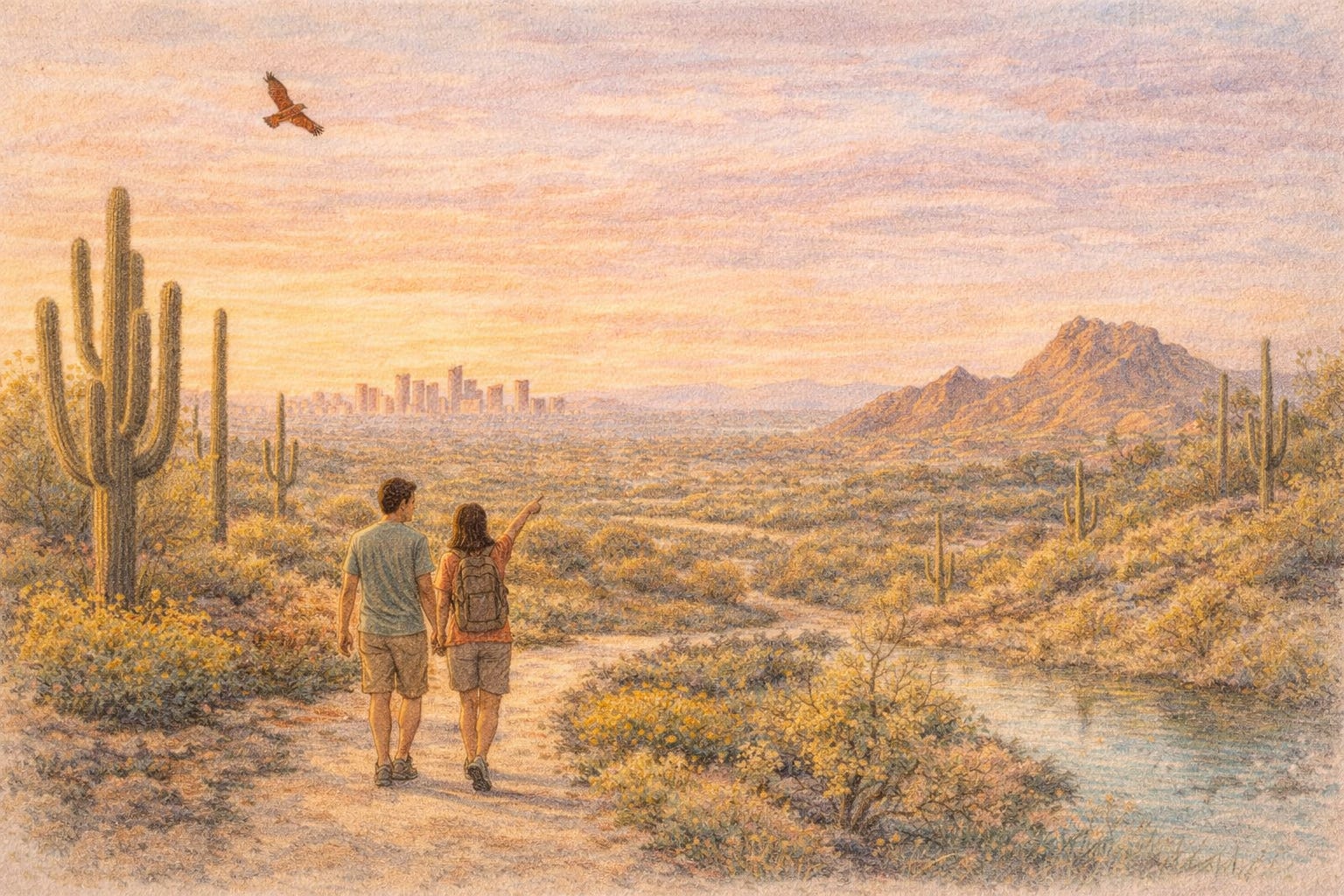
Phoenix is not just a city. It is the anchor of a sprawling metropolitan area that covers over 14,000 square miles of Sonoran Desert, mountains, and irrigated valley floor in central Arizona. The Valley of the Sun, as locals call it, encompasses dozens of cities, towns, and communities that together form the fifth-largest metropolitan area in the United States, home to approximately five million people.
The City of Phoenix itself is the fifth-largest city in the country and the largest state capital. But the metro area functions as an interconnected whole, with residents regularly crossing city boundaries for work, shopping, dining, and recreation. Scottsdale, Tempe, Mesa, Chandler, Gilbert, Glendale, Peoria, Surprise, Goodyear, Avondale, Buckeye, Queen Creek, Fountain Hills, Cave Creek, and Carefree are all part of the daily fabric of Valley life.
This guide is built for the people who live here. Not snowbirds passing through for the winter. Not tourists visiting for a resort weekend. Residents. The people who endure 115-degree summers, navigate the freeway system daily, need to know which hospital serves their neighborhood, and want to discover the trails, restaurants, and resources that make the Valley genuinely worth calling home.
Bookmark this page. Share it with your neighbors. Come back whenever the Valley throws you something new.
Part 1: Healthcare and Medical Services
The Valley of the Sun has one of the strongest healthcare networks in the country, anchored by major hospital systems and world-class specialty institutions.
Major Hospital Systems
Banner Health is the largest healthcare system in Arizona, operating multiple hospitals across the Valley including Banner University Medical Center Phoenix (Downtown), Banner University Medical Center Tucson, Banner Estrella Medical Center (West Valley), Banner Thunderbird Medical Center (Northwest Valley), Banner Desert Medical Center (Mesa), Banner Baywood Medical Center (Mesa), Banner Gateway Medical Center (Gilbert), and Banner Boswell Medical Center (Sun City). Banner’s network provides comprehensive coverage across virtually every part of the metro area.
Dignity Health / CommonSpirit Health operates St. Joseph’s Hospital and Medical Center (Midtown Phoenix), a nationally recognized Level I Trauma Center and the region’s leading facility for neurology and neurosurgery. The Barrow Neurological Institute at St. Joseph’s is considered one of the best neurological institutions in the world. Dignity also operates Chandler Regional Medical Center, Mercy Gilbert Medical Center, and other facilities.
HonorHealth operates Scottsdale Osborn Medical Center, Scottsdale Shea Medical Center, Scottsdale Thompson Peak Medical Center, John C. Lincoln Medical Center (North Phoenix), and Deer Valley Medical Center (North Phoenix). HonorHealth is a major provider for the North Valley and Scottsdale communities.
Mayo Clinic - Phoenix/Scottsdale is one of three Mayo Clinic campuses in the country (alongside Rochester, Minnesota and Jacksonville, Florida). Located in northeast Phoenix adjacent to the Desert Ridge community, Mayo Clinic provides specialty and subspecialty care, including one of the top-ranked cancer programs in the country. Mayo’s presence makes Phoenix a destination for patients seeking the highest level of specialty care.
Valleywise Health (formerly Maricopa Integrated Health System) is the safety-net healthcare system for Maricopa County, providing care regardless of ability to pay. Valleywise Medical Center (formerly Maricopa Medical Center) at 2601 East Roosevelt Street in central Phoenix operates a Level I Trauma Center, the Arizona Burn Center, and comprehensive emergency, inpatient, and outpatient services. The system also operates a network of family health centers across the county providing primary care, dental, behavioral health, and pharmacy services.
Phoenix Children’s Hospital is the largest children’s hospital in Arizona, located at the Thomas Campus in central Phoenix. It provides comprehensive pediatric specialty care and is consistently ranked among the best children’s hospitals nationally.
Community Health Centers
Mountain Park Health Center operates multiple locations across the Valley, providing primary care, dental, behavioral health, and pharmacy services on a sliding-scale fee basis.
Neighborhood Outreach Access to Health (NOAH) serves north Phoenix, Scottsdale, Cave Creek, and surrounding areas with affordable primary care, dental, and behavioral health services.
Valle del Sol provides behavioral health, primary care, and human services primarily serving the Latino community across the Valley.
Native Health provides primary care, dental, and behavioral health services for the Native American community in the Phoenix area.
Health Insurance
Arizona expanded Medicaid (called AHCCCS - Arizona Health Care Cost Containment System, pronounced “access”) under the ACA. AHCCCS provides coverage to qualifying low-income adults and families. Apply at healthearizonaplus.gov or at local DES (Department of Economic Security) offices.
KidsCare (Arizona’s CHIP program) provides health insurance for children in families earning up to 200 percent of the federal poverty level.
The ACA Marketplace (healthcare.gov) provides subsidized plans for individuals and families who do not qualify for AHCCCS. Open enrollment runs November through January.
Mental Health Resources
Arizona Crisis Line: 1-844-534-HELP (4357) or text 4HOPE (44673) to 741741. Available 24/7 for anyone experiencing a behavioral health crisis.
988 Suicide and Crisis Lifeline: Call or text 988.
Mercy Care is the primary AHCCCS managed care organization providing behavioral health services in Maricopa County. They coordinate access to mental health and substance use treatment for qualifying residents.
EMPACT - Suicide Prevention Center provides 24/7 crisis services, outpatient counseling, and community-based programs.
Community Bridges, Inc. (CBI) provides substance use treatment, crisis services, and affordable housing support.
Urgent Care
Major urgent care chains in the Valley include NextCare, FastMed, Dignity Health Urgent Care, Banner Urgent Care, and HonorHealth Urgent Care, with dozens of locations throughout the metro area. Most accept insurance; cash-pay rates typically range from $100 to $250 per visit.
Part 2: Transportation
The Valley of the Sun is fundamentally car-dependent, but transit options are growing and the freeway system, while heavily used, is newer and generally in better condition than those in older American cities.
Freeways
The Valley’s freeway system is extensive and relatively modern, with most major routes built or significantly expanded since the 1990s.
Interstate 10 (Papago Freeway/Maricopa Freeway): The primary east-west route through the heart of the Valley, connecting Goodyear and the West Valley through Downtown Phoenix to Tempe, Mesa, and beyond to Tucson.
Interstate 17 (Black Canyon Freeway): Runs north-south from Downtown Phoenix through North Phoenix to Flagstaff and Northern Arizona. The primary route to the high country.
Loop 101 (Agua Fria/Pima/Price Freeway): The inner ring road circling the central Valley, connecting Scottsdale, Tempe, Chandler, and the West Valley. One of the most heavily used freeways in the metro.
Loop 202 (Red Mountain/Santan/South Mountain Freeways): The outer ring completing the eastern and southern loop around the Valley, connecting Mesa, Gilbert, Chandler, and Ahwatukee. The South Mountain section opened in 2019, completing a decades-long project.
Loop 303: Serves the far West Valley, connecting Surprise, Goodyear, and Buckeye to the broader freeway network.
State Route 51 (Piestewa Freeway): Runs north-south from I-10 near Downtown through central Phoenix to Paradise Valley and north Scottsdale.
State Route 143 (Hohokam Expressway): Connects I-10 to Phoenix Sky Harbor International Airport.
US-60 (Superstition Freeway): Runs east from I-10 through Tempe, Mesa, and into the East Valley suburbs.
Rush hour runs from approximately 6:30 to 9:00 AM and 3:30 to 6:30 PM. The worst bottlenecks are the I-10/I-17 “Stack” interchange in Downtown, the Loop 101/I-10 interchange in Tempe, and the I-17 northbound from Downtown through North Phoenix.
Valley Metro Light Rail
Valley Metro Rail operates a 38.5-mile light rail system connecting Phoenix, Tempe, and Mesa. The system consists of two lines:
A Line: Runs from 19th Avenue/Montebello in north-central Phoenix through Downtown Phoenix, the Phoenix airport area (via a free Sky Train shuttle from the 44th Street station), through Tempe and Arizona State University to Mesa.
B Line (South Central Extension): Opened June 2025, running from Downtown Phoenix south along Central Avenue to Baseline Road. This extension added 5 miles and brought rail service to south Phoenix neighborhoods for the first time.
S Line Streetcar: A 3-mile streetcar serving Downtown Tempe and the ASU campus, connecting to the A Line.
Fares: A single ride is $2.00. A day pass is $4.00. A 7-day pass is $15.00. Reduced fares are available for seniors (65+), people with disabilities, and youth (6-18). Children under 6 ride free. Payment is via the Copper Card (contactless smart card) or the Valley Metro app. The Copper Card replaced paper passes in August 2024.
Key stations: 19th Ave/Montebello (north terminus), Encanto/Central (Encanto Park area), Roosevelt/Central (Roosevelt Row arts district), Washington/Central (Downtown Phoenix), 3rd Street/Washington (near convention center), 44th Street/Washington (Sky Train to airport), Tempe Transportation Center, University Drive/Rural (ASU), and Sycamore/Main (Downtown Mesa).
Valley Metro Bus
Valley Metro operates over 100 bus routes across the metro area. Routes are color-coded by frequency:
High-frequency routes (every 12-15 minutes during peak hours) serve major corridors including Central Avenue, Indian School Road, Thomas Road, and others.
Standard routes operate every 20-30 minutes.
Express routes connect suburbs to Downtown Phoenix and other employment centers via freeways.
RAPID routes provide limited-stop, faster service on key corridors.
Fares: Bus fares match rail fares ($2.00 single ride, $4.00 day pass). Transfers between bus and rail are included within a two-hour window.
Phoenix Sky Harbor International Airport
Phoenix Sky Harbor (PHX) is one of the top ten busiest airports in the country, located just three miles east of Downtown Phoenix. The airport is served by most major domestic and international carriers.
Getting to/from Sky Harbor: The Valley Metro Sky Train is a free automated people mover connecting the 44th Street/Washington light rail station to all airport terminals. This provides a car-free connection between the airport and the light rail system. The PHX Sky Train runs every 3-5 minutes and is the recommended way to reach the airport from anywhere on the light rail line.
Ride-hailing (Uber, Lyft) pickup is available at designated areas at each terminal. Taxi service is available at taxi stands outside each terminal.
Phoenix-Mesa Gateway Airport
Phoenix-Mesa Gateway (AZA) in the far East Valley serves primarily Allegiant Air and some other low-cost carriers. It provides a less-congested alternative to Sky Harbor for travelers in the East Valley.
Cycling
The Valley’s flat terrain and extensive canal system make cycling viable for much of the year (extreme summer heat excepted). The Arizona Canal Trail runs approximately 70 miles through Scottsdale, Phoenix, and Glendale. The Tempe Town Lake Multi-Use Path provides a scenic loop around the lake. Numerous other canal paths and multi-use trails cross the Valley.
Grid Bike Share operates in Tempe and Mesa with stations near light rail stops, ASU, and major destinations.
Ride-Hailing
Uber and Lyft operate extensively throughout the Valley. The flat layout and abundant parking at most destinations make ride-hailing less essential than in denser cities, but the services are widely available.
Part 3: Parks, Recreation, and Outdoor Life
The Valley of the Sun is an outdoor recreation paradise, with hiking, trail running, and desert exploration available year-round (with appropriate precautions during summer). The Sonoran Desert landscape provides a dramatically different outdoor experience from any other major American city.
Mountain Parks and Desert Preserves
South Mountain Park and Preserve (16,283 acres) is the largest municipal park in the United States. The park covers an entire mountain range within Phoenix city limits, with over 51 miles of trails for hiking, mountain biking, and horseback riding. Dobbins Lookout at 2,330 feet provides panoramic views of the entire Valley. The park’s trails range from easy desert walks to strenuous mountain climbs.
Camelback Mountain is the most iconic hiking destination in the Valley, rising 2,704 feet above sea level in the heart of Phoenix between the Arcadia and Biltmore neighborhoods. Two trails reach the summit: Echo Canyon Trail (steep, 1.2 miles one way) and Cholla Trail (longer, 1.5 miles, more moderate). Both are extremely popular and can be crowded. The summit provides 360-degree views of the entire metro area. Warning: Camelback is a serious hike with significant elevation gain and exposure. Do not attempt it in summer heat without extensive water and desert hiking experience.
Piestewa Peak (2,608 feet) in the Phoenix Mountains Preserve offers a similar summit experience to Camelback with slightly less technical terrain. The Summit Trail (Trail 300) is a 1.2-mile steep climb to the top. The surrounding preserve includes additional trails of varying difficulty through desert terrain.
McDowell Sonoran Preserve (approximately 30,500 acres) in Scottsdale is one of the largest urban preserves in the country. Over 200 miles of trails wind through pristine Sonoran Desert landscape with saguaro cacti, palo verde trees, and diverse wildlife. The preserve provides a genuine wilderness experience within the metro area.
Papago Park straddles the Phoenix-Tempe border and is home to the Desert Botanical Garden, the Phoenix Zoo, and the iconic Hole-in-the-Rock formation. Easy trails through the park’s red butte landscape provide accessible desert hiking.
Usery Mountain Regional Park in Mesa offers trails through classic Sonoran Desert terrain with views of the Superstition Mountains to the east.
White Tank Mountain Regional Park in the far West Valley provides 30 miles of trails and seasonal waterfalls after rainfall.
Lost Dutchman State Park at the base of the Superstition Mountains (east of Apache Junction) is the gateway to the Superstition Wilderness, offering desert and mountain hiking ranging from easy nature walks to multi-day backcountry routes.
Desert Botanical Garden
The Desert Botanical Garden in Papago Park is a 140-acre outdoor garden showcasing arid-land plants from around the world, with an emphasis on the Sonoran Desert ecosystem. The garden features five themed trails, seasonal exhibits, concerts (Music in the Garden series), and educational programming. It is one of the most unique botanical institutions in the country and a must-visit for both new and longtime Valley residents.
Tempe Town Lake
Tempe Town Lake is a 220-acre recreational lake created by damming the Salt River in central Tempe. The lake provides kayaking, stand-up paddleboarding, rowing, and fishing. A 7.5-mile multi-use path circles the lake, providing one of the most popular walking and running routes in the Valley. The path connects to the Tempe Beach Park event space and the Rio Salado Habitat Restoration Area.
The Canal System
The Valley’s extensive canal system, originally built for agricultural irrigation, now doubles as a recreational corridor. The Arizona Canal Trail, Grand Canal Path, Western Canal, and other canal paths provide paved, flat, car-free routes for walking, running, and cycling through urban neighborhoods. The canal system is particularly valuable for connecting neighborhoods and providing non-motorized transportation corridors.
City Parks
Encanto Park (central Phoenix) is a historic urban park with a lake, boathouse, playground, sports facilities, and beautiful mature landscaping. The park is adjacent to the Encanto-Palmcroft historic neighborhood.
Margaret T. Hance Park (Deck Park) covers a section of I-10 in central Phoenix, providing green space, the Japanese Friendship Garden, and community event spaces. The park is connected to the Roosevelt Row arts district.
Civic Space Park in Downtown Phoenix features the Janet Echelman net sculpture “Her Secret is Patience” and provides urban green space adjacent to the ASU Downtown Phoenix campus.
Scottsdale’s Indian Bend Wash Greenbelt is an 11-mile linear park following the Indian Bend Wash from north Scottsdale through the heart of the city. The greenbelt includes lakes, golf courses, bike paths, playgrounds, and picnic areas.
Gilbert’s Riparian Preserve at Water Ranch is a 110-acre park with hiking trails, fishing lakes, a butterfly garden, and over 200 bird species recorded. It is one of the best birding spots in the metro area.
Chandler’s Tumbleweed Park provides extensive sports facilities, a playground, and community event space in the heart of Chandler’s growing park system.
Part 4: Libraries
Phoenix Public Library
The Phoenix Public Library operates 17 branch libraries plus the Burton Barr Central Library at 1221 North Central Avenue. Burton Barr is an architecturally striking building designed by Will Bruder, recognized as one of the finest public library buildings in the country.
Services include free library cards for all Maricopa County residents. Access to books, e-books, audiobooks, and digital media. Free WiFi and computer access. Meeting rooms and study spaces. Digital resources including LinkedIn Learning, Kanopy, and Libby. Career resources and job search assistance. Children’s and teen programming. ESL classes and citizenship preparation. 3D printing and maker space access (Burton Barr Central Library).
Scottsdale, Tempe, Mesa, and Other City Libraries
Each city in the Valley operates its own library system. Scottsdale Public Library (four branches including the Civic Center Library), Tempe Public Library (two locations), Mesa Public Library (four branches including the architecturally notable Main Library), Chandler Public Library (four locations), and Gilbert Public Library serve their respective communities with comprehensive collections and programming.
Maricopa County Library District serves unincorporated areas and smaller communities without their own library systems.
Part 5: Education
K-12 Public Schools
The Phoenix metro area is served by over 50 school districts, a reflection of the Valley’s fragmented municipal structure. Notable districts include:
Phoenix Union High School District: Serves central Phoenix with comprehensive and magnet high schools.
Scottsdale Unified School District: Known for academic excellence, serving Scottsdale, Paradise Valley, and parts of Phoenix.
Tempe Union High School District: Serves Tempe, parts of Chandler, and South Phoenix with strong academic programs.
Mesa Public Schools: One of the largest districts in Arizona, serving Mesa and parts of Tempe.
Chandler Unified School District: Fast-growing, highly rated district serving Chandler, Gilbert, and parts of Sun Lakes.
Gilbert Public Schools: Highly rated district serving Gilbert and portions of surrounding communities.
Deer Valley Unified School District: Serves north Phoenix with consistently strong ratings.
Paradise Valley Unified School District: Serves Paradise Valley, north Scottsdale, and parts of Phoenix.
Kyrene School District: Highly rated elementary district in Tempe, Chandler, and Phoenix.
Peoria Unified School District: Serves the growing West Valley communities of Peoria, Glendale, and Surprise.
Charter schools have a significant presence in Arizona, which has some of the most charter-friendly laws in the country. Notable charter networks include Basis Schools (consistently ranked among the top high schools nationally), Great Hearts Academies, and ASU Preparatory Academy.
Higher Education
Arizona State University (ASU) is the largest public university in the country by enrollment, with over 80,000 students across multiple campuses. The main Tempe campus is the traditional university campus. The Downtown Phoenix campus serves urban programs and professional schools. The Polytechnic campus in Mesa focuses on technology and engineering. The West campus in Glendale serves the West Valley. ASU has been ranked the most innovative university in the country by US News & World Report for multiple consecutive years.
Maricopa County Community College District (MCCCD) operates 10 community colleges across the Valley, including Mesa Community College, Scottsdale Community College, Phoenix College, Glendale Community College, South Mountain Community College, Estrella Mountain Community College, Chandler-Gilbert Community College, Paradise Valley Community College, Rio Salado College (largely online), and GateWay Community College. MCCCD is one of the largest community college systems in the country.
Grand Canyon University (GCU) in west Phoenix is a large private university with rapidly growing enrollment and an expanding campus.
Midwestern University (Glendale campus) offers graduate programs in health sciences including osteopathic medicine, dental medicine, and pharmacy.
Part 6: Housing
The Housing Market
Phoenix’s housing market has experienced dramatic swings over the past two decades. The 2008 crash devastated the Valley, with home prices dropping over 50 percent in some areas. Recovery was strong, and the pandemic era brought another surge in prices driven by migration from California and other high-cost states.
In 2025-2026, the market has moderated somewhat. Median home prices in Phoenix are approximately $400,000-$450,000, significantly lower than comparable homes in California but higher than pre-pandemic levels. The East Valley cities of Gilbert and Chandler tend to command premium prices, while areas of West Phoenix, Maryvale, and parts of Mesa offer more affordable options.
Renting
Average one-bedroom apartment rents across the metro range from approximately $1,000 in more affordable areas to $1,800+ in premium neighborhoods like Downtown Scottsdale, Old Town Scottsdale, and Downtown Tempe. The Valley’s ongoing construction of new apartment complexes has helped moderate rental price growth in recent years.
Arizona has relatively landlord-friendly rental laws compared to states like California or New York. There is no rent control in Arizona (and state law prohibits local rent control ordinances). Landlords must provide written notice before eviction and must return security deposits within 14 business days of move-out.
Homebuying Resources
Arizona Department of Housing offers down payment assistance programs for qualifying first-time homebuyers. Maricopa County IDA provides homebuyer education courses and financial assistance. Many individual cities within the Valley also operate their own homebuyer assistance programs.
Part 7: Region-by-Region Neighborhood Guide
Downtown Phoenix
Downtown has experienced a renaissance over the past decade, driven by ASU’s Downtown campus, the Roosevelt Row arts district, the Warehouse District’s restaurant and bar scene, and significant residential development.
Roosevelt Row (RoRo) is the arts and culture heart of Downtown, with murals, galleries, studios, and the monthly First Friday Art Walk that draws thousands of visitors. The neighborhood has a walkable, creative energy unlike anywhere else in the Valley.
The Warehouse District south of the railroad tracks has become a dining and nightlife destination, with restaurants, breweries, and bars occupying converted industrial buildings.
Heritage Square preserves Victorian-era homes from Phoenix’s territorial period, including the Rosson House Museum. The adjacent CityScape complex provides retail, dining, and entertainment.
Footprint Center (home of the Phoenix Suns) and Chase Field (home of the Arizona Diamondbacks) anchor the sports and entertainment district.
The Valley Metro A and B lines both serve Downtown, and the area is the most transit-accessible part of the Valley.
Central Phoenix / Midtown
Central Phoenix encompasses the neighborhoods along Central Avenue from Downtown north to the Camelback corridor. This is the most urban part of the Valley, with mid-rise office buildings, restaurants, and a growing residential population.
Midtown is defined by the Central Avenue corridor, home to the Heard Museum (Native American art and culture), Phoenix Art Museum, and a growing collection of restaurants and shops.
Coronado and Willo are charming historic neighborhoods with pre-war bungalows, tree-lined streets, and a walkable character that is rare in Phoenix.
Encanto-Palmcroft is a historic neighborhood surrounding Encanto Park, featuring Spanish Colonial Revival and other period architecture in one of the city’s most established residential areas.
Arcadia
Arcadia is one of Phoenix’s most desirable neighborhoods, stretching along the southern slopes of Camelback Mountain. The area is known for its citrus-lined streets, mid-century and contemporary homes, proximity to Camelback hiking, and an excellent restaurant and shopping scene along the Camelback Road corridor.
Arizona Falls in Arcadia is a revitalized hydroelectric plant turned public art installation along the Arizona Canal.
Biltmore
The Biltmore area, centered around the historic Arizona Biltmore Hotel (a Frank Lloyd Wright-inspired landmark), is an affluent residential and commercial district. Biltmore Fashion Park provides upscale shopping and dining. The area offers proximity to Piestewa Peak hiking and a central Valley location.
North Phoenix
North Phoenix encompasses a large area north of the Arizona Canal, ranging from the North Mountain Preserve neighborhoods to the master-planned communities of Desert Ridge, Norterra, and beyond.
Desert Ridge is a large master-planned community adjacent to the Mayo Clinic Phoenix campus, with the Desert Ridge Marketplace shopping center, multiple golf courses, and access to the Phoenix Sonoran Desert Preserve.
North Mountain Park provides hiking with panoramic Valley views. Shaw Butte and the Dreamy Draw Recreation Area offer additional trail options.
South Phoenix
South Phoenix encompasses the neighborhoods south of the Salt River/I-17 corridor, anchored by South Mountain Park and Preserve, the largest municipal park in the country. The Valley Metro B Line extension (opened 2025) has brought light rail to South Phoenix along Central Avenue for the first time.
Laveen in the far south is one of the fastest-growing areas in the metro, offering affordable new construction homes with views of South Mountain and the Sierra Estrella.
Maryvale / West Phoenix
Maryvale and the surrounding West Phoenix neighborhoods are among the most affordable areas in the city. The area has a large Latino population with a vibrant food scene. West Phoenix is set to receive a light rail extension along Indian School Road in the coming years, which will be transformative for the community.
Camelback Ranch in Glendale (adjacent to West Phoenix) hosts spring training for the Los Angeles Dodgers and Chicago White Sox.
Scottsdale
Scottsdale is an independent city northeast of Phoenix, known for resorts, golf, upscale dining, art galleries, and a sophisticated lifestyle. The city encompasses dramatically different environments from the urban energy of Old Town to the rural luxury of north Scottsdale ranch properties.
Old Town Scottsdale provides walkable shopping, dining, nightlife, and gallery browsing. The Scottsdale Arts District hosts galleries, the Scottsdale Museum of Contemporary Art (SMoCA), and the annual Scottsdale ArtWalk (Thursday evenings).
North Scottsdale features master-planned luxury communities, world-class resorts (The Phoenician, Four Seasons, Fairmont Scottsdale Princess), and access to the McDowell Sonoran Preserve’s 30,500 acres of pristine desert trails.
The Scottsdale Waterfront along the Arizona Canal provides a pleasant walking and dining corridor in the heart of the city.
Tempe
Tempe is an independent city defined largely by Arizona State University and Tempe Town Lake. The city has a younger, more urban energy than most of the Valley, with walkable neighborhoods near campus, a vibrant Mill Avenue commercial district, and excellent transit access.
Mill Avenue is the primary commercial and nightlife strip, running from Tempe Town Lake south through the university area. Restaurants, bars, shops, and entertainment venues line the street.
Tempe Town Lake provides waterfront recreation, walking and cycling paths, and a venue for community events and festivals.
ASU’s Tempe Campus is one of the largest and most vibrant university campuses in the country, with beautiful architecture, extensive athletic facilities, and a Pac-12 (now Big 12) sports culture.
South Tempe (near Baseline and Guadalupe Roads) offers family-oriented neighborhoods with proximity to Kyrene School District.
Mesa
Mesa is the third-largest city in Arizona and one of the largest suburbs in the country by population. The city encompasses a wide range of neighborhoods from the revitalized Downtown to far East Valley master-planned communities.
Downtown Mesa has undergone significant revitalization, with new restaurants, cultural venues, and the Mesa Arts Center (the largest arts complex in Arizona). The A Line light rail terminates in Downtown Mesa.
Mesa’s East Valley neighborhoods merge into Gilbert, Queen Creek, and Apache Junction, offering newer construction and access to the Superstition Mountains.
Mesa Riverview near Tempe Town Lake provides shopping, dining, and entertainment options.
Chandler
Chandler is one of the most desirable East Valley cities, known for excellent schools (Chandler Unified School District), a revitalized Downtown, and major employment centers. Intel’s Chandler campus is one of the largest semiconductor manufacturing facilities in the world. Chandler Fashion Center is a major regional shopping mall.
Downtown Chandler has been transformed into a walkable dining and entertainment district with restaurants, bars, and community events.
Gilbert
Gilbert has grown from a small agricultural community to one of the fastest-growing cities in the country. Known for family-friendly master-planned communities, top-rated schools, and the rapidly developing Gilbert Heritage District (downtown), Gilbert consistently ranks among the safest and most desirable cities in Arizona.
Riparian Preserve at Water Ranch provides 110 acres of nature trails, fishing lakes, and exceptional birding.
Glendale
Glendale is a West Valley city known for the State Farm Stadium (home of the Arizona Cardinals and host of Super Bowls), the Desert Diamond Arena (home of future NHL expansion), and the sports and entertainment district surrounding these venues. Downtown Glendale features antique shops and the annual Glendale Glitters holiday light display.
Peoria and Surprise
Peoria and Surprise are growing West Valley cities offering newer master-planned communities, spring training facilities (Peoria Sports Complex hosts the San Diego Padres and Seattle Mariners), and increasingly diverse dining and shopping options.
Goodyear, Avondale, and Buckeye
The far West Valley cities of Goodyear, Avondale, and Buckeye represent the fastest-growing edge of the metro area. Buckeye is one of the fastest-growing cities in the United States. These communities offer the most affordable new construction in the Valley, though commute times to central Phoenix can be significant.
Cave Creek and Carefree
Cave Creek and Carefree in the far north Valley offer a small-town, Western-themed atmosphere with independent shops, restaurants, and easy access to the Sonoran Desert. Cave Creek is known for its cowboy culture, live music venues, and unique character.
Fountain Hills
Fountain Hills is a small, affluent community east of Scottsdale known for its iconic 560-foot fountain (one of the tallest in the world) and proximity to the McDowell Mountain Regional Park.
Part 8: Dining
The Valley’s food scene has matured significantly, earning national recognition and multiple James Beard Award nominations and wins.
Mexican and Sonoran
Phoenix’s proximity to the Mexican border gives the Valley one of the best Mexican food scenes in the country. Sonoran-style Mexican food, characterized by flour tortillas, carne asada, Sonoran hot dogs (bacon-wrapped hot dogs with pinto beans, onions, tomatoes, and multiple sauces), and machaca, is the dominant regional style.
Tacos Chiwas (Central Phoenix) has earned James Beard recognition for its Chihuahuan-style tacos. Barrio Cafe (Central Phoenix) serves elevated Mexican cuisine. Los Olivos (Scottsdale) is a longstanding institution for Sonoran food. El Norteno and countless taquerias throughout South Phoenix, Maryvale, and Mesa serve the authentic everyday Mexican food that defines Valley eating.
The Sonoran hot dog is the Valley’s signature street food, available from carts and stands throughout the city, particularly in South Phoenix and along South Central Avenue.
Southwest and New American
Binkley’s Restaurant (Cave Creek area) holds a reputation as one of the finest dining establishments in Arizona. Pizzeria Bianco (Downtown Phoenix/Heritage Square) has been called the best pizza in America by multiple publications. The Gladly (Arcadia), Quiessence (South Mountain), and Kai (Chandler, at the Sheraton Wild Horse Pass) represent the upper echelon of Valley dining.
Asian
The Mesa Asian District along Dobson Road and Main Street features one of the highest concentrations of Asian restaurants in the Valley, with Chinese, Vietnamese, Korean, and Japanese options. Lee Lee International Supermarkets in Chandler and Peoria anchor the Asian grocery scene.
Tempe’s concentration of students and young professionals supports a growing ramen, boba, and Asian fusion scene near ASU.
Middle Eastern
The Valley has a significant Middle Eastern and North African community, with excellent Lebanese, Yemeni, Palestinian, and Afghan restaurants scattered throughout Tempe, Mesa, and central Phoenix. Haji-Baba (Tempe) is a longtime institution for Middle Eastern groceries and prepared food.
Ethiopian and East African
A growing East African community, particularly in the central Phoenix and Tempe area, has brought excellent Ethiopian and Eritrean restaurants to the Valley. The concentration along Apache Boulevard in Tempe and portions of Central Phoenix provides injera-based cuisine that is among the best in the Southwest.
Craft Beer and Coffee
The Valley’s craft beer scene has exploded. Arizona Wilderness Brewing Co. (Gilbert and Downtown Phoenix), Wren House Brewing (Central Phoenix), Huss Brewing (Tempe), and dozens of other breweries have put Phoenix on the national craft beer map.
The coffee scene is equally vibrant. Cartel Coffee Lab (multiple locations), Press Coffee (multiple locations), Lux Coffee (Central Phoenix), and Provision Coffee Bar (Downtown) lead a thriving specialty coffee culture.
Part 9: Financial Services and Benefits
SNAP and Cash Assistance
Apply for SNAP (food stamps), TANF (cash assistance), and AHCCCS (Medicaid) through the Arizona Department of Economic Security at healthearizonaplus.gov or at local DES offices.
Double Up Food Bucks programs at participating farmers markets match SNAP dollars spent on produce.
Utility Assistance
LIHEAP and Arizona utility assistance programs help qualifying households pay energy bills. Given Phoenix’s extreme summer heat, utility assistance can be literally life-saving. Apply through community action agencies or DES.
APS (Arizona Public Service) and SRP (Salt River Project) both offer budget billing, payment plans, and low-income assistance programs. During extreme heat events, Arizona law restricts utility shutoffs.
Community Information
Arizona 211: Dial 211 or visit 211arizona.org for information about food assistance, housing, healthcare, childcare, utility help, and other social services. Available 24/7.
Part 10: Community Resources and Government Services
Phoenix 311
PHX311 handles non-emergency city service requests including potholes, graffiti, illegal dumping, code violations, and water service issues. Call 602-262-6011, visit phoenix.gov/311, or use the PHX311 app.
Neighborhood Services
The City of Phoenix Neighborhood Services Department coordinates neighborhood organizations, block watch programs, community cleanups, and resident engagement initiatives. The department’s Neighborhood College provides workshops on community leadership and civic engagement.
Maricopa County Services
Maricopa County is the fourth-most populous county in the United States. County services include elections, property assessment, superior court, public health (Maricopa County Department of Public Health), air quality, animal care and control, flood control, and parks and recreation.
Legal Services
Community Legal Services (CLS) provides free civil legal help for low-income Maricopa County residents in areas including housing, family law, consumer rights, and public benefits. Call 602-258-3434.
Arizona Legal Center provides free legal services in family law, immigration, and veterans’ issues.
Immigrant Services
AZCEND (formerly Chandler Christian Community Center) provides immigration legal services, ESOL classes, and family support.
International Rescue Committee (IRC) Phoenix provides refugee resettlement services, legal assistance, and community integration programs.
Phoenix Allies for Community Health (PACH) coordinates immigrant health services and community support.
Part 11: Cultural Institutions
Museums
Heard Museum (Central Phoenix): One of the premier museums of Native American art and culture in the world. The collection spans millennia of indigenous artistic traditions. Essential for understanding the cultural context of the region.
Phoenix Art Museum: The largest art museum in the Southwest, with collections spanning American, Asian, European, and contemporary art, plus fashion design.
Musical Instrument Museum (MIM) (North Phoenix): One of the most unique museums in the country, with over 8,000 musical instruments from 200 countries displayed with audio and video. An extraordinary experience regardless of musical background.
Desert Botanical Garden (Papago Park): 140 acres of arid-land plants from around the world, with trails, seasonal exhibits, and concerts.
Arizona Science Center (Downtown Phoenix): Interactive science museum with a planetarium and IMAX theater.
Scottsdale Museum of Contemporary Art (SMoCA): Rotating contemporary art, architecture, and design exhibitions.
Pueblo Grande Museum (Phoenix): Archaeological site preserving a 1,500-year-old Hohokam village, including a platform mound and irrigation canals. Understanding the Hohokam is essential to understanding the Valley’s deep history.
Performing Arts
Arizona Opera performs at Symphony Hall in Downtown Phoenix and at the Tucson Music Hall.
Phoenix Symphony performs at Symphony Hall with a full season of classical, pops, and special event concerts.
The Phoenix Theatre Company is one of the oldest continuously operating community theaters in the country.
Orpheum Theatre (Downtown Phoenix) is a magnificently restored 1929 movie palace now hosting performing arts events.
Scottsdale Center for the Performing Arts hosts concerts, dance, theater, and cultural events.
Celebrity Theatre (Central Phoenix) features a unique theater-in-the-round format for concerts and performances.
Part 12: Weather Survival Guide
The Valley’s weather is the single most defining aspect of daily life. Understanding and preparing for it is essential.
Extreme Summer Heat
Phoenix is the hottest major city in the United States. Average high temperatures in June, July, and August range from 104 to 106 degrees. Temperatures above 110 are common, and occasionally reach 115 to 120 degrees. The record high is 122 degrees (1990).
Heat kills. Phoenix experiences more heat-related deaths than any other U.S. city. Between 2020 and 2024, hundreds of Maricopa County residents died from heat-associated causes each year. This is not an abstract risk. It is a concrete, annual reality.
Summer survival rules: Never hike during the heat of the day in summer. Dozens of hikers are rescued from Valley trails each summer, and some die. If you hike in summer, go before 6 AM and carry at least one liter of water per hour of hiking. Stay hydrated at all times, starting before you feel thirsty. Keep your vehicle’s coolant system maintained. Never leave children or pets in parked vehicles even briefly. The interior of a car in Phoenix summer sun can reach 170 degrees in minutes.
The city operates Cooling Centers (refugios) during extreme heat. Call 602-534-COOL or 211 for locations. Many cooling centers are located at community centers, libraries, and places of worship.
Night heat: Unlike desert areas with dramatic day/night temperature swings, Phoenix’s urban heat island effect means overnight lows in summer often stay above 90 degrees. Air conditioning is not optional; it is a life-safety requirement.
Dust Storms (Haboobs)
The Valley experiences dramatic dust storms during the monsoon season (June through September). These haboobs are massive walls of dust that can reduce visibility to near zero and arrive with little warning.
During a dust storm: If driving, pull off the road completely, turn off your headlights (so other drivers do not follow your tail lights off the road), and wait for the storm to pass. If outdoors, seek shelter and cover your nose and mouth. Dust storms typically last 15-30 minutes.
Monsoon Season
The North American Monsoon brings dramatic thunderstorms to the Valley from mid-June through September. These storms produce intense lightning, heavy rain, flash flooding, and occasionally damaging winds and hail. The storms typically build in the afternoon and evening.
Flash flooding is the primary monsoon danger. The Valley’s normally dry washes and arroyos can fill with fast-moving water within minutes. Never enter or cross a flooded wash, road, or underpass. Arizona’s “Stupid Motorist Law” holds drivers financially responsible for their own rescue if they drive around barricades into flooded areas.
Winter
Phoenix winters are mild and pleasant, with average highs in the 60s and lows in the 40s from December through February. Occasional overnight freezes occur, and frost-sensitive landscaping may need protection. Snow is extremely rare in the Valley floor but common in the nearby mountains (Flagstaff is only two hours north and receives significant snowfall).
Winter is the peak season for tourism, snowbird migration, and outdoor activity. Hiking, golf, and outdoor dining are at their best from October through April.
Part 13: Fitness and Outdoor Recreation
Hiking
Hiking is the defining outdoor activity of Valley life. The Sonoran Desert landscape provides a unique and visually stunning backdrop unlike any other major American city.
Easy hikes: Papago Park’s Hole-in-the-Rock, Desert Botanical Garden trails, Tempe Town Lake multi-use path, canal trails throughout the Valley.
Moderate hikes: Piestewa Peak Summit Trail (1.2 miles, steep), Tom’s Thumb Trail (McDowell Sonoran Preserve, Scottsdale), Pinnacle Peak Trail (Scottsdale), Gateway Loop (McDowell Sonoran Preserve).
Challenging hikes: Camelback Mountain Echo Canyon or Cholla Trail, Flatiron via Siphon Draw (Superstition Mountains), South Mountain National Trail (end-to-end), Mount Humphreys (Flagstaff, highest point in Arizona at 12,637 feet, day trip from Phoenix).
Critical safety warning: Carry more water than you think you need. Start early. Tell someone your plans. Do not hike exposed trails when temperatures exceed 100 degrees. Heat-related hiking emergencies are a regular occurrence in the Valley from May through September.
Golf
The Valley has over 200 golf courses, making it one of the premier golf destinations in the world. Municipal courses operated by the City of Phoenix provide affordable options. Resort courses in Scottsdale, Fountain Hills, and the East Valley provide world-class experiences. TPC Scottsdale hosts the WM Phoenix Open, the best-attended tournament on the PGA Tour.
Water Recreation
Tempe Town Lake provides kayaking, stand-up paddleboarding, and rowing in the heart of the metro. Saguaro Lake, Canyon Lake, Apache Lake, and Roosevelt Lake (all within 1-2 hours east of Phoenix) provide boating, fishing, and swimming in the scenic Tonto National Forest. Tubing on the Salt River (through Salt River Tubing) is a beloved summer activity.
Cycling
The Valley’s flat terrain and canal trail system support cycling throughout the cooler months. The Arizona Canal Trail and Indian Bend Wash Greenbelt provide dedicated cycling corridors. South Mountain Park offers challenging mountain biking. Road cycling is popular on early morning rides before traffic and heat build.
Part 14: Utilities and Essential Services
Electricity
The Valley is served by two primary electric utilities:
Arizona Public Service (APS) serves most of Phoenix, Scottsdale, and the northern/western portions of the metro. Pay bills and report outages at aps.com or 602-371-7171.
Salt River Project (SRP) serves Tempe, Mesa, Chandler, Gilbert, and the eastern/southeastern portions of the metro. Pay bills and report outages at srpnet.com or 602-236-8888.
Summer electric bills can be significant due to air conditioning demand. Bills of $200 to $400 or more per month are common during peak summer months for a typical single-family home. Both utilities offer budget billing plans that spread costs evenly across the year, as well as assistance programs for low-income customers.
Arizona has invested heavily in solar energy. Both APS and SRP offer solar programs, and the Valley’s abundant sunshine makes rooftop solar a particularly effective investment. Various state and federal incentives can reduce the upfront cost of solar installation.
Water
Water is precious in the desert. The Valley’s water supply comes primarily from the Salt River Project (surface water from reservoirs east of the Valley), the Central Arizona Project (CAP) (Colorado River water delivered via a 336-mile canal), and groundwater wells.
Water service within Phoenix is provided by the City of Phoenix Water Services Department. Other cities operate their own water utilities. Conservation is encouraged year-round; many communities offer rebates for desert landscaping (xeriscaping) and high-efficiency irrigation systems.
Natural Gas
Southwest Gas provides natural gas service throughout the Valley. Report gas leaks immediately at 877-860-6020.
Trash and Recycling
The City of Phoenix provides curbside collection of trash, recycling, and green waste (yard waste and food scraps). Each household receives three bins. Bulk trash pickup occurs several times per year on a neighborhood rotation schedule. Check your schedule at phoenix.gov/publicworks.
Internet
Major providers include Cox Communications (dominant in much of the metro), CenturyLink/Lumen, T-Mobile Home Internet, and Google Fiber (available in select areas). Cox is the primary cable/internet provider, though fiber options are expanding.
Part 15: Pet Services
Dog Parks
The Valley has numerous off-leash dog parks. Cosmo Dog Park (Gilbert) is one of the largest and best-designed in the metro. Chaparral Dog Park (Scottsdale), Papago Dog Park (Phoenix), Shawnee Bark Park (Chandler), and Washington Park Dog Park (Phoenix) are other popular options.
Animal Services
Maricopa County Animal Care and Control operates shelters in the East Valley (Mesa) and West Valley (Phoenix). The Arizona Humane Society operates the largest no-kill shelter in the state, providing adoption, veterinary care, and community programs.
Lost Our Home Pet Rescue specializes in helping families facing homelessness or domestic violence keep or rehome their pets.
Heat Safety for Pets
Pavement temperatures in Phoenix summer can exceed 160 degrees. This will burn your dog’s paws. Walk dogs only in early morning or late evening during summer months. Test pavement with the back of your hand before walking your pet. If it is too hot for your hand, it is too hot for paws.
Part 16: Safety and Emergency Preparedness
Emergency Numbers
911 for police, fire, and medical emergencies. 602-262-6011 (PHX311) for non-emergency city services. 211 for social services information.
Phoenix Police Department
The Phoenix Police Department operates from multiple precincts across the city. Community Advisory Boards provide civilian input on policing practices.
Phoenix Fire Department
The Phoenix Fire Department is one of the busiest in the country, responding to over 200,000 calls annually. The department provides fire suppression, emergency medical services (Phoenix Fire operates the ground ambulance service for the city), hazardous materials response, and technical rescue.
Heat Emergency
If you see someone showing signs of heat exhaustion or heat stroke, call 911 immediately. Move the person to shade or air conditioning, apply cool water to their skin, and fan them. Heat stroke (hot, dry skin; confusion; loss of consciousness) is a medical emergency that can be fatal without immediate treatment.
Part 17: Real Estate Overview by Region
Downtown Phoenix: Condos and apartments from $1,200 to $2,000 for one-bedrooms. Growing residential market with new high-rise development.
Central Phoenix / Midtown / Arcadia: One-bedrooms from $1,200 to $1,800. Homes from $350,000 to $1.5M+. Arcadia and Biltmore command premium prices.
North Phoenix / Desert Ridge: One-bedrooms from $1,100 to $1,500. Homes from $350,000 to $700,000. Master-planned communities with good amenities.
South Phoenix / Laveen: Most affordable within Phoenix. One-bedrooms from $900 to $1,200. Homes from $250,000 to $400,000. Growing rapidly.
Scottsdale: Premium pricing. One-bedrooms from $1,400 to $2,500. Homes from $500,000 to multi-millions in north Scottsdale.
Tempe: One-bedrooms from $1,200 to $1,800 (higher near ASU). Homes from $350,000 to $700,000.
Mesa: Affordable and diverse. One-bedrooms from $1,000 to $1,400. Homes from $300,000 to $550,000.
Chandler / Gilbert: Premium East Valley pricing. One-bedrooms from $1,200 to $1,600. Homes from $400,000 to $700,000. Top schools.
Glendale / Peoria / Surprise: West Valley value. One-bedrooms from $1,000 to $1,400. Homes from $300,000 to $500,000.
Goodyear / Buckeye: Fastest-growing, most affordable new construction. Homes from $280,000 to $450,000. Longer commutes to central employment.
Part 18: Sports
Professional Sports
Phoenix Suns (NBA): Footprint Center, Downtown Phoenix.
Arizona Diamondbacks (MLB): Chase Field, Downtown Phoenix (retractable roof, essential for summer games).
Arizona Cardinals (NFL): State Farm Stadium, Glendale.
Arizona Coyotes (NHL): The Coyotes relocated to Salt Lake City in 2024. A new NHL expansion franchise for Phoenix has been discussed but is not confirmed as of early 2026.
Phoenix Mercury (WNBA): Footprint Center.
Phoenix Rising FC (USL): Phoenix Rising Soccer Complex, south Tempe.
Spring Training
The Cactus League brings 15 Major League Baseball teams to the Valley each February and March for spring training. Games are played at intimate stadiums across Scottsdale, Tempe, Mesa, Peoria, Glendale, Goodyear, Surprise, and Salt River Fields (Scottsdale). Spring training is a beloved Valley tradition and a major economic driver.
College Sports
Arizona State University Sun Devils compete in the Big 12 Conference. ASU football at Sun Devil Stadium (Tempe), basketball at Desert Financial Arena, and a wide range of other sports draw strong local support.
Golf Events
The WM Phoenix Open at TPC Scottsdale (January/February) is the best-attended event on the PGA Tour, drawing over 700,000 spectators over the tournament week. The 16th hole’s stadium seating creates an atmosphere unlike any other golf event in the world.
Part 19: Seasonal Events Calendar
January-February
WM Phoenix Open (Scottsdale). Spring training opens. Arizona Renaissance Festival (east of Phoenix, weekends through March). Perfect hiking weather.
March-April
Spring training games throughout the Valley. Ostrich Festival (Chandler). Matsuri: A Festival of Japan (Heritage Square, Downtown). Peak wildflower season in the desert after a wet winter. Ideal outdoor temperatures.
May-June
Temperatures begin climbing above 100. Arizona Republic / azcentral.com Storytellers events. Pool season begins in earnest. Outdoor activities shift to early morning.
July-August
Monsoon season. Dramatic thunderstorms, dust storms, and flash flooding. Peak summer heat. Indoor activities and water recreation dominate. Arizona Cardinals and ASU football training camps begin.
September-October
Temperatures moderate. Arizona State Fair (October-November). Fall hiking season begins. Restaurant events and food festivals return.
November-December
Peak season begins. Snowbirds arrive. Glendale Glitters holiday light display. ZooLights at the Phoenix Zoo. Las Noches de las Luminarias at the Desert Botanical Garden (luminaria-lit evening walks through the garden, one of the most magical experiences in the Valley). Holiday shopping at Scottsdale Fashion Square and the Scottsdale Waterfront.
Part 20: The Heat - A Deeper Look
The Valley’s extreme heat deserves more extensive treatment because it affects every aspect of life from May through October.
How Hot Does It Really Get?
Average high temperatures by month: January 67, February 71, March 77, April 85, May 95, June 104, July 106, August 104, September 100, October 89, November 76, December 66.
These are averages. Individual days in June and July can reach 115 to 118 degrees. The overnight low during the hottest stretches may not drop below 95 degrees. The urban heat island effect means developed areas stay 10 to 15 degrees warmer than surrounding desert, particularly at night.
Adapting to the Heat
Longtime Valley residents structure their summer lives around the heat. Outdoor activities happen before dawn or after dark. Shopping, errands, and socializing shift to air-conditioned environments. Many residents exercise at gyms or indoor pools during summer months rather than outdoor trails.
Summer is the off-season. Many restaurants offer discounts. Resort prices drop dramatically. Cultural institutions run summer programming. The slower pace of summer life has its own appeal for those who have adapted.
Air conditioning costs are the primary financial impact of summer heat. Expect electricity bills to peak between June and September. Both APS and SRP offer energy audit programs, rebates for efficient systems, and low-income assistance.
Newcomer Mistakes to Avoid
Do not hike Camelback Mountain at 2 PM in July. Do not leave water bottles in your car (they will reach temperatures that leach chemicals from the plastic). Do not leave anything heat-sensitive in your car during summer (chocolate, candles, electronics, medications). Do not underestimate the distance between shade and your destination. Do not assume you can “handle the heat” if you have never lived in extreme dry heat before. Acclimation takes weeks.
Part 21: Day Trips from the Valley
One of the Valley’s greatest assets is its proximity to dramatically different landscapes.
Sedona (2 hours north): Red rock formations, world-class hiking (Bell Rock, Cathedral Rock, West Fork), art galleries, and a spiritual/wellness culture. One of the most beautiful places in the Southwest.
Flagstaff (2 hours north via I-17): A mountain college town at 7,000 feet with four-season climate, ponderosa pine forests, and access to the San Francisco Peaks (including Humphreys Peak at 12,637 feet, the highest point in Arizona). Skiing at Snowbowl in winter. A completely different world from the Valley.
Grand Canyon (3.5-4 hours north): One of the natural wonders of the world. Day trips to the South Rim are feasible but long. An overnight stay allows more time to explore.
Prescott (1.5 hours north): A charming mountain town with a historic courthouse square, Whiskey Row saloons, and pleasant mild temperatures.
Payson (1.5 hours northeast): Gateway to the Mogollon Rim and the Tonto National Forest. Significantly cooler than the Valley in summer.
Superstition Mountains (45 minutes east): Dramatic volcanic peaks with legendary tales of lost gold mines. Excellent hiking, including the challenging Flatiron summit.
Saguaro Lake and the Salt River (45 minutes east): Boating, kayaking, tubing, and fishing in the scenic Tonto National Forest.
Part 22: Automotive and Driving
Vehicle Registration
Arizona vehicle registration is handled by the Arizona Department of Transportation Motor Vehicle Division (MVD) or through authorized third-party MVD providers (which often have shorter wait times). New residents must register their vehicles and obtain an Arizona driver’s license within a specified period after establishing residency.
Arizona driver’s licenses are valid until age 65 (one of the longest validity periods in the country), after which renewal every five years is required.
No Emissions Testing (Mostly)
Maricopa County requires emissions testing for most vehicles as part of registration renewal. The Vehicle Emissions Testing program operates stations throughout the metro area.
Toll Roads
The Valley has very limited toll roads. The Loop 202 South Mountain Freeway is free. Most Valley freeways have no tolls, which is a notable advantage over many other major metros.
Parking
Unlike denser cities, parking is generally abundant and often free throughout most of the Valley. Downtown Phoenix, Old Town Scottsdale, and the ASU/Tempe area are the primary locations where parking requires planning and sometimes payment.
Part 23: Moving to the Valley - A Newcomer’s Survival Kit
Before You Move
Understand the heat. Read the heat section of this guide carefully. If you are moving from a cold-weather climate, your first Phoenix summer will be an adjustment. Budget for higher summer electricity bills than you have ever paid. Plan to arrive between October and April if possible, so you can acclimate gradually.
Your First Week
Set up electricity with APS or SRP (check which utility serves your address). Set up water service through your city. Get an Arizona driver’s license at an MVD office or authorized third-party. Register your vehicle. Download the PHX311 app, the Valley Metro app, and a weather app that includes dust storm and flash flood warnings. Find your nearest grocery store, pharmacy, and urgent care.
Your First Month
Hike Camelback or Piestewa Peak early in the morning (if the season permits). Visit the Desert Botanical Garden. Eat a Sonoran hot dog from a street cart. Walk the Roosevelt Row arts district on a First Friday. Drive to Sedona for a day trip. Get a library card. Try three restaurants you have never heard of.
Your First Summer
Take it seriously. Hydrate obsessively. Do not plan outdoor activities between 10 AM and 5 PM. Discover the summer discounts at restaurants and resorts. Learn to appreciate monsoon thunderstorms from a covered patio. Find an indoor exercise routine. Check on elderly or vulnerable neighbors during extreme heat events.
Finding Community
The Valley can feel sprawling and anonymous, especially for newcomers. Community forms around neighborhoods, fitness groups, hiking partners, places of worship, school communities, and professional networks. The city’s many newcomers (Phoenix adds tens of thousands of new residents each year) mean that finding other people in the same “new to the Valley” situation is easy.
Part 24: Essential Phone Numbers and Websites
All Emergencies: 911
Phoenix City Services: 602-262-6011 (PHX311) or phoenix.gov/311
Social Services: 211 or 211arizona.org
APS (Electric): 602-371-7171 or aps.com
SRP (Electric/Water): 602-236-8888 or srpnet.com
Southwest Gas: 877-860-6020
Valley Metro (Transit): 602-253-5000 or valleymetro.org
Arizona Crisis Line (Mental Health): 1-844-534-4357
988 Suicide and Crisis Lifeline: 988
AHCCCS (Medicaid): healthearizonaplus.gov
Valleywise Health (Safety-Net Hospital): 602-344-5011
Community Legal Services: 602-258-3434
Maricopa County Animal Care: 602-506-7387
Phoenix Public Library: phoenixpubliclibrary.org
Phoenix Parks: phoenix.gov/parks
City of Phoenix Water: phoenix.gov/water
Part 25: 20 Things Only Real Valley Residents Know
You know that 110 degrees in Phoenix feels different from 95 degrees with humidity in Houston, and that “but it is a dry heat” is both true and increasingly irrelevant above 115. You know that the best months are October through April and that summer is endured, not enjoyed. You know that Camelback Mountain is not a casual walk and that the rescue helicopters prove it regularly.
You know that monsoon storms are the most dramatic weather events you have ever witnessed and that watching a haboob roll across the Valley from an elevated vantage point is genuinely awe-inspiring. You know that flash floods fill bone-dry washes with raging water in minutes and that the people who drive around barricades are the people who end up on the news.
You know that Sonoran hot dogs are a revelation and that the best ones come from the most unassuming carts. You know that Scottsdale and South Phoenix are different planets despite being 20 minutes apart. You know that the Cactus League in February and March is one of the great sporting experiences in America.
You know that the canal trails are the hidden transportation and recreation network that ties the Valley together. You know that Sedona is the best day trip in the country and that you will never get tired of those red rocks. You know that the stars above the desert on a clear winter night are spectacular and worth driving 30 minutes from the city to see.
You know that Las Noches de las Luminarias at the Desert Botanical Garden is the single most magical evening event in the Valley. You know that the Musical Instrument Museum is one of the most underrated museums in the country. You know that First Fridays on Roosevelt Row is the creative heartbeat of the city.
You know that air conditioning is not a luxury but a survival tool, and that the sound of your AC unit kicking on at 3 AM in July is the sound of civilization itself. You know that your car’s steering wheel in summer requires oven mitts or a windshield shade. You know that the Valley sunsets, when the sky turns impossible shades of pink and orange and purple over the desert mountains, are worth every degree of summer heat.
And you know that despite the heat, the sprawl, and the strip malls, the Valley of the Sun has a quality of life, an access to nature, and a warmth of community that keeps people here for decades after they planned to stay for just a year.
Closing Thoughts
The Valley of the Sun is not for everyone. The summer heat is extreme. The sprawl is real. The landscape, for those unaccustomed to the desert, can feel alien and harsh.
But for the millions who call it home, the Valley offers something remarkable. Three hundred days of sunshine. World-class hiking steps from your front door. A food scene that has earned national recognition. Healthcare anchored by the Mayo Clinic and one of the largest medical systems in the country. A cost of living that, while rising, remains dramatically lower than coastal cities. No state income tax on the horizon (Arizona has a flat income tax rate that is among the lowest in the country). And a sense of possibility that comes from living in one of the fastest-growing regions in America.
The desert demands respect. The heat demands preparation. But the rewards, from the first saguaro-studded sunrise hike of the season to the last sunset over the Superstitions, are extraordinary.
Use this guide as your starting point. Hike a trail you have never tried. Visit a museum you have been meaning to see. Eat at a taqueria in a neighborhood you have never explored. Drive to Sedona on a weekend morning. Watch a Cactus League game on a perfect February afternoon.
The Valley is waiting. And the sun, as always, is shining.
This comprehensive guide was created for the residents of the Valley of the Sun. Bookmark it, share it, and return whenever you need a service, a resource, or a recommendation. And remember: hydrate, wear sunscreen, and never hike Camelback at noon in July.
Part 26: Detailed Dining Deep Dives by Area
Downtown Phoenix and Roosevelt Row
Downtown’s dining scene has transformed from virtually nonexistent to genuinely exciting. Pizzeria Bianco at Heritage Square has been called the best pizza in America. The Larder + The Delta serves elevated Southern-inspired food. Bitter & Twisted is a cocktail bar in the former Arizona Prohibition headquarters building, serving creative cocktails in one of the most atmospheric spaces in the city.
Roosevelt Row’s restaurant scene reflects the arts district’s creative energy. Welcome Diner serves updated comfort food. The Breadfruit & Rum Bar brings Jamaican-Caribbean flavors to the neighborhood. Several coffee shops and casual eateries anchor the district’s daytime culture.
The Warehouse District south of the tracks has rapidly developed with restaurants and bars including Ladera Taverna y Cocina (Mexican seafood), Cobra Arcade Bar (craft cocktails and vintage arcades), and multiple breweries.
Central Phoenix and the Camelback Corridor
The stretch of Camelback Road from Central Avenue to 44th Street is the Valley’s premier dining corridor. The Gladly serves refined American cuisine. Beckett’s Table is a farm-to-table restaurant that consistently ranks among the Valley’s best. The Henry provides an all-day dining experience with a sophisticated atmosphere.
Along Central Avenue, Windsor offers neighborhood-style dining with craft beer and creative comfort food. Tuck Shop serves globally inspired small plates. The concentration of quality restaurants in the Central Phoenix corridor rivals any neighborhood dining scene in the Southwest.
Scottsdale
Scottsdale’s dining scene ranges from resort fine dining to casual neighborhood spots. Old Town features a dense concentration of restaurants and bars, from upscale steakhouses to casual taco joints. The Scottsdale Waterfront along the Arizona Canal provides waterfront dining options.
FnB in Old Town earned a James Beard Award nomination for its vegetable-forward, Arizona-ingredients-focused cuisine. Citizen Public House serves elevated gastropub fare. The Mission (which also has a central Scottsdale location) offers modern Latin food.
North Scottsdale’s dining reflects its resort and luxury community character, with high-end restaurants at the major resorts and along the Scottsdale Road corridor.
Tempe and the ASU Area
Tempe’s dining scene serves both the ASU student population and the broader community. Mill Avenue has evolved beyond college bars to include legitimate dining destinations. House of Tricks (housed in two restored Craftsman cottages) has been a Valley dining institution for decades. Ghost Ranch offers modern Southwest cuisine.
Apache Boulevard and the neighborhoods surrounding ASU feature the Valley’s best concentration of Ethiopian and Eritrean restaurants. Middle Eastern restaurants, particularly along the stretch near Rural Road, serve outstanding falafel, shawarma, and kebabs.
The East Valley
Downtown Chandler has become one of the most pleasant dining districts in the metro, with restaurants, breweries, and bars in a walkable setting. The Brickyard Downtown and SanTan Brewing Company anchor the neighborhood.
Downtown Gilbert’s Heritage District has experienced explosive growth, with restaurants and bars filling the former agricultural town’s charming heritage buildings. The district has earned recognition as one of the best food neighborhoods in the East Valley.
Mesa’s Asian District along Dobson Road provides the Valley’s best concentration of Chinese, Vietnamese, Korean, and Japanese restaurants. Jade Palace serves excellent dim sum. Multiple pho houses, noodle shops, and boba tea spots line the corridor.
South Phoenix and the Sonoran Hot Dog Trail
South Phoenix and the areas along South Central Avenue are the heartland of the Valley’s Mexican food culture. Taco trucks, carnicerias (butcher shops), panaderias (bakeries), and family-run restaurants line the streets, serving food that ranges from everyday tacos de asada to elaborate weekend birria and barbacoa.
The Sonoran hot dog is the Valley’s most distinctive street food, and the best ones are found from carts in South Phoenix, along 16th Street, and at various locations throughout the central and west Valley. The combination of a bacon-wrapped hot dog, pinto beans, grilled and raw onions, tomatoes, jalapeño salsa, mustard, mayonnaise, and lime on a bolillo roll is an essential Phoenix food experience.
West Valley Dining
The West Valley’s dining scene, while less celebrated than central Phoenix or Scottsdale, has been growing rapidly. Litchfield Park (far West Valley) has an unexpectedly charming village center with restaurants. Peoria along Lake Pleasant Parkway has attracted new dining options. The growing population base of Goodyear, Surprise, and Buckeye is driving restaurant development along major commercial corridors.
Part 27: Complete Hiking and Trail Guide
The Must-Do Hikes
Camelback Mountain - Echo Canyon Trail (1.2 miles one way, strenuous): The most iconic hike in the Valley. Scrambling over rocks with chain handholds on the steepest sections. The summit rewards with 360-degree Valley views. Go before 7 AM during cooler months, and do not attempt in summer unless you are an experienced desert hiker starting before dawn. Parking fills early on weekends.
Piestewa Peak - Summit Trail #300 (1.2 miles one way, strenuous): Similar difficulty to Camelback but with better trail conditions. The summit view is outstanding. The trailhead parking lot fills by 7 AM on weekends.
South Mountain - National Trail (14.3 miles one way, or shorter out-and-back sections): The longest continuous trail in the Valley, traversing the full length of the South Mountain range. Most hikers do short sections as out-and-back walks. The trail provides spectacular views of the Valley from multiple vantage points.
Dobbins Lookout (0.25 miles from the summit road, easy): If you want the South Mountain view without the full hike, drive to Dobbins Lookout for a short walk to one of the best viewpoints in Phoenix. Especially spectacular at sunset.
Tom’s Thumb Trail (2.2 miles one way, moderate-strenuous): One of the best hikes in the McDowell Sonoran Preserve in Scottsdale. The trail winds through classic Sonoran Desert to a distinctive rock formation with views of the entire Valley.
Pinnacle Peak Trail (1.75 miles one way, moderate): A well-maintained trail in north Scottsdale with excellent views and manageable difficulty. Good for hikers seeking a quality desert experience without the intensity of Camelback or Piestewa.
Flatiron via Siphon Draw Trail (5.5 miles round trip, very strenuous): Located in the Superstition Mountains east of Mesa, this challenging hike climbs to the top of the Flatiron, a dramatic cliff face visible from throughout the East Valley. The scramble section near the top requires hand-over-hand climbing. Not for beginners.
Peralta Trail to Fremont Saddle (4.6 miles round trip, moderate): A Superstition Mountains classic that leads to a stunning view of Weaver’s Needle, the iconic rock spire at the heart of the Lost Dutchman legend. One of the best moderate hikes in the region.
Easy Walks and Nature Trails
Papago Park: Hole-in-the-Rock (0.3 miles round trip, easy): A short walk to a natural rock formation with views across Papago Park, the Zoo, and the city. Great for families and visitors.
Desert Botanical Garden Trails (1-3 miles, easy): Five themed walking trails through 140 acres of arid-land plants. The trails are paved and accessible. Particularly beautiful in spring when wildflowers bloom and in December during Las Noches de las Luminarias.
Tempe Town Lake Path (7.5 miles loop, easy): A flat, paved multi-use path circling the lake. Popular with walkers, runners, and cyclists at all hours. Well-lit for evening walking.
Arizona Canal Trail (up to 70 miles, easy-moderate): A flat, paved path following the Arizona Canal through Scottsdale, Phoenix, and Glendale. Pick any section for a pleasant, flat walk or cycle through urban neighborhoods.
Wetlands at Tres Rios (approximately 3 miles, easy): A nature trail through constructed wetlands along the Salt River at the confluence of the Gila River. Excellent birding with species including great blue herons, egrets, and ducks.
Riparian Preserve at Water Ranch, Gilbert (2+ miles, easy): Trails around recharge basins that have become one of the Valley’s best birding locations, with over 200 species recorded. Observation areas, interpretive signage, and a butterfly garden make this ideal for families and nature enthusiasts.
Trail Safety Rules
The desert is unforgiving. Follow these rules for every hike:
Carry at least one liter of water per hour of hiking. Begin early, especially between May and September. Tell someone where you are going and when you expect to return. Wear sturdy footwear (not sandals or casual shoes). Watch for rattlesnakes, particularly in morning and evening hours during warm months. Carry a fully charged cell phone but do not rely on cell service in remote areas. If you feel dizzy, nauseous, or stop sweating, you are in danger. Stop, find shade, hydrate, and call for help if symptoms persist.
Part 28: Childcare and Family Services
Preschool and Early Education
Arizona offers free public preschool through many school districts for qualifying four-year-olds. Head Start and Early Head Start programs serve low-income families with free early childhood education and family support services at locations across the Valley.
First Things First is Arizona’s early childhood development agency, coordinating programs and services for children birth through age 5. Their website (firstthingsfirst.org) provides resources for parents including childcare search tools.
Childcare Assistance
The Arizona Department of Economic Security administers childcare subsidies for qualifying working families through the Child Care Assistance Program. Apply at healthearizonaplus.gov.
Family Recreation
City parks and recreation departments across the Valley offer extensive programming for children and families, including summer day camps, sports leagues, swimming lessons, art classes, and after-school programs. The Phoenix Parks and Recreation Department alone operates over 180 parks and 29 community centers.
The Phoenix Zoo in Papago Park is a year-round family destination, best visited in cooler months. The Arizona Science Center in Downtown provides interactive science exhibits. The Children’s Museum of Phoenix is designed specifically for children 10 and under.
Part 29: Senior Services
Area Agency on Aging
The Area Agency on Aging, Region One serves Maricopa County seniors with information, benefits counseling, nutrition programs (congregate and home-delivered meals), caregiver support, and health promotion programs. Call 602-264-HELP (4357).
Senior Centers
Cities throughout the Valley operate senior/community centers providing meals, recreational activities, fitness classes, social services, and social connection for older adults. The City of Phoenix operates multiple senior centers. Scottsdale, Mesa, Tempe, Chandler, and other cities maintain their own senior programs and facilities.
Transit for Seniors
Valley Metro offers reduced fares for seniors age 65 and older. Dial-a-Ride services provide door-to-door transportation for seniors and people with disabilities in many Valley cities.
Heat Safety for Seniors
Older adults are disproportionately affected by extreme heat. The city’s Cooling Centers provide air-conditioned shelter during heat emergencies. Neighbors and family members should check on elderly residents during extended heat events. Ensure seniors have functioning air conditioning and adequate hydration.
Part 30: Sustainability and Water Conservation
Water in the Desert
The Valley’s water supply comes from three primary sources: the Salt River Project (surface water from eastern Arizona reservoirs), the Central Arizona Project (Colorado River water), and groundwater. All three sources face long-term challenges from drought, climate change, and population growth.
Conservation is essential. Arizona has been proactive about water management, and Phoenix-area residents use significantly less water per capita than they did 20 years ago. Continuing this trend is critical to the region’s long-term viability.
Xeriscaping
Desert landscaping (xeriscaping) is the most impactful water conservation measure for homeowners. Replacing grass lawns with native desert plants, gravel, and efficient drip irrigation systems dramatically reduces outdoor water use. Most Valley cities offer rebates for turf removal and xeriscape conversion.
The Desert Botanical Garden provides resources and classes on desert gardening and xeriscaping.
Solar Energy
The Valley receives over 300 days of sunshine annually, making it one of the best locations in the country for rooftop solar. Both APS and SRP offer net metering programs that credit homeowners for excess solar energy produced. Federal and state tax credits reduce the upfront cost of solar installation.
Air Quality
The Valley experiences periodic air quality issues, particularly ground-level ozone during summer and particulate matter during dust storms. The Maricopa County Air Quality Department monitors conditions and issues health advisories. Check air quality at azdeq.gov before planning strenuous outdoor activity.
Part 31: Arts and Entertainment Beyond Museums
First Friday Art Walk
The First Friday Art Walk on Roosevelt Row in Downtown Phoenix is the Valley’s premier monthly cultural event. On the first Friday of each month, galleries, studios, and pop-up spaces along Roosevelt Street and Grand Avenue open their doors for free, creating a vibrant, walkable arts festival. Food trucks, live music, and street art add to the atmosphere.
Scottsdale ArtWalk
The Scottsdale ArtWalk takes place every Thursday evening in the Scottsdale Arts District, with galleries opening for extended hours and offering receptions. The Scottsdale gallery scene includes both traditional Southwestern art and contemporary work.
Live Music
The Van Buren (Downtown Phoenix) and Crescent Ballroom (Downtown Phoenix) are the Valley’s premier mid-sized concert venues, booking national touring acts in intimate settings. The Marquee Theatre (Tempe) hosts larger concerts. Char’s Has the Blues (Central Phoenix) is a beloved blues club. The Rhythm Room (Central Phoenix) books blues, roots, and world music.
The Merc (Tempe) and Valley Bar (Downtown Phoenix) host smaller acts and local performers.
Comedy
Tempe Improv and Stand Up Live (Downtown Phoenix) book national touring comedians. The Torch Theatre (Phoenix) offers improv and sketch comedy.
Film
FilmBar (Downtown Phoenix) screens independent, foreign, and classic films in an intimate setting with a full bar. Harkins Theatres is the dominant local movie theater chain with locations across the Valley, known for its loyalty program and premium formats.
Part 32: Places of Worship and Spiritual Communities
The Valley’s religious landscape reflects its diverse and growing population.
Catholic parishes are prominent throughout the metro, anchored by the Roman Catholic Diocese of Phoenix. Mission-style church architecture is a defining visual element of many Valley neighborhoods.
The Church of Jesus Christ of Latter-day Saints has a significant presence in the East Valley, particularly in Mesa and Gilbert. The Mesa Arizona Temple is one of the oldest LDS temples in the world.
Evangelical and nondenominational churches have a major presence, with several Valley megachurches drawing thousands weekly, including Christ’s Church of the Valley (CCV) and Hillsong Phoenix.
Jewish congregations serve communities across the Valley, with synagogues in Scottsdale, Phoenix, and the East Valley.
Islamic centers and mosques serve a growing Muslim community, particularly in Tempe, Chandler, and Scottsdale.
Hindu temples including the Hindu Temple of Arizona (Chino Valley) and community organizations serve the Valley’s South Asian population.
Sikh gurdwaras, Buddhist temples, and other religious communities reflect the Valley’s increasing diversity.
Native American spiritual traditions are an important part of the regional cultural fabric, particularly given the proximity of the Salt River Pima-Maricopa Indian Community, the Gila River Indian Community, and other tribal nations.
Part 33: Understanding Arizona’s Tax Structure
No State Income Tax? Not Quite
Arizona does have a state income tax, but it is a flat rate of 2.5 percent (reduced from a graduated system in recent years), making it one of the lowest in the country. Combined with no local income taxes, the effective tax burden on earned income is significantly lower than states like California, New York, or Illinois.
Property Taxes
Arizona property tax rates are moderate compared to many states. The effective property tax rate in Maricopa County is approximately 0.6 to 0.8 percent of assessed value, significantly lower than Texas or Illinois. However, property tax bills still represent a meaningful annual expense, particularly for higher-value homes.
Sales Tax
Arizona’s combined state and local sales tax rates are among the higher in the country, typically ranging from 7.8 to 8.6 percent depending on the city. The state rate is 5.6 percent, with cities adding their own rates on top. Phoenix’s combined rate is approximately 8.6 percent.
Vehicle License Tax
Arizona charges an annual Vehicle License Tax (VLT) based on the assessed value of your vehicle, which decreases each year as the vehicle depreciates. For new vehicles, the VLT can be several hundred dollars. This is in addition to registration fees.
Part 34: Volunteering and Community Engagement
Hands On Greater Phoenix
Hands On Greater Phoenix (part of the Points of Light network) coordinates volunteer opportunities across the Valley. Their website lists hundreds of projects in areas including hunger relief, education, environmental stewardship, and community building.
St. Mary’s Food Bank
St. Mary’s Food Bank in Phoenix was the world’s first food bank, founded in 1967. Volunteer opportunities for food sorting and distribution are available year-round. The need is particularly acute during summer when school meal programs are not operating.
Habitat for Humanity Central Arizona
Habitat builds and renovates homes for qualifying families. Construction volunteers are welcome regardless of experience.
Desert Clean Up
Multiple organizations coordinate desert cleanup events, removing trash, illegal dumping, and debris from desert preserves and open spaces. Keep Phoenix Beautiful and individual neighborhood organizations lead regular cleanup efforts.
Part 35: Insurance Considerations
Homeowners Insurance
Arizona homeowners insurance rates are generally moderate compared to coastal states. Standard policies cover fire, theft, and wind damage. Flood insurance requires a separate policy through the NFIP, which is recommended for properties in flood-prone areas (particularly near washes and low-lying areas that flood during monsoon storms).
Auto Insurance
Arizona requires minimum liability auto insurance coverage. Given the Valley’s high rate of vehicle use and freeway driving, comprehensive and collision coverage is strongly recommended. Arizona auto insurance rates are moderate compared to national averages.
Health Insurance
See Part 1 for detailed health insurance information. Key points: AHCCCS (Medicaid) provides coverage for qualifying low-income residents. KidsCare covers children. The ACA Marketplace (healthcare.gov) provides subsidized plans during open enrollment.
Part 36: Phoenix’s Hohokam Heritage
Long before modern Phoenix existed, the same Valley was home to the Hohokam people, who built one of the most sophisticated irrigation canal systems in the pre-Columbian Americas. The Hohokam inhabited the Salt River Valley for over 1,000 years (roughly 300 BCE to 1450 CE), constructing hundreds of miles of canals that allowed them to farm the desert.
Remarkably, many of modern Phoenix’s irrigation canals follow the same routes as the original Hohokam canals. The Pueblo Grande Museum in Phoenix preserves a Hohokam archaeological site, including a platform mound and portions of the ancient canal system. Understanding the Hohokam provides essential context for understanding the Valley’s relationship with water, agriculture, and desert survival.
The S’edav Va’aki Museum (formerly the Park of Four Waters) in central Phoenix preserves another significant Hohokam site.
The Heard Museum’s collection includes extensive Hohokam artifacts, and the museum provides broader context for the indigenous peoples of the Southwest.
The Salt River Pima-Maricopa Indian Community and the Gila River Indian Community, located within the metropolitan area, are the direct descendants of the peoples who lived in this Valley for millennia before European contact.
Part 37: A Month-by-Month Activity Guide (Expanded)
January: WM Phoenix Open golf tournament. Cactus League spring training begins. Perfect hiking weather with highs in the mid-60s. Arizona Renaissance Festival opens (weekends). FBR Open/WM Phoenix Open at TPC Scottsdale draws massive crowds.
February: Spring training in full swing across the Valley. Scottsdale Arabian Horse Show. Valentine’s Day dining specials at top restaurants. Wildflower season begins in the desert after adequate winter rain. Still perfect outdoor weather.
March: Peak spring training season. Matsuri Festival at Heritage Square. Tempe Festival of the Arts on Mill Avenue. Temperatures begin to warm but remain pleasant (highs in the mid-70s to low 80s).
April: Pat’s Run at ASU (in honor of Pat Tillman). Outdoor farmers markets in full swing. Last month of truly comfortable hiking weather before summer heat arrives.
May: Temperatures cross 100 degrees regularly. Outdoor activities shift to early morning. Pool season begins. Summer restaurant deals start appearing.
June: Monsoon season begins (typically mid-June). Hottest month (average high 104). Dust storms possible. Indoor activities and water parks dominate.
July: Peak monsoon season. Dramatic thunderstorms, lightning shows, and flash flooding. Continued extreme heat. Fourth of July celebrations at Tempe Town Lake.
August: Monsoon continues. Back to school. Heat begins to slowly moderate (very slowly). Early football season begins.
September: Heat moderates (highs drop from 100+ to mid-90s by month’s end). Monsoon typically ends. Arizona State Fair planning begins. Fall hiking season starts.
October: Ideal weather returns (highs in the upper 80s, dropping to low 80s). Arizona State Fair at the State Fairgrounds. Peak hiking season begins. Restaurant events and food festivals. Dia de los Muertos celebrations.
November: Beautiful weather (highs in the mid-70s). Rock ‘n’ Roll Arizona Marathon (half marathon). Snowbirds arrive. Holiday events begin. Las Noches de las Luminarias at the Desert Botanical Garden (one of the Valley’s most magical experiences, with thousands of luminarias lighting the garden paths).
December: Holiday events peak. Glendale Glitters display. ZooLights at the Phoenix Zoo. Pueblo Grande Museum Indian Market. Perfect weather for hiking and outdoor activities. New Year’s Eve celebrations across the Valley.
This comprehensive guide was created for the residents of the Valley of the Sun. Bookmark it, share it, and return whenever you need a service, a resource, or a recommendation. And remember: hydrate, wear sunscreen, and never hike Camelback at noon in July.
Part 38: The Valley’s Spring Training Culture
Spring training is not just a sporting event in the Valley. It is a three-week cultural season that defines late February through March for hundreds of thousands of residents and visitors.
The Cactus League
Fifteen Major League Baseball teams train in the Valley each spring, playing games at intimate stadiums scattered across the metro area. The atmosphere is relaxed and accessible in ways that the regular season is not. Players are closer to fans. Tickets are affordable. The weather is perfect. And the casual, outdoor, beer-in-the-sunshine experience captures the Valley at its best.
Scottsdale Stadium: San Francisco Giants. Located in Old Town Scottsdale, walking distance from restaurants and bars.
Salt River Fields at Talking Stick: Arizona Diamondbacks and Colorado Rockies. A stunning facility on the Salt River Pima-Maricopa Indian Community with mountain views.
Tempe Diablo Stadium: Los Angeles Angels. A classic spring training venue with an intimate feel.
Sloan Park, Mesa: Chicago Cubs. The largest spring training stadium in the Cactus League.
Hohokam Stadium, Mesa: Oakland Athletics. Recently renovated.
Camelback Ranch, Glendale: Los Angeles Dodgers and Chicago White Sox. A West Valley destination with desert landscape design.
Peoria Sports Complex: San Diego Padres and Seattle Mariners.
American Family Fields of Phoenix: Milwaukee Brewers.
Surprise Stadium: Texas Rangers and Kansas City Royals.
Goodyear Ballpark: Cleveland Guardians and Cincinnati Reds.
Spring training tickets range from $10 for lawn seating to $40 or more for premium seats. Games frequently sell out, particularly for popular teams and weekend matchups. Buying tickets in advance is recommended.
The Spring Training Lifestyle
Regulars develop spring training routines: morning games followed by lunch in a nearby restaurant district, or afternoon games preceded by a hike. The Scottsdale-Salt River Fields corridor is particularly well-suited to a full day of spring training, dining, and shopping in Old Town. The Mesa stadiums connect to Downtown Mesa’s revitalized restaurant scene. The West Valley venues pair with the Glendale entertainment district.
For many longtime Valley residents, spring training is the highlight of the year, the season when the weather is perfect, the ballparks are buzzing, and the energy of the city is at its peak.
Part 39: The Valley’s Relationship with the Desert
Living in the Sonoran Desert is a fundamentally different experience from living in any other major American city’s environment. Understanding and respecting the desert is essential for Valley residents.
The Sonoran Desert Ecosystem
The Sonoran Desert is the most biologically diverse desert in North America. Unlike the barren sand dune deserts of popular imagination, the Sonoran is a lush, complex ecosystem filled with life. The iconic saguaro cactus (which can live 150 to 200 years and grow 40 feet tall) is found only in the Sonoran Desert. Palo verde trees, ironwood trees, creosote bushes, brittlebushes, cholla cacti, and hundreds of other plant species create a landscape that is harsh but beautiful.
Wildlife is abundant. Coyotes are common in all Valley neighborhoods, including urban areas. Javelinas (collared peccaries) roam suburban neighborhoods, particularly near desert preserve areas. Roadrunners, Gila woodpeckers, cactus wrens, Harris’s hawks, and dozens of other bird species are visible daily. Rattlesnakes (primarily Western diamondback and sidewinder species) are present throughout the Valley and require awareness during hiking and outdoor activities.
Gila monsters (the only venomous lizard native to the United States) are present but rarely seen. Scorpions (particularly the bark scorpion, whose sting is painful but rarely dangerous to healthy adults) are common in Valley homes, particularly in newer developments near desert areas.
Desert Etiquette
Stay on established trails in desert preserves to protect fragile biological soil crusts. Do not approach, feed, or harass wildlife. Never touch or remove saguaro cacti (it is illegal and they are protected by state law). Carry out all trash. Do not build rock cairns or stack stones in natural areas. Respect closures and fire restrictions during dry periods.
Embracing the Desert
Many newcomers initially view the desert as empty or inhospitable. Over time, most come to appreciate its stark beauty, its dramatic seasonal changes (yes, the desert has seasons), its wildflower blooms after winter rains, its spectacular sunsets, and the profound quiet of the open landscape.
The best way to develop a relationship with the desert is to spend time in it. Hike regularly. Visit the Desert Botanical Garden. Watch a monsoon storm from a safe vantage point. Learn to identify the common plants and animals. Over time, the desert transforms from a harsh, alien landscape into a place of extraordinary beauty and resilience.
Part 40: Cost of Living Snapshot
Phoenix’s cost of living is lower than most major coastal cities but higher than some Midwestern metros. Here is a realistic monthly budget for a single person.
Rent (one-bedroom): $1,000-$1,800 depending on neighborhood. Valley-wide average approximately $1,350.
Utilities (electric, gas, water, trash): $150-$300 per month. Summer electric bills can spike to $200-$400 for a house due to air conditioning.
Internet: $50-$80 per month.
Car payment: $300-$600 per month (a car is virtually necessary in the Valley).
Car insurance: $120-$200 per month (Arizona rates are moderate).
Gas: $80-$150 per month depending on commute.
Groceries: $350-$500 per month for a single person.
Valley Metro transit (if applicable): $60 per month for a 31-day pass.
Health insurance (after subsidies): $0-$400 per month depending on income and plan.
Arizona state income tax: Flat 2.5 percent rate.
No city income tax.
Total estimated monthly expenses for a single person: $2,800-$4,500 depending on neighborhood, lifestyle, and transportation choices. Shared housing significantly reduces costs.
Part 41: The Phoenix Technology and Innovation Economy
Phoenix has emerged as a significant technology and innovation hub, driven by several factors.
Semiconductor Manufacturing
Taiwan Semiconductor Manufacturing Company (TSMC) is building a massive semiconductor fabrication complex in north Phoenix, representing one of the largest foreign direct investments in U.S. history. The facility, expected to create thousands of high-paying jobs, positions Phoenix as a major player in the global semiconductor industry.
Intel’s Chandler campus has been a major semiconductor manufacturing facility for decades, and the company has announced significant expansion plans.
Technology Companies
Silicon Valley migration has brought numerous technology companies and workers to the Valley, attracted by lower costs, favorable tax treatment, and quality of life. Companies with significant Valley presences include American Express, PayPal, GoDaddy (headquartered in Tempe), Carvana (headquartered in Tempe), Offerpad, Axon (formerly Taser, headquartered in Scottsdale), and many others.
ASU’s innovation ecosystem drives startup creation and technology transfer, with the university consistently ranked among the most innovative in the country.
Aerospace and Defense
The Valley has a long history in aerospace, with Honeywell Aerospace (headquartered in Phoenix), Raytheon Missiles & Defense (Tucson, with Valley operations), and Boeing (Mesa Apache helicopter facility) representing major employers.
Healthcare Innovation
The Texas Medical Center may be the largest medical complex in the world, but Phoenix’s healthcare innovation ecosystem, anchored by Mayo Clinic, Banner Health, Arizona State University, and the Translational Genomics Research Institute (TGen), is producing significant advances in precision medicine, genomics, and healthcare technology.
Part 42: Accessibility Resources
Valley Metro Accessibility
All Valley Metro buses and light rail vehicles are ADA accessible. Reduced fares are available for seniors (65+) and people with disabilities. Dial-a-Ride services operated by individual Valley cities provide door-to-door transportation for seniors and people with disabilities who cannot use fixed-route transit.
City Services
The City of Phoenix Equal Opportunity Department coordinates ADA compliance and accessibility for city programs and services. Each Valley city maintains its own ADA compliance office.
Parks and Recreation
Many Valley hiking trails are not ADA accessible due to terrain, but the canal trail system provides flat, paved, accessible pathways throughout the metro area. Individual parks and recreation centers offer adaptive recreation programs for people with disabilities.
Part 43: Phoenix’s Growth and Future
Greater Phoenix added approximately 85,000 new residents in 2024 alone, making it one of the fastest-growing metropolitan areas in the United States. This growth brings both opportunities and challenges.
The Opportunities
New residents bring economic energy, cultural diversity, and demand for improved services. The construction of new housing, commercial development, and infrastructure creates jobs and expands the tax base. The influx of technology workers and companies is diversifying an economy historically dependent on real estate, construction, and tourism.
The Challenges
Water: The Colorado River, a critical water source, has been in a multi-decade drought. Lake Mead and Lake Powell, the two largest reservoirs on the river, have reached historically low levels. Arizona has been proactive in water conservation and planning, but the long-term water outlook requires continued vigilance and investment.
Heat: Climate change is making extreme heat events more frequent and more intense. The urban heat island effect means that built-up areas retain heat in ways that amplify the warming trend. Mitigation strategies include tree planting, cool roofing, and shade structures, but the trend is concerning.
Transportation: The Valley’s freeway system is approaching capacity on key corridors, and the transit system, while growing, serves only a fraction of the metro area. Balancing continued automobile dependence with expanded transit and active transportation options is one of the Valley’s most significant long-term challenges.
Housing affordability: While still more affordable than coastal cities, Phoenix’s housing costs have risen dramatically since 2020, pricing some residents out of neighborhoods they previously could afford. Addressing affordability while accommodating growth is an ongoing policy challenge.
Despite these challenges, the Valley’s trajectory is positive. The combination of economic opportunity, natural beauty, outdoor lifestyle, and relative affordability continues to attract residents from across the country and around the world.
Part 44: The Native American Communities of the Valley
The Phoenix metropolitan area includes several Native American communities whose presence predates European settlement by millennia.
Salt River Pima-Maricopa Indian Community
The Salt River Pima-Maricopa Indian Community occupies approximately 52,600 acres between Scottsdale, Mesa, Fountain Hills, and Tempe. The community operates several enterprises including Talking Stick Resort and Casino, Salt River Fields at Talking Stick (spring training complex), the Pavilions at Talking Stick shopping center, and the OdySea in the Desert entertainment complex (which includes OdySea Aquarium, Butterfly Wonderland, and other attractions).
The community’s Huhugam Heritage Center preserves and interprets the history of the O’odham and Piipaash people who have lived in the Salt River Valley for thousands of years.
Gila River Indian Community
The Gila River Indian Community south of Phoenix encompasses approximately 372,000 acres. The community operates Wild Horse Pass Resort and Spa (which houses Kai, one of the finest restaurants in Arizona), the Vee Quiva and Lone Butte casinos, the Sheraton Grand at Wild Horse Pass, and the Huhukam Heritage Center at the Gila River campus.
The Gila River community’s water rights settlement with the federal government is one of the largest in U.S. history and has significant implications for Valley water management.
Fort McDowell Yavapai Nation
The Fort McDowell Yavapai Nation northeast of Fountain Hills operates We-Ko-Pa Casino Resort and the We-Ko-Pa Golf Club, which features two courses consistently ranked among the best public courses in Arizona.
Cultural Significance
The Native American communities of the Valley are not historical footnotes. They are active, sovereign nations with their own governments, economies, and cultural institutions. Their presence provides essential context for understanding the region’s deep history, its relationship with water and the desert landscape, and the ongoing interplay between indigenous sovereignty and metropolitan development.
Residents should visit the Heard Museum in central Phoenix for the most comprehensive introduction to Native American art and culture in the Southwest. The museum’s collections span thousands of years and represent dozens of tribal nations.
Part 45: A Final Note on the Valley’s Character
There is a quality to the Valley of the Sun that takes time to appreciate. It is not a city that impresses with density or walkability or historic architecture. It does not have the cultural cachet of New York or the cinematic mythology of Los Angeles. It sprawls where other cities compress. It bakes where other cities cool.
But spend a year here, and something shifts. You begin to notice the way the desert light changes through the seasons, from the harsh midday glare of summer to the soft, golden glow of a November afternoon. You discover that the mountains visible from every corner of the Valley are not just scenery but actual places you can hike, explore, and return to week after week. You realize that the food scene, built by immigrants from Mexico, Vietnam, India, Ethiopia, Lebanon, and dozens of other countries, is quietly among the best in the country. You find that the canal trails and bayou greenways connect your neighborhood to places you never knew existed.
You learn to read the sky for monsoon signs in July, watch for the first wildflower blooms after winter rain, and plan your outdoor life around the rhythms of the desert. You learn that air conditioning is not just a comfort but the foundation of civilization in this place. You learn that a 6 AM hike in February, with the sun rising over the Superstitions and the desert air still cool and fragrant, is one of the finest experiences available in any American city.
The Valley is a place that rewards those who engage with it on its own terms. It asks for respect of its heat, its water, its desert, and its indigenous heritage. In return, it offers sunshine, space, affordable living, world-class healthcare, extraordinary natural beauty, and a quality of life that keeps millions of people here year after year.
Use this guide as your starting point. Hike a trail you have never tried. Eat at a restaurant in a neighborhood you have never explored. Watch a spring training game on a perfect afternoon. Drive to Sedona for a day trip. Stand at Dobbins Lookout at sunset and watch the entire Valley turn gold beneath you.
The desert is waiting. And it is more beautiful than you think.
This comprehensive guide was created for the residents of the Valley of the Sun. Bookmark it, share it, and return whenever you need a service, a resource, or a recommendation. And remember: hydrate, wear sunscreen, and never hike Camelback at noon in July.
Bonus: 15 Free Experiences Every Valley Resident Should Know
The Valley offers numerous world-class experiences at no cost. Here are the ones every resident should take advantage of.
The Desert Botanical Garden offers free admission on the second Tuesday of each month for Maricopa County residents. The Heard Museum offers free admission on the first Friday of each month. The Phoenix Art Museum offers free admission on Wednesdays and First Fridays. The Scottsdale Museum of Contemporary Art (SMoCA) is free every Thursday. The Pueblo Grande Museum is free on the first Sunday of each month.
Hiking in South Mountain Park, the Phoenix Mountains Preserve (Piestewa Peak, North Mountain), Papago Park, and the McDowell Sonoran Preserve is always free, with no entrance fees required.
Tempe Town Lake’s multi-use path is free for walking, running, and cycling at all hours.
First Friday Art Walk on Roosevelt Row in Downtown Phoenix is free and open to the public on the first Friday of every month.
The Arizona Capitol Museum in Downtown Phoenix is free and open to the public, providing exhibits on Arizona history and government.
Canal trails throughout the Valley provide hundreds of miles of free walking, running, and cycling on paved, flat paths.
Library programs at Phoenix Public Library and other Valley library systems provide free classes, workshops, movie screenings, and cultural events throughout the year.
Spring training batting practice at most Cactus League stadiums is free and open to the public, giving fans a chance to watch Major League players up close without buying a game ticket.
Sunrise at Dobbins Lookout on South Mountain is free and provides one of the most spectacular views in the entire metro area, with the city stretching to the horizon in every direction as the sun comes up.
These free experiences represent a quality of life that money cannot buy in most cities, and they are available to every Valley resident, every day of the year.
Whether you have lived in the Valley for decades or arrived last week, the desert has more to show you. Every season reveals something new. Every trail leads somewhere you have not been. Every neighborhood has a restaurant, a park, a hidden gem waiting to be discovered. The Valley of the Sun is vast, diverse, and endlessly rewarding for those who make the effort to explore it. Welcome home.