
At 8:18 on a Gobi Desert morning, a Long March rocket carried Muhammad Zeeshan Ali toward a space station no foreigner had ever entered. By lunch he was inside it — and the map of who gets to go to space, and on whose terms, had quietly been redrawn.
Eight eighteen in the Gobi
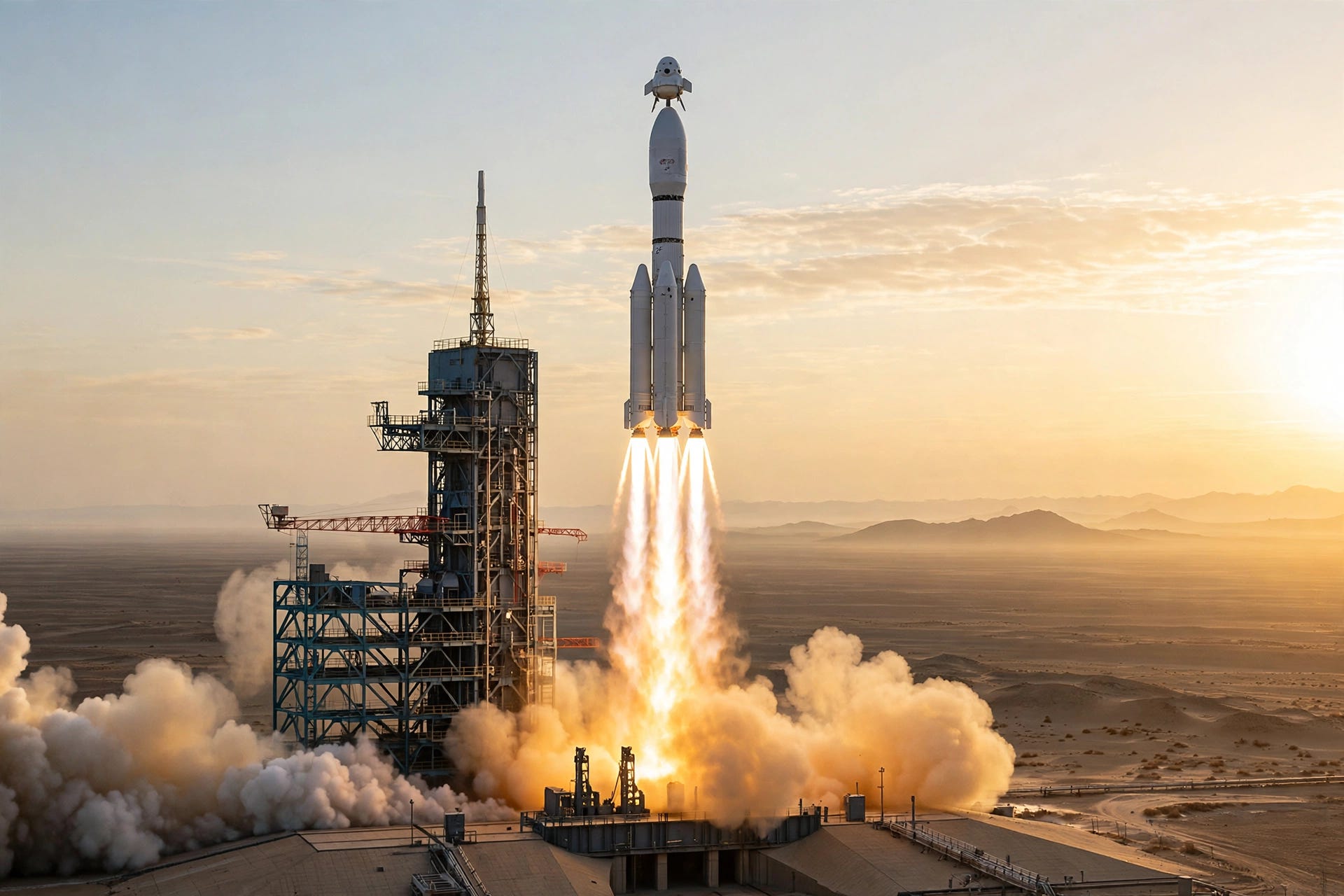
The launch came, as Chinese crewed launches now routinely do, on a timetable stated to the second and then met. At 08:18:52 Beijing time on Wednesday 25 November 2026, Shenzhou-24 lifted off from the Jiuquan Satellite Launch Center in the Gobi Desert of northwestern China, carried by a Long March 2F/G rocket, the Y24 vehicle, from Site 91 in Launch Area 4, according to Xinhua’s launch reporting. About ten minutes after liftoff the spacecraft separated and its solar panels deployed, and the China Manned Space Agency declared the launch a complete success, Xinhua reported.
Those bare mechanics matter because of what was inside the spacecraft. Seated in Shenzhou-24 were three men, only two of them Chinese. The third was a 40-year-old wing commander from the Pakistan Air Force, Muhammad Zeeshan Ali, born on 22 August 1986 in Sargodha, in Punjab, according to the CCTV+ profile cited in the day’s coverage. By the time the solar panels opened, Ali was already something no Pakistani had been before: a Pakistani in orbit. And he was heading somewhere no foreigner had been before at all: Tiangong, China’s space station, whose name means Heavenly Palace.
It is worth pausing on the time itself, because the day that followed was measured, publicly and unusually precisely, in hours and minutes across several capitals at once. The launch at 08:18:52 in Beijing was 00:18 UTC, 05:18 in Pakistan and 19:18 Eastern Standard Time on Tuesday 24 November in the United States, as the mission reporting set out. A story that begins before dawn in Islamabad, in the morning in the Gobi and on the previous evening in Washington is, from its first minute, a story about geography as much as about engineering. Who launches, who rides, who watches and on whose clock are not incidental details of human spaceflight. They are, increasingly, the point.
The BBC made Shenzhou-24 its lead story on 25 November, and Reuters led its account the same way: China’s Shenzhou-24 space flight had taken off with a Pakistani national as the first foreign astronaut on a Chinese crewed mission. That ordering — foreign first, vehicle second — was not a quirk of headline writing. The rocket, the spacecraft and the station have all flown before. What had never happened before was the guest.
China has now flown, according to the mission reporting, its 18th crewed spaceflight and its 24th Shenzhou flight. Shenzhou-24 is the 12th mission to Tiangong and the eighth of the station’s application-and-development phase, NASASpaceFlight reported on 25 November. In a programme that has settled into a rhythm of crew rotations, that sameness is deliberate. A space station is not proved by a spectacular first visit. It is proved by repetition: by rockets rolled out in good time, by a station that adjusts its orbit to receive the next crew, by handovers that become routine enough to carry a cake. And yet inside that routine, on this particular Wednesday, sat a genuine discontinuity.
To understand it, start with the three seats.
The commander who keeps coming back
Tang Hongbo, 51, commanded Shenzhou-24. He had flown on Shenzhou-12 in 2021 and on Shenzhou-17 in 2023-24, and with this launch he became the first taikonaut — the word routinely used in English-language coverage for a Chinese astronaut — to visit Tiangong three times, according to the crew reporting from the China Manned Space Agency’s unveiling at Jiuquan on 24 November. That record is easy to read past. It should not be.
A station that has a repeat visitor in command is a station with a memory. Tang’s presence links three different eras of the same outpost: its early occupation, its settled operations, and now its first opening to a foreign crew member. When a new arrival enters an unfamiliar spacecraft environment, the commander is not simply a pilot. He is the person who knows where things are, how the established crew works, what the unspoken procedures feel like when they are performed rather than described. For a mission whose political meaning depends on everything going smoothly, that experience is a form of insurance.
There is a second, quieter significance. Programmes that are still proving themselves fly their most symbolic missions with their most symbolic people. Programmes that have matured fly them with their most experienced people. Tang’s third visit suggests China regards Tiangong less as a stage to be unveiled again and more as a workplace to be run well. The historic element of Shenzhou-24 was entrusted, in other words, to continuity.
Alongside Tang sat Wu Yi, 39, the flight engineer, a member of China’s third astronaut batch flying in space for the first time, according to the crew announcement reported on 24 November. Every crew rotation mixes memory with renewal, and Wu’s presence supplies the second half of that equation. His first flight is a reminder that even on a day dominated by one man’s first — Ali’s — there were in fact two first flights in the same cabin, arriving by very different routes. One man had come through China’s own astronaut selection and training system. The other had come through an agreement signed in another capital, a selection process run for two candidates, and a training programme that began only in April 2026, as Reuters and Pakistani reporting have described.
The contrast is instructive. China’s crewed programme no longer depends on a handful of irreplaceable figures. It has batches, pipelines and a bench. It can give a first flight to one of its own engineers on the same mission on which it gives a first flight to a foreign guest, without either event crowding out the other. That depth is part of what a guest flight actually tests. Hospitality in orbit is not only a matter of goodwill. It requires spare capacity: in training, in documentation, in food, in language, in the timetable of a station that must keep running its own experiments while accommodating someone else’s.
And then there was the third seat.
The guest in the third seat
Muhammad Zeeshan Ali flew as payload specialist. The title matters, and the rest of this article will return to it, because a payload specialist is not a tourist and not, in the older dismissive phrase, a passenger. According to Zhang Jingbo, the China Manned Space Agency spokesman who briefed reporters at Jiuquan on 24 November, Ali’s work on the station would include installing experiment samples and units, running scheduled tests and joining the routine work of the crew.
Before any of that, though, Ali had already done the piece of work that will be quoted longest. At the pre-launch press conference on Tuesday 24 November, he told reporters, in words carried by Reuters: “I’m not flying for myself. I carry the name of Pakistan on my shoulder.”
It is a carefully chosen sentence, and it deserves to be read carefully rather than merely repeated. Ali did not present the flight as a personal ambition fulfilled, though a fighter pilot who reaches orbit has plainly fulfilled one. He presented it as a representative act. The distinction will sound familiar to anyone who remembers the first spaceflights of other nations, when a single crew member carried, whether they wanted the burden or not, the hopes and the arguments of an entire country. The language of carrying a name on a shoulder is military language — the language of a uniform, of insignia, of a flag worn rather than waved — and Ali is a serving wing commander. He also addressed that press conference partly in Chinese, Pakistan Point reported, a detail that tells its own story about the training behind the flight and about the audience Beijing and Islamabad both had in mind.
Ali’s background, as given in the CCTV+ profile cited in the coverage, is compact: born in Sargodha, a master’s degree, a career in the Pakistan Air Force rising to wing commander. What turned that career toward Jiuquan was a formal agreement. China and Pakistan signed an astronaut cooperation agreement in Islamabad on 28 February 2025, and from a selection process conducted in three stages, two candidates emerged: Ali and Khurram Daud of the Pakistan Navy — spelled Dawood in some Pakistani coverage — who would serve as backup. Both men began training at the Astronaut Center of China in April 2026, working through centrifuge runs, a low-pressure chamber, weightlessness adaptation, spacecraft and station operations, experiment procedures, emergency response and joint exercises, alongside instruction in Mandarin, according to the accounts published by The News and other Pakistani outlets around the launch. Ali was named as the flyer only on 24 November, the day before launch, when the China Manned Space Agency unveiled the crew at Jiuquan.
That late naming is worth noting. Until Tuesday, Pakistan had two trained candidates and China had an announced intention. Only on Tuesday did the mission acquire a face. By Wednesday morning, that face was on front pages well beyond either country.
Three and a half hours to the Heavenly Palace
If the launch was the day’s first set piece, the rendezvous was its technical signature. Shenzhou-24 flew an autonomous fast rendezvous profile and docked at the forward port of Tianhe, Tiangong’s core module, at 11:56 Beijing time — 03:56 UTC — about three and a half hours after liftoff, the China Manned Space Agency reported via Xinhua and Reuters. The crew then entered the station at 14:35 Beijing time, 06:35 UTC, where they were greeted with hugs by the crew of Shenzhou-23, who had prepared a cake for the occasion, according to Reuters’ syndicated reporting.
Three and a half hours from launch pad to docking port compresses what was once the work of days into a single morning. It also changes the human shape of a mission day. Ali did not spend a long, solitary transit contemplating the station ahead of him. He launched at breakfast time in the Gobi, docked before midday, and was inside the station by mid-afternoon, embraced by colleagues who had been in orbit since May. The speed is not a stunt either. A fast rendezvous is a statement about guidance, about confidence in automated systems, and about a programme that flies often enough to treat an accelerated profile as standard practice rather than as a demonstration.
There had been preparation on the station’s side as well. Tiangong adjusted its orbit on 23 November to receive Shenzhou-24, NASASpaceFlight reported, and the rocket had been rolled out on 17 November; the vehicles at Jiuquan had been there since April, stacked and tested in May. None of that is glamorous. All of it is the point. A guest flight arranged as a one-off spectacle might have looked very different. This one was folded into the ordinary machinery of a station programme — the rollout dates, the orbit adjustment, the rotation schedule — and it is precisely that folding-in that makes it significant. China did not pause its station to admit a foreigner. It admitted a foreigner in the course of running its station.
Inside Tianhe, the choreography turned human. The Shenzhou-23 crew — Zhu Yangzhu, Li Jiaying and Zhang Zhiyuan, who had launched on 24 May 2026 and spent six months aboard — had a cake ready, Reuters reported. A cake in orbit is a small thing, and small things are how large claims are made believable. You cannot fake the ease of a welcome. Either a station’s crew has the margin — of time, of supplies, of sheer operational calm — to mark an arrival properly, or it does not.
It was in that setting that Ali said the words that will accompany every retelling of the day. Speaking in Chinese as he entered Tiangong, in remarks carried by CCTV via Reuters, he said: “As the first foreign crew member to board the China Space Station, I am incredibly excited. China Space Station — here I come!”
The exclamation has the ring of a line prepared for a historic threshold, and there is no reason to pretend otherwise; first entries into space stations are not occasions for improvisation. But preparation does not empty a moment of meaning. Ali chose, or accepted, to cross that threshold in the language of his hosts. The Mandarin he had studied since April was not, in that moment, a training requirement being demonstrated. It was the medium of arrival itself.
Three firsts in one flight
It helps to state precisely what Ali is first at, because the day’s coverage, in its excitement, occasionally blurred distinctions that matter — and because Ali himself, and those who prepared the way before him, deserve the precision.
He is the first Pakistani in orbit. He is the first foreign astronaut to visit Tiangong. And he is the first foreigner ever launched on a Chinese crewed mission, on what the mission reporting counts as China’s 18th crewed spaceflight. Three firsts, each distinct, each true on the facts reported by Reuters, the BBC and SpacePolicyOnline on 24 and 25 November.
The first of them requires one careful qualification, and the coverage that handled it best made the point explicitly. Pakistan-born Namira Salim flew suborbitally with Virgin Galactic in 2023, as Space.com and the pre-launch explainer reporting noted. A suborbital flight crosses the boundary of space and returns without completing an orbit of the Earth; it is a real spaceflight, and Salim’s place in Pakistan’s space story is secure. But orbit is a different physical and operational condition — a spacecraft in orbit has the velocity to keep falling around the planet, to rendezvous with a station, to dock, to live and work there for days. Ali is the first Pakistani to do that. Holding both facts at once — honouring the suborbital pioneer while naming the orbital first accurately — is not pedantry. It is how a country’s space history gets written properly, and it is how this flight will be remembered: not as the moment Pakistan first touched space, but as the moment Pakistan first stayed there, however briefly, and worked there.
The second first — first foreigner aboard Tiangong — is in some ways the most consequential of the three. Stations define eras in human spaceflight. For more than two decades the International Space Station has been the destination, and its partnership has defined who belongs to the club of spacefaring nations and on what terms. China was never part of that partnership. The Wolf Amendment, passed in the United States in 2011, bars NASA from bilateral cooperation with China without authorisation from the FBI and Congress, and China built its own station instead. Tiangong’s Tianhe core module was launched in 2021, and the station was completed in November 2022 with the Wentian and Mengtian laboratory modules, as the background reporting rehearsed this week. It has been continuously crewed since 2022. Until Wednesday, however, every person who had entered it had been Chinese. A station visited only by its builders is a national outpost. A station that receives a guest begins, however tentatively, to become something else.
The third first — first foreigner launched on a Chinese crewed mission — completes the picture, because visiting a station as a guest of its owners is a stronger act of trust than visiting it aboard one’s own vehicle. Ali did not arrive in a Pakistani spacecraft, for the simple reason that Pakistan has none. He arrived in a Shenzhou, launched on a Long March, trained in a Chinese facility, working from manuals that the Astronaut Center of China had prepared in Chinese and English, and eating halal space food prepared for the mission, according to The News. Every layer of the flight, from the rocket to the menu, ran through Chinese systems — and China opened every one of those layers to him. That is the fact at the centre of the day.
Why a week is not a stunt
The obvious sceptical question about Shenzhou-24 deserves to be asked plainly, because the rest of this piece exists to answer it: Ali will stay aboard Tiangong for only about a week — Reuters put the expected stay at five to ten days — before returning to Earth aboard Shenzhou-23 with Zhang Zhiyuan and Li Jiaying. Is a visit that short a historic event, or is it a photograph with a rocket attached?
Start with what the shortness actually consists of. Ali is not orbiting alone for a week and coming home. He is slotting into a crew rotation of unusual complexity, described in detail by SpacePolicyOnline on 24 November. The Shenzhou-23 crew has been aboard for six months. When Shenzhou-23 departs, it will carry Ali home along with two of that crew, while the third, Zhu Yangzhu, transfers to Shenzhou-24 and remains aboard for a further six months — becoming, in the process, the first Chinese astronaut to make a planned year-long single stay in orbit. Li Jiaying, who will fly home with Ali, is herself the first woman taikonaut from Hong Kong, SpacePolicyOnline noted. In other words, the guest’s week is woven into a handover in which China is simultaneously extending its own endurance record and rotating a crew that includes a Hong Kong first of its own. Ali’s short stay is not a detour from the station’s serious business. It is timed inside it.
Then consider the work. A stunt does not require a payload. Ali’s flight carries one in his own job description and in the experiments he brought with him. Four Pakistani biotechnology experiments were selected by Chinese institutions from more than 300 proposals submitted to Pakistan’s space agency, SUPARCO, by universities across the country, with a focus on food security and climate change, SUPARCO officials told Reuters; among them is an in-orbit experiment on photosynthetic microorganisms — cyanobacteria — according to SUPARCO’s account carried in Pakistani coverage. Mission-wide, Xinhua put the number of experiments and technology tests on Shenzhou-24’s list at about 90, as reported in Pakistani coverage of the launch. SUPARCO has said that completing the four joint experiments could take six to twelve months: Ali starts work that will continue long after his week ends and his seat flies home without him. The guest leaves; the science stays. That asymmetry is the opposite of a stunt’s logic, in which everything ends when the cameras do.
Consider, too, the cost of the preparation, measured not in money — no figure for the mission was reported, and none should be invented — but in institutional effort. Two candidates trained, not one, so that a backup existed whose work would, in the happy event, never be seen. Manuals were produced bilingually. Food was prepared to a religious requirement. A spokesman for the China Manned Space Agency stood before reporters and described, in operational language, what the foreign crew member would actually do: install samples, run tests, join routine work, in Zhang Jingbo’s words at the 24 November briefing. Institutions do not build that kind of scaffolding for a photograph. They build it when they intend, or at least wish to be able, to do the thing again.
And consider, finally, what the flight demonstrates to its real audience. The BBC’s China correspondent Laura Bicker, in the analysis published alongside the BBC’s news coverage on 25 November, framed the flight as a big political statement: China wants Tiangong to be seen as an international research facility, not an exclusively Chinese one, and is offering partner nations something comparable to what the United States has long offered through its own programme. That framing explains why a week is enough. A proof of concept does not need to be long. It needs to be complete. Launch, rendezvous, docking, entry, work, and — still to come, in early December by the logic of the rotation, though no exact departure date has been announced — a safe return aboard a different spacecraft from the one he arrived in. If every element of that chain succeeds, the argument is made in full: a foreign astronaut can be trained, launched, hosted, worked and brought home entirely within China’s system. The duration is a detail. The completeness is the claim.
There is a comparison available that Pakistani coverage itself has reached for, and it clarifies the scale of the claim. Foreign guest astronauts are an old tradition aboard the International Space Station, which has hosted dozens of partner-nation astronauts over its life. India’s Rakesh Sharma flew on a Soviet mission in 1984, and Shubhanshu Shukla flew to the ISS on Axiom Mission 4 in 2025 — the regional precedents most often invoked alongside Ali’s flight. The pattern in each case is the same: an established space power lends its system to a partner, and the partner’s first flight becomes a national landmark precisely because it happens inside someone else’s machinery. What is new at Jiuquan is not the pattern. It is the identity of the host. For the first time, the machinery is China’s.
The watchers
A first flight is also a public event, and the public side of this one was organised with the same care as the orbital side. In Islamabad, watch gatherings were held at SUPARCO’s headquarters, with chants of “Long live Pakistan-China friendship” reported by Pakistan’s Press Association reporting carried alongside Reuters’ coverage. Prime Minister Shehbaz Sharif congratulated the nation in a statement from his office and in a post on X on 25 November that Reuters quoted: “This is not just one astronaut’s journey, but the journey of 240 million Pakistanis. It is the journey of our younger generation, our scientists and our dreams.” In the same post, Sharif called the flight “living proof of the ironclad friendship between Pakistan and China” and thanked China for making Pakistan part of the mission. His office’s statement, carried by TechJuice, added the line that will likely outlast the day’s other rhetoric: “If a Pakistani can reach a space station today, a Pakistani will reach the Moon tomorrow.”
President Asif Ali Zardari and President Xi Jinping exchanged congratulatory letters, Zardari’s office reported via the Press Association. And at Jiuquan itself stood Ahsan Iqbal, Pakistan’s planning minister, who had travelled to the launch site and who spoke, in remarks reported from the site, about hoping for further cooperation, potentially including a joint lunar mission. “The sky is no longer our limit, it is our launching pad,” Iqbal said. Asked whether Pakistan could one day send astronauts independently, he answered: “Certainly that day will come.”
It would be easy to file all of this under ceremony and move on. That would be a mistake, for two reasons. The first is that the rhetoric, read closely, is unusually specific about the future. Sharif’s statement reaches for the Moon. Iqbal, standing at the launch site, reached for the same destination and for independent capability beyond it. These are not claims that anything has been agreed — Iqbal spoke of hopes, and hopes are what he called them — but they mark the direction in which both governments want the story to travel, in a year that marks 75 years of diplomatic relations between Pakistan and China.
The second reason is the audience at home. Behind the officials stood the constituency that had, in a literal sense, contributed cargo to the flight: the university researchers across Pakistan who submitted more than 300 experiment proposals to SUPARCO, of which four were chosen. A guest flight that carries a nation’s students’ science is a different public object from a guest flight that carries only a flag. It gives the celebration a working core. Somewhere in Pakistan this week are laboratories whose proposals did not fly and laboratories whose did, and both now know the route by which such work reaches orbit: not through a national launcher that does not exist, but through a partnership that, as of Wednesday, demonstrably does.
The full-length video coverage of the day told a similar story in a different medium. Space.com’s VideoFromSpace channel published the launch under the title “Blastoff! China Launches Shenzhou-24 with Nation’s First Foreign Astronaut,” a full replay of the launch credited to CCTV circulated the same day, and CRUX carried live coverage framed around the same fact: the first foreign participation in Beijing’s crewed programme. Across outlets that agree about little else, the framing converged. The foreigner was the story.
A day measured in minutes
There is a reason the launch-day reporting reads, in places, like a railway timetable, and it is worth dwelling on before the week takes over. Liftoff at 08:18:52. Separation about ten minutes later. Docking at 11:56. Entry at 14:35. Each of those times was reported by the China Manned Space Agency through Xinhua and carried by Reuters within the day, and together they describe a mission conducted almost entirely in public and almost entirely to schedule. For a flight carrying this much symbolic weight, predictability is itself a message. A programme that wanted merely to be seen attempting something historic might have tolerated drama. This programme produced a timetable and then kept it, from the rollout of the rocket on 17 November, through the station’s orbit adjustment on 23 November, to the crew unveiling on 24 November and the launch the following morning, as NASASpaceFlight’s reporting laid out.
The unveiling deserves a moment of its own in the day’s chronology, because it was the hinge between preparation and performance. Until 24 November, the mission existed publicly as an agreement, a selection and a training programme. At Jiuquan that day, spokesman Zhang Jingbo presented three named men, assigned them their roles — commander, flight engineer, payload specialist — and described, in plain operational terms, what the foreign member of the crew would do aboard the station. It was also the occasion of Ali’s Tuesday line about carrying Pakistan’s name on his shoulder, delivered to reporters the day before he flew. The sequence is characteristic: first the institution speaks, then the man speaks, then the rocket speaks. By the time Shenzhou-24 lifted off, almost everything that could be said about it in advance had been said, by the people responsible for it, on the record. What remained was only for the flight to happen — which is to say, for the risk to be taken. All the language in the world does not dock a spacecraft. At 11:56 on Wednesday, the spacecraft docked, and the language was retired in favour of fact.
Set against that precision, the few things the day did not settle stand out more clearly. No exact date was announced for Shenzhou-23’s departure with Ali aboard. No second guest nation was named. No figure was put on what the cooperation costs either side. Those absences are not failures of the day; they are its honest edges. A first flight answers the question of whether a thing can be done. It leaves open — deliberately, in this case — the questions of how often, for whom and on what terms it will be done again. Readers who want the whole story settled by Wednesday evening will be disappointed. Readers who understand how space programmes actually change will recognise the shape: a door opened once, on the record, to the minute, with everything after that still to be negotiated.
One more feature of the day should not be lost in the timetable. Shenzhou-24 was, as NASASpaceFlight noted, the eighth mission of Tiangong’s application-and-development phase — the phase in which the station is no longer being built but used. Guest flights belong to that phase by definition. You do not invite a foreign colleague into a construction site; you invite them into a laboratory. Ali’s experiments, chosen from a national competition of proposals and aimed at food security and climate change, are application-and-development cargo in the most literal sense. The day he arrived, the station’s purpose and his purpose were the same: not to prove that Tiangong exists, but to show what it is for, and to begin widening the circle of those it is for. That is the context in which a cake, a hug and a sentence in Chinese become more than colour. They are the social technology of a working station, performed by a crew that had been in orbit for six months for a colleague who would stay for a week — the strong, in the ordinary course of their work, making room for the new.
By mid-afternoon on Wednesday, the drama of arrival was over and the unglamorous part — the part that will decide what this flight actually was — had begun. Ali is aboard Tiangong for roughly a week, on the five-to-ten-day span Reuters reported, as a working member of a station crew that, for a few days, numbers six: Tang, Wu and Ali of Shenzhou-24 alongside Zhu, Li and Zhang of Shenzhou-23. His tasks, as Zhang Jingbo described them before launch, are the tasks of a payload specialist anywhere: install the experiment samples and units, run the scheduled tests, join the routine work. Among the samples are the beginnings of the four Pakistani biotechnology experiments, with their bearing on food security and climate change, and the photosynthetic microorganism work that SUPARCO has described — experiments whose timelines run to six or twelve months, long past their initiator’s departure.
His departure, when it comes, will be its own small landmark. Ali will not return in the spacecraft that carried him up. He will board Shenzhou-23 — the vehicle that has been docked at Tiangong since the spring — with Zhang Zhiyuan and Li Jiaying, leaving Zhu Yangzhu behind to begin the second half of a year in orbit. Riding up in one ship and down in another is the ordinary practice of station rotations, but for a first guest it closes the demonstration neatly: Ali will have been, in sequence, a trainee in China’s system, a launch passenger in China’s newest visiting vehicle, a worker on China’s station and a return passenger in China’s longest-serving one. No exact date for the Shenzhou-23 departure has been announced, and any account that gives one is guessing; early December is the expectation set by the week’s length, nothing more.
What to watch in the coming days is therefore not spectacle but texture. Watch whether the experiment work is reported in the same operational detail as the arrival — samples installed, tests run, results described. Watch what is said, and by whom, about a second flight: China has promoted cooperation with developing countries in its crewed programme, but no second guest nation was named in any of the launch-day sources, and the honest position is that the next guest, if there is one, is still an open question. Watch, too, the quieter milestones travelling with this mission — a Hong Kong taikonaut’s first flight already completed, a year-long stay now beginning — because they reveal the station programme’s own priorities continuing undisturbed around its famous guest.
There is, finally, the simplest measure of the day, and it is the one Sharif reached for in his post on X: 240 million people. Pakistan is one of the most populous countries on Earth, and until Wednesday none of its citizens had ever been in orbit. Whatever arguments strategists make about stations and successions, and whatever sceptics reply about the brevity of the stay, that arithmetic changed at 08:18:52 and cannot change back. A generation of Pakistani students — including the ones whose 300 or more proposals were winnowed down to the four experiments now beginning their long run aboard Tiangong — woke up on Tuesday in a country that had never placed a person in orbit, and went to bed on Wednesday in one that had. First flights do that work in every country that has one. It is not the whole of what Shenzhou-24 means, but it is the part that will be felt first, and remembered longest, in the place Ali said he was carrying on his shoulder.
And hold, underneath all of it, the question this piece set out to answer. A Pakistani pilot spent Wednesday morning crossing a threshold that had stood closed for the entire history of China’s space station: the threshold between a national programme and an international one. He crossed it in about three and a half hours of flight and a sentence spoken in Chinese, carrying four experiments, the name of his country on his shoulder, in his own words, and the congratulations of two presidents in his wake. Whether the door he walked through stays open — for Pakistan again, or for anyone else — is a question for the months ahead. That it opened at all, completely and without incident, on a Gobi Desert morning at 08:18:52, is now a matter of record.
An Agreement Signed in Islamabad
Every historic flight has a paperwork beginning, and this one began not on a launch pad but in Islamabad. According to the research record for this mission, China and Pakistan signed an astronaut cooperation agreement in Islamabad on 28 February 2025. That date matters because it converts what might otherwise look like a sudden invitation into something else entirely: a planned, negotiated, and scheduled piece of cooperation, set in motion well before any crew was named, any rocket was rolled out, or any camera was pointed at the Gobi Desert.
An agreement of that kind does more than announce goodwill. It creates the legal and institutional space in which everything else becomes possible. It allows candidates to be nominated and screened. It allows training facilities in one country to open their doors to officers from another. It allows experiment proposals to be solicited, judged, and flown. It allows flight surgeons, engineers, translators, and mission planners to begin working to a common timetable. Without such a document, a guest flight is a gesture. With it, a guest flight becomes a programme.
That distinction is central to understanding Muhammad Zeeshan Ali’s week aboard Tiangong. Reuters, in its coverage of the launch on 25 November 2026, presented Ali not as a last-minute passenger added for symbolism, but as a payload specialist with assigned work, selected through a formal process and trained inside China’s own astronaut system. The China Manned Space Agency, through its spokesman Zhang Jingbo at the crew unveiling in Jiuquan on 24 November, described that work in practical terms: installing experiment samples and units, running scheduled tests, and joining the routine work of the crew. Those are not the duties of a tourist. They are the duties of a working crew member who happens to have arrived from another country’s air force.
The February 2025 agreement therefore deserves to be read as the true start of the mission. Long before Shenzhou-24 lifted off at 08:18:52 Beijing time on Wednesday 25 November 2026, as Xinhua reported, the decision had already been taken in principle that a Pakistani would fly, that China would train him, and that Pakistan’s own space agency, SUPARCO, would have a scientific stake in what he did once he arrived. The launch was the visible culmination. The agreement was the cause.
There is also a diplomatic weight to the timing that the research record makes plain. The year 2026 marks 75 years of diplomatic relations between Pakistan and China, a fact noted in the official reactions that followed the launch. An anniversary alone does not put a person in orbit. But it does help explain why this particular partnership, between these two particular states, produced the first foreign visit to Tiangong rather than any other. The astronaut programme grew out of a relationship that already had decades of infrastructure, defence, and economic cooperation behind it. Space, in this case, was not a new friendship. It was a new height for an old one.
For Pakistan, signing such an agreement also meant accepting a particular kind of dependence, and doing so openly. Pakistan does not currently launch its own astronauts. It does not operate its own space station. What it could offer this mission was a trained officer, a national scientific community capable of proposing experiments, and a space agency with a history stretching back to 1961. What China could offer was everything else: the rocket, the spacecraft, the station, the training centre, and the mission control system that holds a crewed flight together. The agreement acknowledged that asymmetry and turned it into a division of labour rather than a barrier.
That is how guest flights have generally worked in human spaceflight. One partner builds and operates the vehicle. Another partner contributes people, science, and political commitment, and learns — from the inside — how a crewed programme actually runs. The value to the guest nation is not only the photograph of its flag inside a station. It is the knowledge carried home by the person who flew: how training is sequenced, how emergencies are rehearsed, how experiments are handled in weightlessness, how a crew divides its day. None of that can be learned from a press release. All of it begins, formally, with an agreement signed on the ground.
Two Names Through Three Doors
From that agreement came a selection process that, according to the mission record, ran through three screening stages. Two candidates emerged from it to begin training in China: Muhammad Zeeshan Ali of the Pakistan Air Force and Khurram Daud of the Pakistan Navy — spelled Dawood in some Pakistani coverage, a variation the research record itself notes. Ali is a wing commander, aged 40, born on 22 August 1986 in Sargodha, in Punjab, and holding a master’s degree, according to the CCTV+ profile cited in the research. Those few biographical facts are worth pausing over, because they describe the kind of person both countries were looking for.
A wing commander is not a novice. The rank implies years of operational flying, of responsibility for other people in demanding machines, and of the kind of disciplined calm that astronaut selection processes everywhere tend to prize above brilliance alone. A master’s degree signals the other half of the requirement: the ability to understand, and not merely operate, the scientific work that justifies a seat on a station. A payload specialist who cannot follow the reasoning behind an experiment is only an extra pair of hands. A payload specialist who can follow it becomes part of the experiment itself.
The three-stage structure of the selection also tells its own story. A single interview does not produce an astronaut. Successive stages, by their nature, test different things and remove candidates for different reasons: medical fitness, psychological resilience, technical aptitude, the capacity to learn new systems, and the capacity to learn them in another language and another institution’s culture. The research record does not invent scores or name those who fell away at each stage, and neither should this account. What can be said, on the record available, is that the process was staged, competitive, and joint — and that at its end it produced not one name but two.
That second name matters more than public attention usually allows. Ali and Daud trained together from April 2026 at the Astronaut Center of China. Only on 24 November 2026, the day before launch, when the China Manned Space Agency unveiled the Shenzhou-24 crew at Jiuquan, was Ali confirmed as the man who would fly. Daud became, in the language of spaceflight, the backup. The distinction between them was real — one would board the spacecraft and one would not — but it was a distinction made at the end of a shared road, not at its beginning. For more than a year and a half after the agreement, and for well over a year of formal training, Pakistan’s first astronaut programme had two faces, not one.
There is a quiet logic to selecting two and flying one. A crewed launch cannot be postponed indefinitely because a single individual develops a minor illness, sustains a minor injury, or fails a final medical check. The backup exists so that the mission does not depend on the health and readiness of one body on one morning. He must therefore train as if he will fly, because until the final announcement — and in practical terms until the rocket leaves the pad — he might. That requirement shapes everything about how a backup’s months are spent, and we will return to Daud’s invisible job in its own right below.
For now, it is enough to note what the selection says about Pakistan’s intentions. A country seeking only a headline could have sought a single celebrity candidate and a short preparation. Instead, according to the record, it put candidates through three stages, sent two officers to China, kept both in training through to the eve of launch, and accepted that one of them would do all the work of preparation without the reward of flight. That is the behaviour of an institution trying to learn how astronaut selection works, not merely to borrow its result. The knowledge of how to choose will remain in Pakistan long after Shenzhou-24 has landed, available for a second flight, or a fifth, in a way that a one-off appointment never could be.
It also says something about China’s approach. Opening a selection and training pipeline to a foreign partner is a deeper commitment than offering a finished seat. It requires sharing procedures, standards, and facilities. It requires trusting a partner’s officers inside the system that China built, over decades, for its own taikonauts. Zhang Jingbo’s briefing role at Jiuquan on 24 November, as spokesman for the China Manned Space Agency, was the public face of that system. Behind the briefing stood a much larger fact: the system had, for the first time, processed a foreigner all the way through to a launch.
Learning to Fly Someone Else’s Spacecraft
Training began in April 2026 at the Astronaut Center of China. The research record lists the elements plainly, and each element deserves to be understood rather than merely recited: centrifuge training, a low-pressure chamber, weightlessness adaptation, spacecraft and station operations, experiment procedures, emergency response, joint exercises, and Mandarin instruction. Taken together, they describe the transformation of an experienced military pilot into a crew member for a spacecraft he did not grow up in, operated by an agency that is not his own, in a language that is not his first.
Centrifuge training addresses the most physical fact of launch and return: acceleration. A rocket does not gently persuade its crew into orbit. It presses them into their couches with forces several times their own body weight, and a returning capsule can impose its own harsh loads. The centrifuge is where a trainee learns, in his own body, what those forces feel like, how breathing and vision are affected, and how to keep functioning while they last. For a fighter pilot such as Ali, acceleration itself would not be a new sensation. What is new is the profile: the particular sequence, duration, and direction of forces imposed by a Long March launch and a Shenzhou return, in a seated position, in a pressure suit, with no control over the vehicle. Experience helps. It does not remove the need to rehearse the specific case.
The low-pressure chamber addresses a different danger, one measured in thin air rather than heavy air. A spacecraft cabin, a spacesuit, and the procedures that connect them all depend on pressure behaving as expected. Training in reduced pressure teaches a crew member to recognise the early signs of decompression and hypoxia — the shortage of oxygen whose most treacherous feature is that it can impair the very judgement needed to notice it — and to respond with drilled actions rather than improvised ones. In orbit, there is no stepping outside for fresh air. The response has to be correct the first time.
Weightlessness adaptation is, in its own way, the strangest item on the list, because nothing on Earth fully reproduces living and working without gravity. Training can introduce the sensation in brief episodes and teach the principles that govern movement, orientation, and the handling of objects when nothing stays where it is put and every push sends the pusher in the opposite direction. What it cannot do on the ground is provide a week of continuous practice. That is why the first days aboard a station are always, for a new flyer, a period of learning inside the real environment — and why a guest who stays only about a week, as Reuters reported Ali would, must arrive with his procedures so well learned that adaptation does not consume the short time available for work.
Spacecraft and station operations form the technical core of the syllabus. Shenzhou is the vehicle that carries a crew to Tiangong and brings a crew home. Tiangong itself, with its Tianhe core module and its Wentian and Mengtian laboratory modules, is the workplace. A visiting crew member must know how to move between them, how hatches, systems, and routines are organised, and where his responsibilities begin and end within a division of labour led, on Shenzhou-24, by Commander Tang Hongbo. Tang, at 51, had flown on Shenzhou-12 in 2021 and Shenzhou-17 in 2023–24, and with this mission became the first taikonaut to visit Tiangong three times, according to the mission record. To train under and alongside that level of experience is to be inducted into a mature operational culture, not a demonstration project.
Experiment procedures connect the general training to Ali’s specific assignment. A payload does not run itself because it has reached orbit. Samples must be installed correctly. Units must be configured in the right order. Tests must be run on schedule, observed, and recorded in ways that allow scientists on the ground to trust the result. The research record, citing Zhang Jingbo’s 24 November briefing, puts exactly those tasks at the centre of Ali’s role. Training for them in advance, on the ground, with the actual procedures he would follow in orbit, is what turns a short stay into a productive one. In a six-month mission, a crew member can afford a slow first fortnight. In a stay of roughly five to ten days, as Reuters described the range for Ali’s visit, there is no such margin. The learning curve has to be climbed before launch so that the working curve can begin on arrival.
Emergency response and joint exercises complete the picture, and they are inseparable from each other. An emergency aboard a station — a pressure alarm, a fire warning, a problem with a docked vehicle — is never a solo performance. It is a crew procedure, executed by people who must know not only their own actions but each other’s, and who must be able to perform them under stress, in a confined space, without debate about who does what. Joint exercises are where a guest stops being a guest in the operational sense. If Ali could not be trusted inside the crew’s emergency routines, he could not safely be inside the station at all. That he completed joint training with his Chinese crewmates is therefore one of the most significant facts in the whole preparation story, even though it attracts none of the attention given to the launch itself.
Then there is the Mandarin instruction, listed in the record alongside the centrifuges and chambers as if it were simply another technical subject — which, in an important sense, it is. A spacecraft is a linguistic environment as well as a mechanical one. Labels, checklists, spoken procedures, and the ordinary conversation of a crew all carry safety information. Ali addressed the pre-launch press conference partly in Chinese, according to Pakistan Point reporting cited in the research, and on entering Tiangong he spoke in Chinese — “China Space Station — here I come!” — in the words carried by CCTV via Reuters. Those public moments were warmly received, but they rested on a practical foundation. Language training reduced the friction of every other kind of training. It allowed instruction to be absorbed more directly, procedures to be understood more precisely, and camaraderie — no small asset in a confined station — to develop without everything passing through translation.
It is worth stepping back from the list to see its cumulative meaning. From April 2026 to November 2026, two Pakistani officers were absorbed into the daily reality of China’s astronaut system. They were not given a ceremonial tour of it. They were put through its physical trials, its technical syllabus, its emergency drills, and its language. When the China Manned Space Agency finally named Ali as the flyer on 24 November, it was certifying the outcome of that process to the world. The certificate mattered to China as well as to Pakistan: a foreign crew member who was visibly underprepared would have endangered the mission and the reputation of the station. A foreign crew member who arrived ready to work made a different statement — that Tiangong’s doors could open without its standards dropping.
Manuals, Meals and the Work of Belonging
Some of the most revealing details in the preparation record are also the smallest. According to The News, in its Pakistani coverage of the mission, the Astronaut Center of China prepared Chinese–English operating manuals for the visiting programme and prepared halal space food for its Muslim crew member. Neither detail involves a rocket. Both involve something a rocket cannot provide: the feeling, and the practical reality, of being expected.
An operating manual is where a space programme keeps its distilled experience. It records not only what a switch does, but the order in which things are done, the checks that surround them, and the warnings accumulated from previous flights. To prepare bilingual manuals for a foreign participant is to do translation work at the level where translation is hardest — technical language, where an imprecise word can produce an imprecise action. It is also to make a judgement about access. A guest who works only through an interpreter remains at one remove from the machine. A guest who can read the procedure himself, in a language he commands, while seeing the Chinese terminology alongside it, is being equipped to act.
The choice of Chinese–English manuals, rather than an assumption that Mandarin instruction alone would suffice, reflects the layered way Ali’s preparation actually worked. He learned Mandarin, and used it publicly and, no doubt, practically. But fluency sufficient for a press conference greeting and fluency sufficient for every technical contingency are different achievements, and a serious programme does not gamble a mission on conflating them. The manuals provided a bridge: English for precision where it was needed, Chinese for integration into the system as it actually runs. That combination — respect for the host’s language, without pretence that a year and a half can replace a lifetime in it — is a small model of how the whole cooperation functioned.
Halal food carries a similar double meaning. At the practical level, a crew member must eat, and must eat food that meets his religious requirements, prepared and packaged for spaceflight. At the human level, the provision says that the host programme considered who its guest actually was, rather than treating him as an interchangeable occupant of a seat. Space food is never merely nutrition. It is one of the few comforts of ordinary life that survives translation into orbit, and one of the strongest reminders of home available inside a metal station circling far above it. For a first foreign crew member, in a programme making its first attempt at hosting one, getting the food right was both logistics and diplomacy in the same package.
These details also answer, quietly, a question that sceptics of guest flights often raise: whether the visitor is integrated or merely accommodated. Accommodation puts a person in a seat. Integration rewrites the manual, adjusts the menu, teaches the language, and drills the emergency procedure until the visitor is part of how the crew would respond on its worst day. On the evidence in the research record — bilingual manuals, halal provisions, Mandarin instruction, joint exercises — Shenzhou-24’s preparation pointed toward integration. The point is not that every difficulty vanished. It is that the difficulties were anticipated by institutions, in advance, on paper and in kitchens, rather than left for the crew to improvise around in orbit.
There is a broader lesson here for any future guest programme aboard Tiangong. The hard part of opening a station to the world is not the announcement. Announcements are easy, and they travel at the speed of a press release. The hard part is the accumulation of unglamorous adaptations that make a foreign crew member safe, useful, and at ease: documents, diets, terminology, training schedules, medical standards, and the hundred other interfaces between a person from one system and a machine from another. China and Pakistan have now worked through that list once, together, from February 2025 to November 2026. Whatever happens next, that worked-through list exists. It can be revised, improved, and used again. In that sense, the manuals may outlast the mission that produced them.
The Man Who Trained and Did Not Fly
Khurram Daud’s part in this story is easy to summarise and hard to appreciate. He was selected, through the same three stages. He began training at the Astronaut Center of China in April 2026, alongside Ali. He prepared, in other words, to become the first Pakistani in orbit — and then, on 24 November 2026, the name announced at Jiuquan was not his. He is recorded in the research as the backup. History, which prefers single names and clean firsts, will mostly remember the other one.
That is unfair, but the unfairness is structural rather than personal, and Daud would have known it from the day he accepted the role. A backup is not a runner-up in a talent contest. He is an insurance policy with a heartbeat, and the value of the policy depends entirely on his being genuinely ready to fly. If the designated crew member had been unable to go — for a medical reason discovered in the final days, an illness, an injury in training’s last phase — the mission’s Pakistani element would not have been cancelled or filled by a stranger. Daud would have stepped into the seat, carrying the same training, the same experiment procedures, and the same national expectation. The entire credibility of that arrangement rests on the backup’s preparation being real.
Consider what that requires psychologically. Every centrifuge run, every chamber session, every emergency drill, every Mandarin lesson had to be undertaken with full commitment by a man who knew the odds favoured his watching the launch rather than riding it. There is no partial way to train for orbit that still leaves a person safe to send. Daud’s months in China therefore represent a particular kind of service: excellence performed without the expectation of recognition, in support of a colleague who was also, inevitably, a rival for the single seat. The two men trained together through that tension. That they did so, within a joint programme run by a third institution, says a great deal about the professionalism on which the whole enterprise depended.
The backup’s role also continues after the crew announcement. Until Shenzhou-24 was safely in orbit and docked — which, as Xinhua and Reuters reported, it achieved at 11:56 Beijing time on 25 November, roughly three and a half hours after launch — the possibility of a late substitution, however remote, is part of the architecture of a crewed programme. And beyond this single mission, Daud now constitutes something Pakistan has never previously possessed: a second fully trained astronaut. If a further Pakistani flight is ever agreed — and Pakistan’s planning minister, Ahsan Iqbal, speaking at Jiuquan, expressed hope for further cooperation, as the research record notes — the country does not start from zero. It starts from a man who has already done the training once.
Programmes are built out of such reserves. The first flight makes the headline, but the second trained person makes the programme plausible. When future accounts of Pakistan’s human spaceflight efforts are written, the honest version will record that in November 2026 Pakistan did not produce an astronaut. It produced two, and flew one. The distinction is not a consolation prize. It is the difference between an event and a capability.
A Rotation Built Like Clockwork
Ali’s visit was short. The machinery that made it possible was not, and understanding his week requires understanding the crew rotation into which it was inserted — a rotation that SpacePolicyOnline, in its 24 November 2026 account, described with particular precision.
Tiangong has been continuously crewed since 2022, according to the mission record, and it stays that way through overlapping handover: a new Shenzhou crew arrives before the old one leaves, so that the station is never empty and knowledge passes directly from the departing crew to the arriving one. Shenzhou-24 was the twelfth mission to the station and the eighth of its application-and-development phase, as NASASpaceFlight reported. By November 2026, in other words, this was not an experimental rhythm. It was a routine, and Ali’s flight was folded into the routine rather than staged outside it. That, too, is part of the story’s significance. A special, one-off guest flight would have proved that China could mount a spectacle. A guest flight inside the ordinary rotation proved that a foreigner could be absorbed into the normal running of the station.
The crew Ali was joining had been in orbit for six months. Shenzhou-23 launched on 24 May 2026, at 23:08 Beijing time, carrying Zhu Yangzhu, Li Jiaying, and Zhang Zhiyuan. By the time Shenzhou-24 docked at the forward port of the Tianhe core module on 25 November, that trio had lived and worked aboard Tiangong for half a year. They were, by any measure, the experienced residents. It was they who greeted the new arrivals when the crew entered the station at 14:35 Beijing time, with hugs, and who had prepared a cake for the occasion, as Reuters’ syndicated reporting described. The cake is a small detail, but it captures the handover’s human texture: six people, for a brief overlap, sharing a station built for a smaller crew, marking a first that belonged to one of them and, in a sense, to all of them.
The rotation then divided in an unusual way. Ali would not return on the spacecraft that carried him up. Instead, after his stay of about a week, he is to return aboard Shenzhou-23, together with Zhang Zhiyuan and Li Jiaying. The logic is the logic of seats and vehicles that governs all station operations. A Shenzhou spacecraft serves both as transport and as lifeboat for the crew assigned to it, and its time in orbit is bounded. Shenzhou-23 had been docked since May; its crew’s six months were complete; its departure would close that expedition. By taking a seat in the departing vehicle, Ali’s short visit could be attached to a return that was already scheduled, while Shenzhou-24 remained docked as the fresh vehicle for the crew staying on.
Li Jiaying’s presence in that returning crew carries its own first. According to SpacePolicyOnline, she is the first woman taikonaut from Hong Kong. Her six months aboard Tiangong, from May to the turn of December, formed part of the expedition Ali briefly joined, and her return alongside him means that the Shenzhou-23 landing will carry two distinct chapters of widening access to China’s station: a Hong Kong woman completing a long-duration mission, and a Pakistani officer completing the first foreign visit. Neither diminishes the other. Together they describe a programme whose definition of who belongs in its crews has been expanding along more than one axis at once.
Commander Tang Hongbo’s side of the rotation deserves a final note in this section, because continuity needs a carrier. Tang had visited Tiangong on Shenzhou-12 and Shenzhou-17 before commanding Shenzhou-24, making him, on the mission record, the first taikonaut to visit the station three times. When a first-time foreign guest and a first-time flyer such as Wu Yi — 39 years old, from China’s third astronaut batch, on his first spaceflight, according to the crew profiles in the research — arrive at a station, the commander’s accumulated familiarity with that specific place is a form of safety equipment in itself. He knows its sounds, its routines, its quirks. The rotation system ensures that such knowledge is never entirely absent from orbit. In November 2026, it also ensured that Ali’s introduction to Tiangong was guided by the man who knew it best.
The Year-Long Stay Hidden Inside a One-Week Visit
The most consequential personnel decision on Shenzhou-24 may not, in the long run, be the guest flight that made the world’s front pages. It may be the one that almost no headline mentioned: Zhu Yangzhu, who arrived aboard Shenzhou-23 in May 2026, is transferring to the Shenzhou-24 crew for a further six months. In doing so, according to the mission record, he will complete China’s first planned year-long single stay in orbit.
A year in space is a threshold that space programmes approach deliberately. The human body adapts to weightlessness in ways that are partly reversible and partly, over long periods, more complicated: muscles and bones lose load and therefore lose substance, fluids shift, vision can change, and the return to gravity becomes an event in its own right. A station’s systems, too, are tested differently by continuous long occupation — not in any single dramatic failure, but in the slow accumulation of maintenance, resupply, and repair that keeps a crewed outpost habitable. A programme that intends to operate a station indefinitely, and eventually to sustain people on lunar missions of increasing ambition, needs long-duration data gathered on its own people, in its own vehicle, under its own medical system. Zhu’s extended stay is how such data is gathered: one person, one continuous year, carefully observed.
The mechanics of his extension also demonstrate the maturity of the rotation system described above. A year-long stay cannot be achieved by simply leaving a crew member behind when his spacecraft departs, unless a seat and a vehicle are guaranteed for his eventual return and his lifeboat assignment is transferred with him. Zhu arrived as a member of Shenzhou-23’s crew and will remain as a member of Shenzhou-24’s, returning, by implication of the rotation, with that later expedition. His transfer is therefore both a medical experiment and an administrative one. It proves that China’s crew planning can now compose expeditions out of overlapping parts, rather than treating each Shenzhou flight as a sealed unit of three people who launch and land together.
Set Ali’s visit and Zhu’s extension side by side and a fuller picture of Shenzhou-24 emerges. On a single docking, China demonstrated two opposite extensions of its human spaceflight repertoire: the shortest and most international stay in its station’s history, and the longest and most demanding one it has yet planned. One guest arrived for about a week. One resident stayed on toward a year. The same handover accommodated both. That is what an operational space station, as opposed to an experimental one, actually looks like: a place where different kinds of mission can be combined in a single rotation because the underlying system — transport, docking, life support, ground control — is trusted to handle the combination.
There is also a human symmetry worth recording without embellishing it. Zhu and Ali trained within the same broad system, arrived at the same station, and shared its cabins during the handover period. One of them was beginning a stay so long that it would span seasons on the ground. The other was beginning a stay so short that every scheduled task had to count. Between those two extremes, the ordinary six-month expedition continued around them. If a single image captures Tiangong in late November 2026, it is not only the foreign flag arriving. It is a crew of six, assembled from two spacecraft, quietly rearranging itself into the crew of three who would remain — plus one man settling in for the second half of a year away from Earth.
What a Payload Specialist Actually Does
Of all the titles in spaceflight, payload specialist is the one most often misunderstood, and the misunderstanding matters for how Ali’s flight is judged. It can sound like a polite label invented for a guest: the person attached to the payload, rather than to the flying of the spacecraft. In fact, the title describes a real and demanding function — responsibility for the scientific and technical cargo that gives a mission much of its purpose — and Zhang Jingbo’s account of Ali’s duties, given for the China Manned Space Agency on 24 November and carried in the research record, is a precise description of that function in practice.
According to Zhang, Ali would install experiment samples and units, run scheduled tests, and join the routine crew work of the station. Each clause of that sentence contains more than it first appears to. Installing a sample in orbit is not like placing a box on a shelf. In weightlessness, everything must be secured, connected, and verified in sequence, often within a time window dictated by the sample’s own sensitivity. A biological sample, in particular, is on a clock from the moment it is prepared. It does not wait patiently for a convenient hour. The person installing it is the final, irreplaceable link between the scientists who designed the experiment on the ground and the conditions the experiment was designed to encounter.
Running scheduled tests adds the dimension of time. A station crew’s day is planned in fine increments from the ground, and an experiment’s value often depends on observations or interventions made at specified points — not approximately, and not when the crew member happens to feel ready. The payload specialist works to that schedule while also living inside the station’s other schedules: meals, exercise, maintenance, communications, sleep. Joining routine crew work, the third element in Zhang’s description, is what knits the specialist into that whole pattern. He is not sealed in a laboratory corner with his own nation’s experiments while the host crew runs the station around him. He shares the ordinary labour of the place, which is how trust is built and how a visiting crew member learns what station life actually costs the people who sustain it for months.
It follows that the fairest test of Ali’s flight is not the length of his stay but the work completed within it and set in motion by it. A week is short. But a week in which samples are installed correctly, tests are begun on schedule, and experiments are handed over in good order to the crew who remain is a week with consequences extending far beyond itself — in this case, according to SUPARCO’s own estimate, discussed below, for six to twelve months after he comes home. The payload specialist’s paradox is that his success is measured largely by what continues to work after he has left the room.
That is also why the combination of roles in Ali’s background — operational pilot and master’s graduate, wing commander and payload specialist — is not incidental. Station science needs hands that are steady under procedure and a mind that understands why the procedure exists. A pure passenger could have carried Pakistan’s flag to Tiangong and carried the nation’s pride with it, and there would have been honour in that. A working specialist carries something additional home: the procedural memory of how orbital science is actually done, available to be taught, adapted, and built upon by institution that sent him.
Four Experiments From Three Hundred Proposals
If the training explains how Ali was made ready, the experiments explain what Pakistan most wanted from his readiness. According to SUPARCO officials speaking to Reuters, four Pakistani biotechnology experiments were selected by Chinese institutions from more than 300 proposals submitted to SUPARCO by universities across Pakistan. The focus of the selected work, on the same account, is food security and climate change. One experiment, reported through SUPARCO in Pakistani coverage, concerns photosynthetic microorganisms — cyanobacteria — studied in orbit.
Begin with the number, because it is the most eloquent fact in this section. More than 300 proposals, from universities nationwide, for four places. That ratio tells us, first, that the call reached well beyond a single elite institute. A national competition for spaceflight opportunities drew responses across the country’s university system, which means that hundreds of research groups, most of them knowing their chances were small, considered it worth the effort to design an experiment for a station they would never see, to be handled by an astronaut most of them would never meet. Whatever else the mission achieved, it had already, before launch, given Pakistani science a focal point and a deadline of an entirely new kind.
It tells us, second, that selection was a genuine filter. Chinese institutions made the final choice of the four, according to the Reuters account — a detail worth stating plainly, because it locates scientific authority where it belonged: with the operator of the station on which the experiments would run, the body responsible for their safety, their compatibility with station systems, and their fit within a crowded research schedule. A proposal can be brilliant and still be un-flyable, because it needs too much power, too much crew time, too much volume, or carries a risk the station cannot accept. The four that survived that scrutiny earned their places against both national competition and the station operator’s practical judgement.
The chosen themes — food security and climate change — are not decorative. They are among the most concrete pressures on Pakistan’s future, and their selection signals how SUPARCO and the proposing universities understood the opportunity. This was not a chance to perform abstract prestige science. It was a chance to put questions that matter at home into an environment that exists nowhere at home: sustained weightlessness, and the radiation environment of low Earth orbit. Biotechnology is well suited to such an opening because living systems respond to those conditions in ways that cannot be fully simulated on the ground, and because small samples can carry large amounts of information home.
The cyanobacteria experiment makes the logic tangible. Photosynthetic microorganisms are, in essence, living systems that turn light into chemical energy and, in doing so, interact with their environment’s gases and nutrients. They sit at the base of much of Earth’s biology and at the heart of many ideas about food, feed, and life support. To study how such organisms behave in orbit — how they grow, how their photosynthesis proceeds, how weightlessness and radiation affect them — is to ask questions with two horizons at once. One horizon is practical and terrestrial: hardier, better-understood biological systems for a country confronting climate stress on its agriculture. The other is the long horizon of spaceflight itself, in which any future crew far from Earth will depend on biological systems to renew air, water, and food. An experiment that serves both horizons is a shrewd use of a single place in a payload rack.
It would be wrong, and unsupported by the research record, to promise results. No findings from these experiments are reported in the sources for this article, and none should be invented. What can be said is what the structure of the endeavour already establishes: that the questions were asked competitively, selected independently, and flown; that the data, whatever it shows, will belong to a scientific process rather than a publicity cycle; and that the several hundred groups whose proposals were not chosen have nonetheless participated in a national exercise that raised, across an entire university system, the standard question of space research — what would you test if you could test it up there? That question, once asked in earnest by 300 groups, does not get un-asked when the flight is over. It becomes the starting point for the next call, and the next.
There is one further point about the four experiments that is easily missed. They were not Ali’s personal projects, and he was not their author. He was their custodian in orbit — the trained hands of a collaboration between Pakistani universities, SUPARCO’s coordination, Chinese institutions’ selection, and the station crew’s continuing care. That distribution of credit is not a dilution of his role. It is the normal, healthy shape of station science, in which an astronaut’s individual excellence consists precisely in serving other people’s questions faithfully. The flag on his shoulder, in his own words at the pre-launch press conference as reported by Reuters on 24 November — “I’m not flying for myself. I carry the name of Pakistan on my shoulder” — turns out to describe the science as accurately as it describes the symbolism.
Ninety Experiments and a Twelve-Month Horizon
Ali’s four Pakistani experiments did not travel alone. Mission-wide, Xinhua put the number of experiments and technology tests on Shenzhou-24’s list at around 90, a figure carried in Pakistani reporting of the mission and attributed there to Xinhua. The number is worth holding in mind because it restores the scale of the station’s ordinary business. Tiangong is a working laboratory with a full research programme of its own, into which a guest’s national experiments must be woven without displacing the work of the resident crew. That four Pakistani biotechnology studies found room in a manifest of that size is a measure of the planning that began with the February 2025 agreement. Manifest space, crew time, and power are the currencies of a station, and all three had been budgeted for a partner’s science nearly two years before the launch.
The time horizon runs in the opposite direction to the visit’s brevity. SUPARCO has said that completing the four joint experiments could take six to twelve months. Ali starts them; the work continues after his return, in the hands of the crews who remain aboard, with results and samples following the station’s own schedules home. A one-week visit with a twelve-month scientific tail is not a contradiction. It is the natural shape of station research, where the person who installs an experiment and the people who tend it are often different, and where the scientist who proposed it may wait a year for the full answer. Judged on that horizon, Ali’s flight is less a completed event than an opening entry in a ledger that will not be balanced until well into 2027.
The Mission Hub Back Home
For the public in Pakistan, the mission had an address on the ground as well as a destination in orbit: SUPARCO’s Mission Hub portal, at astronaut.suparco.gov.pk. A portal may seem a modest thing beside a rocket, but it performs an essential function for a first human spaceflight — it gives a national moment a permanent, official home, a place where the programme can present its astronaut, its selection story, and its science in its own words rather than leaving the record entirely to foreign coverage. Watch gatherings at SUPARCO’s headquarters in Islamabad were reported as the launch took place, with chants of “Long live Pakistan-China friendship” reported by the Associated Press and Reuters coverage cited in the research. The hub and the headquarters crowd are two faces of the same fact: this flight was organised, from selection portal to launch-day gathering, as a national institution’s undertaking, not a private adventure.
Not a Passenger
That, in the end, is the answer this part of the story has been building toward. Pakistan could have sought, and China could have offered, a simpler thing: a distinguished passenger, carried safely up and safely down, whose presence alone would have made the historic point. What the record shows instead is more laborious and more valuable. An agreement signed in Islamabad in February 2025. A three-stage selection that produced two candidates, not one. Nineteen months in which a wing commander from Sargodha and a naval officer named Khurram Daud trained inside China’s astronaut centre — in centrifuges and low-pressure chambers, in emergency drills and Mandarin lessons, with bilingual manuals on the desk and halal food in the galley. A rotation engineered so that the guest could ride up with a new crew, work beside a six-month expedition, and ride home in the departing spacecraft, while one of that expedition stayed on toward a year in orbit. And a scientific assignment drawn from more than 300 proposals by the country’s own universities, aimed at the food security and climate questions that will shape its future, and designed to keep producing results for up to a year after the astronaut himself has landed.
A passenger is carried by a programme. A payload specialist is trained by one, trusted by one, and sent home carrying its methods in his head. When Ali returns aboard Shenzhou-23 with Zhang Zhiyuan and Li Jiaying, Pakistan will receive back not only a national hero but a working instructor: a man who knows, procedurally and personally, what it takes to select, train, fly, and employ an astronaut, because for the better part of two years that is exactly what was done to him and by him. The making of the guest, patiently assembled from an agreement, a competition, a syllabus, and a set of experiments, is therefore the part of Shenzhou-24 most likely to matter in ten years’ time — long after the week’s headlines have faded, and long after the four experiments he installed have given up their answers.
A Country That Started Early
To understand why a Pakistani Air Force wing commander stepping through a hatch into a Chinese space station on the afternoon of 25 November 2026 carried so much weight, it helps to begin not at Jiuquan but sixty-five years earlier, in a country that was itself barely fourteen years old.
Pakistan’s space agency, SUPARCO, was founded on 16 September 1961, according to SUPARCO’s own timeline as summarised in the research for this article. That date matters because of where it falls in the wider story. It places Pakistan among the world’s earliest space agencies, and, as the research notes, the first in South Asia. The founding figure was the physicist Abdus Salam, who would later become a Nobel laureate. Salam was not a marginal administrator drafted in to run a publicity office. He was one of the most significant theoretical physicists Pakistan has produced, a man whose scientific reputation travelled far beyond his own country, and his presence at the head of the new commission gave the enterprise a seriousness that its modest means might otherwise have denied it.
That combination — intellectual ambition running well ahead of material resources — would define Pakistan’s space history for the next six decades. It is also what makes that history so easy to misread from the outside. If the measure is only heavy launch vehicles, human spaceflight conducted under a national flag, or a budget comparable to those of the largest space powers, then Pakistan’s record looks thin. If the measure is persistence, the repeated rebuilding of capability under constraint, and the gradual construction of a partnership that eventually carried a Pakistani citizen into orbit, the record looks quite different. Muhammad Zeeshan Ali did not arrive at Tiangong because Pakistan suddenly became a space power in 2026. He arrived there because an institution founded in 1961 never entirely disappeared, even when the decades were lean, and because the relationship through which Pakistan had launched so much of its hardware finally extended to a human being.
There is a temptation, in the excitement of a first, to treat everything before it as a prelude that only matters insofar as it leads to the celebrated moment. SUPARCO’s history resists that treatment. Its early years contained a genuine achievement that stood on its own terms. Its middle years contained a lesson about how space programmes wither when money, political attention and industrial depth do not move together. Its later years contained a patient, sometimes unglamorous accumulation of satellites for communications, remote sensing and science, many of them launched with Chinese help. Ali’s flight, as Reuters and Xinhua reported it on 25 November 2026, was the visible crest of that long accumulation. The crest is what cameras record. The accumulation is what made it possible.
The Sounding Rocket Summer
The early promise was not merely rhetorical. In 1962, less than a year after SUPARCO’s founding, Pakistan flew Rehbar-I, a sounding rocket launched from Sonmiani, according to SUPARCO timeline sources cited in the research. The rocket reached approximately 130 kilometres, a figure the research presents as approximate and which should be read in that spirit. Sounding rockets are not orbital vehicles. They rise, they carry instruments through the upper atmosphere, and they fall. They do not place satellites in orbit and they do not carry people. But in 1962, a successful sounding rocket programme was a serious technical undertaking. It required range safety, telemetry, propulsion, recovery of data and a cadre of engineers who understood, in practical terms and not only on paper, how a rocket behaves when it leaves the ground.
The date carries a further significance. This was the very dawn of the space age beyond the two superpowers. The Soviet Union had launched Sputnik in 1957 and Yuri Gagarin in 1961; the United States was in the early, urgent years of its response. For a new state in South Asia to be conducting sounding rocket work at Sonmiani in 1962 was to declare, early, that space was not somebody else’s subject. The research notes a discrepancy in some sources over the precise day — early June is given in SUPARCO timeline sources, with some accounts suggesting a July date — and that small uncertainty is itself instructive. The early record is not documented with the density a modern launch, live-streamed and timed to the second, leaves behind. What is not in dispute is the year, the place, the vehicle and the fact of the flight.
Seen from 2026, Rehbar-I can look like a false start, because the trajectory it seemed to promise did not continue in a straight line. Pakistan did not proceed from sounding rockets in the 1960s to an independent orbital launcher in the 1970s and a national astronaut in the 1980s. That is not, however, how most national space programmes developed. Outside the superpowers, and later China, India, Europe and Japan, the pattern was almost always uneven: an early burst of scientific enthusiasm, a long negotiation with budgets and priorities, and a dependence on partners for the heaviest and most expensive steps. Pakistan’s distinctiveness lay less in the unevenness than in its duration, and in the identity of the partner to whom it would eventually turn most consistently.
Nor should the Salam connection be treated as decoration. A space agency founded under a physicist of his stature began life with a scientific, rather than purely military or prestige-driven, rationale: upper-atmosphere research, meteorology, communications and the training of a technical generation. Those purposes never vanished from SUPARCO’s work, even when the hardware was modest. When, six decades later, SUPARCO officials told Reuters that the four Pakistani biotechnology experiments flying with Ali had been selected from more than 300 proposals submitted by universities nationwide, with a focus on food security and climate change, they were speaking a language Salam’s generation would have recognised — space as a laboratory for problems on the ground.
The Long Lean Decades
Between Rehbar-I and Pakistan’s first satellite lies a gap of twenty-eight years. That gap is the central fact of the middle chapters of this story, and it deserves to be faced plainly rather than hurried past on the way to a happier ending.
A space programme is not a single invention that, once achieved, sustains itself. It is an ecosystem: universities producing engineers faster than other industries can absorb them, factories capable of precision work, a launch infrastructure, ground stations, a data-processing base, and, above all, a state willing to fund unglamorous continuity through changes of government and competing emergencies. Pakistan, through the 1970s and 1980s, faced no shortage of competing emergencies. Defence, energy, debt and political instability all made claims on public money that were more immediate than a satellite. In that contest, a small civilian space commission was rarely the strongest claimant
The result was not abolition but attenuation. SUPARCO continued to exist, to conduct research and to train people, yet the distance between its founding ambition and the achievements of other early starters widened year by year. India, which had begun its own space work in the same broad era, built an increasingly capable national launcher family and a deep applications programme. China, after its own difficult decades, accelerated into a position of independent strength. Pakistan, by contrast, entered the satellite age as a customer and a junior partner rather than as a launch provider. That position brought real benefits — satellites could be obtained without first mastering every stage of a heavy rocket — but it also imposed a ceiling. A country that does not control its own ride to orbit decides the timing, and to some extent the terms, of its space activity in negotiation with those who do.
It would be too simple to call those decades wasted. The engineers who kept remote-sensing, communications and atmospheric work alive preserved the institutional memory without which later expansion would have had to start from zero. When Pakistan did begin launching satellites with some regularity, it was not inventing an agency from nothing; it was re-equipping one that had existed, on paper and in practice, since 1961. The lean years also shaped the strategic choice that followed. Having learned the cost of trying to do everything alone on a small budget, Pakistan leaned, increasingly deliberately, into partnership — and the partner, from very early in its satellite history, was China.
There is a human dimension to institutional survival that launch statistics do not capture. A young engineer joining SUPARCO in, say, 1975 could spend an entire career without seeing a Pakistani satellite carry a Pakistani-built payload of real consequence, let alone a Pakistani astronaut. To stay in such a field, in such a period, requires a belief that the work matters even when the milestones do not arrive. The celebrations reported by Pakistani media at SUPARCO headquarters in Islamabad on launch day, 25 November 2026, with watch gatherings and chants of “Long live Pakistan-China friendship” reported by the Associated Press of Pakistan via Reuters, were therefore not only about one man’s week in orbit. They were also, whether the chanters framed it that way or not, a vindication claimed on behalf of generations of staff for whom the vindication had been a very long time coming.
Launched by Others, Built at Home
Pakistan’s first satellite, Badr-1, was launched on 16 July 1990 — by China, according to the historical record summarised in the research. The pairing in that single sentence contains the next thirty-six years in miniature: a Pakistani satellite, a Chinese launch. Badr-1 was a small experimental communications satellite, modest by the standards of the commercial spacecraft already circling the Earth by 1990. Its importance to Pakistan was not its mass or its capability. It was proof that the country could design and build a satellite that worked in space. The ride belonged to someone else; the spacecraft was Pakistan’s own.
Badr-B followed in 2001, launched from Russia, a reminder that Pakistan’s partnerships were never, in principle, exclusive. PakSat-1R, a communications satellite, followed in 2011. Then, on 9 July 2018, came a pairing that signalled a broadening of ambition: PRSS-1, a remote-sensing satellite, launched together with PakTES-1A, an experimental satellite. Remote sensing matters to a country like Pakistan in intensely practical ways. It is about water, crops, glaciers, floods, urban growth and disaster response — the observation of a large, climatically exposed territory from above. A communications satellite connects people; an Earth-observation satellite helps a state see itself.
The sequence since then, as set out in the research, has quickened. PakSat-MM1 flew in May 2024. EO-1 followed in January 2025, HS-1 in October 2025, and EO-2 and EO-3 in early 2026, according to the programme chronology in the research notes. Read quickly, those designations look like alphabet soup. Read slowly, they describe a state building a modest orbital infrastructure in layers: communications for connectivity, electro-optical satellites for imaging, and hyperspectral capability for the finer distinctions — crop health, water quality, mineral and environmental signatures — that ordinary imaging cannot make. None of this places Pakistan in the first rank of space powers. All of it places the country in a different position from the one it occupied in the long satellite gap of the 1970s and 1980s. The programme had become cumulative. Each launch added a capability rather than merely repeating a gesture.
Two qualifications belong here. The first is that dependence did not disappear as activity increased; if anything, a fuller programme conducted substantially through partnership deepened the importance of the partner relationship. The second is that a satellite programme, however useful, does not by itself produce an astronaut. Human spaceflight requires life-support, crew training, medical screening, emergency systems and a station to go to. Pakistan possessed none of that infrastructure independently. If a Pakistani was ever to fly, it would be as a guest, in someone else’s vehicle, to someone else’s station, under an agreement that had to be negotiated as a political act before it could be executed as a technical one. That is precisely what eventually happened — and the guest’s host was the same country that had launched Badr-1 thirty-five years earlier.
The China Ladder, Rung by Rung
It is possible to tell the story of Pakistan-China space cooperation as a ladder, and the metaphor is useful provided it is not stretched too far. A ladder implies steady ascent by the climber’s own effort, with the wall merely holding it in place. In this case the wall did a good deal of the work. Still, the rungs are real, and each one took Pakistan a measurable step further from the Earth.
The lower rungs were the satellite launches: Badr-1 in 1990 at the foot, the communications and remote-sensing spacecraft of the 2010s and 2020s above it. A higher and more striking rung came in May 2024, when Pakistan reached the Moon — not with a lander, not with a crew, but with a small lunar orbiter called iCUBE-Qamar, also rendered ICUBE-Q, carried aboard China’s Chang’e-6 mission, according to the research. The orbiter was built by students at Pakistan’s Institute of Space Technology together with Shanghai Jiao Tong University. Chang’e-6 itself went on to return the first samples ever collected from the far side of the Moon — 1,935.3 grammes, according to China’s space administration as cited in the research — a landmark in China’s own programme. Pakistan’s contribution was tiny beside that achievement, and it would be misleading to inflate it. Yet a student-built Pakistani spacecraft in lunar orbit is not nothing. It trained a cohort, it produced images and data, and it placed Pakistan’s name, in a literal and verifiable sense, in cislunar space.
Pakistani commentary has also noted, the research records, that Pakistani seeds were previously flown to Tiangong for exposure research — plant material sent up, subjected to the space environment and returned for study. That detail, easy to overlook among the satellite designations, turns out to have been a quiet rehearsal for Ali’s own mission. Long before a Pakistani person was cleared to work aboard the station, Pakistani experimental material had already been there. The four biotechnology experiments Ali was tasked with starting in November 2026 — selected, as SUPARCO officials told Reuters, by Chinese institutions from more than 300 proposals submitted to SUPARCO by universities across Pakistan — grew from that soil, in every sense. Their stated focus, food security and climate change, is not an abstraction for a country of 240 million people exposed to flood, heat and water stress. It is the national agenda, translated into experiment trays.
The next rung is already on the calendar. A Pakistani rover is planned to fly on China’s Chang’e-8 mission in 2028, according to the research. A rover is a more demanding thing than an orbiter: it must survive a landing it does not control, operate on a surface, and do useful work at a distance. If it flies as planned — and the word planned should be kept firmly attached to it — Pakistan will have progressed in four years from a student-built orbiter riding along to a robotic vehicle intended to work on the lunar surface. The ladder, at that point, has only one obvious rung left, and on 25 November 2026 Ali’s flight supplied its human equivalent in Earth orbit rather than on the Moon: a Pakistani not merely contributing hardware to a Chinese mission, but travelling on one.
Against all of this stands a number that should give any celebrant pause. SUPARCO’s budget for 2025–26 was reported at approximately Rs 5,418 million, roughly US$19.4 million, according to the educated.space figure cited in the research and presented there as a reported figure to be used sparingly. Figures of this kind need care — budgets are not always comparable between countries, and partnership contributions in kind do not show up neatly in an appropriation line — but even as an order of magnitude it makes the point starkly. For roughly the cost of a modest municipal building project in a wealthy country, Pakistan maintains a space agency, operates a growing satellite fleet in partnership, sends experiments to a space station and now counts an astronaut among its citizens. One can read that as efficiency, and admirers will. One can also read it as evidence of how completely the model depends on the partner’s infrastructure, and sceptics will. Both readings are true, and the tension between them runs through everything that follows.
What the small budget unquestionably buys, when a flight like Ali’s lands well at home, is symbolic return out of all proportion to its size. A satellite launch is an event for specialists. A countryman in orbit, speaking to cameras, carrying the national name on his shoulder — in Ali’s own words at the pre-launch press conference on 24 November, reported by Reuters, “I’m not flying for myself. I carry the name of Pakistan on my shoulder” — is an event for everyone. Prime Minister Shehbaz Sharif’s congratulations, and the watch gatherings at SUPARCO headquarters, reflected a government well aware of that exchange rate between money and meaning. The harder question, which belongs to the years rather than the day, is whether symbolic returns can be converted into durable ones: more students choosing physics, more universities submitting the next 300 proposals, more of the ladder’s weight gradually borne by Pakistan itself.
Excluded by Law
The second long arc that ended, for one week at least, at Jiuquan begins not with a founding but with a prohibition.
In 2011, the United States Congress wrote into law the provision known as the Wolf Amendment, which, as the research summarises it, bars NASA from bilateral cooperation with China without authorisation from the FBI and Congress. The amendment did not create the separation between the American and Chinese space programmes — China had never been a partner in the International Space Station, which has been flying since 1998, and the two programmes had developed in parallel, with mutual suspicion, for years — but it hardened the separation into statute. Whatever individual scientists or administrators might have wished, the default position of the world’s most experienced space agency toward the rising one became, by law, non-cooperation.
Exclusion is a policy with two edges, and both of them cut in this story. The intended edge was protective: to deny a strategic rival access to American technology, expertise and legitimacy. The unintended edge was motivational. A country told that it will not be admitted to the existing club has a limited set of responses available to it. It can abandon the ambition, it can buy its way into lesser arrangements, or it can build a club of its own. China, which by 2011 already had a human spaceflight programme — Shenzhou-24, the research notes, was China’s 18th crewed spaceflight and the 24th Shenzhou flight overall — chose the third response with a completeness that now looks, in retrospect, inevitable. Tiangong is what building your own club looks like when the builder has the money, the industrial base and the patience to finish the job.
It is worth pausing on the word patience, because the Chinese programme’s tempo has often been misdescribed in both directions — as a frantic race by its critics, as effortless mastery by its admirers. The actual record, as the template coverage assembled for this article shows, is one of methodical increments sustained over decades: early Shenzhou flights, rendezvous and docking demonstrations, two small experimental space laboratories, then a modular station, then a permanent crew presence, then — only then — a foreign guest. Each step was a prerequisite for the next, and none was skipped. The Wolf Amendment did not cause that programme; China’s ambitions plainly predate 2011 and would have produced a station in some form without it. What exclusion did was determine the station’s character. Tiangong would not be a Chinese module attached to an international complex, built to shared standards under a partnership agreement. It would be a Chinese station, whole and entire, to which others might one day be invited — as guests, on Chinese terms, in Chinese-built hardware, operating in Chinese and, as the Astronaut Center of China’s bilingual manuals for Ali’s mission attest, in English where the guest requires it.
There is a further irony that the events of 25 November throw into relief. The country that legislated to keep China at arm’s length did so in the name of protecting a cooperative order in space — the ISS partnership of the United States, Russia, Europe, Japan and Canada — whose own future is now time-limited. The ISS is planned to retire around 2030, according to the research. When it does, if no Western commercial station is yet operating as a full replacement, the only continuously crewed space station in Earth orbit may be the one built by the country that was never invited to join the first one. That prospect, which analysts cited in the research raise as a framing rather than a certainty, is the strategic backdrop against which a Pakistani payload specialist’s week aboard Tiangong stops looking like a curiosity and starts looking like an early move in a succession.
Building a Palace Alone
Tiangong means “Heavenly Palace”, and the name was not bestowed on the finished station in a moment of poetic excess. It was carried through the programme’s experimental phase, in the Tiangong-1 laboratory launched in 2011 and the Tiangong-2 laboratory launched in 2016, according to the chronology in the research. Those two small stations were China’s classrooms in orbit. Aboard and around them, Chinese crews and engineers practised the arts on which a permanent station depends: rendezvous and docking, living and working in a pressurised volume for extended periods, resupply, and the management of a spacecraft that must keep people alive rather than merely carry them briefly and bring them home.
The permanent station followed in stages. The Tianhe core module was launched in 2021. In November 2022 the station was completed with the addition of the Wentian and Mengtian laboratory modules, forming the T-shaped configuration it retains, according to the research. It has been continuously crewed since 2022. The figures usually given for the finished station — approximately 100 tonnes in mass, a pressurised volume of roughly 340 cubic metres, orbiting at an altitude in the region of 340 to 450 kilometres at an inclination of about 41.5 degrees — are cited in the research from TechTimes and CSIS-referenced sources and are presented there as approximate, and they are best understood in comparison rather than in isolation. Tiangong’s pressurised volume is roughly a third of the International Space Station’s. It is, by that measure, the smaller palace. It is also newer by two decades in its core technology, designed as a single integrated system rather than assembled across the political generations that the ISS represents, and — the point that matters most for the succession question — it is at the beginning of its operational life rather than the end.
The station’s recent operational rhythm, as NASASpaceFlight’s launch report of 25 November 2026 sets out, is that of a mature facility rather than an experiment. Shenzhou-24 was the 12th mission to the station and the eighth of what is called its application-and-development phase — the phase, that is, in which the station stops being a construction project and becomes a workplace. The practical details in NASASpaceFlight’s account have the unglamorous texture of routine: the rocket rolled out to the pad at Jiuquan on 17 November; the station adjusted its orbit on 23 November to receive the incoming crew; the visiting vehicles had been at Jiuquan since April, stacked and tested in May. Routine, in spaceflight, is the highest compliment available. It means the extraordinary has been made repeatable.
Into that routine, on 25 November, stepped a complication the system had never handled before: a crew member who was not a product of it. Every previous occupant of Tiangong had been selected, trained and employed within the Chinese programme. Ali was trained at the Astronaut Center of China from April 2026, as The News and other Pakistani coverage detailed — centrifuge, low-pressure chamber, weightlessness adaptation, spacecraft and station operations, experiment procedures, emergency response, joint exercises and Mandarin instruction — but he remained, throughout, a Pakistani officer and a guest. The station’s procedures had to accommodate halal space food prepared for him, operating manuals rendered in Chinese and English, and a payload specialist whose scientific programme had been proposed by universities in another country. None of that is technically dramatic. All of it is organisationally significant. A station that can absorb a foreign crew member safely, feed him according to his requirements, brief him in a language he commands and put his country’s experiments on its schedule has demonstrated something about itself that no amount of domestic flying could demonstrate: it can be operated, and not merely owned, internationally.
That demonstration was plainly intended to be noticed. The China Manned Space Agency announced the Shenzhou-24 crew at Jiuquan on 24 November through its spokesman Zhang Jingbo, whose briefing, reported by Xinhua, described Ali’s duties in the plain language of station work — installing experiment samples and units, running scheduled tests, joining routine crew operations. The ordinariness of the job description was, in its way, the message. Ali was not presented as a flag planted in orbit. He was presented as a working member of a crew, who happened to be the first foreigner the crew system had ever carried.
The Guest Tradition China Was Denied
Guest astronauts are not a Chinese invention, and treating Ali’s flight as though hospitality in orbit began at Jiuquan would flatter Beijing at the expense of the historical record. As the research notes, foreign guest astronauts are an old tradition aboard the International Space Station, which has hosted dozens of partner-nation astronauts across its life. Nor is the ISS the origin of the practice. The Soviet Union flew guests from allied nations under its Interkosmos programme in the late 1970s and 1980s; it was on a Soviet mission in 1984 that India’s Rakesh Sharma became his country’s first citizen in space, a precedent Pakistani coverage of Ali’s flight itself invokes, alongside the more recent flight of India’s Shubhanshu Shukla to the ISS aboard Axiom Mission 4 in 2025. The pattern is well established and, in its essentials, always the same: a spacefaring power with a vehicle and a destination offers a seat to a partner nation that has neither, and both sides take something home. The host gains goodwill, influence and a claim to leadership of a community. The guest gains the experience, the prestige and — if it uses them well — the beginnings of a cadre.
China knew this tradition, for most of its history, only from the outside. It was never part of the ISS, which has been flying since 1998. Its astronauts never visited the station whose guest book constitutes, in effect, the membership roll of the cooperative era in human spaceflight. When Chinese officials spoke, over the years, of their willingness to cooperate internationally in space, the offer was made by a party that had been refused the most obvious venue for such cooperation and had reason to doubt that the refusal would be reconsidered. The Wolf Amendment, from 2011, gave that doubt a statutory basis.
What happened on 25 November 2026 can therefore be described, accurately, as China replicating on its own station a tradition from which it had been excluded elsewhere. The replication is faithful in structure: a close partner nation, a military pilot as the chosen flyer, a short stay, a scientific programme tailored to the guest’s national priorities, a head-of-government exchange of congratulations — Presidents Asif Ali Zardari and Xi Jinping exchanged congratulatory letters, according to Zardari’s office via the Associated Press of Pakistan — and a harvest of goodwill on both sides. Even the supporting arrangements echo the older programmes: a backup candidate, Pakistan Navy officer Khurram Daud, trained alongside Ali and stood ready, unnamed as the flyer until the announcement on 24 November, in the long tradition of the understudy whose work is essential and whose reward is to watch.
But replication is not the whole of it, because the context has inverted. The ISS guest tradition operated within a settled order: one station, one dominant partnership, guests admitted to a going concern whose leadership was not in question. The Tiangong guest tradition, if Ali’s flight proves to be its beginning rather than its entirety, operates within an unsettled one. The ISS has a retirement date, planned around 2030. Its successor arrangements in the West rest substantially on commercial stations still in development. China’s station, by contrast, exists, is crewed, and has now shown it can take a foreigner. When Beijing offers a seat aboard Tiangong, it is not merely being hospitable. It is auditioning, before an audience of every space agency too small to build its own station — which is to say, nearly all of them — for the role of host of the next era. Pakistan, as the first guest, is both beneficiary and evidence.
There is a regional resonance here that deserves a sentence of its own. South Asia’s two spacefaring nations have now both put citizens in orbit as guests of greater powers, forty-one years apart: Sharma with the Soviet Union in 1984, Shukla with an American commercial mission to the ISS in 2025, and Ali with China in 2026. The research is careful, and this article follows it, not to invent reactions from Indian officials to Ali’s flight, none having been verified in today’s sources. The bare chronology needs no embellishment. It records a subcontinent whose path to orbit has always run through partnership, and whose two programmes have now flown under the flags of all three of the great space powers of the age.
An International Facility, on Chinese Terms
The most economical account of what China intends came, in the template coverage studied for this article, from the BBC’s China correspondent Laura Bicker, whose analysis accompanied the BBC’s lead report on 25 November 2026. Bicker framed the flight, in the research’s summary of her analysis, as a big political statement: China wants Tiangong to be seen as an international research facility, not an exclusively Chinese one, and is offering partner nations something comparable to what the United States has historically offered — access, training, a seat, a share in the prestige of human spaceflight — as part of a wider ambition that includes a crewed Moon landing by 2030.
Each element of that framing can be tested against the day’s facts and survives the test. An international research facility: Ali’s programme aboard the station consisted substantially of research — four Pakistani experiments among the approximately 90 experiments and technology tests Xinhua put on Shenzhou-24’s overall list, as reported in Pakistani coverage — and the experiments were chosen through an open national call that drew more than 300 proposals. Not exclusively Chinese: the crew photograph alone, a Pakistani wing commander between Commander Tang Hongbo, on his third visit to the station, and Flight Engineer Wu Yi, on his first flight, makes the point more efficiently than any communiqué. Offering what America offers: the offer, in this case, included two years of structured cooperation from the agreement signed in Islamabad on 28 February 2025, selection through three screening stages, full astronaut training at the Astronaut Center of China for two candidates, bilingual documentation, dietary accommodation, and a return seat aboard Shenzhou-23 — a complete guest-astronaut package of the kind the ISS partnership pioneered.
And yet the phrase “on Chinese terms”, which is this article’s gloss rather than Bicker’s, is necessary to complete the picture. The ISS, for all the asymmetry of its funding, was a partnership of owners: its major partners built modules, held seats on its management boards and flew their astronauts as of right. Tiangong has one owner. Its guests will fly, as Ali flew, by invitation, in numbers and at times of the host’s choosing, to conduct experiments the host’s institutions have helped to select, after training the host provides and certifies. That is not a criticism — a guest programme run any other way would be unworkable — but it is a description of a different kind of internationalism: centralised, bilateral and sequential, one relationship at a time, rather than multilateral and institutional. For many prospective partners, particularly developing countries without the leverage to demand a share of ownership, that model may be entirely acceptable, even attractive. It asks little of them except alignment and patience, and it delivers the one thing they cannot deliver themselves.
Pakistan’s planning minister, Ahsan Iqbal, who was present at Jiuquan for the launch, gave the guest’s side of the bargain its clearest expression. He hoped, he said, for further cooperation, potentially including a joint lunar mission, and he framed the significance of the day in developmental terms, in remarks reported on 25 November: “This shows the way forward how developing countries can cooperate to have capability in areas which are very critical for future economic development.” That is the pitch and the acceptance of the pitch in a single quotation. China offers capability without ownership; Pakistan accepts capability without ownership as a way forward for the developing world; and the first flight stands as the demonstration that the exchange works. Whether the model scales — whether a second and a third nation follow Ali through Tiangong’s forward hatch, and on what schedule — is a question today’s sources leave open, and honesty requires leaving it open here. No second guest nation was named in the coverage of 25 November. A door opened once is a proof of concept. A door opened repeatedly is a policy.
Seventy-Five Years, from Highways to Skyways
The year 2026 marks 75 years of diplomatic relations between Pakistan and China, a milestone noted in the research and woven through the official rhetoric of launch week. Anniversaries of that kind are usually the occasion for communiqués that nobody reads. This one acquired, by the accident or design of scheduling, a centrepiece that nobody in Pakistan could miss: a citizen of one country, in orbit, aboard the other country’s space station, in the anniversary year.
The relationship being celebrated has been built, across those seventy-five years, in successive layers of concrete and steel before it was ever a matter of rockets. It is a relationship of mountain highways driven through the Karakoram, of ports and power stations, of the economic corridor that bound Chinese finance to Pakistani infrastructure, and of a strategic alignment that both capitals describe in the language of permanence — Prime Minister Sharif, in his post on X on 25 November 2026, called the flight “living proof of the ironclad friendship between Pakistan and China” and thanked “our brother country, China, for making Pakistan part of this historic mission”. The vocabulary of brotherhood and iron is the established dialect of this partnership, and it was spoken fluently on launch day by every official who appeared before a microphone.
What is new is the altitude. Iqbal, at Jiuquan, reached for the image that this closing section borrows from him: “The sky is no longer our limit, it is our launching pad.” Asked whether Pakistan could one day send astronauts independently, he answered, “Certainly that day will come.” Those are the words of a minister enjoying a very good day, and they should be weighed as such — Pakistan’s reported space budget of roughly US$19.4 million does not describe a country on the verge of an independent human spaceflight programme, and no serious observer in Islamabad believes otherwise. But the direction of the metaphor is the news. For seventy-five years, the Pakistan-China relationship was measured in things built on the ground and, increasingly, in things launched into orbit on Pakistan’s behalf. On 25 November it was measured, for the first time, in a person: selected in a process the two countries ran together, trained in China for over a year, launched from Chinese soil at 08:18:52 Beijing time, docked within three and a half hours, and welcomed through a hatch that no foreigner had ever passed through before him.
Two long arcs met at that hatch. One began in Karachi’s scientific circles in 1961, with a Nobel laureate-to-be founding a space commission for a young country, and ran through sounding rockets at Sonmiani, through decades of scarcity, through satellites built at home and launched by friends, to a student orbiter at the Moon and, at last, a wing commander from Sargodha in orbit. The other began in exclusion, in a station partnership China never joined and a law that formalised the distance, and ran through two small laboratories and a three-module palace assembled alone, to the morning its owners decided the palace was ready for a guest. Neither arc is finished. SUPARCO’s four experiments will take, by its own estimate reported to Reuters, six to twelve months to complete, long after Ali has come home; the Chang’e-8 rover waits in 2028; Tiangong’s guest book stands at one name, with the rest of its pages blank. But arcs do not need to be finished to have a turning point. They need a moment after which the story cannot be told the old way again. For Pakistan, which can no longer be described as a country that has never put a person in orbit, and for China, which can no longer be described as running a station for itself alone, 25 November 2026 was that moment — seventy-five years of friendship, consummated, improbably and entirely fittingly, above the Earth.
A Journey Counted in Millions
By the time Muhammad Zeeshan Ali had floated through the hatch into Tiangong on the afternoon of Wednesday 25 November 2026, the flight had already stopped belonging only to the three men who had made it. In Islamabad, in Lahore, in Karachi and in Sargodha, the town in Punjab where Ali was born on 22 August 1986, according to the profile carried by CCTV+, it was being claimed, celebrated and argued over as a national event. That claiming began at the very top of the Pakistani state, and it began in language that was deliberately larger than one mission, one spacecraft or one week in orbit.
Prime Minister Shehbaz Sharif, in a post on X on 25 November 2026 reported by Reuters, wrote: “This is not just one astronaut’s journey, but the journey of 240 million Pakistanis. It is the journey of our younger generation, our scientists and our dreams.” In the same post, as reported by Reuters, he added: “This is living proof of the ironclad friendship between Pakistan and China. We are grateful to our brother country, China, for making Pakistan part of this historic mission.”
Those two sentences deserve to be read slowly, because they contain, in miniature, almost everything this flight is about. The first sentence turns a payload specialist’s working visit to a space station into a collective journey. Ali himself, at the pre-launch press conference on 24 November, had said something strikingly similar in a more personal register, according to Reuters: “I’m not flying for myself. I carry the name of Pakistan on my shoulder.” The prime minister’s version widens that shoulder to carry a whole population. The second sentence names the relationship that made the flight possible, and names it in the superlative language that Pakistan and China habitually use for each other. “Ironclad friendship” is not a phrase invented for this occasion. It is the standing vocabulary of the partnership. What was new on 25 November was the setting in which it could be used: not a highway, a port or a power plant, but a crewed spacecraft docked to a space station in low Earth orbit.
A separate statement from the Prime Minister’s Office, reported by TechJuice, carried the ambition one step further: “If a Pakistani can reach a space station today, a Pakistani will reach the Moon tomorrow.” It is a line built for headlines, and it was plainly meant to be. But it is also a line that reveals how the flight was being understood in Islamabad within hours of the launch. The station visit was not being presented as a culmination. It was being presented as a beginning, a proof that a longer road exists and that Pakistan has now set foot on its first stretch. Whether that road leads where the statement implies is one of the central questions this final part of our account will examine. What cannot be doubted is that the intention to travel it was declared, publicly and at the highest level, on the day itself.
The ceremonial register was matched at the presidential level. President Asif Ali Zardari and President Xi Jinping exchanged congratulatory letters on the occasion of the flight, according to the reporting of the Zardari office carried by the Associated Press of Pakistan. Such exchanges are easy to dismiss as diplomatic furniture, the kind of correspondence that accompanies almost any joint achievement between friendly states. Yet their presence here matters for a precise reason. A guest flight to a space station is, among other things, a transaction between states. It required an agreement signed in Islamabad on 28 February 2025, a selection process run jointly, training conducted at the Astronaut Center of China from April 2026, and, as The News reported, the preparation of Chinese-English operating manuals and halal space food. The letters at the top merely crown a structure that was built, over twenty months, at every level beneath them. When heads of state exchange congratulations over a spaceflight, they are signalling that the cooperation is not a technical arrangement between agencies alone. It is a commitment of the state itself.
That signal arrived in a year that already carried symbolic weight for the relationship. As the research reporting for this story noted, 2026 marks 75 years of Pakistan-China diplomatic relations. Three quarters of a century is a long time in the life of two states that were both, in their modern forms, founded in the middle of the twentieth century. In that span the partnership has been expressed through roads over the Karakoram, through the China-Pakistan Economic Corridor, through fighter aircraft and frigates and, repeatedly, through satellites launched on Chinese rockets, from Badr-1 in 1990, Pakistan’s first satellite, to the iCUBE-Qamar lunar orbiter that rode China’s Chang’e-6 mission to the Moon in May 2024. The flight of Shenzhou-24 extends that list into the most exclusive category of all: human spaceflight. There is a difference in kind, not merely in degree, between launching another country’s satellite and launching another country’s citizen. The first trusts a partner with hardware. The second trusts a partner with a life, and trusts that partner’s training, medicine, engineering and judgement to bring that life home.
The Minister at the Launch Site
If Sharif’s words supplied the national framing and the presidential letters supplied the ceremonial one, it was Planning Minister Ahsan Iqbal, present at the Jiuquan Satellite Launch Center in the Gobi Desert for the launch, who supplied the policy framing, and he supplied it in unusually expansive terms, according to Reuters’ reporting from the site on 25 November 2026.
Iqbal spoke of his hope for further cooperation, including potentially a joint lunar mission. He framed the flight as a model that reaches well beyond the two countries involved. “This shows the way forward how developing countries can cooperate to have capability in areas which are very critical for future economic development,” he said, in remarks reported by Reuters. And in a phrase that Pakistani coverage seized upon, he declared: “The sky is no longer our limit, it is our launching pad.”
Perhaps the most revealing moment came when Iqbal was asked whether Pakistan could one day send astronauts into space independently, on its own rockets and spacecraft. His answer, reported by Reuters, was: “Certainly that day will come.”
Each of those statements can be read at two levels. At the level of the day, they are the natural remarks of a minister watching his country’s first citizen enter orbit, carried live, with the launch declared a complete success by the China Manned Space Agency, according to Xinhua, and the docking completed in about three and a half hours. Celebration loosens tongues, and no politician in Iqbal’s position on such a morning was going to speak in footnotes. But at the level of policy, the remarks sketch a doctrine, and doctrines uttered at launch sites have a way of being quoted back for years.
The doctrine, as Iqbal expressed it, has three parts. First, advanced capability no longer needs to be built alone. A developing country can acquire a presence in the most demanding technological fields by cooperating deeply with a partner that already possesses them, rather than by spending decades and vast sums replicating every element from scratch. Second, space is named explicitly as one of the areas “very critical for future economic development,” which places the programme in the language of planning ministries and budgets, not only in the language of prestige. Third, cooperation in the present is not presented as a permanent substitute for independent capability. The independent day “will come,” but it is placed in the future, without a date, as a destination rather than a promise with a timetable attached.
There is honesty in that sequencing, if one reads it carefully. Pakistan’s space programme, led by SUPARCO, the agency founded on 16 September 1961 under the physicist Abdus Salam, operates on a budget reported at around 5,418 million rupees, roughly 19.4 million US dollars for 2025-26, according to the figure compiled by educated.space. A budget of that size, as earlier parts of this account have described, sustains satellites, applications and a small, determined scientific community. It does not sustain an independent human spaceflight programme of rockets, capsules, life support, astronaut training and recovery forces. Iqbal’s remarks do not pretend otherwise. They propose that the route to orbit for a country in Pakistan’s position runs, for now, through partnership, and that partnership itself is a form of capability: the capability to be chosen, to be trained, to be trusted, and to do useful scientific work once aboard.
At Jiuquan, that usefulness was not abstract. Ali travelled as a payload specialist, not as a passenger, with a defined programme of work described by China Manned Space Agency spokesman Zhang Jingbo at the crew announcement on 24 November, according to Xinhua and China Daily reporting: installing experiment samples and units, running scheduled tests, and joining the routine work of the crew. The four Pakistani biotechnology experiments he carried up in his work plan had been selected by Chinese institutions from more than 300 proposals submitted to SUPARCO by universities across Pakistan, according to SUPARCO officials speaking to Reuters, with a focus on food security and climate change. When a minister speaks of space as critical to future economic development, those experiments, modest as they are beside the station’s full programme of around 90 experiments and technology tests attributed by Pakistani reporting to Xinhua, are the concrete referent. Seeds, microorganisms and photosynthetic processes may sound small beside rockets. For an agricultural country confronting a changing climate, they are not small at all.
Celebration, and What It Was Really About
Beyond the statements of leaders, the day produced the kind of public response that cannot be stage-managed into existence, however carefully a launch is prepared. Watch gatherings were held at SUPARCO headquarters in Islamabad, according to reporting by the Associated Press of Pakistan and Reuters, and chants of “Long live Pakistan-China friendship” were reported at those gatherings. Pakistani public celebration, diaspora pride and a wave of comparison chatter on social media formed the wider atmosphere of the day, themes visible across coverage without needing any single post to stand for the whole.
It would be easy, and wrong, to treat that celebration as simple nationalism with a rocket attached. Something more specific was being celebrated, and it helps to name it precisely. Pakistan is a country whose scientific history contains a paradox that its educated public knows well. SUPARCO was founded in 1961, among the earliest space agencies in the world and the first in South Asia, in an era when Pakistan’s scientific establishment, associated with figures of the stature of Abdus Salam, could plausibly imagine itself at the frontier. The Rehbar-I sounding rocket followed in 1962. Then came long lean decades in which the programme survived but did not soar, while other countries in the region built launch vehicles and, eventually, sent their own citizens into space. For Pakistanis who grew up on that history, the image of a Pakistani wing commander entering a space station, and greeting it in Chinese with the words “China Space Station — here I come!”, as CCTV footage reported by Reuters showed, carries a particular charge. It is not only pride in an achievement. It is relief at a return.
The comparison that hovered over the day, invoked in Pakistani coverage itself, was with India. India’s Rakesh Sharma flew on a Soviet mission in 1984, becoming a household name whose flight entered the region’s collective memory, and Shubhanshu Shukla flew to the International Space Station on Axiom Mission 4 in 2025. Those precedents matter here not as rivalry for its own sake, but because they define the regional grammar of human spaceflight. In South Asia, a citizen in orbit is understood, instantly and by everyone, as a statement about a country’s place in the modern world. Pakistan’s absence from that grammar lasted four decades after Sharma’s flight. On 25 November 2026 it ended, not through an Indian-style independent programme and not through a commercial American seat, but through the Chinese station and the Chinese partnership. The route is itself the message, and everyone in the region is capable of reading it.
There is a second, quieter constituency for whom the day mattered in a different way: the students and researchers who had submitted those more than 300 experiment proposals to SUPARCO, and the much larger number who watched the selection become a flight. Programmes like SUPARCO’s Mission Hub, whose portal at astronaut.suparco.gov.pk served as a public face of the astronaut effort, exist to convert spectacle into participation. A flag planted in the public imagination does little by itself. A competition that tells a biotechnology student in Faisalabad or Hyderabad that her experiment might, quite literally, fly, does a great deal. SUPARCO has said that completing the four joint experiments could take six to twelve months, with Ali starting the work during his short stay and the programme continuing after his return. That long tail is where the educational value resides. The flight lasts a week. The experiments, the data and the example last longer.
The Station That Was Never Supposed to Need Guests
To understand why a single guest flight can bear the strategic weight being placed on it, it is necessary to step back from Pakistan for a moment and look at the station itself, and at the vacancy that is slowly opening in low Earth orbit.
Tiangong, whose name means “Heavenly Palace,” was assembled in orbit from the Tianhe core module, launched in 2021, and the Wentian and Mengtian laboratory modules, with the station completed in its three-module T-configuration in November 2022, according to the technical summaries cited in this story’s research. It is, by the approximate figures commonly cited from CSIS-related assessments, a station of roughly 100 tonnes with roughly 340 cubic metres of pressurised volume, about a third of the volume of the International Space Station, orbiting at between 340 and 450 kilometres at an inclination of 41.5 degrees. It has been continuously crewed since 2022, and Shenzhou-24 is, according to NASASpaceFlight’s launch report of 25 November 2026, the twelfth mission to the station and the eighth of its application-and-development phase. It is, in other words, no longer an experiment in having a station. It is a working laboratory in its operational prime.
China built it alone because it had to. The Wolf Amendment, passed in the United States in 2011, bars NASA from bilateral cooperation with China without specific authorisation involving the FBI and Congress. China was never a partner in the International Space Station, which has been flying since 1998. The country that now operates the world’s second station arrived there by a road of exclusion: denied a seat at the existing table, it built its own table. That history is the essential background to the welcome extended to Ali. A station built in isolation is now, deliberately and publicly, being opened to a guest. The opening is the story inside the story.
The BBC’s China correspondent Laura Bicker, in analysis accompanying the BBC’s coverage on 25 November 2026, framed the flight as a political statement and as part of a Chinese effort to have Tiangong seen as an international research facility rather than an exclusively Chinese one. In that reading, China is offering something it was itself denied: access. It is presenting its station as a place where other nations, particularly developing nations without independent access to orbit, can do science, train astronauts and share in the prestige of human spaceflight, under Chinese leadership and on Chinese terms. The offer is genuine, and it is also strategic. Both things can be true at once, and in space diplomacy they usually are.
For there is a succession approaching, and everyone in the spaceflight world can see its outline. The International Space Station’s retirement is planned for around 2030. The ISS has been, for more than a quarter of a century, the default address of humanity in orbit: the place where partner nations flew, where guest astronauts from dozens of countries were hosted under a tradition so established that it barely attracted comment, and where the norms of cooperation in space were largely written. When it is gone, the landscape changes completely. Commercial stations are planned in the United States, but plans are not stations. If, in the early 2030s, Tiangong is the only fully operating crewed station in orbit, then for a period it becomes, by default, the sole destination of its kind: the only laboratory, the only training ground, the only address. Analysts writing about the station, including in the TechTimes coverage surveyed for this story, have drawn exactly that conclusion. A guest programme begun in 2026, when the ISS still flies, looks very different in retrospect if, by 2031, the guest programme is the only door still open.
This is why the modesty of Ali’s flight, one man for about a week, should not be mistaken for insignificance. Institutions are built out of precedents. The first foreign astronaut to visit Tiangong establishes, in a single mission, a whole apparatus that did not previously need to exist: selection agreements between states, joint training pipelines at the Astronaut Center of China, bilingual operating manuals of the kind The News reported were prepared for this mission, dietary provision such as the halal space food prepared for Ali, medical and safety protocols for a foreign crew member, and a public narrative that both countries can tell about why the visitor is there. Once that apparatus exists, using it a second time is an administrative and political decision, not an engineering leap. The expensive part of opening a door is building the doorway. On 25 November, the doorway was built and walked through, in front of the world’s cameras, without incident.
Two Moons, Two Coalitions
The station, however, is only the nearer of the two stages on which this flight will be read. The farther stage is the Moon, and it was the Moon that kept surfacing in the day’s rhetoric, from the Prime Minister’s Office’s “Moon tomorrow” line to Iqbal’s hope, reported by Reuters, of potentially a joint lunar mission in the future.
The lunar competition of the late 2020s is usually described as a race, and in important respects it is one. China has set itself the target of a crewed lunar landing by or before 2030, with the Long March 10 rocket, the Mengzhou spacecraft and the Lanyue lander in development to make it possible. NASA’s Artemis programme, on the timeline trackers current in September 2026, targets its first crewed landing early in 2028, on the Artemis IV mission. Both dates must be handled with care. They are targets, not facts, and the history of crewed spaceflight is a history of targets that moved. What can be said without speculation is that two programmes, led by the two most capable space powers of the age, are aiming at the same destination within a few years of each other, for the first time since the Apollo era, and that each is assembling a wider framework around its effort.
Those frameworks matter as much as the landers. On one side stand the Artemis Accords, the principles and partnership structure associated with the American-led return to the Moon. On the other stands the International Lunar Research Station, the lunar base partnership led by China. The two frameworks offer partner nations different terms, different partners and, implicitly, different futures. For a country like Pakistan, which has already flown a small orbiter, iCUBE-Qamar, to the Moon aboard Chang’e-6 in May 2024, which saw that same Chang’e-6 mission return the first samples from the lunar far side, 1,935.3 grams of material according to the China National Space Administration, and which has a rover planned to fly on China’s Chang’e-8 mission in 2028, the choice of framework is not theoretical. It has already been made, mission by mission, over several years. Ali’s flight is the human chapter of a lunar story that Pakistani hardware had already begun.
Seen from Beijing, the logic compounds. A partner that has flown your satellite, ridden your lunar orbiter programme, planned a rover for your lander and now trained and flown its citizen to your station is a partner integrated at every level of your space architecture except the launch pad itself. Seen from Islamabad, the same integration reads as a ladder, each rung real and each rung higher than the last: communications satellites, remote-sensing satellites, a lunar orbiter, a lunar rover, a human being in orbit. Iqbal’s phrase about the sky as a launching pad is, in this light, less a flourish than a description of method. Pakistan has been climbing by cooperation for thirty-five years, since China launched Badr-1 in 1990. Shenzhou-24 is simply the first rung of that ladder that carried a person.
There is a wider audience for this demonstration, and it is not in South Asia. Across Africa, the Middle East, Southeast Asia and Latin America, there are space agencies with capable engineers, real scientific ambitions and budgets that will never stretch to independent human spaceflight. To those agencies, the ISS partnership was always a room they could glimpse but rarely enter, its guest seats allocated within a club formed in the 1990s. The message of 25 November, broadcast in the launch coverage of outlets from Reuters to the live streams carried on YouTube by channels such as CRUX and VideoFromSpace, is that there is now another room, and its door has been seen to open. Whether that message converts into a queue of applicants depends on what happens next, a question to which we will return. But the advertisement itself, a flawless launch at 08:18 Beijing time, a docking before noon and a smiling guest floating through the hatch by mid-afternoon, could hardly have been better produced if it had been scripted, and in a sense the timing, the choreography of a three-and-a-half-hour rendezvous, was the product of a system that has now flown eighteen crewed missions and knows how to show its work.
The Sceptic’s Case, Stated Fairly
A serious account owes its readers the counter-argument, stated at its strongest rather than its weakest. The sceptic’s case against reading too much into Shenzhou-24 has four parts, and none of them is foolish.
The first is scale. This was one guest, for a stay that Reuters described as roughly a week, within a range of five to ten days, returning aboard Shenzhou-23 with Zhang Zhiyuan and Li Jiaying, the first woman taikonaut from Hong Kong, according to SpacePolicyOnline. Ali’s scientific programme, the four biotechnology experiments, will take six to twelve months to complete, according to SUPARCO, which means the bulk of the work continues after the guest has gone home, conducted by others. A sceptic is entitled to ask how much of the flight was substance and how much was ceremony, and to note that the ceremony was flawless precisely because the substance was kept deliberately modest. First flights of a new kind usually are modest. Modesty is how programmes survive their firsts. But modesty also limits what a first can prove.
The second part concerns the choice of guest. Pakistan is not a neutral test case for international openness. It is China’s closest and oldest partner in the region, the country of the “ironclad friendship,” bound to Beijing by decades of defence cooperation, infrastructure investment and diplomatic alignment, including support in forums where China needs friends. Opening a station to one’s closest ally is a significant act, but it is not the same act as opening it to the world. It tests the machinery of a guest flight under the most favourable political conditions imaginable, where trust was never in question and no hard negotiation over terms, liability, technology exposure or public messaging was ever likely to stall the programme. A door opened for a brother, to borrow the language of Sharif’s post, has not yet been shown to open for a stranger. In the sources available on the day of the flight, no second guest nation had been named. That absence is not a failure. It is simply the boundary of what has so far been demonstrated.
The third part is about dependence, and it is the part most relevant to Pakistan itself. Every rung of the ladder described above was supplied by China: the rocket, the spacecraft, the station, the training centre, the manuals, even the food. Pakistan supplied the man, the experiments and a share of the science, and those contributions are real. But a programme that reaches orbit entirely through a partner’s systems has no independent leverage over its own future in space. If the partnership cools, if priorities in Beijing change, if a future guest list is drawn up on different criteria, Pakistan’s human spaceflight programme has no fallback, no vehicle of its own and no station of its own to fly to. Iqbal’s answer that an independent day will “certainly” come acknowledges the gap without closing it. Critics within Pakistan, and the country has a vigorous tradition of them, will ask whether the celebration of access risks becoming a substitute for the harder, slower work of building indigenous launch and spacecraft capability, work for which a budget reported at roughly 19.4 million dollars a year is plainly insufficient. The honest answer is that both things are needed and only one of them happened this week.
The fourth part of the sceptic’s case is about novelty. Guest astronauts are not a Chinese invention, and openness in orbit is not new. The International Space Station hosted partner and guest astronauts from dozens of nations over its life, and before it, the Soviet Union flew guests, including Rakesh Sharma in 1984, under its own Interkosmos-style arrangements. From this angle, Shenzhou-24 is less a rupture than a replication: China, excluded from the existing club, has built its own club and begun, four years after completing its station, to issue its first guest invitation, exactly as its predecessors did. The sceptic concludes that what changed on 25 November was not the nature of space diplomacy but its address.
Each of these points lands. Together they establish that the flight was a proof of concept conducted under ideal conditions, small in scale and dependent in structure. What they do not establish is that a proof of concept is a small thing. In engineering, and in diplomacy, the proof of concept is the moment when an idea stops being a communiqué and becomes a capability. The question the sceptics rightly pose is not whether the flight mattered. It is whether it will be followed by flights that are harder: longer stays, guests from countries that are partners rather than brothers, scientific programmes led by the guest nation rather than hosted by the host, and eventually, perhaps, a guest whose presence aboard Tiangong is routine enough to merit only a paragraph in the news. Routine, in spaceflight, is the final form of success. Nothing about 25 November was routine, which is precisely why it was news.
What One Flight Does to a Country’s Imagination
Between the strategic reading and the sceptical one, there is a third register in which the flight will do its work, slower than diplomacy and harder to measure than science. It is the register of imagination, and it is the register Sharif was addressing when he dedicated the journey, in his post on X on 25 November 2026, to “our younger generation, our scientists and our dreams.”
The mechanism is well documented by precedent, even if its effects take a generation to become visible. When Rakesh Sharma flew in 1984, his flight became, for India, a reference point that outlived the mission itself: a name taught to schoolchildren, a proof invoked in arguments about what the country could do, a seed in the imagination of engineers who were children at the time. When Shubhanshu Shukla flew to the International Space Station on Axiom Mission 4 in 2025, Indian coverage treated the flight in the same grammar, as both an individual achievement and a national rehearsal for independent crewed flight. Pakistan’s commentators reached for those precedents this week because they understood the grammar instinctively. A citizen in orbit reorganises what a country’s young people regard as a plausible ambition. It does not give them laboratories, funding or mentors, and it would be sentimental to pretend otherwise. What it gives them is a face, a name and a biography that begins in a place they recognise.
Ali’s biography is unusually well suited to that work. He is not a celebrity or a wealthy space tourist. He is a serving Pakistan Air Force wing commander from Sargodha, aged 40, with a master’s degree in his CCTV+ profile, who was selected through three screening stages alongside a second candidate, Khurram Daud of the Pakistan Navy, who trained as his backup, according to the selection reporting in the research for this story. He spent months from April 2026 in centrifuges, low-pressure chambers and weightlessness training at the Astronaut Center of China, learning spacecraft and station operations, experiment procedures and emergency response, and learning Mandarin well enough to address a press conference partly in Chinese, according to Pakistan Point, and to greet the station in Chinese on arrival. For a student watching, the lesson embedded in that biography is not that space is glamorous. It is that space is reached through examinations, training, languages and endurance, through institutions that select on merit and prepare without shortcuts. That is a more useful lesson than glamour, and it travels further.
There is also the matter of the 300 proposals. Somewhere inside the story of Shenzhou-24 is a quiet administrative fact with large consequences: when SUPARCO invited universities across Pakistan to propose biotechnology experiments for the station, more than 300 proposals came back, according to SUPARCO officials speaking to Reuters. Three hundred research groups believed the invitation was real enough to do the work of applying. Four were chosen, focusing on food security and climate change, including an in-orbit experiment on photosynthetic microorganisms, described in Pakistani coverage as cyanobacteria research, attributed to SUPARCO. The other 296-odd groups were not chosen, but they were not wasted either. Each now contains people who have designed an experiment for a space station once, and who will design better ones if a second invitation ever comes. This is how a scientific culture thickens: not by proclamation, but by repeated, credible opportunities to try. If China’s guest programme becomes a recurring feature of Tiangong, and if Pakistan’s participation recurs with it, the proposal count will be one of the numbers worth watching. It measures belief.
For the diaspora, whose pride was one of the themes of the day’s social media response, the flight performs a different service. Emigrant communities live between two narratives about their country of origin, one of crisis and one of capability, and the first narrative usually shouts louder. A week in which the world’s leading news organisations, from the BBC, which led its homepage with the story, to Reuters, whose reporting runs through this account, carried Pakistan’s name in a headline about a scientific first is a week in which the second narrative had evidence behind it. Such weeks do not change a country’s fundamentals. They change what its far-flung citizens feel able to say about it, and what their children, growing up in Toronto, Birmingham or Houston, absorb about the place their parents came from. States understand this, which is one reason states celebrate astronauts so lavishly. The celebration is not vanity. It is an investment in a story a nation tells about itself, at home and abroad, and stories of that kind are a real, if unquantifiable, national asset.
The Week Ahead, and the Years After
What happens next can be divided, usefully, into the near term that is already scheduled and the longer term that is still to be decided.
In the near term, Ali has a working week. His stay is expected to last roughly a week, with Reuters reporting a range of five to ten days, and no exact departure date had been announced in the sources available at the time of the flight, so none will be invented here. He will install experiment samples and units, run scheduled tests and join routine crew work alongside Commander Tang Hongbo, on his third visit to Tiangong, the first taikonaut to make three such visits, and Flight Engineer Wu Yi, on his first spaceflight, according to the crew details announced by the China Manned Space Agency on 24 November. He will then return aboard Shenzhou-23 with Zhang Zhiyuan and Li Jiaying, leaving Zhu Yangzhu, who arrived with Shenzhou-23 on 24 May 2026, to transfer to Shenzhou-24 and remain for a further six months, completing China’s first planned year-long single stay in orbit, according to SpacePolicyOnline. That detail, easy to overlook amid the firsts attached to Ali, is a milestone in its own right. A year in orbit is the timescale of a Mars transit. The station that hosted its first foreign guest this week is simultaneously rehearsing, with Zhu’s extended stay, for voyages far beyond Earth orbit. Tiangong is a laboratory with more than one experiment running, and some of them are aimed very far away.
The joint biotechnology programme will continue after Ali lands, with SUPARCO estimating six to twelve months to complete the four experiments he started. Results, when they come, will arrive in the unglamorous form of papers, data sets and follow-up proposals, and their reception will be a fair test of the flight’s scientific substance. On the Pakistani side, the planned rover for Chang’e-8 in 2028 is the next dated milestone of the partnership, followed by the open questions Iqbal raised at Jiuquan: whether a second Pakistani will fly, whether the cooperation extends to a joint lunar mission, and whether, as he predicted, an independent Pakistani capability eventually emerges. On the Chinese side, the open questions are wider: whether a second guest nation is announced, and if so which one; whether guest stays lengthen from a week toward the month-long increments that would signal a mature international programme; whether the planned Xuntian telescope, designed to co-orbit with the station, adds a further attraction for partner science; and how the station’s role is presented as the International Space Station’s retirement around 2030 approaches and the succession question stops being hypothetical.
The Moon targets frame all of it. If NASA’s Artemis programme achieves its targeted first crewed landing early in 2028, and if China achieves its targeted crewed landing by 2030, the early 2030s will open with two lunar capabilities, two frameworks in the Artemis Accords and the International Lunar Research Station, and a large number of countries deciding, or being courted to decide, where their futures lie. In that competition, the events of this week are a small but genuine asset for Beijing: a demonstrated willingness, and now a demonstrated ability, to carry a partner’s citizen into orbit safely and bring him home. Courtship in space is conducted in exactly this currency. Promises are cheap in diplomacy. A completed guest flight is not.
A mission like this also runs on paper as much as on propellant, on checklists, timelines and logs kept to the minute by controllers, engineers and crews working across Beijing, Jiuquan, Islamabad and the station itself, and that habit of keeping a faithful, searchable record of what was decided and what was learned is the same habit that leads serious readers and researchers to keep their own findings in VaultBook, where a week’s reading on a fast-moving story can be kept, organised and returned to long after the headlines have moved on.
The same mission is a small lesson in time itself, since today’s launch was reported at 8:18 in the morning in Beijing, 5:18 in the morning in Pakistan, 00:18 GMT and 7:18 the previous evening in Washington, and anyone who has watched a schedule quietly break because a clock, a calendar or a time zone setting had drifted out of true will recognise why a tool such as Check Date & Timezone Drift exists, to catch the small discrepancies before they turn into missed rendezvous of a more everyday kind.
The Door of the Heavenly Palace
Every era of human spaceflight has a photograph that contains it. For this week, the image is the one carried in the coverage of the entry at 14:35 Beijing time on 25 November 2026: the Shenzhou-23 crew, six months into their own mission, welcoming three new arrivals with hugs, and, as Reuters’ syndicated reporting noted, a cake they had prepared for the occasion. In the middle of that scene stood a man who, a day earlier, had been a wing commander in training in a desert launch centre, and who had become, in the space of a morning, the first foreigner to enter a Chinese space station, the first foreigner ever launched on a Chinese crewed mission, and the first citizen of his country to reach orbit. China’s eighteenth crewed spaceflight, according to the mission count in NASASpaceFlight’s reporting, will be remembered less for its commander, a veteran on a record third visit to the station, than for its passenger who was not a passenger: its guest who came to work.
It is right to end with the sceptics’ question rather than with the celebration, because the sceptics’ question is the one history will answer. The door of the Heavenly Palace opened once, on 25 November 2026, for one guest, from China’s closest friend, for one week. Everything about the flight was executed to a standard that suggests the opening was meant to be repeated: the agreement, the selection, the training, the manuals, the food, the experiments chosen from a nation’s universities, the ministers and presidents deployed to bless it. Programmes do not build such machinery for a single use if they can help it. But meaning in spaceflight is conferred by sequence, not by single events. A first flight that is never followed is a stunt that aged into a curiosity. A first flight followed by a second, a fifth and a tenth, by guests from countries with no ironclad friendship to invoke, by stays that stretch from days to months and by science that could only have been done together, becomes the founding event of an institution.
Which of those futures arrives depends on decisions that have not yet been announced in Beijing, in Islamabad and in capitals that have not yet been named in this story at all. It depends on whether the International Space Station’s retirement around 2030 leaves the sky to Tiangong and concentrates minds wonderfully. It depends on whether the Moon race rewards coalition-builders, and on whether the coalitions now forming, Artemis on one side and the lunar station partnership on the other, compete by offering access generously or by guarding it jealously. And it depends, in Pakistan, on whether the energy of a single November morning is converted into budgets, laboratories and second proposals, the slow compound interest of a scientific culture that this week received the most vivid encouragement in its sixty-five-year history.
Muhammad Zeeshan Ali will come home within days, aboard an older spacecraft, carrying data, samples and a story he will tell for the rest of his life. He said before he left, according to Reuters, that he was not flying for himself. By the evidence of the reaction, from the prime minister’s office to the watch parties at SUPARCO, a country believed him. The harder and more interesting work, for Pakistan and for China alike, begins after the landing, when the cameras leave and the question is no longer whether the door can open, but whether it opens again, and for whom.