
The closing plenary at the Antalya Expo Center on Sunday, 22 November 2026, did not look like the end of anything grand. By the account of the official COP31 Türkiye closing plenary stream and the live coverage carried by APT that day, it looked like what it was: a room full of exhausted people who had been negotiating, in one form or another, since 9 November, who had been supposed to finish on Friday, 20 November, and who were still sitting under the lights on Sunday, some forty-four to forty-nine hours after the scheduled end, waiting to hear whether two weeks of work had produced a text the world could agree on. It had not. According to Reuters reporting on 23 November and CNN’s account of 22 November, the summit ended that Sunday without adopting its cover decision, the document delegates called the Antalya Pact. It was, as the BBC coverage summarised in the Carbon Brief Daily Briefing of 23 November put it, due Friday, ran to Sunday, and became the longest COP ever held. Length, in this case, was not a sign of thoroughness rewarded. It was a measure of how long it took to establish, beyond any remaining doubt, that there was no agreement to be had.
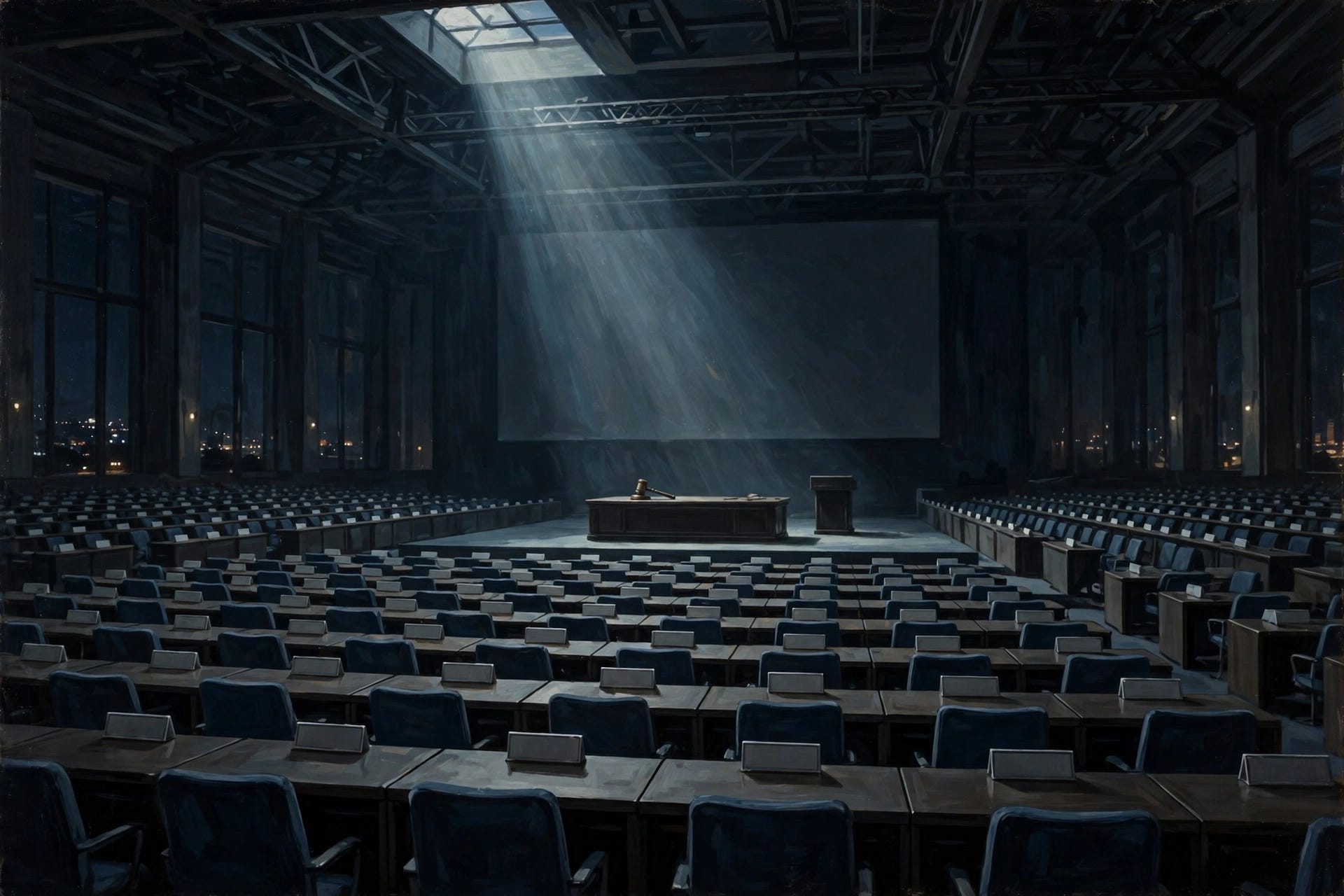
Climate summits do not usually die in a single dramatic vote. The United Nations process that produced COP31, the thirty-first Conference of the Parties to the climate convention, works by consensus, which in practice means that a text lives only so long as no delegation is prepared to stand up in plenary and kill it, and dies the moment enough of them make clear that they will. On Sunday in Antalya, according to Le Monde’s report of 22 November and Reuters’ reaction roundup of the same weekend, that moment arrived in public, on the record, and in language unusually blunt for a process that prefers its disagreements wrapped in procedure. The presidency conceded there was no consensus. The European Union objected, formally and furiously. Other delegations objected alongside it. Still others made clear they would have accepted the text, or had never been willing to accept the language its critics demanded. And then, with speeches still continuing, the summit that had run longer than any before it simply ended without the one document that was supposed to give the fortnight its meaning.
The room at the end
There is a particular quality to the final hours of a conference that has already failed in private before it fails in public. The closing plenary footage carried by eudebates.tv on 22 November, drawn from the official stream, shows the formal machinery still turning: delegations recognised in turn, statements delivered for the record, objections entered in the measured phrases diplomacy keeps for its most serious moments. The official COP31 Türkiye channel streamed the closing plenary in full, in three parts, and APT carried live pictures under a headline that told its own story about the day, noting simply that the talks had run into overtime. By Sunday, overtime was no longer a colourful detail for reporters to note in passing. According to the BBC-derived reporting summarised by Carbon Brief on 23 November, the conference had become the longest COP in history. A process scheduled to run from 9 to 20 November was still in session on 22 November, and the extra time had not been spent polishing a near-finished agreement. It had been spent testing, draft by draft and consultation by consultation, whether any form of words existed that both sides of the central divide could live with. Sunday’s plenary was the public answer to that private question.
The presidency of COP31 was itself split, a fact that shaped how the end unfolded and who had to announce it. As the research record for the summit notes, Murat Kurum of Türkiye held the office of COP President, while Chris Bowen of Australia served as President of Negotiations. It was Kurum, as president, who had to concede the outcome in the chair, and Bowen, as the man who had carried the negotiating burden, who had to explain it afterwards. Between them, on Sunday, they delivered the two halves of the same admission: there was no consensus, and there would be no further text to chase one with. For a summit host, that is the bleakest sentence in the vocabulary. Hosts are supposed to land planes. They cajole, they shuttle between rooms, they produce compromise drafts at indecent hours, they trade on the prestige of the presidency to squeeze the last objections out of the last holdouts. When a president instead tells the plenary that the effort has been made and has not succeeded, he is telling the world that the machinery itself has reached its limit on this occasion, in this place, on this question.
Delegates had arrived in Antalya on 9 November, according to the summit’s own schedule, with the conference formally listed to run to 20 November. By the standards of recent climate conferences, which have made a habit of overrunning by hours and sometimes by a day, an extension into Saturday would have been unremarkable, and even a Sunday finish might have been spun, had it produced a deal, as evidence of determination. What made Antalya different, as CNN and Reuters both recorded, was the combination of the length of the overrun and the emptiness of its result. Forty-four to forty-nine hours of extra time is not a rounding error in a diplomatic calendar. It is two full days in which flights were missed and rebooked in spirit if not in fact, in which draft followed draft, in which the presidency tested whether silence on the central question could be made acceptable to those who had come demanding that the question be named. The answer, when it finally came in plenary, had been visible in outline for some time. Sunday did not create the failure. Sunday certified it.
The president concedes
The words with which a presidency ends a summit matter, because they become the official epitaph that every subsequent argument must quote or contest. According to the press remarks reported by Reuters and AP, Kurum’s epitaph for Antalya was short and without adornment. “We have done our utmost… no consensus on this document… these decisions have not been adopted,” he said. Each clause does a different kind of work. The first defends the presidency: the utmost was done, the effort was real, the failure is not laziness or incompetence in the chair. The second names the procedural fact at the heart of the UN process: consensus, the only currency the system recognises, did not exist for this document. The third draws the legal consequence without flinching: the decisions were not adopted. Not deferred, not noted, not welcomed in part. Not adopted. In the flat language of conference procedure, that is as final as a sentence gets.
Just as significant was what Kurum did not do. According to the accounts of the close carried by Reuters and CNN, he would not advance a new text. That refusal, if refusal is even the right word for a judgement that no further draft could succeed, closed the last theoretical escape route from failure. In many past conferences, a presidency facing objections has reached for one more draft, one more bracketing exercise, one more late-night consultation in the hope that fatigue itself will manufacture agreement. Antalya had already run two days past its scheduled end; fatigue was not in short supply, and it had manufactured nothing. A new text on Sunday would have faced the same room, the same red lines and the same missing words. By declining to offer one, the presidency acknowledged something that the plenary speeches were about to demonstrate from both directions: the gap between the delegations was not a drafting problem awaiting a cleverer form of words. It was a disagreement about what the summit was for, and no rearrangement of paragraphs was going to reconcile delegations who wanted the text to name fossil fuels with delegations who had made clear, in Russia’s case in terms reported verbatim by Reuters, that they could not agree to any formulation on fossil fuel at all.
There is a temptation, in narrating any diplomatic collapse, to treat the chair’s concession as the moment of death. It is more accurate to treat it as the moment of announcement. The Antalya Pact, the name attached to the cover decision that was never adopted, had been losing its claim to life through the final drafts, in which, according to CNN’s account of 22 November, all mentions of fossil fuels had been stripped after opposition led by Saudi Arabia and Russia, even though the first draft of Monday, 16 November had called, in CNN’s quotation of its language, for “the immediate transition away from fossil fuels in energy systems.” A text that began the week speaking that plainly and ended it saying nothing at all on the subject had travelled a long way in the wrong direction for the more than one hundred countries that, as Reuters and CNN both reported, had pushed to keep the fossil-fuel language in, backed by a letter supported by around one hundred and thirty countries. By the time Kurum rose on Sunday, the question before the plenary was no longer whether the pact said enough. For its critics, the question was whether a pact that said nothing on the central cause of the problem deserved to exist at all. Their answer, delivered within the hour, was no.
The objection
If Kurum supplied the epitaph, the European Union supplied the drama, and it did so through an Irish minister speaking for the bloc in the closing plenary. The footage of Darragh O’Brien’s interventions, preserved in the eudebates.tv recording of the plenary proceedings on 22 November and reflected in Reuters’ reaction reporting, shows a delegation doing something the EU rarely does with such completeness at a climate summit: objecting not to a clause, not to a figure, not to a timetable, but to the entire document and to the process that had produced it, in terms chosen to be impossible to misunderstand or to soften in the retelling. According to the plenary record and the reports drawn from it, O’Brien strongly objected to the text. He objected, as the brief of the day’s footage notes, to both iterations of it that were placed before the room. And he explained why in a sequence of phrases that moved, within a single intervention, from the textual to the moral to the political.
The textual charge came first, and it was the simplest. The pact, O’Brien said in the words reported by Le Monde on 22 November and echoed across the wires, “does not even mention fossil fuels.” The word “even” carried the weight of the sentence. This was not a complaint that the text mentioned fossil fuels inadequately, or in the wrong paragraph, or with the wrong verb. It was a complaint that a climate agreement negotiated in 2026, three years after the Dubai summit had found language for a transition away from fossil fuels, contained no mention of them whatsoever. For the EU, according to its delegation’s plenary statement as reported by Reuters, that absence alone disqualified the document. A cover decision is supposed to state what the world, assembled, believes about its situation and intends to do about it. A cover decision silent on fossil fuels, in the EU’s reading, stated something false by omission, and the bloc was not prepared to lend its name to the falsehood.
Then came the moral charge, and with it the word that led news bulletins through Sunday evening. The text, O’Brien said, was “unconscionable.” It is not a word diplomats use by accident, and it is not a word that can be walked back into a technical reservation. To call a negotiated document unconscionable is to say that adopting it would offend conscience, that the objection is not tactical but ethical, and that no side payment or parallel pledge could cure the defect. In the same intervention, as reported by Reuters and Le Monde, he said the process had been “hijacked by some oil states,” and he set out the bloc’s bottom line in a sentence built for quotation: the EU “will not accept a COP that greenwashes fossil fuel.” Greenwashing is an accusation usually aimed at corporations by campaigners. Aimed by the European Union, in plenary, at the product of a UN summit, it landed with the force its speaker intended. The EU was not describing the Antalya Pact as a weak agreement. It was describing it as a dishonest one, an agreement whose function would be to provide cover for the very activity the process exists to curtail.
Who refused, and who would have accepted
No delegation kills a summit alone, and Antalya’s closing hours are best understood as a roll call of refusals and acceptances that, laid side by side, show a room divided not at its margins but through its centre. On the side of refusal, according to the reporting of Le Monde, Reuters and the reaction roundups of 22 and 23 November, the EU was joined by a coalition that spanned wealthy states and some of the most climate-exposed nations on earth. The United Kingdom objected in terms nearly as sharp as Brussels’. Kate Hughes, speaking for the UK in remarks reported by the wires, said the text “moves us backwards” and dismissed it as the “lowest common denominator” of what the room could produce, language echoed in the position associated with Energy Secretary Miatta Fahnbulleh. To move backwards is a specific charge in this process, because it invokes the one achievement almost everyone in Antalya claimed to honour: the Dubai agreement of COP28 in 2023, the first COP text to call for a transition away from fossil fuels. A 2026 text silent on the subject did not merely fail to advance on Dubai. In the UK’s formulation, it retreated from it, and retreat, unlike mere stagnation, was something London said it would not sign.
Around the EU and the UK stood a group of delegations whose objections carried a different kind of authority, the authority of exposure. Panama objected. The Marshall Islands objected. Vanuatu objected, its position recorded in Le Monde’s account of the plenary rejection. Belize objected. Norway and Switzerland, wealthy states with their own complicated energy stories, objected as well. And the Least Developed Countries group, the negotiating bloc of the world’s poorest nations, was among those refusing the text. Lists of names in a news report can read like diplomatic bookkeeping, but this one repays a second look, because of the company it assembles. Small island states and least developed countries do not refuse climate agreements lightly; they are the delegations that most need the finance, the adaptation support and the international attention that a successful COP is supposed to mobilise, and they know better than anyone that a failed summit delivers none of those things quickly. When such delegations nonetheless conclude that a text is worse than no text, they are making a calculation about legitimacy: that a pact which cannot name fossil fuels would, if adopted, set the ceiling of global ambition at silence, and that silence, once agreed by consensus, would be quoted back at them for years. Their presence in the refusal column transformed Sunday’s story. This was not a rich world’s tantrum. It was a rejection in which some of the poorest and most vulnerable delegations in the building stood in the same line as the European Union.
On the other side of the roll call stood the delegations that would have accepted the text, or that had spent the fortnight ensuring it could contain nothing stronger. Russia’s position, as reported by Reuters from the mouth of its negotiator Sergei Kononuchenko, was the most absolute statement made by any delegation in Antalya: Russia could not agree, in his words, “to any formulation on fossil fuel.” Not this formulation, not a weaker one, not a reference tucked into a preamble. Any formulation. Reuters’ reporting paired that position with the argument that ran beneath it, a price-shock case against language that might unsettle energy markets, and the bluntness of the formulation matters because it defined the true shape of the deadlock. Negotiators can bridge a gap between “phase out” and “phase down,” between a date and a decade, because those are differences of degree that drafting exists to solve. There is no drafting solution to a gap between “some words” and “no words at all.” Kononuchenko’s sentence, quoted by Reuters on 23 November, is the sound of a red line that no presidency, however patient, could draft its way around.
China and India, the two delegations whose positions matter most to any calculation of where the process goes next, occupied the more complicated ground that the wires were careful to record precisely. China’s Li Gao, according to the reaction reporting, expressed “deep disappointment” at the outcome while insisting that confidence in the process was not lost, a pairing that China Daily’s framing of the collapse complemented from Beijing’s side. Disappointment from a delegation that did not join the refusal is a signal worth reading exactly as written: Beijing regretted the failure, did not cause it by objection, and was at pains to present itself as a custodian of the multilateral process at the moment of its most visible breakdown in seventeen years. India’s position, voiced by Bhupender Yadav and reflected in the Like-Minded Developing Countries statement that described climate finance in the talks as “dead in the water,” tied New Delhi’s stance to the summit’s other unresolved argument, over money, a thread this account notes here only as it appeared in the closing positions and reserves for fuller treatment elsewhere. What the roll call shows, taken whole, is a room in which the text had defenders, accepters and sponsors, in which the presidency had done its utmost, and in which consensus was nonetheless impossible, because the delegations refusing it included both a major economic bloc and the organised voice of the world’s most vulnerable countries. A text can survive many objections. It cannot survive those.
One absence completed the picture of the room, and it was noted by every major account of the collapse. The United States was not there. Under President Trump, as CNN recorded in its report of the failure, the US has pulled out of international climate action, and its absence from Antalya was therefore not a negotiating tactic but a settled policy arriving in the form of an empty chair. The consequences of that absence cut in more than one direction, and honest reporting should record them without pretending to settle them. A US delegation might have added weight to the demand for fossil-fuel language, or might have opposed it, or might have brokered the finance arguments in ways no other delegation could. What can be said on the record of the weekend is narrower and more telling: the summit that failed in Antalya was a summit at which the world’s historically largest economy and emitter played no part in either the failure or any attempt to avert it, and the arguments that filled its final plenary were arguments among the countries that had chosen to remain in the room. The process went on without the United States. In Antalya, going on was not enough.
The secretary-general’s farewell verdict
Into this wreckage stepped the one figure in Antalya whose authority does not depend on any delegation’s permission, and who was attending, as the United Nations itself noted, his last COP. António Guterres, the outgoing Secretary-General, had addressed delegates earlier in the summit, on 11 November, in remarks carried by the UN and recorded on the official transcript at unfccc.int, under a title that summed up his decade in the role: he would not stop telling the truth and fighting for it. On Sunday, after the collapse, he told the truth as he saw it about what had just happened, in a statement reported by the UN, by APP and in the Guardian’s live coverage of the close. He was, in his own words, “deeply disappointed,” and he spoke of “profound frustration” at the outcome. From a secretary-general, whose public language is usually calibrated to keep every door in every capital at least slightly open, those are not routine phrases. They are the vocabulary of a man at the end of his tenure using the freedom of departure to say plainly that the process he has championed had failed on his watch, at his final summit, on the issue he has made the centre of his office.
The centre of Guterres’ statement, as reported across those sources, was not procedural regret. It was an accusation about power. “Those who profit from the destruction of our planet must never dictate the terms,” he said. In a weekend full of carefully attributed claims about influence, the Secretary-General’s sentence stood apart for its refusal to be careful. It did not name a delegation. It did not need to. Every reader of Reuters’ account of the influence that had loomed over the failed deal, every delegate who had watched the fossil-fuel language disappear draft by draft, could supply the referent, and the sentence was plainly constructed to be read that way. Alongside it, Guterres restated the scientific and diplomatic baseline from which he has refused to be moved: fossil fuels are, as he put it in the statement’s framing, “the main cause” of the crisis, and the task the Dubai COP28 agreement set, the transition away from them, is the task the world must now accelerate and finance rather than abandon. A failed summit, in his telling, did not revise the assignment. It made the assignment later, harder and more urgent, and it left the blame for the delay with those who profit from the status quo.
“Very disappointing”
If Guterres spoke for the institution and O’Brien for the objectors, the task of speaking for the summit itself fell to Chris Bowen, and his verdict, reported by Reuters and AP from his press remarks, was the plainest of the day. The outcome was, Bowen said, “very disappointing.” In a different context the phrase might sound mild to the point of evasion. In Antalya it carried a specific weight, because Bowen was not a commentator on the negotiations but their president, the Australian minister who had held the negotiating chair under the summit’s split presidency while Kurum held the conference presidency. When the man who ran the talks calls their result very disappointing, he is filing a report on his own fortnight, and the wires were right to treat the understatement as the significant thing. Nobody who had spent two weeks inside the Antalya process, and two extra days beyond its scheduled end, needed the disappointment embellished. It needed only to be confirmed by the person best placed to know whether more had been possible.
Bowen’s fuller explanation, in the same remarks, reached for the phrase that may prove the most durable diagnosis of the collapse. The talks, he indicated, had run into “unbridgeable red lines.” The adjective does the work. Negotiations are built out of red lines; every delegation arrives with them, and the craft of a presidency lies in discovering which lines are painted on and which are load-bearing. An unbridgeable red line is one that drafting cannot cross, and by Sunday the summit had located at least two of them facing each other across the same sentence: the European-led insistence that a cover decision must mention fossil fuels, and the Russian formulation, echoed in the drafting outcome, that no formulation on fossil fuel could be agreed. Bowen’s phrase concedes, with a negotiator’s precision, that the failure was structural rather than accidental. The lines did not move because, on the evidence of the weekend, they could not be moved by the means available in Antalya, and a presidency’s utmost, to borrow Kurum’s word, is not a means that can repeal another government’s instructions to its delegation.
What a cover decision is, and why losing one matters
To a reader encountering the phrase for the first time in the wreckage of Antalya, a cover decision can sound like the most disposable kind of diplomatic furniture, a ceremonial text draped over the real business of a summit. The opposite is true, and Sunday’s failure cannot be weighed until the term is understood. In the architecture of a COP, dozens of technical decisions are negotiated in separate rooms on separate subjects: finance, adaptation, markets, reporting, the machinery of the Paris Agreement grinding through its agenda. At Antalya, according to the Economic Times reporting synthesised by Carbon Brief on 23 November, most of the summit’s roughly one hundred and sixty agenda items did in fact conclude. The cover decision is the document that sits above all of that machinery. It is the single political text in which the assembled governments state, together, what this summit recognised about the world and what it collectively intends. It is the headline the process writes for itself, the paragraph that history quotes, the commitment that ministers read out on their return home. When diplomats fight for a fortnight over whether a cover decision will contain a particular phrase, they are not fighting over decoration. They are fighting over the only sentence from the summit that the future is guaranteed to remember.
That is why cover decisions have carried, at the summits that produced them, the defining phrases of climate diplomacy. It was in such texts that the process found its way, summit by summit, toward ever plainer language about the cause of the problem, a road whose milestones belong to the longer history told elsewhere in this account: Kyoto in 1997, Paris in 2015 with its temperature goals, Glasgow in 2021 and its contested language on coal, and Dubai in 2023, where a cover text for the first time called for a transition away from fossil fuels. Each of those phrases survived because it stood in the document every government had agreed. A phrase in a cover decision has a peculiar authority that no national plan and no bloc statement can replicate. It is the position of the whole world, formally adopted, and campaigners, courts, investors and governments cite it for years precisely because everyone signed it. The electrification pledge Bowen cited has its value, and the technical decisions concluded in Antalya’s committee rooms have theirs. None of them can do the work the Antalya Pact was supposed to do, because none of them is the world speaking in one voice about the main thing.
The failure to adopt a cover decision is, accordingly, the gravest formal failure a COP can register short of collapse of the conference itself, and Antalya’s was, as every major account of the weekend recorded, the first such failure since Copenhagen. COP15 in the Danish capital in 2009 remains the process’s defining trauma: a summit that ended without the assembled governments adopting the agreement its hosts had laboured to produce, leaving the Copenhagen Accord to be merely noted rather than adopted, and leaving a scar on the institution’s confidence that took years of careful diplomacy, culminating in Paris, to heal. The comparison should be drawn with precision. Antalya was not Copenhagen in scale of chaos, and the technical business of the summit, unlike Copenhagen’s, largely concluded. But in the one respect that defines the category, the two summits now stand alone together in the modern history of the process: the cover decision was placed before the world, and the world could not adopt it. Seventeen years separate the two failures, years that included Paris and Dubai and the whole apparatus of pledges and ratchets built since. That the second failure arrived in 2026, at the longest summit ever held, after the fullest possible expenditure of time and presidential effort, is what elevates Antalya from a bad COP to a landmark one. The process has demonstrated, for the first time since 2009, that its central ritual can fail even when everyone stays in the room until Sunday.
The longest summit
Records in diplomacy are usually set quietly, in footnotes about attendance or agenda size. Antalya set its record in full view and in the least flattering category available: duration without decision. The conference was scheduled, as its own programme recorded, from 9 to 20 November 2026. It ended on 22 November. The BBC’s characterisation, carried in the Carbon Brief synthesis of 23 November, was blunt: due Friday, ran to Sunday, the longest ever. CNN’s coverage of the collapse and Reuters’ reporting both dwelt on the overtime figure, forty-four to forty-nine hours beyond the scheduled end, a range that itself testifies to the confusion of the final days, in which even the measurement of the overrun depends on which scheduled hour and which final gavel a newsroom counts from. Two days is a long time to keep a conference alive. It is long enough for hope to be raised and extinguished several times, for drafts to circulate and die in successive versions, for ministers who stayed to become prisoners of their own staying, since every hour invested made departure without a result harder to explain at home. The length of COP31 will be quoted in every future account of the summit, and it should be, because it is the most objective measure available of how hard the system tried, and how completely trying was not the problem.
Two words
Every long negotiation eventually reveals the small point on which the whole structure was balanced, and Antalya’s point was smaller than most: two words. “Fossil fuels.” The entire fortnight, with its one hundred and sixty agenda items and its two presiding ministers and its drafts and its overtime, turned in the end on whether the cover decision of the thirty-first climate summit would say them. The first draft said more than them; it built a sentence around them, calling, in the language CNN quoted on 22 November, for “the immediate transition away from fossil fuels in energy systems.” The final text said nothing. Between those two states of the same document lies the whole story of the summit, and everything that happened in the closing plenary on Sunday, Kurum’s concession, O’Brien’s objection, the roll call of refusals and acceptances, Guterres’ accusation and Bowen’s tired verdict, was the sound of the world’s governments discovering that they could not agree to move from the first state to any state in between. There was no third version of the sentence that both the delegations demanding the words and the delegations refusing any formulation could sign. The sentence existed, or it did not. It did not.
Two words are an easy thing to mock as a cause of collapse, and the mockery should be resisted, because it misunderstands what words do in this process. In ordinary legislation a phrase is a compromise among interests. In a consensus climate text a phrase is a permission structure for the future: it tells finance ministries what may be planned, tells courts what the world has acknowledged, tells investors where the assembled governments believe history is going, and tells every future negotiator where the floor of the next argument stands. Dubai’s sentence about transitioning away from fossil fuels did that work for three years, which is precisely why the fight to keep the words in Antalya was so fierce and the determination to remove them so complete. Nobody in the Expo Center was confused about the stakes of the phrase. The delegations that stripped it from the drafts were not tidying the prose. The delegations that refused to adopt a text without it were not performing purity. Both sides were acting on the same correct understanding: that in this process, the words are the deed, or as close to a deed as a consensus of nearly two hundred governments can come, and that a summit which cannot say “fossil fuels” has announced something true and damaging about the state of the world’s resolve, whether it announces it by adoption or, as happened on Sunday, by collapse.
So the longest climate summit in history ended, forty-four to forty-nine hours late, with no Antalya Pact, no cover decision, and no agreed sentence about the fuels that every delegation in the room knew to be at the centre of the crisis they had gathered to address. The presidency recorded that its utmost had not produced consensus. The European Union recorded that the omission was unconscionable. The Secretary-General, at his last summit, recorded his profound frustration and named the interests he believed had dictated the terms. The President of Negotiations recorded his disappointment and pointed the process toward Addis Ababa. And the record of COP31, for all its concluded agenda items and its ninety-country pledges, will be headed forever by the failure that defined it: the first failure of a cover decision since Copenhagen in 2009, at the summit that ran longer than any other in the attempt to avoid it. How the fortnight produced that failure, hour by hour and draft by draft, is the story that follows. But the end of the story can be stated now, in the two words the end turned on, and in the silence where the Antalya Pact was supposed to put them.
A presidency in two parts
The collapse in Antalya was announced in a plenary hall on Sunday, but it had been assembled, piece by piece, across the previous fortnight. To understand why a text that was meant to be a cover decision, the political umbrella under which the rest of a summit shelters, could not be adopted at all, it helps to begin not with the final argument over fossil fuels but with the unusual way this summit was led, and with the deliberately modest expectations that surrounded it from the first day.
COP31 met in Antalya, Türkiye, from 9 to 22 November 2026, having been scheduled to run from 9 to 20 November, according to the summit record summarised by the BBC and carried in the Carbon Brief Daily Briefing on 23 November. It was, on paper, a Turkish presidency. Murat Kurum of Türkiye was COP President. Alongside him, in a split arrangement that delegates discussed throughout the two weeks, Chris Bowen of Australia held the separate title of President of Negotiations. That division mattered in Antalya in a way it might not have mattered at a calmer summit. The presidency of a COP is not ceremonial. It controls the drafting process, decides when a text is mature enough to put to the room, judges whether to push for one more iteration or to concede that no iteration will pass, and carries the political responsibility when the room divides. A split presidency divides those judgements, or at least complicates them, and by the final weekend the question of who spoke for the process, and with what authority to close it, had become part of the story of the failure itself. When the end came, it was Kurum who told the plenary, in words reported by Reuters and the Associated Press from the closing session on 22 November, “We have done our utmost,” that there was “no consensus on this document,” and that “these decisions have not been adopted.” It was Bowen who, in parallel remarks reported the same day, called the outcome “very disappointing” and spoke of “unbridgeable red lines.” Two office holders, two registers of regret, and between them no adopted pact.
The expectations set for Antalya before it opened were, by the standards of these summits, restrained. This was not billed in advance as a Paris moment, nor as a summit at which a single new headline target would redefine the process. The framing that recurred in coverage before and during the meeting, reflected in the reporting of CNN on 22 November and in the cross-outlet synthesis published by Carbon Brief on 23 November, was of a working summit in a difficult political season: a year after COP30 in Belém, ten years and more after the Paris Agreement, with a recent United Nations report having confirmed that the world would overshoot 1.5 degrees Celsius, with current policies pointing, according to that same scientific backdrop reported by CNN and the BBC, towards around 2.8 degrees of warming by 2100, and with the world already at about 1.4 degrees above pre-industrial levels. A summit that begins with overshoot already confirmed is not a summit that can plausibly promise to prevent it in the old language. Its work is necessarily about acceleration, about finance, and about whether the political language agreed in earlier, more hopeful rooms can even be repeated, let alone strengthened. In Antalya, it could not be repeated. That is the measure of how far the ground had shifted.
The host’s wager on electricity
Türkiye’s own emphasis, as host, pointed in a direction that might, in another year, have provided common ground. The Turkish presidency pushed electrification, the shifting of final energy demand towards electricity as the clean system expands, and that push found a measurable response. More than 90 countries signed an electrification pledge during the summit, a figure Bowen himself cited in his closing remarks as reported on 22 November. Draft language circulating during the talks, summarised by Saur Energy and IntelliNews in their accounts of the negotiating texts, contemplated electricity reaching a 35 per cent share of final energy by 2035. That is not a trivial ambition. Final energy is everything an economy actually consumes, in transport, in heating, in industry and in buildings, and electricity’s share of it has historically moved slowly, because it requires not only clean generation but new vehicles, new heating systems, new industrial processes and the grids to carry them. A pledge signed by more than 90 countries, and a draft figure of the kind described in those summaries, suggested that on the demand side of the transition, on the question of what the future system would look like when it worked, there was a coalition available to the presidency that was broad and genuinely multinational.
The difficulty was that electrification, on its own, does not answer the supply question that has haunted every recent COP. A world can electrify rapidly and still argue, bitterly, about how quickly the fuels that currently supply most of its energy must decline, about who pays for adaptation, and about whether capturing carbon from continuing fossil fuel use counts as a solution or as a delay. Türkiye’s wager, if it was a wager, was that progress on the architecture of the future system might create enough momentum to carry the harder questions. The summit opened on 9 November in a year when, according to the scientific backdrop reported by CNN on 22 November, 2026 could still end as the hottest year on record, in a season marked by a super El Niño, by catastrophic flooding in Nepal and by deadly heat in Europe.
And yet the host country also embodied the contradiction the cover text would break on. During the summit period, President Recep Tayyip Erdoğan announced two huge new oilfields in Türkiye, reported by Europe Says and noted in the Guardian’s live coverage. The symbolism inside the Antalya Expo Center was unavoidable: a presidency asking the world to accelerate a transition away from fossil fuels was simultaneously celebrating an expansion of its own fossil fuel base. That did not cause the collapse, whose causes lay in capitals far from Ankara, but it set a tone negotiators could point to when they questioned how much pressure the presidency was willing to apply when the drafting reached the words that mattered most.
In Dubai in 2023, at COP28, countries had agreed for the first time to language about transitioning away from fossil fuels. That sentence became the benchmark against which every later text has been measured. To repeat it in Antalya would have been, for its supporters, the minimum sign that the process was holding its ground. To lose it entirely, to produce a cover decision that, in the words Ireland’s Darragh O’Brien used for the European Union in the closing plenary as reported by Reuters on 22 November, “does not even mention fossil fuels,” was not a neutral drafting outcome but a reversal. The fortnight was, in large part, the story of that reversal happening in slow motion, draft by draft, while neither side moved.
The first draft, and what was taken out
The first draft of the cover text appeared on Monday 16 November, according to CNN’s account of the summit published on 22 November, and it is the single most important document of the fortnight, because everything that followed was a falling away from it. That first draft, CNN reported, called for “the immediate transition away from fossil fuels in energy systems.” Delegates who had followed the process from Dubai recognised the lineage at once. Here, in a presidency text, in the first week, was the Dubai formulation not merely repeated but sharpened, with an insistence on immediacy that the original had not carried in quite that form. For the coalition of countries that had come to Antalya determined to defend and extend the Dubai language, the first draft was evidence that the presidency understood the assignment. For the countries that had resisted that language in Dubai, accepted it there as part of a larger bargain, and regretted parts of it since, the first draft was evidence of something else: that the text, left to its drafters, would move in a direction they had no intention of following.
What happened next is not in dispute between the rival accounts of the summit, even where almost everything else is. All fossil fuel mentions were stripped from later drafts after opposition led by Saudi Arabia and Russia, according to CNN’s reporting on 22 November, a sequence also reflected in the reporting of the BBC and in Le Monde’s account of the rejection in plenary on 22 November. The stripping was not a single editorial act performed in private. It was the visible result of sustained pressure applied through the normal machinery of the process: interventions in negotiating rooms, bilateral meetings with the presidency, coordinated positions among producer states, and the simple, structural fact of consensus decision-making, under which a determined minority does not need to win an argument in the room at large if it can make clear that it will not join a consensus that contains particular words. Under consensus, deletion is often easier than insertion. The side that wants language out needs only to hold its position and wait. The side that wants language in needs everyone, including its opponents, to let it stay.
That asymmetry shaped the middle days of the summit. As the drafts succeeded each other, and as the fossil fuel language thinned and then vanished, the political question for the countries that wanted it restored changed character. In the first week they had been negotiating a text. By the second week they were deciding whether to make the restoration of two words a condition of their acceptance of any text at all, with all the risk that such a condition carries, including the risk of exactly the outcome that eventually occurred. Their answer, organised and public, was yes. More than 100 countries pushed to keep fossil fuels in the text, according to the reporting of the summit by CNN and others on 22 November, and that push took its most concrete form in a letter backed by around 130 countries calling for the language to be retained. A letter of that scale in the middle of a COP is not a press release. It is a counting exercise made visible. It tells the presidency, and it tells the opposing camp, that the demand is not the preference of a region or a bloc but the stated position of a clear majority of the parties in the building. It also, however, hardens the confrontation, because it frames the eventual text as a test that one side or the other must publicly fail. Once around 130 countries have signed a letter demanding that fossil fuels be named, a final text that does not name them is no longer a compromise that everyone can describe in their own way at home. It is a defeat, with a signatory list attached. And once the opposing countries have forced the deletion through successive drafts, restoring the words would be a defeat of the same public kind for them. Drafting processes are supposed to find formulations that avoid such binary outcomes. In Antalya, by the second week, the binary outcome was the only one left.
The third draft of the text, for reference, ran to 94 provisions, according to TASS reporting noted in summaries of the drafts. Ninety-four provisions is a substantial document, covering far more than the disputed phrases, and its length is a reminder that the negotiators in Antalya were not idle, and that the cover decision failed not for want of text but because of the few provisions, present or absent, on which agreement proved impossible. In multilateral drafting, a text can be 95 per cent agreed and wholly unadoptable, because the remaining 5 per cent is the part each capital reads first. In Antalya the missing words were the part everyone read first.
Riyadh in the room
No account of the fortnight published after the collapse assigned a larger role to any single delegation than Reuters assigned to Saudi Arabia. Its report of 23 November, headlined on the influence Riyadh exerted over the failed deal, drew on negotiator sourcing to describe a Saudi presence that was not confined to formal interventions in negotiating rooms. Access, in that reporting, was the point: Saudi representatives were able to reach the process, and the presidency, in ways that allowed their position to be registered early, often and at the level where drafting decisions are actually taken. Influence of that kind is difficult to photograph and easy to exaggerate, and Reuters’ account should be read for what it is, reporting based on what negotiators involved in the talks told the agency about how the fortnight unfolded. But its central finding was consistent with the observable sequence of the drafts. The fossil fuel language went out, and stayed out, and the country most consistently identified across the coverage of CNN, the BBC and Le Monde as leading the opposition to its return was Saudi Arabia.
The Saudi position itself was not improvised in Antalya, and it was not concealed. Riyadh has argued across successive summits that energy transitions must accommodate continued production, that demand for oil and gas will persist through any realistic transition pathway, and that technologies such as carbon capture should be treated as central tools rather than as concessions. In Antalya that position expressed itself in two ways that interacted. The first was negative, the refusal of fossil fuel transition language in the cover text. The second was positive, a push for carbon capture, to which this account returns below, in which a Saudi delegate was reported to have expressed surprise at the resistance the proposal encountered. The pairing mattered. A delegation that only says no can be isolated. A delegation that says no to one formulation while offering an alternative centrepiece for the text, a technology target around which a different kind of deal might theoretically be built, is harder to isolate, because it can present itself as negotiating rather than obstructing. Whether that presentation persuaded anyone outside the producer group is doubtful, given the reaction the carbon capture proposal received from climate policy analysts and from the delegations that eventually rejected the text. Inside the drafting process, however, it gave the argument a structure: not transition away from fuels, but management of their emissions, at scale, with targets. That structure is recognisably the producer states’ preferred architecture for the entire regime, and Antalya was the summit at which they succeeded in preventing the alternative architecture from being restated.
It is also important, in fairness to the record, to note what the Saudi role in Antalya was not. It was not a veto exercised in a vote, because the process does not work by votes on such texts. It was not a solitary position. Russia stood publicly alongside it, the Arab group of countries was listed among those who accepted or supported the final text as it stood without the fossil fuel language, according to the reaction roundups published by Reuters on 22 November, and other producer and consumer states had their own reasons, on finance and on sovereignty over energy policy, for not making the restoration of the language their own red line. Reuters’ reporting on 23 November described influence that loomed large, not influence that acted alone. The distinction is not pedantic. If Antalya had failed because one delegation blocked one sentence, the remedy imagined for Addis Ababa in 2027 might be a narrow one. It failed because a coalition of states, with Saudi Arabia at its most effective centre, held a position that a larger coalition, with the European Union at its most vocal centre, eventually decided it could not accept. That is a structural failure, and structural failures travel to the next summit unless the structure changes.
Moscow’s argument, made in the open
Russia’s contribution to the fortnight was, by contrast with the access politics described by Reuters, made substantially in the open, and it deserves to be taken on its own stated terms before it is judged. Sergei Kononuchenko, representing Russia, said that his country could not agree, in the formulation reported by Reuters in its roundup of reactions on 22 November, “to any formulation on fossil fuel.” That is about as complete a statement of a negotiating position as these summits produce. It does not distinguish between strong language and weak language, between a transition and a phase-down, between a commitment and an aspiration. It excludes the subject. Alongside that exclusion, Russia advanced a price-shock argument, reported in the same coverage: that rapid moves against fossil fuels carry consequences for energy prices, with the shocks falling on consumers and economies least able to absorb them. Arguments about price shocks have a long history in these negotiations, and they resonate beyond producer states, because finance ministries in importing countries fear energy price volatility as much as energy ministries in exporting countries fear stranded demand. In Antalya, however, the argument was attached to a position that admitted no formulation at all, and that attachment limited its reach. A concern about pace might have been negotiable, through dates, through qualifiers, through the careful language of differentiation that the process specialises in. A refusal of any formulation is not a bid in a negotiation about wording. It is a statement that the negotiation itself is illegitimate on that point, and the countries on the other side heard it as such.
The empty chair
Every account of the fortnight, whatever its emphasis, recorded the same absence. Under President Donald Trump, the United States has pulled out of international climate action, as CNN put it in its report of 22 November, and the United States was absent from Antalya in the sense that has come to matter at these summits: not necessarily an empty seat in every room, but the absence of the world’s largest economy as an engaged negotiating force for an ambitious outcome. The consequences of that absence ran through the fortnight in both directions, and honest reporting has to hold both at once. On one side, American withdrawal removed a traditional, if always complicated, source of pressure on producer states and of finance for the wider bargain. The United States has historically been, at different summits, both a brake on ambition and the indispensable broker of it, the country whose domestic politics constrained the text and whose signature gave the text weight. In Antalya it was neither, and the space where that brokerage might have happened, between the European demand for language and the producer refusal of it, stayed empty. On the other side, some delegates and commentators have argued at successive summits since the American withdrawal that a process no longer organised around accommodating Washington might find other centres of gravity, in Europe, in China, in coalitions of willing countries acting outside the consensus text altogether. Antalya tested that hope and found it, at least within the cover decision, insufficient. The coalition of around 130 countries that signed the letter demanding fossil fuel language included much of the world. It did not include a mechanism for imposing its preference, and in a consensus room a preference, however widely held, is not a mechanism.
Beijing and Delhi, neither rescuers nor wreckers
If the American absence was one fixed point of the fortnight, the positions of China and India were the two that other delegations watched most closely for movement, because between them they represent the largest present emitter, the largest population, two of the largest future energy systems on earth, and the core of the developing country negotiating tradition in this process. Neither, in the event, rescued the text, and neither was identified in the principal coverage as its wrecker. Their interventions, as reported, are more revealing than either of those simpler roles would have been.
China’s voice in the closing phase was Li Gao, who expressed, in words reported by Reuters on 22 November, “deep disappointment” at the outcome, while adding that China had not lost confidence in the process. China Daily’s framing of the summit, noted in Carbon Brief’s synthesis on 23 November, presented the Chinese position in terms consistent with that combination: regret at the failure, continued commitment to the multilateral track. It is a combination that repays attention. China did not join the European Union in rejecting the final text as unacceptable. It also did not use its considerable weight to force the fossil fuel language back into the text, nor to make its own acceptance conditional on finance terms that might have reconstructed the bargain. Deep disappointment without a red line is a diplomatic posture, not an intervention, and in a fortnight that ended in collapse it left China in the position, familiar from recent summits, of a power large enough to shape the outcome that chose to let the outcome happen. Analysts will argue about Beijing’s reasons long after Antalya, and this article will not invent motives that the reporting does not support. What the reporting does support is the posture itself, on the record, at the end: disappointment, and confidence professed in a process that had just failed to adopt its central decision for the first time since 2009.
India’s position was expressed at two levels, and the two levels pointed in the same direction. At the level of the collective developing country argument, the Like-Minded Developing Countries group, with which India is associated in these negotiations, described the finance position in the text as, in the phrase reported from its statement, “dead in the water.” Four words of that kind, issued as a group statement during a summit, are not an invitation to further drafting. They are a verdict on the draft. At the level of national presentation, India’s Bhupender Yadav represented a country that could point, as Indian ministers have pointed throughout this process, to a domestic build-out of renewable capacity that includes solar generation of more than 170 gigawatts, a figure cited in the reporting of India’s position at the summit. The juxtaposition is the Indian argument in miniature, and it has been consistent for years: that India is delivering energy transition at home at genuine scale, that its per capita emissions and historical responsibility remain far below those of the developed world, and that a text which asks for accelerated commitments while leaving finance undefined has the bargain the wrong way round. Delegates who disagree with that argument dispute its conclusions, not its coherence. In Antalya it meant that the second most populous negotiating presence in the building was aligned, on the finance question that ran underneath the fossil fuel fight, with the verdict of dead in the water. A cover decision needs, at minimum, the acquiescence of the major developing economies. On finance, the Antalya text never had it.
The finance row, in numbers
Finance is the permanent substructure of climate diplomacy, the question underneath every other question, and in Antalya it was not substructure at all. It was on the surface, stated in figures, and the figures are where any honest account of the fortnight has to slow down, because the gap between what the drafts acknowledged as necessary and what they were willing to commit is the widest measurable gap in the whole negotiation.
Start with need. Draft material before the summit, as summarised by Saur Energy and IntelliNews in their accounts of the negotiating texts, put the climate finance needs of developing countries at between 5.1 trillion and 6.8 trillion dollars through 2030. Figures of that size resist intuition, and negotiators know it, which is why they are usually broken down by year, by sector and by source before they are argued over. Left whole, as they stood in the summaries of the Antalya drafts, they make a simpler point. The sums required to fund mitigation and adaptation across the developing world in the remainder of this decade are counted in trillions, they are front-loaded, and they are not discretionary. They represent power systems not built, defences against flood and heat not constructed, and agricultural systems not adapted, in countries whose exposure to the physical consequences described in the summit’s scientific backdrop, the flooding in Nepal and the heat in Europe reported by CNN and the BBC, is immediate rather than theoretical. Against need measured in trillions through 2030, every other finance figure in Antalya has to be read.
Read, next, the promise that Antalya inherited. At COP30 in Belém in 2025, countries agreed to triple adaptation finance. Tripling is a strong word in a negotiated text, stronger than increasing, stronger than scaling up, because it implies a multiple applied to something that exists. The Antalya draft carried the tripling forward with a date, by 2035, but, as the BBC’s reporting via Carbon Brief on 23 November emphasised, it carried it without a baseline and without numbers. A tripling without a baseline is not a commitment that can be checked. Three times an unspecified figure is an unspecified figure, and every finance ministry in the room knew the arithmetic as well as the journalists reporting it. Delegates from countries that receive adaptation finance treated the omission not as a technical gap to be repaired in a later draft but as the defining feature of the offer, and the history of the fortnight supports their reading: the baseline did not appear in the later drafts either. What appears in a first draft and disappears can be an accident of drafting. What is absent from every draft, while its absence is being publicly protested, is a position.
The omission was compounded by a deletion. A target of 120 billion dollars for adaptation finance, present in the earlier architecture of the negotiation, was dropped from the Antalya text, according to the summaries of the drafts reported by Saur Energy and IntelliNews. Dropping a number while retaining the word tripling produced a text that sounded, in headline terms, more ambitious than its predecessor and was, in verifiable terms, less so. That combination, rhetorical escalation over numerical retreat, is precisely the pattern that developing country negotiators have been trained by thirty years of this process to detect, and in Antalya they detected it early and named it in the Like-Minded Developing Countries’ verdict that the finance position was “dead in the water.” It is difficult, reading the figures together, to call that verdict unreasonable on its own terms. A negotiation that begins from needs of 5.1 to 6.8 trillion dollars, inherits a tripling pledge, and produces a text with no baseline, no figure for the tripling, and a previously stated 120 billion dollar adaptation target removed, has not narrowed the distance between need and provision. It has widened the distance between language and provision, which in this process is the distance that matters, because language is what gets adopted and provision is what gets delivered.
The adaptation numbers make the same point from the receiving end, and they come from the United Nations Environment Programme rather than from any negotiating bloc. UNEP’s Adaptation Gap Report for 2026, cited in the summaries of the Antalya finance debate, put international adaptation finance flows at between 28.2 billion and 31.7 billion dollars in 2024. Against those flows, the same report put adaptation needs at 305 billion dollars a year by 2035. Set those two figures side by side and the structure of the argument in Antalya becomes clear without any rhetoric at all. The world currently provides, in a year, roughly a tenth of what the United Nations’ own assessment says will be needed in a year within a decade. The flow would have to increase approximately tenfold to meet assessed need, in a period when the largest historical provider has withdrawn from international climate action and when the summit charged with organising the increase could not agree to state the baseline from which its own promised tripling would be measured. Delegates from the least developed countries and the small island states, the countries for whom adaptation finance is not a development preference but a condition of physical survival in place, did not need the UNEP report to know their exposure. But the report gave their interventions in Antalya a dated, authoritative, non-partisan foundation, and they used it. When Panama, the Marshall Islands, Vanuatu and Belize appear in the list of those who rejected the final text, as they do in Reuters’ roundup of 22 November, and when the least developed countries group appears there too, the finance figures are part of the explanation. Island and low-lying states were being asked to accept a cover decision that named neither the fuels driving the seas up nor the money, in figures, that might hold the seas back. Their refusal was of a piece.
The carbon capture fight
If finance was the argument about money, carbon capture was the argument about meaning, and in some ways it was the more bitter of the two, because it asked delegates to decide what kind of transition they believed they were engaged in. Carbon capture and storage, the collection of carbon dioxide from industrial sources or power generation and its storage underground, has genuine applications that few serious analysts dispute, in sectors such as cement and certain chemical processes where emissions are intrinsic to the chemistry and cannot simply be electrified away. The argument in Antalya was not about whether the technology exists or whether it has any role. It was about scale, about prominence, and about whether a cover decision should set a global target for captured carbon that would place the technology at the centre of the transition story, alongside, or in the minds of its critics instead of, the decline of the fuels themselves.
The proposal on the table, as summarised in the accounts of the drafts by Saur Energy and IntelliNews, was a goal of capturing at least 500 million tonnes of carbon dioxide a year by 2035, on a trajectory towards a range of 1.3 to 2.5 gigatonnes. Delegates will argue about trajectories in any negotiation, but the political meaning of the 500 million tonne figure was understood immediately by everyone in the building, because of the company it kept in the draft. In a text from which the words fossil fuels had been removed, a large, dated, numerical target for capturing the emissions of continued fossil fuel use was not a neutral technical provision. It was, in effect, the draft’s answer to the question the deleted words had asked: not how fast the fuels would go, but how much of their pollution the world would undertake to catch. Saudi Arabia’s advocacy of the technology was consistent with its wider position, and a Saudi delegate’s reported surprise at the resistance the proposal met, noted in the coverage of the summit, may well have been genuine. From Riyadh’s stated perspective, capture is a pragmatic technology that allows energy systems to decarbonise without dismantling the industries that supply them, and resistance to it can look like ideology. From the perspective of the countries and analysts who resisted, the same proposal looked like the opposite kind of ideology, a technological promise deployed to postpone a political decision.
The most quoted sentence of the argument belonged to neither delegation. Matt Webb of the E3G think tank described the reliance on carbon capture in the terms reported across the reaction coverage on 22 November: “like trying to quit smoking without putting down the cigarettes.” The sentence travelled because it compressed the critics’ case into an image anyone could test against their own intuition. The point was not that nicotine patches are useless, or that capture has no role in hard sectors. The point was about the object of the exercise. A strategy for quitting that is organised around continuing to smoke, with better filtration, has mistaken the instrument for the goal. Scientists’ caveats about capture, which ran through the expert commentary on the summit, pointed in the same direction with less colour: that capture deployed at the scale implied by gigatonne trajectories by 2035 would require build-out rates, storage characterisation, monitoring regimes and cost reductions that have not been demonstrated at anything like the necessary pace, and that counting on them in a cover decision therefore risks substituting a projected technology curve for an emissions curve that needs to fall on the basis of decisions taken now. Supporters of the target answered, in substance, that the same objection could be made about many technologies the transition already depends on, and that excluding capture from the central text would strand the industries and the producer economies whose cooperation the process needs. Both arguments are recognisable, and both were made in Antalya. What could not be done in Antalya was to hold both in the same document at the same time as a missing fossil fuel commitment. A capture target inside a text that also named the transition away from fossil fuels might have been read as one tool among several. A capture target inside a text that named nothing else was read, by the countries that eventually walked away from the document, as the document’s actual policy. Texts are judged by their centres of gravity. By the final weekend, the Antalya draft’s centre of gravity sat on capture and on a finance promise without figures, and its opponents had concluded that adopting it would move the regime’s stated position backwards from Dubai. Kate Hughes, for the United Kingdom, used almost exactly that formulation in the closing phase, as reported by Reuters on 22 November, saying the text “moves us backwards” and represented the “lowest common denominator.” The carbon capture provisions were not the only reason she said it. They were among the clearest illustrations of what she meant.
The final weekend
By Friday 20 November, the scheduled closing day, none of the three disputes had moved. The summit ran past its deadline, as COPs often do, but overtime in Antalya did not produce the usual narrowing. According to the BBC reporting carried by Carbon Brief on 23 November, a summit due to finish on Friday ran to Sunday, becoming the longest COP in history, some 44 to 49 hours into overtime. Through Saturday, successive efforts failed to restore the fossil fuel language, to give the adaptation tripling a baseline, or to settle the capture target, and Bowen’s later phrase for the position, “unbridgeable red lines,” reported on 22 November, described the weekend accurately. The Financial Times, in coverage summarised by Carbon Brief on 23 November, reached the same formulation. On Sunday 22 November the process reached the point at which a presidency must either issue another text or admit that none can pass. Kurum, as reported by Reuters and the Associated Press that day, would offer no new text and conceded there was no consensus. That concession was not a surprise by then. It was the formal recognition of a fortnight in which the first draft’s central sentence had been removed, a letter from around 130 countries had failed to restore it, finance had been left without figures, and a capture target had been asked to carry weight its opponents would not accept. The weekend did not break the summit. It revealed, hour by hour, that the summit had already been broken in the drafting.
The long road to Antalya
To understand why a room in Antalya could argue for a fortnight, run two days into overtime, and still leave without a cover decision, you have to understand that the delegates were not really arguing about a document. They were arguing about a history. Every climate summit carries the weight of the summits before it, and by the time the thirty-first Conference of the Parties opened in Türkiye on 9 November 2026, that weight had become the story itself. As CNN reported on 22 November 2026, the talks in Antalya collapsed over the failure to agree on moving away from fossil fuels. As Reuters reported on 23 November 2026, the influence of Saudi Arabia loomed large over that failure. As the BBC coverage summarised in the Carbon Brief Daily Briefing of 23 November 2026 made clear, the meeting that was due to finish on Friday ran to Sunday and became the longest COP in history. None of those facts makes sense in isolation. Together, they describe the end of a road that began three decades earlier, when the world first tried to write its way out of a warming atmosphere.
Thirty-one COPs is, in itself, a remarkable number. It means thirty-one times the nations of the world have gathered, under the United Nations framework, to negotiate a collective response to climate change. It means a generation of diplomats has grown old inside the process. It means language agreed in one decade has been defended, diluted, reinterpreted and, in Antalya, lost again in another. The brief history matters because the Antalya Pact did not fail over a new idea. According to CNN’s reporting of 22 November 2026, the first draft of the text, published on Monday 16 November, called for “the immediate transition away from fossil fuels in energy systems”. That phrase was not invented in Antalya. It was inherited. It came, in its essential form, from Dubai. When later drafts stripped out every mention of fossil fuels, after opposition led by Saudi Arabia and Russia, more than 100 countries pushed to keep the words, in a letter backed by around 130 countries. The fight, in other words, was over whether an inheritance would be honoured or revoked. That is why the long road matters. Without it, Antalya looks like a quarrel over wording. With it, Antalya looks like what it was: a test of whether three decades of incremental language could survive contact with the politics of the present.
Kyoto and the first architecture
The first great landmark on the road, as the history anchors for this summit record, was Kyoto in 1997. Kyoto matters to Antalya not because its mechanisms survived intact — they did not — but because it established the first architecture: the idea that climate change could be governed by a treaty, with targets, timetables and a distinction between the responsibilities of richer and poorer nations. That distinction has never left the room. It was present in Antalya in the finance row, in the statement from the Like-Minded Developing Countries group that finance was “dead in the water”, reported in coverage of India’s position and that of the LMDC bloc, and in India’s own insistence, voiced by Environment Minister Bhupender Yadav, that support for poorer nations was not a favour but a condition of any credible transition. It was present, too, in the older argument that countries which industrialised on coal, oil and gas cannot now demand the same restraint, on the same timetable, from countries still building basic prosperity. Kyoto gave that argument a legal home. Paris would later try to soften it into a universal system of national pledges. Antalya showed that the softening had never fully taken.
Copenhagen, the parallel no one wanted
If Kyoto is the founding landmark, Copenhagen is the warning. The research record for Antalya is explicit on the parallel: the failure to adopt a cover decision in Antalya was, according to coverage on 22 and 23 November 2026, the first such failure since COP15 in Copenhagen in 2009. That single fact explains the particular dread that ran through the final weekend in Türkiye. Diplomats do not fear failure in the abstract. They fear a specific, remembered failure, with a name and a city attached to it. Copenhagen is that name.
The Copenhagen summit of 2009 was supposed to be the moment the post-Kyoto world was settled. Instead, it became synonymous with collapse: with leaders arriving to great expectation, with a text negotiated among a smaller group and rejected by the wider room, and with a final outcome that many participants refused to treat as a true agreement of the whole conference. The lessons drawn from Copenhagen shaped everything that followed. One lesson was procedural: never again let a text appear to be imposed. Another was architectural: move away from top-down targets imposed on unwilling nations, toward a system in which each country offers its own contribution and the collective effort is reviewed and, in theory, ratcheted upward over time. That second lesson led directly to Paris. A third lesson was emotional, and it is the one that mattered most in Antalya. Copenhagen taught a generation of negotiators that a COP can fail, publicly and humiliatingly, and that the process can survive the failure — but only just, and only by spending years rebuilding trust that was spent in a single fortnight.
When Murat Kurum, the Turkish COP President, conceded in the closing plenary on 22 November 2026 that there was no consensus and that he would offer no new text — “We have done our utmost… no consensus on this document… these decisions have not been adopted”, as reported by Reuters and the Associated Press — the echo was unmistakable to anyone who knew the history. So was the intervention that preceded it. Darragh O’Brien of Ireland, speaking for the European Union in plenary footage recorded by eudebates.tv on 22 November 2026, said the EU “strongly objects” to a text that, in his words, was “unconscionable”, objecting to both iterations of the draft. The United Kingdom’s Kate Hughes, in reaction coverage the same day, said the text “moves us backwards” and represented the “lowest common denominator”. Those are not the phrases of delegations haggling over a comma. They are the phrases of delegations who believed that accepting the text would do more damage than rejecting it, because it would rewrite the history the process had spent seventeen years trying to outgrow since Copenhagen.
The Copenhagen parallel also illuminates what did not happen in Antalya. In 2009, the collapse was followed by a long, slow reconstruction that eventually produced a different kind of agreement in Paris six years later. Whether Antalya produces a similar reconstruction is a question for the years ahead, and for COP32 in Addis Ababa in 2027. What can be said now, on the record of 22 and 23 November 2026, is that the participants themselves understood the parallel and named it through their actions. The EU chose a Copenhagen-style rejection over a Copenhagen-style imposed text. The presidency chose to concede no consensus rather than gavel through a document the room would not own. Chris Bowen of Australia, President of Negotiations in the split presidency, called the outcome “very disappointing” and spoke of “unbridgeable red lines”, as reported on 22 November 2026. Red lines, unbridgeable: the language of a process that had rediscovered its oldest failure mode, and knew it.
Paris and the invention of 1.5 degrees
If Copenhagen was the collapse that taught the process how not to proceed, Paris in 2015 was the agreement that taught it a new language. The history anchors for Antalya record Paris simply and accurately: 2015, and the pairing of 1.5°C and 2°C. Behind that shorthand lies the most consequential reframing in the whole thirty-one-year story. Paris committed the world to holding warming well below 2°C and to pursuing efforts to limit it to 1.5°C. It replaced the Kyoto idea of targets imposed on a subset of countries with universal national contributions, reviewed over time. And it made 1.5°C — a number championed for years by the small island states and least developed countries most exposed to sea-level rise and extreme weather — into the moral centre of the entire process.
That moral centre is why the science backdrop at Antalya, set out below, hit the negotiations with such force. Paris did not merely set a temperature goal. It created a standard against which every later summit would be judged, and against which the physical world would, year by year, deliver its own verdict. When a recent United Nations report, cited by CNN and the BBC in coverage of Antalya, confirms that the world will overshoot 1.5°C, that is not an abstract scientific finding. It is a judgment on the central promise of Paris, delivered a decade after the promise was made. When the same coverage reports that the world is now at about 1.4°C of warming, the nearness of the number is the story: the limit that Paris asked the world to pursue is no longer a distant threshold. It is the weather outside the window.
Paris also explains the peculiar intensity of the language fights that followed it. Because the Paris system relies on voluntary national contributions rather than binding top-down targets, the words of the collective texts — the cover decisions, the stocktakes, the signals sent to governments and markets — carry an outsized share of the system’s actual power. There is no world climate police force to enforce a phase-out. There is, instead, a text, agreed by consensus, that finance ministries, energy ministries, courts, investors and campaigners can point to and say: the world has agreed this direction. Strip the direction out of the text, and you have not merely edited a document. You have weakened one of the few levers the Paris architecture actually possesses. That is the deeper reason two words — “fossil fuels” — could hold up the longest COP in history. In a system built on signals, the signal is the substance.
Glasgow, and the fight over a single verb
Glasgow matters to Antalya for three reasons. The first is coal itself. Glasgow put a specific fossil fuel — coal — into the agreed text of a COP for the first time, and that precedent made the later, broader language possible. Once one fuel could be named, the argument for naming all of them acquired a foothold. The second reason is the lesson of the verb. “Phase down” and “phase out” describe different worlds. One implies a managed decline with no necessary end point. The other implies an ending. Every negotiator in Antalya had lived through Glasgow, or had been trained by someone who had, and all of them knew that the difference between those worlds can be carried by two or three letters. The third reason is the most sobering. Glasgow’s fight was over coal alone, in a text that still passed. Antalya’s fight was over fossil fuels as a whole, in a text that did not. The scope had widened, as Dubai would widen it further, and with the scope, so had the resistance. The long road, read honestly, is not a story of steadily strengthening language. It is a story of language strengthening in one summit and being contested, with greater force, in the next. Glasgow strengthened it and showed the cost. Dubai strengthened it further and showed a greater cost still. Antalya was where the bill arrived.
Dubai, the sentence that could not be repeated
Every account of Antalya, from CNN’s collapse report of 22 November 2026 to the reaction statements collected by Reuters, returns sooner or later to Dubai. The reason is a sentence. At COP28 in Dubai in 2023, according to the history anchors for this story, the world agreed for the first time to language calling for a transition away from fossil fuels. After three decades in which the cause of climate change had been discussed at climate summits in almost every term except its most direct one, the fuels themselves were finally named in the central agreed text. António Guterres, the outgoing United Nations Secretary-General, reminded Antalya of that achievement directly. In his statement of 22 November 2026, reported via the UN and the Associated Press, Guterres said he was “deeply disappointed” and expressed “profound frustration” at the Antalya outcome, insisted that fossil fuels are “the main cause” of the crisis, and framed the task ahead as accelerating and financing the transition agreement reached in Dubai. The Secretary-General, at his last COP, was not introducing a new demand. He was defending an old sentence.
Why was that sentence so hard to win in Dubai, and harder still to repeat in Antalya? Part of the answer lies in what the sentence did. Naming fossil fuels in a consensus text does not shut a single well or mine. But it does establish, at the level of the whole world’s agreed diplomacy, that the future of the energy system is a future with less of them, tending toward none. For countries whose state revenues, export earnings and development strategies rest on oil and gas, that establishment is not rhetorical. It is a signal to investors to price their reserves differently, to lenders to question long-lived projects, and to their own publics to ask what comes next. Saudi Arabia’s position in Antalya, as reported by Reuters on 23 November 2026 through negotiator sourcing, was built on deep access to the process and a fixed resistance to fossil-fuel phase-out language. Russia’s delegate, Sergei Kononuchenko, stated the position with unusual bluntness in the closing phase, as reported on 22 November 2026: Russia could not agree “to any formulation on fossil fuel”, and he advanced a price-shock argument against rapid transition language. When the opposition is that explicit, the sentence from Dubai stops looking like a settled consensus and starts looking like what it perhaps always was: a moment, seized in one host country in one year, that the opponents of the sentence immediately set out to ensure would not harden into a permanent rule.
Antalya proved their effort had succeeded, at least for now. According to CNN’s reporting of 22 November 2026, the first Antalya draft of Monday 16 November carried the Dubai inheritance forward in strengthened form — “the immediate transition away from fossil fuels in energy systems” — and every mention of fossil fuels was then stripped from later drafts. The movement was backwards, through the drafts, away from Dubai. That is why the word “backwards”, used by the UK’s Kate Hughes on 22 November 2026, carried such weight, and why Darragh O’Brien’s charge that the final text would greenwash fossil fuels, and had been “hijacked by some oil states”, in his plenary remarks reported the same day, was aimed not just at a paragraph but at a reversal. To accept Antalya’s final text, in the EU’s judgment, would have been to stand in a plenary and agree that the sentence won in Dubai no longer commanded the room. Better, the rejecters concluded, to have no sentence at all than to have one that quietly repealed its predecessor. Students of Copenhagen will recognise the logic. It is the logic of a process that would rather record a failure than record a retreat.
Baku, Belém and the money that was always the argument
The two summits between Dubai and Antalya are easy to skim past, and skimming them is a mistake, because they explain why the Antalya finance argument was so bitter before a word of the final text was read. The history anchors record Baku, COP29 in 2024, as the finance summit, the site of the 2024 Baku finance deal. They record Belém, COP30 in 2025, as the tenth anniversary of Paris and the summit that agreed to triple adaptation finance. Put those two facts together and you have the shape of the argument that Antalya inherited. Baku was where the world argued about how much money the rich world would commit to the poor world’s transition and adaptation, and produced a deal that many recipients considered inadequate the moment it was agreed. Belém was where adaptation — money not to prevent warming, but to survive the warming already locked in — was elevated, with a commitment to triple it. Antalya was where both arguments came back, unresolved, and attached themselves to the fossil-fuel sentence until the whole structure fell.
The numbers in the Antalya reporting give the scale of the underlying need. According to the draft figures summarised by Saur Energy and IntelliNews and carried in the summit’s research record, the needs identified in the draft ran to some $5.1 to $6.8 trillion through 2030. Against needs of that order, the arguments in Antalya were about comparatively specific and fiercely contested sums. A target of $120 billion for adaptation was dropped from the text, according to the same reporting. The Belém commitment to triple adaptation finance reappeared in the Antalya draft as a tripling by 2035, but, as BBC coverage summarised by Carbon Brief on 23 November 2026 reported, without the baseline or the numbers that would make a tripling measurable. A promise to triple an unspecified amount, from an unspecified starting point, by a date a decade away, is the kind of sentence the COP process produces when it wants the appearance of the Belém achievement without its cost. The delegations that noticed — and many did — treated the omission not as a drafting lapse but as the point.
The adaptation figures published by the United Nations Environment Programme sharpen the picture further. According to the UNEP Adaptation Gap Report 2026, as cited in the summit reporting, adaptation finance flows in 2024 were in the range of $28.2 to $31.7 billion, against adaptation needs estimated at $305 billion a year by 2035. Read those two numbers slowly. The world is currently providing roughly a tenth of what its own assessments say will be needed, every year, merely for poorer countries to adapt to impacts that are already arriving. That gap is the context in which India’s Bhupender Yadav and the Like-Minded Developing Countries group described climate finance in Antalya as “dead in the water”, in statements reported on 22 November 2026. It is the context in which Mohamed Adow’s charge that rich nations arrived “empty-handed” found its audience. And it is the context in which the European Union’s insistence that, in the words of Denmark’s Samira Nawa in reaction coverage, “this was never about finance… for the European Union”, could be heard by other delegations as a distinction too fine to survive the room. For the EU, the Antalya failure was about language and direction. For much of the rest of the room, language without money had been the failure of every summit since Baku, and Antalya was simply the one where both failures happened at once, in the same text, on the same weekend.
The science that would not wait for the text
While the diplomats argued over the inheritance of Dubai, the physical world delivered its own report on the summit, and it did so in the language the process has always claimed to follow: the science. The backdrop recorded in the Antalya coverage is stark, and it deserves to be set out plainly, with its sources, because it explains the moral pressure under which the final weekend unfolded. According to CNN’s reporting of 22 November 2026 and BBC coverage of the summit, a recent United Nations report confirms that the world will overshoot the Paris limit of 1.5°C. The world is now at about 1.4°C of warming above pre-industrial levels. On current policies, according to the same reporting, the world is on course for about 2.8°C of warming by 2100. The year 2026, the coverage noted, could end as the hottest on record, in a period marked by a super El Niño. And the impacts were not projections. CNN and the BBC both cited, as part of the summit’s immediate context, catastrophic flooding in Nepal and deadly heat in Europe.
Overshoot is a word that requires unpacking, because it carries the whole weight of the Paris promise inside it. To overshoot 1.5°C does not mean the Paris Agreement was meaningless. It means the first and most ambitious of its temperature goals will be passed, at least for a period, even if warming is later brought back down by deep emissions cuts and the removal of carbon dioxide from the atmosphere. The distinction matters enormously to scientists and, increasingly, to negotiators. A world that overshoots briefly and returns is a different world from one that passes 1.5°C and keeps rising toward 2.8°C, which is the trajectory current policies describe, according to the figures cited at Antalya. But it is a harder story to tell in a plenary, and a harder promise to sell in a text. “Pursuing efforts to limit warming to 1.5°C” was a sentence a summit could agree in 2015, when the number still lay ahead. “Managing an overshoot of 1.5°C while preventing a far worse outcome” is a sentence no summit has yet learned how to agree, and Antalya, which could not agree the far simpler sentence about fossil fuels, was never going to be the first.
The science also explains why the island states and least developed countries, whose rejection of the final text was reported by Le Monde and Reuters on 22 November 2026, speak about these negotiations in terms that richer delegations sometimes find uncomfortably absolute. At about 1.4°C of warming, according to the figures in the Antalya coverage, the world is already experiencing the catastrophic Nepal flooding and deadly European heat that the same coverage recorded. Those impacts are not distributed evenly, and they are not distributed fairly. Nepal did not cause the warming that intensified its floods. The Pacific islands did not cause the sea-level rise that threatens their territory. When such countries insist that a climate text must name the cause of the problem, they are not making a literary point. They are making the only point their geography allows them to make: that a process which cannot say what is causing the damage cannot be trusted to stop it. Guterres gave that insistence its sharpest official form on 22 November 2026 when he said, in his statement on the collapse, that “those who profit from the destruction of our planet must never dictate the terms”. It was the statement of an outgoing Secretary-General at his last COP, and it was aimed, unmistakably, at the dynamic Reuters documented the following day in its reporting on Saudi influence over the failed deal.
Why two words carry the weight of the world
It is reasonable for a reader, encountering this story from outside the process, to ask the simplest question in it. Why did the longest climate summit in history break over two words? Why could the room not simply note the disagreement, publish the rest of a text that covered finance, adaptation and the many agenda items that, as the Economic Times reported, did conclude, and go home? The answer lies in what those two words do inside the peculiar legal and political machinery of the Paris era, and it is worth setting out carefully, because Antalya will be misremembered as a summit that failed over semantics unless the substance of the semantics is made clear.
“Fossil fuels” is not a description. In a consensus text, it is a direction of travel, agreed by every government in the room, including the governments whose economies depend on selling them. Once that direction is agreed, it can be cited everywhere the text’s authority reaches. It can be cited by a finance minister resisting a subsidy, by a court hearing a challenge to a new licence, by an investor explaining a divestment, by a small island state demanding faster action, and by the UN Secretary-General himself — as Guterres did on 22 November 2026 — when he framed the work ahead as accelerating the Dubai transition. Remove the words, and every one of those citations loses its strongest reference. The objectors in Antalya understood this perfectly. Sergei Kononuchenko’s statement that Russia could not agree “to any formulation on fossil fuel”, reported on 22 November 2026, is the statement of a delegation that understood exactly how much work a formulation does. So is the EU’s refusal. Darragh O’Brien’s insistence, in the plenary footage of 22 November 2026, that a COP which greenwashes fossil fuels would not be accepted, and his description of the final text as “unconscionable”, only make sense if the words matter. Both sides agreed that they mattered. That agreement is why there was no compromise available. You cannot split the difference on a signal. A text either tells the world that fossil fuels are the problem to be transitioned away from, or it declines to tell the world that. Antalya declined, and the delegations who needed it said declined to sign.
The legal weight of the words is inseparable from their political weight, and the political weight has a history that Glasgow and Dubai wrote. After Glasgow named coal, and Dubai named fossil fuels as a whole, the phrase acquired the status of a ratchet: a line that, once crossed, was not supposed to be crossed back. The entire theory of the Paris system is a ratchet theory. National contributions are supposed to strengthen over time. Collective language is supposed to strengthen over time. Nothing is supposed to move backwards, because the physics does not move backwards; at about 1.4°C and rising, as the Antalya science coverage recorded, the atmosphere offers no reverse gear. When the UK’s Kate Hughes said the Antalya text “moves us backwards”, she was invoking the ratchet by name in all but the word itself. When Belgium’s Jean-Luc Crucke, in reaction coverage on 22 and 23 November 2026, said the rejection was “not the end of multilateralism, but there has to be courage to say no”, he was defending the ratchet’s logic: that a multilateralism which ratifies retreat has lost the property that made it worth defending. And when Mary Robinson, in the same reaction coverage, condemned a “shameful lack of urgency and leadership”, the shame she named was the shame of a process contemplating, for the first time since Dubai, a text that would leave the world formally less committed than a previous text had left it. Ann Harrison of Amnesty International gave the rejecters’ case its most polemical form in calling the draft, in reaction coverage, a “polluters’ charter”. A charter is a founding document. The charge was that Antalya’s text would not merely fail to advance the transition but would found something else in its place: a permission structure for the fuels the science says must decline.
The carbon capture debate, or how to quit while still smoking
If the fossil-fuel sentence was the argument Antalya could not settle, carbon capture was the argument it had instead — and the substitution tells you almost everything about where the politics of the transition now stand. According to the summit reporting summarised in the research record, the Antalya drafts carried a carbon capture and storage goal of at least 500 million tonnes of carbon dioxide a year by 2035, on a path toward some 1.3 to 2.5 billion tonnes. Saudi Arabia, in the same reporting, pressed the case for carbon capture as its preferred route through the negotiations, and a Saudi delegate expressed surprise at the resistance the push encountered. To understand why that resistance was so fierce, you have to understand what carbon capture promises, what its critics fear it delivers, and why a technology that almost no one opposes in principle became, in Antalya, a proxy for the entire argument about the fuels themselves.
Carbon capture and storage, in its simplest form, is a set of technologies for catching carbon dioxide — at a power station, an industrial plant, or directly from the air — and storing it, typically underground, so that it does not enter the atmosphere. In the abstract, it is easy to see its place in a serious transition. There are industrial processes, in cement, steel and chemicals, whose emissions are hard to eliminate by electrification alone. There is the overshoot problem described above: a world that passes 1.5°C, as the UN report cited at Antalya confirms it will, may need to remove carbon dioxide at scale to come back down. And there is the existing energy system itself, whose infrastructure will not vanish on the timetable the science prefers, and whose emissions, while it persists, are better captured than vented. None of the serious critics of the Antalya carbon capture push deny any of that. Their argument, as it surfaced in the summit, was about proportion, purpose and substitution: about whether capture was being offered as one tool in a transition away from fossil fuels, or as the reason no transition away from fossil fuels needed to be named.
Matt Webb of the think tank E3G gave that argument its most quoted form during the summit. Carbon capture pursued in place of a phase-out, Webb said in reaction coverage on 22 November 2026, is “like trying to quit smoking without putting down the cigarettes”. The line travelled because it compresses a technical debate into a single image, and because the image is accurate to the critics’ case. A smoker who invests heavily in better filters, while continuing to smoke at the same rate, has not misunderstood the technology of filters. He has misunderstood, or avoided, the nature of his problem. The scientists’ caveats that accompanied the Antalya debate, as reflected in the summit coverage, run in the same direction. Capture rates in practice fall short of the rates assumed in plans. Storage must be monitored not for years but for timescales that dwarf the institutions doing the monitoring. Every tonne captured at a fossil-fuel plant costs energy to capture, which must itself come from somewhere. And the arithmetic of scale is unforgiving: a goal of 500 million tonnes a year by 2035, as the Antalya draft proposed, is a very large industrial achievement that would still address only a fraction of annual global emissions from fossil fuels, which is why the same draft’s longer path toward 1.3 to 2.5 billion tonnes was contested as both too much to promise credibly and too little to substitute for a phase-out. The caveats do not add up to a case against the technology. They add up to a case against the sequence. Capture first, phase-out later, has a way of becoming capture instead, phase-out never.
The defenders of the Antalya approach had an argument too, and honesty requires recording it in the form the summit record gives it. Saudi Arabia’s push for carbon capture, as reported by Reuters on 23 November 2026 and in the summit’s draft coverage, rested on the claim that the world’s problem is emissions, not fuels: that a tonne of carbon dioxide kept out of the atmosphere by capture is climatically identical to a tonne never produced, and that a text which prescribes the fuels rather than the outcome trespasses on each nation’s right to choose its own path — the same sovereignty argument that runs from Kyoto’s differentiated responsibilities through every subsequent summit. Russia’s price-shock argument, advanced by Sergei Kononuchenko in the closing phase, belongs to the same family: move too fast against the fuels, the argument runs, and the costs land on energy prices, on food prices, and on the poorest consumers in every country, rich and poor alike. These are not frivolous concerns, and the history of energy politics is littered with transitions that failed because their designers ignored them. But Antalya exposed the weakness in the argument as it was actually deployed. A delegation that genuinely believed capture could carry the transition could have accepted the Dubai sentence and argued about the balance of tools beneath it. The sentence names the destination; it does not prescribe the vehicle. The refusal of, in Kononuchenko’s words, “any formulation on fossil fuel” suggests the destination itself was the objection, and that capture was being advanced not as the vehicle for the journey but as the reason the journey need not be announced. That is the judgment Webb’s smoking line encodes, and it is the judgment the EU, the island states and the least developed countries acted on when they rejected a text in which the capture goal survived and the fossil-fuel sentence did not.
The sentence and the science, carried to Addis Ababa
Stand back from the individual fights — over a verb in Glasgow, a sentence in Dubai, a baseline in Antalya, a capture target in a draft most readers will never see — and a pattern emerges that is the real subject of the long road. The COP process advances by language, and it advances by language because language is the only currency a consensus of nearly two hundred sovereign nations can mint. That is its weakness, endlessly and correctly mocked by those who note that the atmosphere responds to molecules, not to communiqués. But it is also, on the evidence of thirty-one summits, its strange and durable strength. The sentence agreed in Dubai did not reduce emissions by a single tonne on the day it was agreed. What it did was change the terms on which every subsequent argument would be held. Antalya was fought on Dubai’s terms. The rejecters in Antalya were defending Dubai’s sentence. The delegations that stripped the sentence from the drafts were obliged, by Dubai, to do their stripping in the open, where Reuters could report it on 23 November 2026 as the central fact of the summit’s failure, and where an outgoing Secretary-General could name it, on 22 November 2026, as a case of those who profit from destruction attempting to dictate the terms. A process whose failures are this legible is not a process that has ceased to matter. It is a process whose mattering has become impossible to disguise, in success and in failure alike.
None of those questions was answered in Antalya. But the long road suggests a final, cautious reason not to mistake Antalya for the end of the story it belongs to. Copenhagen failed in 2009, and the process that emerged from its failure produced Paris. Glasgow’s weakened verb was answered, two years later, by Dubai’s stronger sentence. The pattern of the thirty-one COPs is not progress, and it is not stasis. It is a ratchet that slips — painfully, publicly, and at the worst possible moments — and then, so far, catches again. In Antalya the ratchet slipped further than it has slipped since 2009, over the two words the whole process now knows it cannot do without. The delegates who rejected the text that omitted them were betting, in effect, that the catch will come again: in Addis Ababa, under an African sun, with the science one year hotter and the sentence from Dubai still standing in the record as the last thing the whole world managed to agree. It is not a comfortable bet. On the evidence of the long road, it is the only one the process has ever offered.
When no deal became the argument
By the time the closing plenary in Antalya finally gave up on Sunday, 22 November 2026, the argument in the corridors was no longer really about whether the Antalya Pact should pass. According to Reuters and the other wires that stayed through the overtime, it had already failed to command consensus, and Murat Kurum, the Turkish president of COP31, had told delegates, in the words recorded in the research from that session, “We have done our utmost… no consensus on this document… these decisions have not been adopted.” Chris Bowen of Australia, who held the separate role of President of Negotiations in the split presidency described by CNN and Reuters, called the outcome “very disappointing” and spoke of “unbridgeable red lines.” Those two phrases, disappointment and unbridgeable lines, set the terms for everything that followed, because a failed climate summit does not end when the gavel does not fall. It continues as an argument about what the failure means.
That argument matters more than the usual post-summit recrimination. As the BBC coverage summarised by Carbon Brief on 23 November noted, this was the first time since COP15 in Copenhagen in 2009 that a conference had ended without adopting its cover decision, and it was, by the same accounts, the longest COP in history, running some 44 to 49 hours into overtime from a scheduled close on 20 November. A cover decision is the political headline a summit sends to the world. When that text dies, the question is not only what was lost in Antalya. It is whether anything was protected by letting it die.
Two answers formed within hours, and both were offered by people who had wanted a deal of some kind when the fortnight began on 9 November. The first answer, heard from climate justice campaigners, from several European ministers and from former leaders who have watched this process for decades, was that no deal was better than the deal on offer. The second answer, heard from island states that had also rejected the text, from diplomats who feared for the multilateral system itself, and from commentators who worried that the centre had not held, was that a collapse on this scale was a disaster regardless of the text’s flaws, because it left the world without even the flawed compass it had carried since Dubai. Between those two answers lies the real story of what happens now.
Harjeet Singh of Satat Sampada put the first case in its starkest form, in a line carried in the reaction roundups on 22 and 23 November: “No deal is better than a deal that locks in failure”. It is a sentence worth pausing over, because it reverses the instinct that has governed climate diplomacy since Paris in 2015. For a decade, the working assumption of the process, as it was described again and again in the template coverage studied for this article, was that a weak agreement could be strengthened later, that naming a direction mattered even if the speed was disputed, and that keeping every country inside the tent was itself a form of progress. Singh’s argument, as reported, was that the Antalya text had crossed a different line. A text that could not mention fossil fuels at all, after the first draft of 16 November had called, according to CNN, for “the immediate transition away from fossil fuels in energy systems”, was not a weak step forward. In that reading, it was a step that locked in a pretence.
Ann Harrison of Amnesty International used even sharper language, calling the draft outcome a “polluters’ charter” in the reaction reported by the wires. The phrase was aimed not at the absence of a deal but at what a deal on those terms would have licensed. If the assembled nations had adopted a cover decision that, in the words used by Ireland’s Darragh O’Brien for the European Union in the closing plenary, “does not even mention fossil fuels”, then every government could have gone home claiming a climate agreement while the central cause identified by the United Nations secretary-general went unnamed. António Guterres, in his statement on 22 November reported via the UN and the Guardian live blog, called fossil fuels “the main cause” and warned that “Those who profit from the destruction of our planet must never dictate the terms”. To adopt a text shaped, in O’Brien’s plenary words, under pressure he described as a hijack “by some oil states” would, in the Amnesty reading, have turned the summit’s authority against its own purpose.
Mary Robinson, whose reaction was also carried in the 22 November roundups, spoke of a “shameful lack of urgency and leadership”. That criticism cut in both directions, and it is important to hear it that way. Robinson did not present the collapse as a triumph. She presented the whole fortnight as a failure of leadership that had made a shameful outcome unavoidable. Belgium’s Jean-Luc Crucke offered the formulation that perhaps came closest to holding both truths at once, when he said, as reported in the same reaction coverage, that this was “not the end of multilateralism, but there has to be courage to say no”. The courage to say no is not the same as satisfaction with no agreement. It is a claim that multilateralism survives only if its participants are willing to refuse a text that would make its promises meaningless.
Mohamed Adow of Power Shift Africa embodied the tension inside a single voice. He called Antalya, in the words reported on 22 November, the “worst ever COP” and a “wake-up call”, and he charged that “Rich nations… arriving empty-handed” had helped to produce the impasse. Adow has spent years arguing, in the tradition reflected in this reaction coverage, that finance is not a side issue to the energy transition but the condition that makes it possible for poorer nations. His verdict therefore cannot be reduced to the slogan that no deal was preferable. He was saying, in effect, that the deal failed because the richer world had not brought the means to make a real deal possible, and that the failure should wake the system rather than excuse it. That is a different kind of no-deal argument: not that the text was too polluting to sign, but that the politics behind it were too empty to sustain a signature that meant anything.
Denmark’s Samira Nawa added a clarification that reframed the European refusal, when she said, as reported in the reaction roundup, “This was never about finance… for the European Union”. Coming after days in which the finance row had dominated reporting — the tripling of adaptation finance agreed at Belém at COP30 in 2025, restated at Antalya only as a tripling by 2035 with no baseline or numbers, according to the summaries studied, and the dropping of a $120bn adaptation target — Nawa’s point was that the European Union’s objection in the plenary was not a bargaining tactic over money. O’Brien himself had called the text “unconscionable” and said the Union “will not accept a COP that greenwashes fossil fuel”, in footage from the closing plenary carried by eudebates.tv and summarised by Reuters. For the Union, in this account, the line was the language itself. A summit that could not name fossil fuels could not be signed, whatever else it contained.
The United Kingdom made a similar argument in different words. Kate Hughes, in the British reaction reported on 22 November, said the text “moves us backwards” and amounted to the “lowest common denominator”, a phrase echoed in remarks attributed to Energy Secretary Miatta Fahnbulleh. To move backwards from Dubai is a specific charge. At COP28 in Dubai in 2023, according to the historical record summarised in the research, nations agreed for the first time to language about transitioning away from fossil fuels. That language was never repeated in the same way afterwards, and Antalya’s first draft had briefly revived a version of it before, according to CNN and Reuters, all mentions were stripped from later drafts after opposition led by Saudi Arabia and Russia. To sign a 2026 text with no mention at all would therefore not have preserved the Dubai floor. It would, in the British reading, have lowered the floor beneath it, and future negotiators would have started from silence rather than from a sentence they could try to strengthen.
The disaster case, stated plainly
Against all of that stands the disaster case, and it deserves to be stated without caricature, because many of its strongest voices were not defenders of the draft. Panama, the Marshall Islands, Vanuatu, Belize, Norway, Switzerland and the group of Least Developed Countries were all listed in the wire reaction as rejecters of the final text, alongside the European Union and the United Kingdom. Their rejection did not make the collapse welcome to them. For a small island state, a cover decision is not an abstract communique. It is one of the few instruments through which a nation with little economic weight can compel the attention of the largest emitters, and its absence leaves a vacuum that bilateral power fills less fairly. Le Monde’s coverage on 22 November, which carried Vanuatu and European voices from the plenary, conveyed that sense of a process in which the most vulnerable had spoken clearly and still come away without a collective text to take home.
China’s reaction captured another strand of the disaster case. Li Gao, speaking for China as reported on 22 and 23 November, expressed “deep disappointment” while insisting there was no loss of confidence in the process, a framing also reflected in China Daily’s account noted by Carbon Brief. That combination — disappointment without abandonment — is the classic defence of multilateral continuity. It says that the system is flawed, that this outcome was poor, and that walking away from the system would be worse. India’s position, as reported, pointed in a related direction. Bhupender Yadav represented India in Antalya, and the Like-Minded Developing Countries statement carried in the summaries described finance as “dead in the water”, while India also pointed to its own solar capacity of more than 170 gigawatts. In that telling, the disaster was not only a missing sentence about fossil fuels. It was a finance conversation that had failed to move from the promises made at Baku in 2024 and Belém in 2025 toward the baselines and figures that would let developing nations plan.
Guterres himself refused to treat the collapse as a vindication. His statement on 22 November, as reported via the UN, was that he was “deeply disappointed” and felt “profound frustration”. He did not say that the right text had been bravely rejected. He said the world had failed to do what he had urged delegates to do in his address on 11 November, in what the UN transcript and the video record describe as his last COP as secretary-general, when he framed the task as accelerating and financing the transition agreed in Dubai. The distinction matters for what happens next. If even the man who warned that profiteers must never dictate the terms regarded the outcome as profound frustration, then the no-deal case cannot claim his authority for celebration. At most, it can claim that frustration was preferable to a false consensus. That is a narrower and more honest claim, and it is the one the coming year will test.
There is also a practical disaster to count. A cover decision carries signals that other texts do not. It is the document that finance ministries cite, that courts and campaigners quote, and that officials use to argue inside their own governments that a commitment was made collectively and must be honoured. Without it, as the Financial Times line summarised by Carbon Brief put it, the summit exposed “unbridgeable red lines” — Bowen’s phrase as well — and left those lines as the public memory of Antalya. The Guardian, the New York Times and other outlets in the Carbon Brief synthesis on 23 November treated the collapse as the story, not the many subsidiary agreements that did conclude. That imbalance is itself a cost. When the headline is failure, the patient work that did survive risks being discounted by the very audiences whose confidence the process needs.
Reuters Breakingviews offered the most unsettling version of the disaster case because it refused to call it a pure disaster at all. Its verdict, as noted in the research summaries, was that the failure was “both healthy and a sideshow”. Healthy, in that reading, because a forced consensus on a hollow text would have concealed the real divisions rather than resolving them, and an honest rupture might clarify what coalitions actually want. A sideshow, because the real energy transition is being driven elsewhere — by technology costs, by national industrial policy, by markets and by the electrification choices that countries are making whether or not a plenary names them. That double verdict is uncomfortable for everyone. It denies campaigners the comfort that blocking a bad text was the main event, and it denies diplomats the comfort that their text was the main event either. If Breakingviews is right, Antalya mattered most as a revelation: it showed where the consensus model reaches its limit, while the transition itself continued, unevenly, outside the hall.
What survived Antalya
It would be a mistake, and the wire synthesis was careful not to make it, to describe Antalya as a fortnight in which nothing happened. Carbon Brief’s Daily Briefing on 23 November, drawing on the Economic Times among others, noted that most of the roughly 160 agenda items before the conference did conclude. That figure reframes the collapse without minimising it. The cover decision failed, and because it failed the summit will be remembered as a failure, but the machinery underneath the headline text kept working through a long list of subsidiary questions that govern how cooperation is organised between the summits. Diplomacy is often like that: the sentence the world notices is the sentence that cannot be agreed, while the paragraphs that shape implementation are settled in rooms few cameras enter.
The clearest survivor was electrification. Bowen, in his closing remarks as reported by Reuters and the Australian coverage, pointed to more than 90 countries signing an electrification pledge. That pledge sits alongside the figures in the draft summaries studied for this article, which spoke of electricity reaching a 35 percent share of final energy by 2035. Whatever the fate of the cover text, a coalition of more than 90 governments aligning around electrification is a material fact for planners. It speaks to grids, to storage, to the electrification of transport and heat, and to the industrial supply chains that follow. It also speaks to the Turkish presidency’s own emphasis, noted in the fortnight’s coverage, on electrification as a practical route that could gather support even when the fossil fuel sentence could not. A pledge is not a law, and the history of climate pledges is littered with announcements that outran delivery. But a named coalition with a shared direction is easier to hold to account than a vague aspiration, precisely because its membership can be counted and its progress can be measured against the share of energy that electricity actually provides.
Carbon markets produced a second survivor. Seventeen governments endorsed a high-integrity carbon-credit playbook, according to the summaries of the Antalya outcomes, and on 12 November, as the research records, UNCTAD launched a Global Carbon Market Network. Those two facts belong together. Carbon markets have always divided climate politics between those who see them as a way to channel finance toward reductions that would not otherwise happen and those who fear they become a licence to delay direct cuts. A playbook described as high-integrity does not settle that argument, but it acknowledges its centre: a credit is worth only what its verification is worth. A network launched through UNCTAD, meanwhile, gives the argument an institutional home between summits, where standards, registries and disputes can be worked on continuously rather than rediscovered each November in a negotiating hall.
A third survivor was money, though in a form smaller and more specific than the finance row that helped sink the cover text. The United Kingdom, Norway and Canada backed a $10bn initiative for climate action in emerging markets, according to the outcome summaries. Ten billion dollars is not the scale described in the draft needs assessments, which, as Saur Energy and IntelliNews summaries noted, put developing-country needs at $5.1 to $6.8 trillion through 2030, nor does it answer the adaptation gap set out in the UNEP Adaptation Gap Report 2026, which recorded flows of $28.2 to $31.7 billion in 2024 against needs of $305 billion a year by 2035. To place the initiative beside those numbers is not to dismiss it. It is to understand its function. Initiatives of this kind are coalition finance: a group of willing governments pooling a sum they can actually announce, for markets they have chosen, without waiting for a universal text to authorise them. That is both their strength and their limit. They move faster than consensus, and they cover less ground than consensus promises.
The carbon capture argument, by contrast, survived as an unresolved fight rather than an agreement. The draft summaries described a goal of capturing at least 500 million tonnes of carbon dioxide a year by 2035, toward a larger range of 1.3 to 2.5 gigatonnes, and Saudi Arabia’s delegation, according to Reuters negotiator sourcing, pushed carbon capture as a central answer, with a Saudi delegate recorded as “surprised” at the resistance it met. Matt Webb of E3G gave that resistance its most memorable image when he compared reliance on carbon capture, in the line carried in the reaction coverage, to “like trying to quit smoking without putting down the cigarettes”. The scientists’ caveats noted in the research point in the same cautionary direction without needing embellishment: capture may have a role for emissions that are hardest to eliminate, but a target for capture is not a substitute for a sentence about the fuels whose combustion produces the emissions in the first place. Antalya did not resolve that distinction. It exposed it, in numbers, in a draft, in public. That exposure will travel to the next summit whether delegates wish it to or not.
What survived, then, was not a hidden success story waiting to be spun out of a failed summit. It was a set of partial instruments — an electrification coalition, a carbon-market playbook and network, a $10bn initiative from three governments — that share a common trait. None of them required every nation to agree. Each of them was built by the subset of actors willing to move on that question, at that speed, with that money or that standard. That trait is the bridge to the largest question Antalya leaves behind: whether the future of climate cooperation belongs less to universal consensus and more to coalitions that act first and invite others to join.
Coalitions in place of consensus
The idea did not begin in Antalya. Earlier in 2026, as the research records, 57 nations took part in the Santa Marta process, a fossil-fuel transition conference outside the COP framework, with its next meeting to be co-hosted by Tuvalu and Ireland. That detail, easy to overlook beside the drama of a collapsing plenary, may in time be read as one of the year’s most significant. Tuvalu is among the states with the most immediate stake in sea-level rise, and Ireland gave the European Union its voice in the Antalya plenary through O’Brien. A process co-hosted by those two, gathering 57 nations around the specific question the COP could not name, is not a protest meeting. It is an alternative venue for the sentence itself, where the starting point is agreement on the transition rather than agreement to discuss whether the transition may be mentioned.
Roadmaps belong to the same shift. During and after a fortnight in which, according to CNN, a call for an immediate transition away from fossil fuels could be written on Monday and removed by the following weekend, the appeal of a roadmap is that it sequences what a single sentence cannot. A roadmap can say which sector moves first, which finance follows, which date applies to which technology, and which country has volunteered to be counted. It trades the universality of a cover decision for the specificity of a plan. The risk is obvious and was implicit in the commentary themes noted in the research, where the shift toward “coalitions not consensus” circulated as a signal in wider discussion rather than as an agreed fact: a world of coalitions can become a world of fragments, each with its own accounting, each claiming leadership, none obliged to reconcile its claims with the others. The promise is equally obvious. A coalition that acts cannot be vetoed by the slowest member of a universal room.
Russia’s position in Antalya, as reported by Reuters, illustrates why the consensus room has become so difficult to move. Sergei Kononuchenko argued that Russia could not agree “to any formulation on fossil fuel” and advanced a price-shock argument against rapid formulation. Saudi access and a fixed position were, according to Reuters negotiator sourcing, a defining feature of the fortnight. When a participant’s stated position is that no formulation is acceptable, consensus does not produce moderation. It produces deletion, because the rules of a consensus text give the refusal the same weight as the assent of more than 100 countries whose letter, backed by around 130 nations according to the research, had pushed to keep the fossil fuel language. That arithmetic is the strongest structural argument for coalitions. It does not require any participant to be cast as a villain. It requires only the observation that a system in which one refusal erases the stated wish of 130 will, over time, teach the 130 to build rooms where their agreement counts.
Yet consensus still has one thing coalitions cannot manufacture: legitimacy of a particular kind. A COP cover decision, when it works, lets a small state say to a large emitter that the commitment was not imposed by a club but adopted by all, including the emitter itself. Paris in 2015 derived much of its force from that universality, as the historical summaries remind us, and Dubai’s transition sentence mattered because the countries whose industries it described were in the room and did not block it. If the work migrates entirely to coalitions, the countries outside each coalition can treat its conclusions as someone else’s policy. The likely future, suggested by what survived Antalya, is therefore not a replacement but a layering: consensus summits that set the widest possible frame, however thin, and coalitions underneath them that move at different speeds on electrification, on markets, on finance and on the fossil fuel transition itself, reporting back into the universal process when they can. Antalya’s failure was that the frame itself could not be set this year. The layering beneath it continued anyway.
There is a warning in that picture for the coalition builders. The finance dispute showed how quickly a coalition of ambition can stall when the money does not follow the language. The Like-Minded Developing Countries called finance “dead in the water”, in the statement summarised in the research, and Adow’s charge about rich nations arriving empty-handed was aimed at the same gap. A coalition of the willing that consists mainly of countries asked to transition fastest, while the finance is offered by a separate and smaller coalition on its own terms, reproduces inside the new model the injustice that helped break the old one. Santa Marta’s next meeting, and the roadmaps that emerge from it, will be judged not only by whether they can say the words Antalya could not, but by whether they attach those words to baselines, figures and dates of the kind whose absence — a tripling with no baseline, a $120bn target dropped — was itself one of Antalya’s central grievances, as the BBC-derived coverage emphasised.
The world outside the hall
While Antalya argued over words, markets were repricing the future on other fears. On the same day’s news agenda, as the topic scan for 23 November recorded, an AI stock sell-off cut the Nikkei by 5.06 percent and the S&P by 3.7 percent, a reminder that the attention of investors, and of the publics who follow them, is not waiting for climate diplomats to finish a sentence. That contrast should not be pressed too far. A market fall driven by anxiety about artificial intelligence valuations is not a verdict on energy policy, and no serious reading of Antalya would treat it as one. Its value here is simpler and more sobering. The transition that Breakingviews called the real story does not pause when a summit fails, but neither does it automatically accelerate in the right direction. Capital moves toward what it believes the future rewards, and it can move, in a single Monday, on a narrative that has nothing to do with emissions at all.
That is one reason the signals a summit sends still matter even if they are not the main event. An electrification pledge signed by more than 90 countries tells a grid investor something different from a collapsed plenary, and both messages arrived in the same weekend. A carbon-market playbook endorsed by 17 governments tells a project developer something about the standards a credit may need to meet. A $10bn initiative from the United Kingdom, Norway and Canada tells an emerging-market finance ministry that a particular door is open, even as the wider adaptation gap recorded by UNEP — flows of $28.2 to $31.7 billion in 2024 against needs of $305 billion a year by 2035 — tells it how many doors remain closed. Markets read fragments as readily as they read communiques, and a year without a cover decision is a year in which the fragments carry more weight, for better and for worse.
Ordinary readers, meanwhile, increasingly track the numbers of the world themselves with open data explorers, following a box office run or an energy chart with the same habit of checking the figures behind a headline; a tool such as the Bollywood Box Office Explorer is one small example of that wider public data-explorer culture, in which the audience for a claim expects to be able to look at the underlying numbers rather than simply be told to trust them. Climate politics has been slower than entertainment or sport to absorb what that habit means. A tripling of finance with no baseline, of the kind the BBC-derived coverage identified in the Antalya draft, is exactly the sort of claim a data-literate public has learned to interrogate. Triple of what, from when, counted how? Those are not hostile questions. They are the questions the UNEP gap figures invite, and a process that cannot answer them in its own text should not be surprised when its text is refused.
There is a second paper trail that Antalya leaves, quieter than the market data and older than any explorer. Decades of drafts, brackets and near-agreements are a public record researchers keep in personal knowledge bases such as VaultBook, where a negotiator’s discarded sentence from one summit can be set beside the sentence that replaced it three years later and the pattern of concession becomes visible across a career. That long memory matters because climate diplomacy is an unusually iterative craft. The phrase fought over in Glasgow in 2021, when “phase down” replaced stronger coal language according to the historical summaries, reappeared in new forms in Dubai, in Baku, in Belém and again in Antalya, where a first draft’s call for an immediate transition was written and then removed within a single week. Without a kept record, each summit looks like a fresh argument. With one, it is recognisable as the same argument, returning with higher stakes, in a world that the science summaries say is already at about 1.4 degrees of warming, heading toward about 2.8 degrees by 2100 on current policies, with a recent UN report confirming overshoot of 1.5 degrees. The brackets are the biography of that argument, and the people who keep them are performing a service the plenary cannot perform for itself.
Addis Ababa inherits the questions
COP32 will meet in Addis Ababa, Ethiopia, in 2027, as Bowen noted in his closing remarks when he said the work reconvenes in Ethiopia next year. The choice of host gives the next summit a setting in which the finance argument cannot be treated as an abstraction. Ethiopia sits in the continent whose voice in Antalya, through Adow’s intervention among others, insisted that empty-handed arrivals by rich nations were part of the failure, and an African host will shape the agenda’s centre of gravity whether or not any delegate says so explicitly. The questions that travel there are already visible, because Antalya did not answer them. It clarified them, which is a lesser achievement than answering them and a greater one than concealing them.
The first question is the sentence itself. Will a cover text in Addis Ababa mention fossil fuels, and if it does, will the mention carry the force of Dubai’s transition language or the stronger force of Antalya’s deleted first draft, which called for an immediate transition away? The letter backed by around 130 countries in Antalya suggests a majority for inclusion exists. The stated position of Russia, that it could not agree to any formulation, and the Saudi-led opposition described by Reuters suggest the blocking minority will also return. Something in that geometry has to change — a formulation not yet tried, a coalition that arrives with a roadmap already agreed elsewhere, a presidency that sequences the argument differently — or Addis Ababa will rehearse Antalya with a different backdrop.
The second question is finance with numbers attached. Belém agreed to triple adaptation finance, according to the research, and Antalya restated a tripling by 2035 without a baseline while dropping the $120bn target. Addis Ababa will be judged, by the developing nations whose statements called finance dead in the water, on whether a baseline appears, whether the $305 billion annual need identified by UNEP is acknowledged as the scale against which offers are measured, and whether the $5.1 to $6.8 trillion of needs through 2030 described in the draft summaries is treated as a planning figure or as a rhetorical one. India’s example will be part of that argument, as it was in Antalya, where Yadav’s delegation could point to more than 170 gigawatts of solar while still insisting that the collective finance conversation had stalled. National progress and collective failure can both be true, and Addis Ababa will have to hold both truths in one text if it is to succeed where Antalya did not.
The third question is the role of the absent and the ambivalent. The United States, as CNN noted, was absent from Antalya under President Trump, who has pulled the country out of international climate action. A consensus system missing one of its largest historical emitters is already working with a hole in its centre, and no draftsmanship in Addis Ababa can pretend otherwise. China, expressing deep disappointment while professing continued confidence, and Türkiye itself, whose president Recep Tayyip Erdoğan announced two huge new oilfields during the summit period according to Europe Says and the Guardian live coverage, embody the other difficulty: countries can participate fully in the process while expanding the very production the process exists to transition away from. Addis Ababa inherits not a simple contest between supporters and blockers but a room in which absence, disappointment and domestic expansion coexist, and in which the electrification pledge’s 90-plus signatories will need to show that their coalition means something in the year between summits, not only in the week of them.
Over all of this will hang a farewell. Antalya was, as the UN record describes it, Guterres’s last COP as secretary-general, and his address on 11 November carried the valedictory charge that the video and transcript preserve in his insistence that he would not stop telling the truth and fighting for it, a stance the research summarises in his closing framing of “never, ever give up”. His statement after the collapse, with its profound frustration and its warning to those who profit from destruction, reads now as both an epitaph for Antalya and a brief for his successor. Whoever holds that office when Addis Ababa opens will inherit his unfinished sentence: that the Dubai agreement to transition away from fossil fuels is the task, and that the task is to accelerate and finance it. A new secretary-general will phrase it differently. The overshoot science summarised by CNN and the BBC, the possibility that 2026 ends as the hottest year on record amid a super El Niño, the catastrophic flooding in Nepal and the deadly European heat that formed Antalya’s backdrop — none of that will phrase itself differently. It will simply be a year further advanced.
What Antalya changed by failing
So what, in the end, did Antalya change? Not the trajectory the science describes; no single summit could, and the claim that this one might was always a burden the process placed on itself. Not the underlying distribution of interests; Saudi access, Russian refusal, American absence, Chinese disappointment and Indian insistence on finance were all visible before the final weekend and all remain. Not even, on the evidence of the 160 concluded agenda items, the working machinery of cooperation, which ground on beneath the failed headline and produced its playbooks, networks and pledges as it usually does.
What Antalya changed is the alibi. Before Antalya, it was still possible to argue that the Dubai sentence, once agreed, had settled the direction of travel and that subsequent summits were arguing only about pace. After a fortnight in which that sentence could not survive a draft — in which more than 100 countries asked for it, around 130 backed the letter, and it was removed anyway — that argument is no longer available in good faith. The direction of travel is contested at the level of naming, in 2026, at 1.4 degrees, after the hottest years on record. Crucke’s courage to say no, Hughes’s refusal of the lowest common denominator, O’Brien’s word “unconscionable” — those were not ornaments on a procedural failure. They were the sound of a group of governments deciding that the alibi of consensus was worth less than the clarity of refusal.
Clarity is not a policy. The electrification coalition must build grids. The $10bn initiative must reach projects. The Santa Marta process, when Tuvalu and Ireland co-host its next meeting, must produce more than a purer sentence. The carbon-market playbook must survive contact with credits that do not deserve its endorsement. And Addis Ababa must find, in a year’s time, the baseline, the formulation and the finance that Antalya could not. If none of that happens, then the disaster case will have been right in retrospect, and Antalya will be remembered as the summit where the process learned to describe its own failure eloquently instead of preventing the next one.
But if the coalitions do move — if the layering that survived Antalya becomes the method by which the transition is actually organised, with the universal summit as its conscience rather than its engine — then the longest COP in history may come to be read differently. Not as the moment the world gave up on agreement, but as the moment it stopped pretending that agreement, on any terms, was the same thing as progress. Guterres, leaving the stage he will not occupy at Addis Ababa, offered the only closing line the evidence supports, in the spirit the research records from his final address: never, ever give up. Antalya did not give the world a pact. It gave the world a clearer view of who will build what comes next, and of the two words around which, sooner or later, they will have to build it.